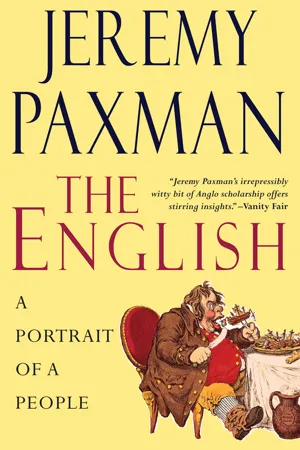
The acclaimed author of
On Royalty explores the mysteries of English identity in this "witty, argumentative book bursting with good things" (
The Daily Telegraph).
A Sunday Times Top Ten Bestseller
Being English used to be easy. As the dominant culture in a country that dominated an empire that dominated the world, they had little need to examine themselves and ask who they were. But something has happened over the past century. A new self-confidence seems to have taken hold in Wales and Scotland, while others try to forge a new relationship with Europe. What exactly sets the English apart from their British compatriots? Is there such a thing as an English race?
Renowned journalist and bestselling author Jeremy Paxman traces the invention of Englishness to its current crisis and concludes that, for all their characteristic gloom about themselves, the English may have developed a form of nationalism for the twenty-first century.
"Paxman's irrepressibly witty bit of Anglo scholarship offers stirring insights." —
Vanity Fair
- 309 pages
- English
- ePUB (mobile friendly)
- Available on iOS & Android
eBook - ePub
About this book
Information
Topic
HistoriaSubtopic
Historia británicaCHAPTER ONE
THE LAND OF
LOST CONTENT
Ask any man what nationality he would prefer to be, and ninety nine out
of a hundred will tell you that they would prefer to be Englishmen.
of a hundred will tell you that they would prefer to be Englishmen.
CECIL RHODES
Once upon a time the English knew who they were. There was such a ready list of adjectives to hand. They were polite, unexcitable, reserved and had hot-water bottles instead of a sex life: how they reproduced was one of the mysteries of the western world. They were doers rather than thinkers, writers rather than painters, gardeners rather than cooks. They were class-bound, hidebound and incapable of expressing their emotions. They did their duty. Fortitude bordering on the incomprehensible was a byword: ‘I have lost my leg, by God!’ exclaimed Lord Uxbridge, as shells exploded all over the battlefield. ‘By God, and have you!’ replied the Duke of Wellington. A soldier lying mortally wounded in a flooded trench on the Somme was, so the myth went, likely to say only that he ‘mustn’t grumble’. Their most prized possession was a sense of honour. They were steadfast and trustworthy. The word of an English gentleman was as good as a bond sealed in blood.
It is 1945. At last, the apparently endless war which has governed every waking moment of the British population is ended and they can relax. Everywhere in the industrial cities are gap-toothed mementoes of the Luftwaffe. In the towns that had survived relatively unscathed, the High Street is a jigsaw of different shop fronts, most of them little individual businesses, for this is, in Napoleon’s famously scathing condemnation, ‘une nation de boutiquiers’, a nation of shopkeepers. The vast retail chains which will within a few decades have driven the small tradesmen out of business are there, but if you dropped into the chain of Boots chemists, it might as easily have been to change your books at the library. In the evening, maybe a visit to the cinema.
There is a strong case for agreeing with Churchill that the Second World War had been his country’s ‘finest hour’. He was talking about Britain and the British Empire, but the values of that empire were the values which the English liked to think were something which they had invented. Certainly, the war and its immediate aftermath are the last time in living memory when the English had a clear and positive sense of themselves. They saw it reflected back in films like In Which We Serve, Noel Coward’s fictionalized account of the sinking of HMS Kelly. As the survivors of the destroyer, sunk by German dive-bombers, lie in their life-raft they recall the ship’s history. What they are really calling up is a picture of the strength of England. The captain and the ratings may be divided by their accents, but they share the same essential beliefs about what their country represents. It is an ordered, hierarchical sort of place in which the war is an inconvenience to be put up with, like rain at a village fête. It is a chaste, self-denying country in which women know their place and children go dutifully and quietly to bed when told. ‘Don’t make a fuss,’ say the wives to one another during an air raid, ‘we’ll have a cup of tea in a minute.’ As the Chief Petty Officer leaves home his mother-in-law asks him when he’ll be ashore again.
‘All depends on Hitler,’ he says.
Well, who does he think he is?’ asks the mother-in-law.
‘That’s the spirit.’
In Which We Serve was unashamed propaganda for a people facing the possible extinction of their culture, which is the reason it is so illuminating. It shows us how the English liked to think of themselves. The picture that emerges from this and many similar movies is of a stoical, homely, quiet, disciplined, self-denying, kindly, honourable and dignified people who would infinitely rather be tending their gardens than defending the world against a fascist tyranny.
I have lived all my life in the England which emerged from the shadow of Hitler, and have to confess an admiration for the place as it seemed to be then, despite its small-mindedness, hypocrisy and prejudice. It fell into a war that it had repeatedly been promised it could avoid, and in so doing advanced its fall from world eminence by decades. The revisionists tell us that so much of the British achievement in that war was not what it seemed at the time. Certainly, the English have clung fiercely to heroic illusions about the war, the favourite ones being the Little Ships at Dunkirk, the victory of the Few in the Battle of Britain and the courage of Londoners and other city-dwellers in the Blitz. All right, the role of the Little Ships has been exaggerated, the Battle of Britain was won as much by Hitler’s misjudgement as by the heroism of the fighter pilots, and the Blitz by the courage and ruthlessness of Bomber Command’s retaliatory raids on Germany. It may be demonstrably false that the English won the war alone, as any reading of Churchill’s desperate attempts to secure American intervention will attest. But the fact remains that the country did stand alone in the summer of 1940 and had it not done so the rest of Europe would have fallen to the Nazis. Had it not had the great benefit of geography, perhaps, like the rest of Europe, from France to the Baltic, the country would have found willing executioners to do the Nazi bidding. But geography matters; it makes people who they are.
How many attempts have there been to explain what the Second World War did to Britain? One thousand? Ten thousand? What none of them can undermine is that in that titanic struggle the English had the clearest idea of what they stood for and, therefore, the sort of people they were. It was nothing to do with Hitler’s pride in his Fatherland, it was something smaller, more personal, and I think, more quietly powerful. Take David Lean’s 1945 tale of forbidden love, Brief Encounter. The couple meet in the tearoom of a railway station, where she is waiting for the steam train home after a day’s shopping. A speck of coal dirt gets caught in her eye and, without a word of introduction, the gallant local doctor steps forward and removes it. The following eighty minutes of this beautifully written movie depict their deepening love and the guilt each feels about it. Trevor Howard’s tall, spare frame, strong nose and jaw, Celia Johnson’s retroussé nose and clear eyes seem to embody the ideal Englishman and Englishwoman. They belong to the infinitely respectable middle class, in which strangulated scheme of things ‘levly gels’ wish only to be ‘relly heppy’.
The doctor begins his seduction with the classic English gambit of commenting on the weather. A few moments later he mentions music. ‘My husband’s not musical,’ she says. ‘Good for him,’ says the doctor. Good for him? Why is it good for him? It makes it sound as if he has managed to fight off a killer disease. It is good for him, of course, because it recognizes a God-ordained right to philistinism and the rectitude of individuals who please themselves in their own homes. As Rachmaninov’s Second Piano Concerto comes and goes in the background, their affair unfolds, measured out in cups of tea in the waiting room of Milford station. Celia Johnson’s husband is the sort of man who calls his wife ‘old girl’ and to whom sympathy is the suggestion that they do the newspaper crossword together. ‘I believe we’d all be different if we lived in a warm and sunny climate,’ she thinks to herself at one point. ‘Then we shouldn’t be so withdrawn and shy and difficult.’ Being English, she feels no animosity towards her husband, whom she considers ‘kindly and unemotional’. Trevor Howard, equally trapped in a dry marriage, also expresses no hostility towards his wife and children. But the two of them are in the force of a passion they can hardly control. ‘We must be sensible,’ is the constant refrain. ‘If we control ourselves, there’s still time.’
In the end, despite all the protestations of undying devotion, the romance remains unconsummated. He does the decent thing and takes a job at a hospital in South Africa and she returns to her decent but dull husband. The end.
What does this most popular of English films tell us about the English? Firstly that, in the immortal words, ‘we are not put on earth to enjoy ourselves’. Secondly, the importance of a sense of duty: wearing uniform had been a fact of life for most of the adult population. (Trevor Howard had been a lieutenant with the Royal Corps of Signals, with a number of entirely imaginary acts of heroism credited to him by the film studios’ publicity machines. Celia Johnson had been an auxiliary policewoman: they knew all about sacrificing their pleasures for a greater good.) Most of all, the message is that the emotions are there to be controlled. It was 1945. But it could as easily have been 1955 or even 1965; the fashions might have changed, but the weather would still be damp and the policemen still avuncular. It would, despite the post-war Welfare State, be a country where everyone knew their place. Delivery carts, driven by men in uniform, still brought milk and bread to the front door. There were things which were done and things which were not done.
One could assume about these people that they were decent, and as industrious as was necessary to meet comparatively modest ambitions. They had become accustomed to seeing themselves as aggressed against, steady under fire, defiant against the enemy. The image is of the British troops at Waterloo withstanding all-out assault by the French, or the dome of St Paul’s emerging from the smoke and flames of German bombs. They had a deeply held sense of their own rights, yet would proudly say they were ‘not much bothered’ about politics. The abject failure of both left-and right-wing extremists to get themselves elected to Parliament testified to their profound scepticism when anyone offered the promised land. They were, it is true, reserved and prone to melancholy. But they were not in any meaningful sense religious, the Church of England being a political invention which had elevated being ‘a good chap’ to something akin to canonization. On the occasions when bureaucracy demanded they admit an allegiance, they could write ‘C of E’ in the box and know that they wouldn’t be bothered by demands that they attend church or give all they had to the poor.
In 1951, the People newspaper organized a survey of its readers. For three years, Geoffrey Gorer pored over the 11,000 responses. At the end of which he concluded that the national character had not really changed much in the previous 150 years. The superficial changes had been vast: a lawless population had been turned into a law-abiding one; a country which enjoyed dog-fights, bear-baiting and public hangings had become humanitarian and squeamish; general corruption in public life had been replaced by a high level of honesty. But
what seems to have remained constant is a great resentment at being overlooked or controlled, a love of freedom; fortitude; a low interest in sexual activity, compared with most neighbouring societies; a strong belief in the value of education for the formation of character; consideration and delicacy for the feelings of other people; and a very strong attachment to marriage and the institution of the family … The English are a truly unified people, more unified, I would hazard, than at any previous period in their history. When I was reading, with extreme care, the first batch of questionnaires which I received, I found I was constantly making the same notes: ‘What dull lives most of these people appear to lead!’ I remarked; and secondly, What good people!’ I should still make the same judgements.1
The reasons for this unity are obvious enough – the country had just come though a terrible war, which had required shared sacrifice. The population of England was still relatively homogeneous, used to accepting the inconvenience of discipline and unaffected by mass immigration. It was still insular, not merely in a physical sense but because the mass media had yet to create the global village.
It is the world of today’s grandparents. It is the world of Queen Elizabeth and her husband, the Duke of Edinburgh. The young Princess Elizabeth married the naval lieutenant, Philip Mountbatten, in 1947. In an age of austerity (potatoes rationed to 3 lb per person per week and bacon to one ounce) the wedding brought a breath of spectacle and magic to a drab country. Philip wore his naval uniform for the occasion, Elizabeth had abandoned the forage cap she had been seen in during the war for a satin dress embroidered with 10,000 seed pearls. In the spirit of Trevor Howard and Celia Johnson, they might have expected to share a long life together. And they did. But they were the last generation to live by that code. Like one quarter of the couples who married in 1947, the royal couple reached their Golden Wedding anniversary in 1997, but by then, the predicament of Celia Johnson and Trevor Howard had become little more than an anthropological curiosity: less than one tenth of the couples who married fifty years on were expected to complete the same marathon. By then, women made up almost half the workforce, an astonishing change in light of the meekness fifty years earlier with which most had surrendered their wartime jobs when demobilized men demanded employment. The best part of 200,000 marriages now ended in divorce every year, with proceedings more often than not initiated by women, unprepared any longer to think ‘we must be sensible’.2 By the time of Prince Philip and Queen Elizabeth’s celebrations, their four children had contracted three marriages, every single one of which had failed. The heir to the throne had divorced the woman intended to be the next queen, and she had met her death in a Paris underpass, alongside her playboy lover, Dodi Fayed, whose father, Mohammed, owned the most famous shop in the nation of shopkeepers, and made a habit of handing money in brown paper envelopes to Conservative MPs, who claimed to belong to a party based on English traditions of probity and honour. Diana’s funeral had brought forth scenes of public mourning so bizarrely ‘un-English’ – the lighting of candles in the park, the throwing of flowers on to her passing coffin – that the wartime generation could only look on as baffled travellers in their own land.
The flower-throwers had learned their behaviour from watching television, for it is a Latin custom: the potency of the mass media can hardly be exaggerated. Fashions in food, clothing, music and entertainment are no longer home-grown. Even those customs which remain authentically indigenous are the fruit of a greatly changed ‘English’ population. Within fifty years of the docking of the Empire Windrush at Tilbury, disembarking 492 Jamaican immigrants, the racial complexion of the country had changed utterly. Mass immigration to Britain had been concentrated on England and most cities of any size contained areas where white people had become a rarity. In those places, talking about immigrants as ‘ethnic minorities’ was beginning to sound decidedly perverse. By 1998, it was white children who had become a minority at local-authority secondary schools in inner London and even in the suburbs they made up only 60 per cent of the secondary-school population. Over a third of inner London’s children did not even have English as their first language.3
If the English people had changed, so too had the towns in which most of them lived. In his wartime celebration of Englishness, The Lion and the Unicorn, George Orwell managed to escape the dreamy right-wing pastiche about England being all hedgerows and gardens. Seeking to define a country that corresponded more closely to the reality of the lives of most of its citizens, he described a place of red pillar boxes, Lancashire clogs, smoky towns, crude language and lines outside labour exchanges. The picture is as recognizable as an L. S. Lowry painting, and like a Lowry, it is a period piece. The smoky mills have closed down as the textile trade has collapsed, the lines outside labour exchanges replaced by benefit offices in which clerks sit behind anger-proof glass screens. The red pillar boxes are still there, but the other red feature of the pavement, Sir George Gilbert Scott’s telephone kiosk, has been torn down, to be replaced by a functional steel and glass cubicle. If one survives, it is there as ornament to a ‘heritage site’, as one shop after another is colonized by burger bars and pizzerias. In these places, the world the English live in is emphatically not Made in England. The High Streets are either jammed with cars or pedestrianized, the newly laid cobbles, wrought-iron lampposts and litterbins a self-conscious imagination of how the place might have looked in Victorian days, had the Victorians had the questionable pleasures of the Big Mac. In those cities most self-conscious about their claim to be part of English history, like Oxford or Bath, the shops where you could have bought a dozen nails, home-made cakes or had a suit run up, have shut down and been replaced with places selling teddy bears, T-shirts and gimcrack souvenirs. Elsewhere, the small traders have vanished, replaced by branches of retail chains specializing in anything from kitchen utensils to babywear: a nation of shopkeepers become a nation of checkout operators. The police cruise the streets in cars or sit in vans waiting for trouble.
In another essay, George Orwell described the perfect city pub, a place called The Moon under Water.4 It was down a side-street, busy enough to be welcoming, but quiet enough to have a conversation. It was unmodernized Victorian in style, had friendly barmaids who called everyone ‘dear’, served soft, creamy stout on draught, and good lunches in a room upstairs. Liver-sausage sandwiches, mussels and cheese and pickles were always available on the snack counter. At the back was a large garden, where children played on swings and a slide. At the end of his piece, Orwell came clean with what most of his readers must have suspected: The Moon under Water did not exist. It does now. There are fourteen Moons Under Water, all owned by a vast brewing conglomerate with headquarters in Watford. Its Manchester Moon Under Water claims to be the biggest pub in Britain, with 8,500 square feet of drinking space spread over three...
Table of contents
- Cover
- Copyright
- Contents
- Dedication
- Preface
- 1. The Land of Lost Content
- 2. Funny Foreigners
- 3. The English Empire
- 4. ‘True Born Englishmen’ And Other Lies
- 5. We Happy Few
- 6. The Parish of the Senses
- 7. Home Alone
- 8. There Always was an England
- 9. The Ideal Englishman
- 10. Meet the Wife
- 11. Old Country, New Clothes
- Acknowledgements
- Notes
- Bibliography
- Index
Trusted by 375,005 students
Access to over 1.5 million titles for a fair monthly price.
Study more efficiently using our study tools.
Frequently asked questions
Yes, you can cancel anytime from the Subscription tab in your account settings on the Perlego website. Your subscription will stay active until the end of your current billing period. Learn how to cancel your subscription
No, books cannot be downloaded as external files, such as PDFs, for use outside of Perlego. However, you can download books within the Perlego app for offline reading on mobile or tablet. Learn how to download books offline
Perlego offers two plans: Essential and Complete
- Essential is ideal for learners and professionals who enjoy exploring a wide range of subjects. Access the Essential Library with 800,000+ trusted titles and best-sellers across business, personal growth, and the humanities. Includes unlimited reading time and Standard Read Aloud voice.
- Complete: Perfect for advanced learners and researchers needing full, unrestricted access. Unlock 1.5M+ books across hundreds of subjects, including academic and specialized titles. The Complete Plan also includes advanced features like Premium Read Aloud and Research Assistant.
We are an online textbook subscription service, where you can get access to an entire online library for less than the price of a single book per month. With over 1.5 million books across 990+ topics, we’ve got you covered! Learn about our mission
Look out for the read-aloud symbol on your next book to see if you can listen to it. The read-aloud tool reads text aloud for you, highlighting the text as it is being read. You can pause it, speed it up and slow it down. Learn more about Read Aloud
Yes! You can use the Perlego app on both iOS and Android devices to read anytime, anywhere — even offline. Perfect for commutes or when you’re on the go.
Please note we cannot support devices running on iOS 13 and Android 7 or earlier. Learn more about using the app
Please note we cannot support devices running on iOS 13 and Android 7 or earlier. Learn more about using the app
Yes, you can access The English by Jeremy Paxman in PDF and/or ePUB format, as well as other popular books in Historia & Historia británica. We have over 1.5 million books available in our catalogue for you to explore.