eBook - ePub
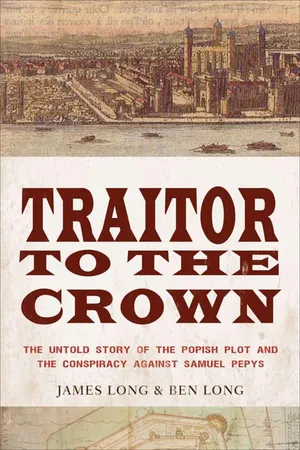
Traitor to the Crown
The Untold Story of the Popish Plot and the Consipiracy Against Samuel Pepys
- 336 pages
- English
- ePUB (mobile friendly)
- Available on iOS & Android
eBook - ePub
Traitor to the Crown
The Untold Story of the Popish Plot and the Consipiracy Against Samuel Pepys
About this book
"The meticulousness of the Longs' research is awesome" in this historical account of the plot to brand a British naval official as a Catholic traitor ( The Guardian).
1679, England: Fear of conspiracy and religious terrorism have provoked panic in politicians and a zealous reaction from the legal system. Everywhere, or so it is feared, Catholic agents are plotting to overthrow the King. Samuel Pepys, Secretary of the Admiralty, finds himself charged with treason and facing a show trial and execution. Imprisoned in the Tower of London, Pepys sets to work investigating his mysterious accuser, Colonel John Scott, and uncovers a life riddled with ambition, forgery, treason and—ultimately—murder.
Using rare access to Pepys' account of the affair, James Long and Ben Long brilliantly evoke a turbulent period in England's history—and tell the forgotten story of the two most dangerous years in the life of the legendary diarist.
"As gripping as any thriller." — The Times (London)
"I couldn't put it down, and there aren't many books on the seventeenth century you can say that about." — History Today
Trusted by 375,005 students
Access to over 1.5 million titles for a fair monthly price.
Study more efficiently using our study tools.
Information
1
Into the Tower
He was led outside, the heat of their wrath at his back. As he emerged through the stone archway, fat drops of spring rain
were falling from a dark sky.1
His eyes suggested a judicious mind and he carried authority, but his fleshy lower lip and extra chin told a more sensuous
story of good food, wine and women. The inquisitive little frown was permanent though deepened at this moment, perhaps, by
indignation. His colleague arrived beside him and, under guard, they began the journey away from their old lives. His name
was Samuel Pepys. He was an MP. He had just been accused of treason in the whitewashed chamber of the House of Commons.
The heavy sky rumbled. They were led away from the seething Commons, through the houses that spilled down to the steps on
the bank of the Thames and into a boat. Nearby, Pepys’s luxurious private barge, decorated with paintings of ‘little seas’,
lay ignored at its mooring.2 They pulled out into the tide and got a last view of Westminster. The Commons’ House – St Stephen’s Chapel – rose in medieval
splendour. Once Henry VIII’s private place of worship (and lined with squirrel tails and peacock feathers), its stripped walls
now contained the turbulent MPs who had taken it for themselves.3 Beside it were Westminster Abbey and Westminster Hall, and beyond them, parkland and open fields. A hundred yards further
on, they passed the Admiralty Office in Derby House with Pepys’s comfortable lodgings over it, now entirely beyond his reach.
The modern world knows Pepys’s loves, ambition, anxieties and transgressions through his Diary, but at this moment it remained
his secret, closed ten years earlier and protected from prying eyes by his neat shorthand.
The men who had condemned him in the Commons knew him only for his public work as Secretary to the Admiralty; a short man
who cut a mighty figure in King Charles II’s administration.* The knowledge necessary to qualify a man for that position, as Pepys himself was aware, unavoidably carried with it the ability
to deliver up his country (if, like this, an island) to any neighbour furnished with even a moderately powerful navy.4 Nonetheless, it had come as an immense surprise to be accused of having sold England to her oldest enemy.
The King’s ramshackle palace of Whitehall sprawled along the bank, then gave way to the gardens of the Strand mansions running
down to the river. As the boat rounded the bend, the quiet, upstream world of governmental and judicial power dropped out
of sight and London stretched ahead. At its western outskirts St James’s church was under construction in the opulent new
courtier area around Piccadilly, and the garden of the Earl of Leicester’s mansion had recently been developed and renamed
Leicester Square.5 Their boat picked a line through the river bustle, and the mansions gave way to quays and wharves. In the aftermath of the
Great Fire thirteen years before, the entire river frontage of the city had been cleared and the first buildings now stood
forty feet back, making a space to collect water should the city burn again.6 Behind these, the anarchic patchwork of timber-framed houses had gone. Londoners had pushed stakes into the charred ground
to claim back the land their homes had stood on and medieval London had risen again, fast and bland, in brick and stone.7 The buildings no longer reached over the streets at their upper storeys, and the sky seemed bigger.
Against the black clouds, the city was a sorry sight. Most of the spires – ornamental extras in a rebuilding effort born of
pressing necessity – were not yet raised above the new churches.8 Only the blackened skeleton of old St Paul’s drew Pepys’s eye upwards. When London burned, the lead had come pouring off
the cathedral’s high roof and its stones had burst like grenades.9 All that was left were the high columns and soaring arches, and the sky was visible through the glassless windows. As the
prisoners passed by, a host of labourers was scaling the heights to swing pickaxes into the scorched mortar. They detonated
explosives under the taller structures, which rose a few feet before falling ponderously in a cloud of dust.10 Tucked low, out of the prisoners’ sight, were the beginnings of a new cathedral, gleaming in clean Portland stone.*
The city was familiar to Pepys and his serious-faced fellow MP, prisoner and companion on this journey, Sir Anthony Deane.
They knew the towering Monument to the Fire, its walls filled with the rubble of old St Paul’s.11 They were familiar with the motion of the vessel on the water from years of travelling between the rural quiet of Westminster
and this part of the city, a short boat-ride and a world away. Here was buzzing business and, beyond London Bridge, a clutter
of tall masts. The bridge, the only crossing point for land traffic, acted as a giant sieve, allowing smaller craft through
but forcing the larger ships to offload at the docks downriver. If the tide was wrong, even the smaller boats had to stop
and their passengers disembark and walk since the narrow arches formed a sluice, through which the running tide poured in
dangerous torrents. On the far side, blocks of white stone, wrapped against irreparable salt water staining, were being unloaded
on to the dock and dragged by teams of straining horses off towards St Paul’s churchyard.12
The tall buildings right across London Bridge blocked their view downstream. The barge rocked on the tide through the archway
and rushed out into the port of London. There ahead, dominating the north bank, was William the Conqueror’s grim bastion,
the Tower of London. The barge came alongside and the two men were escorted ashore and taken into captivity by officials of
the Tower. Samuel Pepys found himself a prisoner in the medieval building which formed the final eastern marker, the end of
the city, on contemporary maps. It had been protected from the Fire by the good fortune of an easterly wind. From here, Pepys
had watched medieval London, the London of Shakespeare – whose powerful kings could keep their servants safe under royal wings
– burn and disappear.13 Alone, with no hope of protection from King Charles, he faced a trial it would be almost impossible to win. If he lost, he
would be executed.
2
Toys for King Louis
In May 1660, nineteen years before Samuel Pepys’s imprisonment in the Tower of London, Charles Stuart came down in triumph to the beach at The Hague. After nine years as an exile on the Continent he was preparing to sail for England and sit as king on the throne that had been denied him. The white sands of the Dutch coast were black with the people who came to watch his departure. When the King’s presence on the shore was made known to the English fleet waiting to collect him, its commander fired his ship’s guns. The rhythmic explosions of the salute fell out of time as the fleet joined in, a disordered cacophony of celebration.1 Pepys, who at that time was a young clerk, was on board one of the ships by virtue of his family links to Edward Montagu who commanded the fleet sent to bring Charles home. Pepys fired one of the guns himself, but leaned too far over, and the flash from the touchhole hurt his right eye.2 All day the guns fired; England had a king again.
When Pepys woke the next morning, his eye was red and sore but his spirits were high, for a new age was being born. Everywhere the old regime was coming to an end. The ships’ crews had been busy painting the royal coat of arms over the Commonwealth harp, and the King and his brother, the Duke of York, set to at a table on the Naseby’s quarterdeck to make changes. Having no wish to travel back to England in a ship named after the Cromwellian Civil War victory which finished his father, Charles renamed her the Royal Charles, while the Richard, accompanying her, became the Royal James. On deck Pepys watched as ‘we weighed anchor, and with a fresh gale and most happy weather we set sail for England’.3
He set these events down in a book he had bought at the end of the previous year. Its pages were white, and he had ruled neat red margins on to them. On 1 January he had begun his record. It was the diary of a poor man at the beginning of his career.
As the wind filled the sails to return the fleet and its precious royal cargo to England, a series of little events marked the turn in the fortunes of Samuel Pepys. First, he discovered that he quite liked the new king. Pepys had been sufficiently republican to watch the execution of Charles I with interest, but there was a note of admiration in his description of the dead king’s son. ‘All the afternoon,’ he observed, ‘the King walked here and there, up and down (quite contrary to what I thought him to have been) very active and stirring.’ Industrious Pepys admired the display of energy. The King could also tell a good story, relating what happened to him after the battle that drove him abroad.
Upon the quarterdeck he fell into discourse of his escape from Worcester, where it made me ready to weep to hear the stories that he told of his difficulties that he had passed through, as his travelling four days and three nights on foot, every step up to his knees in dirt, with nothing but a green coat and a pair of country breeches on, and a pair of country shoes, that made him so sore all over his feet, that he could scarce stir.4
In the years to come, Pepys was to hear this many times as Charles told it to courtiers at every opportunity. On that quarterdeck at that moment though, he was privy to the first telling of the most exciting adventure in the life of the most famous Englishman. It would be the talk of the alehouses the length and breadth of the country, a poignant tale with the happiest of endings.
Charles’s dog defecated in the boat, to Pepys and his companions’ huge delight. A king, Pepys concluded privately, is just as others are. The discovery was both mundane and momentous. At the heart of royal power there was a human being – fallible, powerful and accessible; Pepys was in the right place at the right time. As the fleet approached the English shore, he went to Charles’s royal brother James, Duke of York, about some business, and the Duke delighted Pepys by showing that he already knew his name. Pepys plucked up the courage to ingratiate himself and the Duke’s response was encouraging. In his diary that night the little clerk recorded the moment with typical brevity; the Duke, wrote Pepys, ‘upon my desire did promise me his future favour’.5 When the fleet completed its Channel crossing, great crowds greeted the royal brothers at Dover. ‘The shouting and joy expressed by all is past imagination,’ wrote Pepys.6 Four days later, on 29 May, King Charles II entered London and the old city – Shakespeare’s London, a city of tightly packed timber-framed houses whose upper levels still reached out over the streets and shrank the sky – welcomed him and his brother with celebration and open arms.
For his part in the Restoration, Pepys’s patron Montagu was made Earl of Sandwich. Sharing Montagu’s good fortune, Pepys was helped to the post of Clerk of the Acts – an administrative post with secretarial duties – in the Navy Office later that summer. It was a lucrative job. The Navy Office ran the supply side of the navy, providing it with men, materials and ships. Pepys was officially the most junior of the four officials in charge of it and his Diary shows that his enthusiasm was initially for the comforts of his new life.7 The navy was disorganised and run on a hand-to-mouth basis. The new Clerk of the Acts did his job well enough but no better.
His life changed at the beginning of 1662 when new instructions from the Duke of York as Lord High Admiral arrived at the Navy Office. Pepys recognised in them the Duke’s determined appetite for reform. He saw that he would do well to follow that lead and began to employ a vigorous precision in his work. As he wrote in his Diary the next day: ‘and so to the office, where I begin to be exact in my duty there and exacting my privileges – and shall continue to do so.’8 From then, he had an increasingly high regard for the Duke as a clear-sighted champion of proper resourcing for the beleaguered, cash-strapped navy. The Duke was a stiffer and less intelligent man than his subtle brother, the King, but he was an expert on this subject. The favour that he had promised Pepys on the ship came naturally. Pepys and the Duke stood together against frequent outbursts of obstruction, suspicion and criticism from the House of Commons and Pepys became the Duke’s advocate and public protector in that forum. He was a man on the make, seizing the opportunities the job offered to raise his own status among his Navy Office colleagues and to swell his own income in the process.
Through the rest of the 1660s, as that first Diary was filled and succeeded by five slightly larger volumes, a million and a quarter words in Pepys’s neat shorthand tell the story of his increasing status and the growing royal dependency on his bureaucratic and presentational skills. In the foreground of the Diary stand the dramatic events of that decade, the Plague and the Great Fire, woven in with Pepys’s sharp observations on all around him and all within him – few diarists have been so honest about their own frailties and peccadilloes. He confessed everything on the page: his jealousy of his wife’s flirtations, his own extramarital sexual encounters and, memorably, one unsuccessful search for any woman in a ‘hot humour’ which ended with him going to bed alone to fantasise about the Queen.9 The Diary ended abruptly in sadness on 31 May 1669 when Pepys’s eye troubles persuaded him he would go blind if he continued to write. It was a low point in his private life. His passionate French wife Elizabeth had caught him in a compromising position with t...
Table of contents
- Cover
- Copyright
- Dedication
- Contents
- List of Illustrations
- Authors’ Note
- Acknowledgements
- Illustrations Credits
- 1 Into the Tower
- 2 Toys for King Louis
- 3 A Single Hair
- 4 Gravesend
- 5 Saving Sam Atkins
- 6 The Temper of the House
- 7 Through Pellissary’s Window
- 8 Fat Harry and the Scotsman
- 9 Jobs for the Scotsman
- 10 The Light and Darkness
- 11 Catastrophes
- 12 The Signature
- 13 Scott’s Glory
- 14 New Amsterdam
- 15 The Fallen Man
- 16 Pellissary’s Household
- 17 Wind and Smoke
- 18 The Serpent’s Prudence
- 19 John Joyne’s Journal
- 20 Habeas Corpus
- 21 The Confessions of John James
- 22 The Road to Oxford
- 23 The Leman and Ower
- 24 Gravesend Unravelled
- Notes
- Bibliography and Further Reading
- Index
Frequently asked questions
Yes, you can cancel anytime from the Subscription tab in your account settings on the Perlego website. Your subscription will stay active until the end of your current billing period. Learn how to cancel your subscription
No, books cannot be downloaded as external files, such as PDFs, for use outside of Perlego. However, you can download books within the Perlego app for offline reading on mobile or tablet. Learn how to download books offline
Perlego offers two plans: Essential and Complete
- Essential is ideal for learners and professionals who enjoy exploring a wide range of subjects. Access the Essential Library with 800,000+ trusted titles and best-sellers across business, personal growth, and the humanities. Includes unlimited reading time and Standard Read Aloud voice.
- Complete: Perfect for advanced learners and researchers needing full, unrestricted access. Unlock 1.5M+ books across hundreds of subjects, including academic and specialized titles. The Complete Plan also includes advanced features like Premium Read Aloud and Research Assistant.
We are an online textbook subscription service, where you can get access to an entire online library for less than the price of a single book per month. With over 1.5 million books across 990+ topics, we’ve got you covered! Learn about our mission
Look out for the read-aloud symbol on your next book to see if you can listen to it. The read-aloud tool reads text aloud for you, highlighting the text as it is being read. You can pause it, speed it up and slow it down. Learn more about Read Aloud
Yes! You can use the Perlego app on both iOS and Android devices to read anytime, anywhere — even offline. Perfect for commutes or when you’re on the go.
Please note we cannot support devices running on iOS 13 and Android 7 or earlier. Learn more about using the app
Please note we cannot support devices running on iOS 13 and Android 7 or earlier. Learn more about using the app
Yes, you can access Traitor to the Crown by James Long,Ben Long in PDF and/or ePUB format, as well as other popular books in History & British History. We have over 1.5 million books available in our catalogue for you to explore.