A military studies professor and former combatant "rationally dissects the strategies and mindsets on both sides" of this thirty-year conflict (
New York Journal of Books).
Since the fall of Saigon in 1975, there have been much discussion of why (and whether) America lost the war in Vietnam. The common belief is that the war was lost not on the battlefield but in Washington, DC. The stark facts, though, are that the Vietnam War was lost before the first American shot was fired. In fact, it was lost before the first French Expeditionary Corps shot, almost two decades earlier, and was finally lost when the South Vietnamese fought partly, then entirely, on their own.
Offering an informed narrative of the entire thirty-year war, this book seeks to explain why. Written by a combatant in six large battles and many smaller firefights who was also a leader with a full range of pacification duties, a commander who lost forty-three wonderful young men,
Autopsy of an Unwinnable War is the result of a quest for answers by one who, after decades of wondering what it was all about, turned to a years-long search of French, American, and Vietnamese sources.
This is a story lived and revealed mainly by the people inside Vietnam who were directly involved in the war, from leaders in high positions down to the jungle boots and sandals level of the fighters—and among the Vietnamese who were living it. Because of what was happening inside Vietnam itself, no matter what policies and directives came out of Paris or Washington, or the influences in Moscow or Beijing, it is about a Vietnamese idea that would eventually triumph over bullets.
Includes photographs
- 336 pages
- English
- ePUB (mobile friendly)
- Available on iOS & Android
eBook - ePub
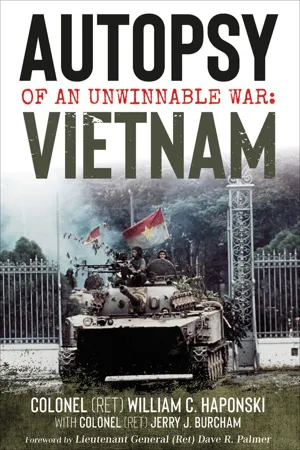
Autopsy of an Unwinnable War: Vietnam
About this book
Information
PART ONE
THE FRENCH WAR—THE IDEA, AND BULLETS
***
General Vo Nguyen Giap:
“C’est fini. It’s over. We will yield no longer.”
Hanoi, December 18, 1946
***
CHAPTER 1
Independence, Union
Those words—independence, union—came to illuminate the aspirations of millions of Vietnamese, North and, yes, South.
The consuming desire for independence had been imbedded in the Vietnamese for two thousand years. They hated foreign domination, whether Chinese, Mongol, Champa, French, Japanese, French again, or American. Independence and union of their country became a passionate credo of not just the 20th-century Vietnamese Communists, but of other independence-minded Vietnamese nationalists as well. It was the Communists, however, who organized early and well, and from a slow beginning spread this desire to a sufficiently large core of adherents that ultimately it became the driving force of the North as well as many in the South throughout thirty years of Indochina wars. In Saigon on April 30, 1975, after decades of enormous sacrifices and losses on both sides, the gates of the Diem-named Independence Palace were smashed down, and a new government took charge. From all the tragic waste emerged a new Vietnam. That it was deeply flawed then, and to a large degree still is, does not seem as important to most Vietnamese as the fact that after desperate struggle, Vietnam since 1975 has been one nation, independent, unified.
***
I served as a lieutenant colonel in two combat units in Vietnam—11th Armored Cavalry Regiment, and 1st Squadron, 4th Cavalry, 1st Infantry Division. In 11th Cav in 1968 I was first the plans and operations officer, then executive officer, the two top staff roles. In 1/4 Cav (QuarterCav) in 1969 I was the commander. In these assignments I was deeply into pacification and violent combat against our enemy’s guerrilla, local and regional, and main forces. I reacted to their attacks and planned and directed a variety of actions against them. I was with my men, many times shot at on the ground and in the air, mortared and rocketed. I narrowly missed mines and being hit, and like them I unknowingly sucked in the defoliant toxins that have killed, or is killing, many of us. In the gory business of war, I had direct or indirect responsibility in the killing of many enemy And at very close range I killed one man, perhaps three men, who came near to killing me. I knew from fighting the enemy and interrogating prisoners that, like my soldiers, most of my enemy were incredibly dedicated, courageous young men.
In 11th Cav we lost 64 troopers KIA while I was with the regiment, not counting the soldiers from our Vietnamese Ranger battalions or U.S. battalions under our operational control. In Task Force 1/4 Cav I lost 36 task force soldiers killed and seven others I had responsibility for protecting. Around 100 of my soldiers were evacuated from the battlefield with serious wounds, and many others were patched up and returned to duty. These soldiers were wonderful young men, called to perform tasks well beyond their 18, 19, 20 or so years, day after day, night after endless terrible night, to the end of their tours, medical evacuations, or deaths. I have experienced agonizing sorrow for those men killed and dreadfully wounded, and for their families and loved ones. Those great guys served their country magnificently. They were the best.
For years afterward I found myself pondering the enormous tragedy, wondering what it was about. What in hell was it all about?
In 1998, 29 years after I had come home, I was cleaning my storage shed and found myself looking at my old GI footlocker. I do not know why, but I opened it. The footlocker still smelled of Vietnam, an unmistakable musty smell of jungle. I pulled out my journals, maps, letters, audiotapes, and other memorabilia, then put everything back except the journals: three large notebooks full of entries. I placed the journals on a shelf in my bedroom. On the Internet I came across a reference to my old unit. That led to contact with Mike O’Connor, who, I discovered, as a young sergeant had commanded a tank in my B Troop during our fierce QuarterCav battle in the Michelin Plantation, and we began corresponding. But for another year I could not bring myself to read my journals. When I finally looked into the first of them I knew I had to revisit that fantastically agonizing—and compelling—experience.
Mike had developed a unit website, and with his help I began contacting former troopers (cavalry soldiers) and soldiers of my task force and, my curiosity piqued by what they told me, I began researching in earnest. Having committed so much of myself to this war, I had arrived at the point of wanting to know what it was about—not for our president and national leaders who committed us to a war to contain Communism, citing the domino theory—not even so much for our nation which had seemed to come apart as a result of that war. I wanted to know what it was about for me, for my men.
Soon I established a research team of over a dozen of my veterans, and we met and recovered thousands of pages of original documents from National Archives. A few were in my handwriting; some others were typed operation orders bearing my signature. I began studying the war in earnest, doing Internet research, buying books, making several more trips to National Archives, corresponding with Frenchmen who had fought in the Indochina War, querying my troopers and other veterans. Within a year I had collected copies of all unit records from squadron and battalion and higher units up to MACV which related to our 1968–69 11th Cav and 1/4 Cav experiences, and I added to this collection in the next several months and years.
During the war in Vietnam I had been profoundly curious about our enemy. I took every opportunity to root out and absorb information. Through my interpreters I extensively interviewed many prisoners. I probed intelligence personnel in my headquarters, adjacent and higher headquarters and in district and province advisory staffs. I had many conversations with a Vietnamese district chief and his village chiefs, all with long experience in fighting our common enemy. I talked with residents of hamlets about the Viet Cong and NVA. At scenes of our small contacts and large battles I tried to discover how our enemy lived and fought. What did they believe? Why did they do the things they did? I tried also to learn as much as possible about the South Vietnamese with whom I came into contact, soldiers and civilians.
From my decades-later research, I learned much more than I knew when I served in Vietnam, particularly about the enemy—the fighters themselves, their units, their terrain, and especially their motivations. Much of the enemy story was contained in our records, in particular, interrogation of prisoner-of-war reports and other intelligence reports. I collected hundreds of books and articles, and thousands of original documents in French and English. Also of great interest were translations of books and other material that had been written by our former enemy. One such book was the official, comprehensive history of the People’s Army of Vietnam, Victory in Vietnam, translated by Merle Pribbenow. I contacted him and learned that he was an Indochina expert, retired from the CIA. After countless exchanges of information by mail and email, I found that Merle had given me a unique opportunity to discover much more about the actual enemy who had faced my units. His keen insights into our former enemy’s order of battle, personnel, combat practices, mannerisms, and motivations have been invaluable.
My sources are:
1) My Vietnam journals. 2) Letters and audio tapes to and from my wife, daughter, friends and family, and many photos and films I took in Vietnam. 3) A multitude of interviews, letters, e-mails, personal conversations, recorded and unrecorded phone calls with former members of my task force. 4) Original records of participating U.S. and South Vietnamese units from squadron/battalion through Army levels (over 15,000 pages of documents, most from National Archives, some from other repositories). 5) Original North Vietnamese unit histories and articles, some translated specifically for me by Merle Pribbenow. 6) Endless queries of an important South Vietnamese official, Lieutenant Colonel Nguyen Minh Chau. 7) Original materials from French colonial times, supplemented by personal accounts sent to me by French combatants in the Indochina War. 8) All the books, articles and other secondary sources I could find on American, South Vietnamese, North Vietnamese, French, and British units in our area of operations, their commanders and methods, especially those written by combatants. 9) A trip to Vietnam in 2005 to study the scenes of our actions, talk with Vietnamese participants on both sides in the war, and meet one of my “adopted daughters” from the hamlet that was the center of our 11th Cav pacification operations. 10) Additionally, for this current book I made another trip to Vietnam in 2010 to get more information and meet the remainder of my “adopted” Vietnamese family. Also, I added substantially to my secondary sources of books and articles.
***
My experiences in Vietnam combat and my subsequent research led me to conclude that:
1. The Vietnam War was lost before French expeditionary corps or American combat units came ashore. Said another way, there was never a war there which could be won. The reasons lie in the history of Vietnam and the character of its people going back more than 2,000 years.
2. From about 1930 forward, the desire for independence from foreign domination was so strong among the Vietnamese that it would sustain its growing number of adherents no matter how long the effort, no matter what the sacrifice. From about 1944, the desire for unification of their nation began to coalesce with the desire for independence. From 1945 to 1954 the Viet Minh fought and ultimately defeated the French Expeditionary Corps. The bulk of the Vietnamese people, North and South, so much resented French domination that no French high commissioner(s) or general(s) could have brought victory in Vietnam.
3. Following the 1954 Geneva Accords, the Communist leaders were able to reenergize the North and many Vietnamese in the South to fight the Southern government and military. They would outlast any other power which threatened their view of independence and unification.
4. By mid-1964 the intensive U.S. military and economic aid program in South Vietnam had failed. It would have failed under any MAAG/MACV commanding general or American ambassador because so many South Vietnamese people would not support their government. The North could govern and harness the will of the people; the South could not.
5. After the March 1965 insertion of U.S. ground combat forces, the People’s War strategy of Ho Chi Minh and Vo Nguyen Giap proved flexible in adapting to changed circumstances, just as it had during the French war. They were able to fight using guerrillas, local and regional forces, and main forces simultaneously with some pauses in intensity which enabled them to regroup and go at it again. They were aided by an extensive intelligence and espionage network which persisted despite vigorous attempts to counter it. No American generals, followed after 1971 by South Vietnamese generals, could permanently diminish the recuperative powers of their enemy.
6. The one chance for success—pacification—could never succeed in the South, no matter how promising, for two basic reasons. First, the South Vietnamese government could not gain the loyalty of a sufficient number of its people. Second, virtually every pacification effort was planned and supported by Americans instead of South Vietnamese. Even had the South Vietnamese planned and conducted the operations, they could not have succeeded because the efforts, almost always corrupted by an inbred manner of doing business, came from the top down and not the village up. Importantly, South Vietnam’s regular army, ARVN (Army, Republic of Vietnam), was widely despised by the people. While I was with my “adopted” Vietnamese family in 2010 I asked them many questions about their experiences as children and young adults during the war. They had lived in a tiny agricultural hamlet up against the jungle of War Zone D northeast of Saigon. Among my questions, I asked if they were afraid of the VC (Viet Cong)? Of the Americans? No, they were not afraid of either. But they didn’t like and were afraid of the ARVN.
***
One commentator said, “To begin the story of America’s ‘longest war’ in the Johnson years—or even in the Kennedy Thousand Days—is like coming into a darkened theater in the middle of the picture. You can gather what has happened after a while, but the relationship between what you are seeing happen on the screen and what had gone before remains fuzzy.”1 Yet that is what not just many historians but also key players in the war itself have done. William Colby, one of the most important among them in his role as America’s Vietnam pacification manager, entitled his book, Lost Victory: A Firsthand Account of America’s Sixteen-Year Involvement in Vietnam. He said we must investigate “the ‘dilemma of defeat’ … . from the perspective of the War on the ground and in the villages, jungles, mountains, and rice paddies of South Vietnam. We must review the long span of the years from 1959, when the Vietnamese Communists decided to open the ‘Second Indochinese War’ against the American-Diem’ Government of South Vietnam, to their final victory in 1975.”2
Colby’s book, based on his experiences from then forward, provides much-needed insights into the later stages of pacification as he built toward his conclusion that we lost a war which should have been a victory. This dedicated American who sacrificed much to serve our country went on to become the director of the CIA. He investigated well, and he pulled together many useful pieces from his research, contacts, and own experiences. But by starting in 1959 “in the middle of the picture” without considering the long Vietnamese history of struggle against foreigners, without understanding the Confucian nature of Vietnamese character, without considering the French war, compounded by gravely misunderstanding the American war despite his close involvement in it, he came to the wrong conclusion. There was no Lost Victory There was never a victory to be won.
***
During the dark days of 1963, Under Secretary of State George W. Ball told President Kennedy,
To commit American [ground combat] forces to South Vietnam would, in my view, be a tragic error. Once that process started, I said, there would be no end to it. “Within five years we’ll have three hundred thousand men in the paddies and jungles and never find them again.” … To my surprise, the President seemed quite unwilling to discuss the matter, responding with an overtone of asperity: “George, you’re just crazier than hell. That just isn’t going to happen.”3
Reflecting on Kennedy’s assassination, General Bruce Palmer who had two command assignments as a lieutenant general in Vietnam wrote, “Since that day I have often asked myself what would have happened with respect to South Vietnam if President Kennedy had lived.”4
It is tempting but ultimately fruitless to indulge in what might-have-been, could-have-been, shoulda-c...
Table of contents
- Cover
- Title
- Dedication
- Front
- Contents
- Foreword
- Preface
- Acknowledgments
- Maps
- Part One: The French War—The Idea, and Bullets
- 1 Independence, Union
- 2 Indochina to September 1945
- 3 General Leclerc, October 1945 to June 1946
- 4 Occupation of the North, 1946
- 5 Fontainebleau and All-Out War, July 1946–49
- 6 Huge Battles and Simultaneous Guerrilla Warfare, 1950–mid-1953
- 7 Dien Bien Phu and the End, mid-1953–54
- Part Two: The American War—Many More Bullets
- 8 America in Support, Advisory Mission, 1954–64
- 9 General Westmoreland, Attrition, Search and Destroy, 1964–67
- 10 The Big, Big Unit War, 1967–mid-1968
- 11 General Abrams, “One War,” mid-1968 to Early 1969
- 12 Inside a U.S. Unit at Squadron (Battalion) Level, 1969
- 13 American Withdrawal and Vietnamization, 1969–72
- Part Three: The Vietnamese War—The Result
- 14 A South Vietnamese-North Vietnamese War, 1973–74
- 15 Revolutionary Violence, the Final Act, 1975
- 16 Conclusion: “You Cannot Kill an Idea with Bullets”
- Endnotes
- Selective Further Reading
- Copyright
Trusted by 375,005 students
Access to over 1.5 million titles for a fair monthly price.
Study more efficiently using our study tools.
Frequently asked questions
Yes, you can cancel anytime from the Subscription tab in your account settings on the Perlego website. Your subscription will stay active until the end of your current billing period. Learn how to cancel your subscription
No, books cannot be downloaded as external files, such as PDFs, for use outside of Perlego. However, you can download books within the Perlego app for offline reading on mobile or tablet. Learn how to download books offline
We are an online textbook subscription service, where you can get access to an entire online library for less than the price of a single book per month. With over 1.5 million books across 990+ topics, we’ve got you covered! Learn about our mission
Look out for the read-aloud symbol on your next book to see if you can listen to it. The read-aloud tool reads text aloud for you, highlighting the text as it is being read. You can pause it, speed it up and slow it down. Learn more about Read Aloud
Yes! You can use the Perlego app on both iOS and Android devices to read anytime, anywhere — even offline. Perfect for commutes or when you’re on the go.
Please note we cannot support devices running on iOS 13 and Android 7 or earlier. Learn more about using the app
Please note we cannot support devices running on iOS 13 and Android 7 or earlier. Learn more about using the app
Yes, you can access Autopsy of an Unwinnable War: Vietnam by William C. Haponski,Jerry J. Burcham in PDF and/or ePUB format, as well as other popular books in History & Military & Maritime History. We have over 1.5 million books available in our catalogue for you to explore.