This book is available to read until 15th November, 2025
- 236 pages
- English
- ePUB (mobile friendly)
- Available on iOS & Android
eBook - ePub
Available until 15 Nov |Learn more
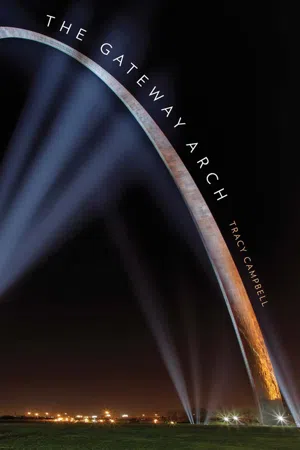
The Gateway Arch
About this book
This "fascinating, engaging" history of St. Louis's monument to American expansion reveals a story of greed, discrimination, and community displacement (NextSTL.com).
Rising to a triumphant height of 630 feet, the Gateway Arch is one of the world's most widely recognized structures and attracts millions of tourists to St. Louis every year. Envisioned in 1947 but not completed until the mid-1960s, its story is one of innovation and greed; civic pride and backroom deals. Weaving together social, political, and cultural perspectives, historian Tracy Campbell uncovers the complicated and troubling history of this iconic symbol.
In this revealing account, Campbell shows that the so-called Gateway to the West was the scheme of shrewd city leaders who were willing to steal an election, destroy historic buildings, and drive out communities in order to make downtown St. Louis more profitable. Campbell also tells the human story of the architect Eero Saarinen, whose prize-winning design brought him acclaim but also charges of plagiarism, and who didn't live to see the completion of his vision.
Rising to a triumphant height of 630 feet, the Gateway Arch is one of the world's most widely recognized structures and attracts millions of tourists to St. Louis every year. Envisioned in 1947 but not completed until the mid-1960s, its story is one of innovation and greed; civic pride and backroom deals. Weaving together social, political, and cultural perspectives, historian Tracy Campbell uncovers the complicated and troubling history of this iconic symbol.
In this revealing account, Campbell shows that the so-called Gateway to the West was the scheme of shrewd city leaders who were willing to steal an election, destroy historic buildings, and drive out communities in order to make downtown St. Louis more profitable. Campbell also tells the human story of the architect Eero Saarinen, whose prize-winning design brought him acclaim but also charges of plagiarism, and who didn't live to see the completion of his vision.
Frequently asked questions
Yes, you can cancel anytime from the Subscription tab in your account settings on the Perlego website. Your subscription will stay active until the end of your current billing period. Learn how to cancel your subscription.
No, books cannot be downloaded as external files, such as PDFs, for use outside of Perlego. However, you can download books within the Perlego app for offline reading on mobile or tablet. Learn more here.
Perlego offers two plans: Essential and Complete
- Essential is ideal for learners and professionals who enjoy exploring a wide range of subjects. Access the Essential Library with 800,000+ trusted titles and best-sellers across business, personal growth, and the humanities. Includes unlimited reading time and Standard Read Aloud voice.
- Complete: Perfect for advanced learners and researchers needing full, unrestricted access. Unlock 1.4M+ books across hundreds of subjects, including academic and specialized titles. The Complete Plan also includes advanced features like Premium Read Aloud and Research Assistant.
We are an online textbook subscription service, where you can get access to an entire online library for less than the price of a single book per month. With over 1 million books across 1000+ topics, we’ve got you covered! Learn more here.
Look out for the read-aloud symbol on your next book to see if you can listen to it. The read-aloud tool reads text aloud for you, highlighting the text as it is being read. You can pause it, speed it up and slow it down. Learn more here.
Yes! You can use the Perlego app on both iOS or Android devices to read anytime, anywhere — even offline. Perfect for commutes or when you’re on the go.
Please note we cannot support devices running on iOS 13 and Android 7 or earlier. Learn more about using the app.
Please note we cannot support devices running on iOS 13 and Android 7 or earlier. Learn more about using the app.
Yes, you can access The Gateway Arch by Tracy Campbell, Mark Crispin Miller in PDF and/or ePUB format, as well as other popular books in Politics & International Relations & Architecture General. We have over one million books available in our catalogue for you to explore.
Information
Notes
The following abbreviations are used in the notes.
AAA | Archives of American Art, Smithsonian Institution, Washington, D.C. |
ACP | Alfonso Cervantes Papers, University Archives, Department of Special Collections, Washington University in St. Louis |
AESP | Aline and Eero Saarinen Papers, Archives of American Art, Smithsonian Institution, Washington, D.C. |
AF | Architectural Forum |
BFDP | Bernard F. Dickmann Papers, The State Historical Society of Missouri, University of Missouri–Columbia |
CA | Cranbrook Archives, Cranbrook Academy, Bloomfield Hills, Michigan |
CCP | Clarence Cannon Papers, The State Historical Society of Missouri, University of Missouri–Columbia |
CGP | Clifford Greve Papers, Missouri Historical Society, St. Louis. |
CREC | Charles and Ray Eames Collection, Manuscript Division, Library of Congress. |
ES | Eero Saarinen. |
ESP | Eero Saarinen Papers, Manuscripts and Archives, Yale University Library, New Haven, Connecticut. |
FLWP | Frank Lloyd Wright Papers, Manuscript Division, Library of Congress. |
HAP | Harris Armstrong Papers, University Archives, Department of Special Collections, Washington University Libraries, St. Louis. |
HBAP | Harland Bartholomew and Associates Papers, University Archives, Department of Special Collections, Washington University Libraries, St. Louis. |
IPSR | Institute of Personality and Social Research, University of California-Berkeley. |
JKDP | James K. Douglas Papers, Missouri Historical Society, St. Louis. |
JNEMA | Jefferson National Expansion Memorial Archives, National Park Service, St. Louis. |
LES | Luther Ely Smith |
LESP | Luther Ely Smith Papers, Missouri Historical Society, St. Louis. |
LSSP | Lilian Swann Saarinen Papers, Archives of American Art, Smithsonian Institution, Washington, D.C. |
NPSCCF | National Park Service Central Classified Files, 1933–1949, Record Group 79, National Archives, College Park, Maryland. |
NYT | New York Times |
POPC | Paul O. Porter Collection, Special Collections, Andrews Library, College of Wooster, Wooster, Ohio. |
RTPP | Raymond R. Tucker Personal Papers, University Archives, Department of Special Collections, Washington University Libraries, St. Louis. |
SLGD | St. Louis Globe-Democrat |
SLPD | St. Louis Post-Dispatch |
SSP | Stuart Symington Papers, The State Historical Society of Missouri, University of Missouri–Columbia. |
Introduction
1. Philip Ball, Universe of Stone: Chartres Cathedral and the Invention of the Gothic (New York: Harper Perennial, 2008), 279–80; William Anderson, The Rise of the Gothic (London: Hutchinson, 1985), 41–45.
2. David Harvey, “Monument and Myth,” Annals of the Association of American Geographers 69 (September 1979): 381.
ONE
The New York of the West
1. Daniel K. Richter, Facing East from Indian Country: A Native History of Early America (Cambridge: Harvard University Press, 2001), 2–4; Timothy R. Pauketat, Cahokia: Ancient America’s Great City on the Mississippi (New York: Viking, 2009), 22–35, 101–2; Biloine Whiting Young and Melvin L. Fowler, Cahokia: The Great Native American Metropolis (Urbana: University of Illinois Press, 2000), 2–3, 307, 310; William R. Iseminger, “Culture and Environment in the American Bottom: The Rise and Fall of Cahokia Mounds,” in Andrew Hurley, ed., Common Fields: An Environmental History of St. Louis (St. Louis: Missouri Historical Society Press, 1997): 38–57; Stephen Aron, American Confluence: The Missouri Frontier from Borderland to Border State (Bloomington: Indiana University Press, 2006), 5–9.
2. Jay Gitlin, The Bourgeois Frontier: French Towns, French Traders, and American Expansion (New Haven: Yale University Press, 2010), 14; James Neal Primm, Lion of the Valley: St. Louis, Missouri, 1764–1980 (St. Louis: Missouri Historical Society Press, 1998), 2–13; William E. Foley, A History of Missouri vol. I, 1673–1820 (Columbia: University of Missouri Press, 1971), 23–25; Shirley Christian, Before Lewis and Clark: The Story of the Chouteaus, the French Dynasty That Ruled America’s Frontier (New York: Farrar, Straus and Giroux, 2004), 3–17; John A. Bryan, “ The Changing Scene on the St. Louis Riverfront, 1764–1954,” report no. 295, box 8, JNEMA, 1; Aron, American Confluence, 50–54.
3. Bryan, “The Changing Scene,” 9–12; Pauketat, Cahokia, 27; Gitlin, Bourgeois Frontier, 84–86; Aron, American Confluence, 106–8; Adam Arenson, The Great Heart of the Republic: St. Louis and the Cultural Civil War (Cambridge: Harvard University Press, 2011), 6–13.
4. Jay Feldman, When the Mississippi Ran Backwards: Empire, Intrigue, Murder, and the New Madrid Earthquakes (New York: Free Press, 2005), 15, 172–76; James A. Taylor, “Earthquake Ground Motion and Soil Amplification Effects in the St. Louis Metropolitan Area,” M.S. thesis, Washington University in St. Louis, 1997, 14–16. Many seismologists consider St. Louis to be in a secondary area of potential damage from a major earthquake along the New Madrid fault.
5. Aron, American Confluence, 186–87.
6. Scott v. Sandford 60 U.S. 393 (1857); James M. McPherson, Battle Cry of Freedom: The Civil War Era (New York: Oxford University Press, 1988), 170–73.
7. Joel A. Tarr and Carl Zimring, “The Struggle for Smoke Control in St. Louis,” in Andrew Hurley, ed., Common Fields: An Environmental History of St. Louis (St. Louis: Missouri Historical Society Press, 1997), 199–204.
8. Bryan, “The Changing Scene,” 39–40; Arenson, The Great Heart of the Republic, 9–12, 21.
9. Bryan, “The Changing Scene,” 39–58; Rob Wilson, “Cholera and Quarantine: St. Louis’ Battle With the 1849 Epidemic,” paper delivered at the annual meeting of the Western History Association, St. Louis, October 2006; Primm, Lion of the Valley, 154–58; SLPD, July 18, 2010.
10. Daily Evening News, March 30, 1855; New York Journal of Commerce, September 14, 1856; J. A. Dacus and James W. Buel, “A Tour of St. Louis, or, the Inside Life of a Great City” (St. Louis: Western Publishing, 1878), 29.
11. Arenson, The Great Heart of the Republic, 120–22.
12. Bryan, “The Changing Scene,” 61–68; Primm, Lion of the Valley, 235–53, 286–87; Maury Klein and Harvey A. Kantor, Prisoners of Progress: American Industrial Cities, 1850–1920 (New York: Macmillan, 1976), 152–53.
13. Colin Gordon, Mapping Decline: St. Louis and the Fate of the American City (Philadelphia: University of Pennsylvania Press, 2008), 22–23, 35; Don Phares, “Planning for Regional Governance in the St. Louis Area: The Context, the Plans, the Outcomes,” in Mark Tranel, ed., St. Louis Plans: The Ideal, and the Real St. Louis (St. Louis: Missouri Historical Society Press, 2007), 55–62.
14. Bryan, “The Changing Scene,” 68–72; Primm, Lion of the Valley, 373.
15. Merrill D. Peterson, The Jeffe...
Table of contents
- Cover Page
- Title Page
- Copyright Page
- Contents
- Dedication
- Acknowledgments
- Introduction: Saarinen’s Cathedral
- ONE The New York of the West
- TWO Getting Things Done
- THREE The St. Louis Municipal Parking Lot
- FOUR A Peculiarly Happy Form
- FIVE The Architect
- SIX The Laughingstock of the World
- SEVEN “Got It Made”
- EIGHT Expendable Culture
- NINE Symbol and Symptom
- Notes
- Bibliography
- Index