eBook - ePub
Available until 15 Nov |Learn more
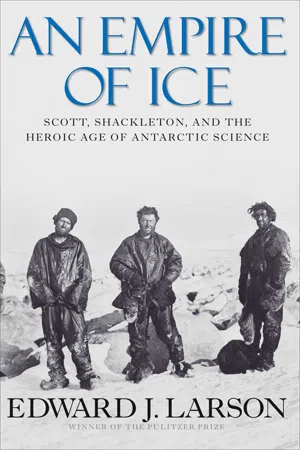
An Empire of Ice
Scott, Shackleton, and the Heroic Age of Antarctic Science
This book is available to read until 15th November, 2025
- 360 pages
- English
- ePUB (mobile friendly)
- Available on iOS & Android
eBook - ePub
Available until 15 Nov |Learn more
About this book
A Pulitzer Prize–winning author examines South Pole expeditions, "wrapping the science in
plenty of dangerous drama to keep readers engaged" (
Booklist).
An Empire of Ice presents a fascinating new take on Antarctic exploration—placing the famed voyages of Norwegian explorer Roald Amundsen, his British rivals Robert Scott and Ernest Shackleton, and others in a larger scientific, social, and geopolitical context.
Recounting the Antarctic expeditions of the early twentieth century, the author reveals the British efforts for what they actually were: massive scientific enterprises in which reaching the South Pole was but a spectacular sideshow. By focusing on the larger purpose of these legendary adventures, Edward J. Larson deepens our appreciation of the explorers' achievements, shares little-known stories, and shows what the Heroic Age of Antarctic discovery was really about.
"Rather than recounting the story of the race to the pole chronologically, Larson concentrates on various scientific disciplines (like meteorology, glaciology and paleontology) and elucidates the advances made by the polar explorers . . . Covers a lot of ground—science, politics, history, adventure." — The New York Times Book Review
An Empire of Ice presents a fascinating new take on Antarctic exploration—placing the famed voyages of Norwegian explorer Roald Amundsen, his British rivals Robert Scott and Ernest Shackleton, and others in a larger scientific, social, and geopolitical context.
Recounting the Antarctic expeditions of the early twentieth century, the author reveals the British efforts for what they actually were: massive scientific enterprises in which reaching the South Pole was but a spectacular sideshow. By focusing on the larger purpose of these legendary adventures, Edward J. Larson deepens our appreciation of the explorers' achievements, shares little-known stories, and shows what the Heroic Age of Antarctic discovery was really about.
"Rather than recounting the story of the race to the pole chronologically, Larson concentrates on various scientific disciplines (like meteorology, glaciology and paleontology) and elucidates the advances made by the polar explorers . . . Covers a lot of ground—science, politics, history, adventure." — The New York Times Book Review
Frequently asked questions
Yes, you can cancel anytime from the Subscription tab in your account settings on the Perlego website. Your subscription will stay active until the end of your current billing period. Learn how to cancel your subscription.
No, books cannot be downloaded as external files, such as PDFs, for use outside of Perlego. However, you can download books within the Perlego app for offline reading on mobile or tablet. Learn more here.
Perlego offers two plans: Essential and Complete
- Essential is ideal for learners and professionals who enjoy exploring a wide range of subjects. Access the Essential Library with 800,000+ trusted titles and best-sellers across business, personal growth, and the humanities. Includes unlimited reading time and Standard Read Aloud voice.
- Complete: Perfect for advanced learners and researchers needing full, unrestricted access. Unlock 1.4M+ books across hundreds of subjects, including academic and specialized titles. The Complete Plan also includes advanced features like Premium Read Aloud and Research Assistant.
We are an online textbook subscription service, where you can get access to an entire online library for less than the price of a single book per month. With over 1 million books across 1000+ topics, we’ve got you covered! Learn more here.
Look out for the read-aloud symbol on your next book to see if you can listen to it. The read-aloud tool reads text aloud for you, highlighting the text as it is being read. You can pause it, speed it up and slow it down. Learn more here.
Yes! You can use the Perlego app on both iOS or Android devices to read anytime, anywhere — even offline. Perfect for commutes or when you’re on the go.
Please note we cannot support devices running on iOS 13 and Android 7 or earlier. Learn more about using the app.
Please note we cannot support devices running on iOS 13 and Android 7 or earlier. Learn more about using the app.
Yes, you can access An Empire of Ice by Edward J. Larson in PDF and/or ePUB format, as well as other popular books in History & Science & Technology Biographies. We have over one million books available in our catalogue for you to explore.
Information
CHAPTER 1
“Three Cheers for the Dogs”
HE STOOD IN TRIUMPH AND TREPIDATION. IT WAS the evening of November 15, 1912. A proud, plain-speaking Norwegian adventurer, Roald Amundsen rose to address a packed house at London’s elite Royal Geographical Society after having bested better-equipped and better-funded British explorers in attaining a long-prized goal. He had reason to tremble. Some in the audience saw him as a jackal in a den of lions.
His talk would be modest, focused more on technical details of the journey than on the end accomplishment—but it could not be modest enough to please many of his British listeners. They, in turn, could not avoid insulting him even had they wanted to do so. For the second time in his life, he had achieved what Britain’s greatest heroes could not, but he had done it in a way that they disdained to attempt.
In 1912, when Amundsen made this second triumphal appearance before the society, London reigned over the most extensive empire in the history of the world. For three centuries, British explorers had led Europe in the discovery of other lands and seas. The Royal Geographical Society, or RGS, traced its origins to 1788, as the Association for Promoting the Discovery of the Interior Parts of Africa, and had succeeded famously in its original goal through its support of David Livingston, Richard Burton, John Speke, Henry Stanley, and other renowned explorers. Under the patronage of Queen Victoria, it extended its reach to the ends of the earth. Antarctica, the last large blank space on world maps, had by 1900 become a focus of its ambitions. The South Pole took on aspects of a holy grail.
British geographers of the late Victorian and Edwardian era viewed themselves as scientists and their expeditions as grand enterprises of science. Simply reaching the head of the Nile, the high Himalayas, or the South Pole was not enough. An RGS explorer had to conduct research along the way. A series of RGS-endorsed expeditions had been opening the way to the pole for more than a decade when, late in 1911, Amundsen stole a march on a team already in the field to capture the prize by questionable means. Hailed for this achievement throughout most of the Western world, Amundsen was all but required to address the leaders of British geographical science and receive their validation of his effort. He did not want to come but could scarcely decline their summons. The Royal Geographical Society’s status as the arbiter of world geography was well earned.
The British boasted a long history of exploration and claimed a certain province over the far south, where early geographers thought a large landmass must exist to counterbalance the continents of the north. During the 1770s, the Admiralty launched a scientific expedition under the command of James Cook to look for this hypothesized southern land. “January 17th, 1773, was an epoch in the world’s history,” RGS Librarian Hugh Robert Mill declared in 1905, “for just before noon on that day the Antarctic circle was first crossed by human beings.” The intrepid Cook crossed the Antarctic Circle twice more on the same voyage but retreated each time before dense pack ice without sighting land. By circumnavigating the globe at roughly latitude 60° south, he established that, if an Antarctic continent existed, it must lie in the far south behind a daunting blockade of sea ice. “I will not say it was impossible any where to get farther to the South; but attempting it would have been a dangerous and rash enterprise,” Cook wrote in his journal. “It was, indeed, my opinion, as well as the opinion of most on board, that this ice extended quite to the pole, or perhaps joined to some land, to which it had been fixed from the earliest time.”1
Later British explorers thought otherwise. In 1839 the Admiralty commissioned a second expedition to Antarctic waters. James Clark Ross, already famous as the first European to reach the wandering North Magnetic Pole, was given two sturdy wooden ships, HMS Erebus and Terror, and a charge to make magnetic observations throughout the deep southern seas. By this time, sealers, whalers, and expeditions from various countries had probed the edges of the ice pack and returned with reports of isolated bits of land.
“Impressed with the feeling that England had ever led the way of discovery in the southern as well as in the northern regions,” Ross commented, “I considered it would have been inconsistent with the pre-eminence she has ever maintained, if we were to follow in the footsteps of the expedition of any other nation.” Instead he plowed through the ice pack south of New Zealand and found a vast open sea with a mountainous western coast that he named Victoria Land for his young queen. “It was an epoch in the history of discovery,” the RGS’s Mill later wrote, “the magic wall from before which every previous explorer had to turn back in despair, had fallen into fragments at the first determined effort to break through it.”2
Sailing south along the Victoria Land coast in the sea later named for him, Ross encountered at about latitude 78° south what he described as “a perpendicular cliff of ice between one hundred and fifty and two hundred feet above the level of the sea, perfectly flat and level on top, and without any fissures or promontories on its even seaward side.”3 The awestruck captain found that this “Great Ice Barrier” extended eastward from the Victoria Land coast for hundreds of miles. He realized it would prevent anyone from sailing farther south. Despite this obstacle in the way to the pole, Ross had found an exposed coastline with majestic mountains and, jutting from the Ice Barrier across the Ross Sea’s McMurdo Sound, a large island that was later named for him. He never set foot on the Antarctic mainland, but his namesake island became the base for many later efforts to probe the southern continent.
In 1901, after years of prodding by its president, Clements R. Markham, the RGS cosponsored the first British land expedition to the southern continent. Aboard the purpose-built wooden ship Discovery, which wintered over for two years at Ross Island’s Hut Point with a select team of scientists, officers, and sailors under Royal Navy commander Robert Falcon Scott, the British National Antarctic Expedition became the first to send parties south across the Ice Barrier and east over the Victoria Land mountains. A team consisting of Scott, Ernest Shackleton, and Edward Wilson set a new farthest south record on the last day of 1902 before turning back at the extreme end of their endurance, at just over latitude 82° south. They had covered almost five hundred miles on foot with heavy sledges. “Whilst one cannot help a deep sense of disappointment in reflecting on the ‘might have been’ had our team remained in good health,” Scott wrote in his published journal, “one cannot but remember that even as it is we have made a greater advance towards a pole of the earth than has ever yet been achieved by a sledge party.”4
Shackleton returned to Antarctica five years later leading a privately funded expedition aboard the forty-year-old converted sealer Nimrod. Accompanied by a small land party that included several scientists, he wintered at Cape Royds on Ross Island before heading south with three men across the Ice Barrier, up a glacial pass through the mountains of South Victoria Land, and onto the vast Polar Plateau. They man-hauled their sledge to within 120 miles of the pole before being forced to turn back or face certain death by starvation. “We have shot our bolt, and the tale is latitude 88° 23? South, longitude 162° East,” Shackleton wrote on January 9, 1909. “We hoisted her Majesty’s flag and the other Union Jack afterwards, and took possession of the plateau in the name of his Majesty,” King Edward VII.5
Scott, sailing from England aboard Terra Nova, with his sights locked on the South Pole, had his second Antarctic expedition under way before Amundsen’s ship, Fram, departed on September 9, 1909, with the same ultimate destination. Scott brought along more scientists than any prior Antarctic expedition; Amundsen took none. The two teams spent the Antarctic winter at Ross Sea harbors four hundred miles apart, with the British base at Ross Island’s Cape Evans and the Norwegian one at a cleft in the Ice Barrier known as the Bay of Whales. They set off with sledges for the pole within days of each other—Amundsen on October 20, 1911, and Scott on November 1. Many Britons viewed the entire Ross Sea basin as their domain by right of discovery and prior exploration. The Norwegians were virtual trespassers.
For all the attraction of the South Pole, the Arctic held greater fascination for the British during the nineteenth century—and here too Amundsen had come late to the game. British interests in the Arctic regions of North America began with the practical purpose of finding a Northwest Passage for sea trade with Asia. In 1497, soon after Christopher Columbus returned from his epic first voyage to the New World, King Henry VII of England sent John Cabot in search of a northern route around the Americas. He found none. A succession of expeditions over the next three centuries, while cementing British claims to the Hudson Bay region under Western concepts of acquisition by European discovery, established that if a Northwest Passage existed through Canada’s Arctic Archipelago, then it was likely blocked by ice most of the year. Still, hopes of finding open water at the top of the world persisted into the mid-1800s.
Idle years for the British navy following the defeat of Napoleon in 1815 led Admiralty Second Secretary John Barrow to promote naval expeditions to the Canadian Arctic as a means to engage sailors and officers during peacetime, expand the empire, and make scientific and geographical discoveries. Surplus British warships were soon probing the far northern seas and coasts under the command of such veteran naval officers as John Ross, William Parry, and John Franklin—all of whom had served with distinction in the Napoleonic Wars. Ross’s nephew James Clark Ross, the future Antarctic hero, got his education in polar exploration by participating in six of these Arctic voyages from 1818 to 1833 under the tutelage of his uncle and Parry. Coinciding with the Romantic movement in the arts, these expeditions provided grist for countless books, paintings, and poems, including Mary Shelley’s groundbreaking 1818 science fiction tale, Frankenstein. Shelley’s tragic hero pursues his monstrous creation to the frozen north, where they encounter an icebound British Arctic expedition, which carries back their story of scientific hubris, death, and self-immolation on the polar ice. “I shall quit your vessel on the ice-raft which brought me hither,” the monster tells the expedition’s leader, “and shall seek the most northern extremity of the globe; I shall collect my funeral pile and consume to ashes this miserable frame.”6 The North Pole already had become an ultimate destination.
Leaders of actual British Arctic expeditions returned with their own tales of life, death, and science in the far north, which they often related in popular articles and books. Franklin became famous as “the man who ate his boots” after surviving a harrowing overland expedition in which most of his men starved to death and the rest resorted to eating lichen, shoe leather, and (by some accounts) their fallen comrades. For successful officers—especially those who published gripping accounts of their exploits—Arctic service provided a means to attain promotion in a peacetime navy, as well as celebrity status and entry into elite social circles. Following their initial triumphs, Parry married into the aristocracy while Franklin wed the poet Eleanor Porden and, after her death, the wealthy world traveler Jane Griffin.
By 1845, parts of the Arctic Archipelago had been surveyed from either the Atlantic or Pacific end, but no one had completed a voyage through it. At age fifty-nine, after an interlude as a colonial governor, Franklin accepted command of Ross’s fabled Erebus and Terror to complete the passage in the course of taking magnetic readings around the North Magnetic Pole, but these ships became trapped in the ice and never returned. Assuming that the explorers would have abandoned their ships and proceeded on foot, the Admiralty dispatched a series of land and sea expeditions to find them. When these failed, Franklin’s wife sponsored four expeditions of her own and offered a reward that spurred on others before conclusive evidence showed that Franklin and his men had died either on board the icebound ships or during their attempted trek to safety. Inuit accounts of cannibalism among some starving crewmembers, at first discounted but later proven, darkened these reports.
To search for Franklin on the ice and land, the Royal Navy refined techniques of man-hauling heavy sledges. Although participants reportedly described this as “about the most severe work to which man has ever been put, at least in modern times,” it served as an appropriate means of winter transport in the far north for young sailors disciplined for teamwork and accustomed to handling ropes. The native people would have used dogsleds, but these required training that the searchers lacked. After a disastrous Arctic expedition during 1875–76, one former sledger wrote to the niece and companion of Franklin’s widow about continuing the brutal practice, “I would confine every one who proposed such a thing in a Lunatic Asylum, burn every sledge in existence and destroy the patterns.”7 He did not reckon with the force of navy tradition.
Through a dozen publicly or privately funded expeditions and over a hundred sledge trips, during which more sailors and ships were lost than on the original voyage, the Franklin searches greatly extended the survey of the Canadian Arctic. Yet no single ship traversed the entire Northwest Passage. That distinction was left to a small, shallow-draft fishing sloop, Gjoa, commanded by Amundsen with a crew of six. Inspired by Franklin’s 1824 book about searching for the Northwest Passage and by the outpouring of nationalistic euphoria after six Norwegians led by Fridtjof Nansen had skied across Greenland in 1888, Amundsen in his teens resolved to become a polar explorer. “Strangely enough,” he later wrote about Franklin’s book, “the thing in Sir John’s narrative that appealed to me most strongly was the sufferings he and his men endured. A strange ambition burned within me to endure those same sufferings.” Of Nansen, he added, “The 30th May, 1889, was a red-letter day in many a Scandinavian boy’s life. Certainly it was in mine. That was the day when Fridtjof Nansen returned from his Greenland Expedition.”8 Amundsen’s remote but revered seafaring father had died three years earlier; in Nansen, he found a hero and mentor.
After his mother’s death freed him from her demands that he become a land-bound physician, Amundsen openly pursued his polar dreams. Descended from a family of ship owners and captains, in 1897, the twenty-five-year-old threw in his lot with a barebones Belgian expedition to Antarctica that became the first to winter at the southern continent when its ship, Belgica, became trapped in the sea ice west of the Antarctic Peninsula. “For thirteen months, we lay caught in the vise of this ice field,” Amundsen recalled. “Two of the sailors went insane. Every member of the ship’s company was afflicted with scurvy, and all but three of us were prostrated by it.”9 In his memoirs, Amundsen credited himself and the expedition’s American doctor, Frederick Cook, with saving the expedition by directing the crew to eat fresh seal meat and to cut a channel in the ice from their ship to a nearby melted basin that eventually opened to the sea.
Having earned his spurs in polar exploration and gained Nansen’s backing, Amundsen organized his ambitious cruise through the Northwest Passage, which lasted from 1903 to 1906. Nansen was by this time a world-renowned professor of zoology and oceanography. To win his support, Amundsen cast this expedition as primarily a scientific effort to relocate and study the movement of the North Magnetic Pole. “He emphasized that this investigation of the magnetic pole was the expedition’s mission statement, the scientific core which gave it legitimacy,” Nansen later recalled, “and that, as they were already there, they might as well include the Northwest Passage.” To prepare, Amundsen briefly studied in Germany under Georg von Neumayer, a leading expert in terrestrial magnetism and proponent of polar exploration. He also secured the RGS’s endorsement for the effort. “My expedition must have a scientific purpose as w...
Table of contents
- Cover Page
- Title Page
- Copyright Page
- Dedication
- Contents
- Preface
- Chapter 1: “Three Cheers for the Dogs”
- Chapter 2: A Compass Pointing South
- Chapter 3: The Empire’s Mapmaker
- Chapter 4: In Challenger’s Wake
- Chapter 5: Taking the Measure of Men
- Chapter 6: March to the Penguins
- Chapter 7: Discovering a Continent’s Past
- Chapter 8: The Meaning of Ice
- Epilogue: Heroes’ Requiem
- Notes
- Index