This book is available to read until 15th November, 2025
- 193 pages
- English
- ePUB (mobile friendly)
- Available on iOS & Android
eBook - ePub
Available until 15 Nov |Learn more
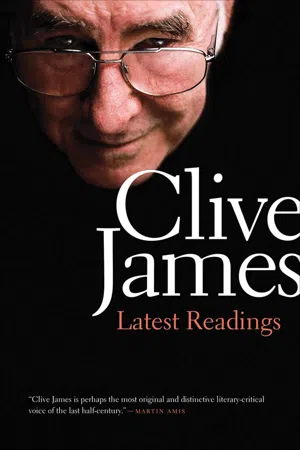
Latest Readings
About this book
"[A] collection of Clive James's essays on a variety of literary topics . . . This is sanity, humor and acuity in the face of death" (
The Wall Street Journal).
In 2010, Clive James was diagnosed with terminal leukemia. Deciding that "if you don't know the exact moment when the lights will go out, you might as well read until they do," James moved his library to his Cambridge house, where he would "live, read, and perhaps even write." James is the award-winning author of dozens of works of literary criticism, poetry, and history, and this volume contains his reflections on what may well be his last reading list. A look at some of James's old favorites as well as some of his recent discoveries, this book also offers a revealing look at the author himself, sharing his evocative musings on literature and family, and on living and dying.
As thoughtful and erudite as the works of Alberto Manguel, and as moving and inspiring as Randy Pausch's The Last Lecture and Will Schwalbe's The End of Your Life Book Club, this valediction to James's lifelong engagement with the written word is a captivating valentine from one of the great literary minds of our time.
"These essays and poems are death-haunted but radiant with the felt experience of what it means to be alive, even when mortally sick, especially when mortally sick." — Financial Times
" Latest Readings is a plain demonstration that Mr. James remains as learned and as funny as any critic on earth." — The New York Times
In 2010, Clive James was diagnosed with terminal leukemia. Deciding that "if you don't know the exact moment when the lights will go out, you might as well read until they do," James moved his library to his Cambridge house, where he would "live, read, and perhaps even write." James is the award-winning author of dozens of works of literary criticism, poetry, and history, and this volume contains his reflections on what may well be his last reading list. A look at some of James's old favorites as well as some of his recent discoveries, this book also offers a revealing look at the author himself, sharing his evocative musings on literature and family, and on living and dying.
As thoughtful and erudite as the works of Alberto Manguel, and as moving and inspiring as Randy Pausch's The Last Lecture and Will Schwalbe's The End of Your Life Book Club, this valediction to James's lifelong engagement with the written word is a captivating valentine from one of the great literary minds of our time.
"These essays and poems are death-haunted but radiant with the felt experience of what it means to be alive, even when mortally sick, especially when mortally sick." — Financial Times
" Latest Readings is a plain demonstration that Mr. James remains as learned and as funny as any critic on earth." — The New York Times
Frequently asked questions
Yes, you can cancel anytime from the Subscription tab in your account settings on the Perlego website. Your subscription will stay active until the end of your current billing period. Learn how to cancel your subscription.
No, books cannot be downloaded as external files, such as PDFs, for use outside of Perlego. However, you can download books within the Perlego app for offline reading on mobile or tablet. Learn more here.
Perlego offers two plans: Essential and Complete
- Essential is ideal for learners and professionals who enjoy exploring a wide range of subjects. Access the Essential Library with 800,000+ trusted titles and best-sellers across business, personal growth, and the humanities. Includes unlimited reading time and Standard Read Aloud voice.
- Complete: Perfect for advanced learners and researchers needing full, unrestricted access. Unlock 1.4M+ books across hundreds of subjects, including academic and specialized titles. The Complete Plan also includes advanced features like Premium Read Aloud and Research Assistant.
We are an online textbook subscription service, where you can get access to an entire online library for less than the price of a single book per month. With over 1 million books across 1000+ topics, we’ve got you covered! Learn more here.
Look out for the read-aloud symbol on your next book to see if you can listen to it. The read-aloud tool reads text aloud for you, highlighting the text as it is being read. You can pause it, speed it up and slow it down. Learn more here.
Yes! You can use the Perlego app on both iOS or Android devices to read anytime, anywhere — even offline. Perfect for commutes or when you’re on the go.
Please note we cannot support devices running on iOS 13 and Android 7 or earlier. Learn more about using the app.
Please note we cannot support devices running on iOS 13 and Android 7 or earlier. Learn more about using the app.
Yes, you can access Latest Readings by Clive James in PDF and/or ePUB format, as well as other popular books in Literature & Literary Essays. We have over one million books available in our catalogue for you to explore.
Information
American Power
I FIRST BOUGHT and read David Halberstam’s The Powers That Be in Washington, in 1980. On assignment from the Observer, and faced with such daunting tasks as interviewing Zbigniew Brzezinski, I needed books that would explain the American political system to me as concisely as possible. In his knowledgeable analysis of how the power structure of the media related to the power structure of the nation—the newspapers were still instrumental in those days, but television was already becoming a preponderant element—Halberstam helped to form my taste for reading about American politics. Reading the book again now, I am usefully reminded that the sainthood of William Paley was questionable. Contrary to legend, it wasn’t the CBS news programmes, with Ed Murrow to the fore, that undid McCarthy; and Paley not only ensured that Murrow was kept on a taut leash, he eventually got rid of him altogether. Paley’s supposedly ethical empire turned stupid in order to expand: an edemic declension that he encouraged, having deduced, correctly, that in America his prestige would be enhanced the more power he took. All this was laid out well by Halberstam, and it still reads like essential news. Unfortunately, one is also once again reminded that Halberstam, so diligent in his research, was hopelessly careless at the level of constructing a sentence. It wasn’t as if he couldn’t write at all: he could, but only a breath at a time. Clauses were botched together with no thought for grammatical continuity. Today, his scrappy paragraphs look so clumsy that I wonder why, at the time, I wasn’t put off American political writing altogether.
But others wrote better, and anyway the subject was too rich to leave alone. About power in the media, Ken Auletta has written a whole string of thrilling books about which conglomerate merged with which, and dozens of books such as Timothy Crouse’s The Boys on the Bus bring you the very smell of the political reporters crammed onto the zoo plane and behaving more and more badly as they slog away at translating press handouts into printable copy. As for power in Washington, by now there are enough essential books to keep you going forever, or anyway to make you redefine the word “essential.” I went on to read all the many books about Washington by Elizabeth Drew, and at least one book—The Wise Men, by Walter Isaacson and Evan Thomas—opened up for me the huge subject of how American politics affected the whole world, and vice versa. Essentially such books were journalism, but they were also proof that journalism is the first draft of formal history. And sometimes, of course, it was the journalists, not the professors, who wrote the formal history that counted: William Shirer’s The Rise and Fall of the Third Reich might have begun as a report by a journalist on the spot, but as a history of its subject it was never been equaled, nor is it likely to be.
Reading about American politics was as thrilling, and almost as much fun, as reading about Hollywood. Even today I usually read the latest book by Bob Woodward as soon as it comes out, even though I find him a pedestrian writer, and his book about John Belushi, Wired, was so misleading—he treated the crack-up of a comedian as if it were the fall of a president—that it made me suspect the emotional veracity (not the veracity: he checks his facts until they weep with boredom) of everything Woodward has written since. Nor is Woodward fully at home when writing about the American Establishment, even though he has long been a co-opted member of it. British students of American political writing would prefer to believe that in America there is much less emphasis on social background. In fact there is at least as much. It not only helps us if we know exactly what the words mean when we are told that the young George W. Bush was tapped for Skull and Bones; it also helps us if we know that part of Nixon’s paranoia about the Kennedy family had an understandable basis in social resentment. He thought that JFK had been born to the purple, and that the patriarch of the family, old Joe Kennedy, was the kind of man against whom it was wise to get your retaliation in first. He was quite right about that.
Sally Bedell Smith’s Grace and Power, a chronicle of the JFK White House, is an example of the Higher Gossip: always a suspect genre, because we tend to enjoy it too much. I bought the book new, from Heffer’s in Trinity Street: an act of extravagance justifiable because I thought it would make a good birthday present for my younger daughter, who has an uncanny ability to race through a factual book and retain every fact in it, thereby steadily replenishing herself in the role of a walking encyclopedia available for consultation to the entire family. The book, she reported, was an ace effort. I borrowed it back from her and soon found that she was right. Sally Bedell Smith has Kitty Kelley’s gift for getting at the real story behind the glamour, but she does a better job of bringing everything to the level of historic significance, instead of lowering it to the level of triviality. JFK’s compulsive womanizing is not scamped: indeed it is the central subject. (In a real book about his presidency, the central subject would be his politics, but this is a book about the man himself, whom Bedell Smith insists, correctly in my opinion, on locating within the pattern of his private behavior.) But if JFK emerges as a satyr, his wife Jackie does not emerge as a patsy. This is one of the best accounts I have read of her formidable stature. Usually any written portrait of her, especially if the work of a woman, makes her out as a fashion plate, even when the high levels of her taste and knowledge are conceded. Bedell makes the taste and knowledge the center of her story. She was the perfect consort for JFK in his imperial role. He knew it, but he betrayed her anyway. It wasn’t just that he couldn’t help it; he didn’t want to help it, even for a moment.
The press knew but said nothing, just as they had known about FDR’s paralysis but never mentioned it. In later times—which can be said to have started the moment after JFK was shot—his behavior would have got him either fired, or, more probably, never elected. Bill Clinton got into a Watergate-sized scandal over an adulterous episode that ranked nowhere beside JFK’s least frolic. But JFK didn’t just have the advantage of living in an era when the administration was still able to control the twenty-four-hour news cycle: most of his women were of a classy background and thus not susceptible to being hired by the press to spill the beans. That being said, however, there was nothing upmarket about Judith Campbell, the mistress he shared with the mobster Sam Giancana. Not much further in the future, such an alliance would have dished him.
The story is intoxicating but raises the question of whether we ought to be intoxicated. Perhaps not, but abstention would not be easy. Gossip of such quality (at these altitudes, as the Spanish say) feels like the food of life, as if hors d’oeuvres could be the whole meal. And if the caviar and the blinis are good enough, why eat anything else? Well, knowing how many new young women the glowing American prince could get through in a week won’t tell you how he got Khrushchev to take the missiles out of Cuba. There is a bigger picture. But to do her credit, our author knows about that too, and is able to set JFK’s priapic energies within a truly historical context. So finally this is an essential book about American politics. The story about François Hollande’s entanglement with the enchantress Julie Gayet—it was still going on while I was reading about JFK’s heroic efforts to marshal the supply of secretaries who joined him in the White House swimming pool—would be an essential book about French politics, but less sensational in its effect, because in France these things are well understood. In America, what is well understood is that they are not allowed. Among his many deleterious medical conditions, JFK had at least one that threatened his life, but nobody in the Kennedy family, and not one staff member, ever told the press. In The West Wing, President Bartlet has a similarly serious chronic ailment, and the whole plot of almost the entire multiseason serial turns on the fact that the ailment has been concealed. But what Bartlet was not allowed to have, even in supposedly more enlightened times, was a secret habit involving women. Nobody would have watched. In that respect, the American TV culture, impressive though it has become, is still outstripped by books.
Gripped by a specific hunger for huge American books that deal with the new imperialism—which is a cultural imperialism, beyond the power of armies—I moved directly to Personal History, the autobiography of Katharine Graham, which I should have read in 1997, when it first came out. At the time, Kay Graham was still well in charge of the whole Washington Post conglomerate, including Newsweek and the TV stations: the proprietress had become the hands-on administrator, and therefore one of the most powerful women in America. She wrote the book in the full confidence conferred by her position. But what makes the book so good is that she remembers a time when she was not confident at all. It lasted for all of her childhood and much of her adulthood. She had an overwhelming mother, and later she was plunged into an overwhelming world.
Briefly, it can be said that she was born and raised in a context where women were supposed to be dainty and attractive, and she always felt like a lump. Even her mother, who did all kinds of extracurricular things including translating Thomas Mann, was basically a glamour puss: i.e., not a lump. That Kay Graham–née–Meyer’s lack of routine glamour worked her way in the end is easy to say now. Had she been the standard-issue high-society debutante, she might have gone on to consume her mature years as a wife, mother, and hostess of many accomplishments. She might have had the life that seemed set down for Jacqueline Lee Bouvier before she, too, went looking for a real personality of her own, instead of just a standard screenplay. But Kay Meyer, as inside the system of rich connections as a woman could be, felt like an outsider. She was a wallflower, and her nervousness made her ill. In the book she is disturbingly frank about how unsettling it felt. Another strength of her account is that she is fully aware that her anguish of uncertainty is bound to seem like self-indulgence in a context where so many American women were too poor to choose their lives. Such a realization added embarrassment to uncertainty. She wasn’t Cinderella: she belonged at the ball. That was just the trouble. She belonged; but she was not, by her own estimation, qualified. She could feel the eyes of a whole social stratum on her, finding her inadequate.
The book is the long and sometimes sad story of how she attained a sense of qualification. It was a social milieu in which men ruled. It was taken for granted that her brilliant husband, Phil Graham, would run things, although he did not own them. As well as running the Empire, Phil was the one who had the entrée into the Kennedy administration’s Camelot on the Potomac. Kay was just the wife. To do her credit, she was not content with this; and to do some of the men credit, they were in her corner. Ben Bradlee, as editor of the Washington Post, behaved especially well. With Bradlee’s help she gradually asserted herself until, after Phil’s suicide, she was ready to adopt the burden of command. I wonder why the book is not more often cited by feminists: perhaps too many of them are too far on the left, and don’t believe that a poor little rich girl can have real problems. In chapter 21, she gives an especially touching account of how women of her class were pressured to belittle themselves in order to fit into a man’s world. She fought back well, and eventually she was ready to resist even the tawdry might of the Nixon administration, which pulled every conceivable dirty trick in order to persuade her to call off the Post’s investigations of the Watergate caper. Woodward and Bernstein could not have done without the support of Bradlee, but Bradlee could not have done without the support of Kay Graham. The Nixon people—with the aid of the Justice Department, which was in their pocket—were ready to burn down the whole of the Washington Post empire. The constitution would not have been enough to stop them. It took the guts of the proprietress. In her brainy integrity, the great lady reminds you of Eleanor Roosevelt, who was no glamour girl either, but was still the center of attention. Kay Graham and Adlai Stevenson used to see a lot of each other. Their conversation must have been fascinating. Unfortunately, there are no tape recordings of it. We only have tapes of Nixon.
Kipling and the Widow-maker
BACK IN 2010, during my first year of illness, I added to my woes by stupidly contriving to remain immobile in my cabin throughout an Atlantic crossing to New York, instead of walking around the deck a few times each day as I should have done. It rained all the way, but that was no excuse, because on a ship as big as the Queen Mary 2 you can do a satisfactory deck walk just by using the internal corridors. Instead, I did a long lie-down, and paid the penalty by finding out, when I arrived in New York, that I had contracted a thrombosis. After ten days in Mount Sinai hospital there was the long trip back to England, and even then I was not free of the effects. The price of safety from a further occurrence, I was told, lay in Ambulation. The doctors managed to pronounce the word with a capital “A,” and I still do so myself. Every day I Ambulate for at least half an hour, to make sure that my legs get some work to do. In the summer months the walk to town and back counts as Ambulation. I Ambulate to the bookshops, load up with a few books, and Ambulate back again. But in cold or wet weather, Ambulation must be done inside the house. It felt like a perfect waste of time until I hit upon the device of reading while I Ambulated. All I needed was a fair mental map of where the furniture was and I could Ambulate while reading Kipling’s poetry. It seemed a fitting activity because so many of his poems are written in a kind of march rhythm. They are soldierly stuff.
And yet, how brilliant. Technically, he could do anything. Here is the whole of his little four-line epic “The Sleepy Sentinel.”
Faithless the watch I kept: now I have none to keep.
I was slain because I slept; now I am slain I sleep.
Let no man reproach me again, whatever watch is unkept—
I sleep because I am slain. They slew me because I slept.
The trouble with the owner of the technique that can do anything is that he is continually tempted to do everything at once. Left to their own impulses, his poems make so much noise that they seldom settle into the condition of a statement: they are always giving you a whole symphony. Yet one must confess to a certain relief that so many of Kipling’s poems rule themselves out: whether because they are burdened by too much dialect, or too much flashy wordplay, they usefully tell us that we need not go back to them. If he had reined himself in, he would have been a poet the way he was a writer of short stories: one of the supreme exponents in the language. Even as things are, with your capacity for attention automatically whittling down the number of his poems that you would wish to revisit—and perhaps your capacity for attention is declining anyway—there is more than enough of him to keep you murmuring with admiration. He has the knack, peculiar to the poetic genius, of speaking in your own throat. It would be the wish of any poet to attain the phonetic force of the first stanza of “Harp Song of the Dane Women.”
What is a woman that you forsake her,
And the hearth fire and the home-acre,
To go with the old grey Widow-maker?
Unforgettable for the power of its movement, the whole poem is like that. If that one poem had ten companions, he would have changed the history of English poetry. But of course it has, scattered about in his works; and he almost did. It’s just that his influence proved impossible to absorb. Kipling deserves all the praise he gets from Craig Raine’s introductory essay to Rudyard Kipling: Selected Poems, a Penguin of the perfect weight and dimensions for the Ambulatory student. T. S. Eliot once did a good selection too, with an essay presaging Raine’s in its analytical approval. Both Eliot and Raine, inventors of their own manner, can be seen struggling, however elegantly, with the self-imposed task of coaxing a raging bull into the back of a small truck. The urge, for any poet who reads Kipling, is to get his energy under control before it infects everybody with the ruinous urge to emulate him.
Speer in Spandau
WHEN HE WAS IN Spandau prison, Albert Speer walked long distances to stay in shape. He calculated the number of paces to Istanbul, checked off the number of paces he walked each day in the prison yard, and eventually, without having left Berlin, he reached his destination. Later on he got as far as Beijing. It’s one of the more believable stories in his book Spandau: The Secret Diaries, which I have just read again. This time I read it in English, although there was a day when I could read it fairly easily in German. All his books are good for your German, but I am not at all sure they are good for your soul. As a writer, he never let up on his act as the civilized man, the true artist, who got caught up in the dream world of the fake artist Hitler because it offered such irresistible aesthetic opportunities.
The message being, you might have been him. To deny this, you have to be unembarrassed about speaking with a confidence that feels like bluster. But surely he was pulling a fast one, which he made all the more persuasive by pulling it slowly. Over the years, after the war, both in prison and out, he told the world that he should have known what the Nazis were up to, and could not forgive himself for his ignorance. But he did know, and he was never ignorant. He was especially vulnerable on that last point because he liked to...
Table of contents
- Cover Page
- Title Page
- Copyright Page
- Dedication
- Contents
- Acknowledgments
- Introduction
- Hemingway in the Beginning
- Revisiting Conrad
- Novels in Sequence
- Patrick O’Brian and His Salty Hero
- War Leader
- Sebald and the Battle in the Air
- Phantom Flying Saucer
- Under Western Eyes
- Anthony Powell, Time Lord
- Treasuring Osbert Lancaster
- American Power
- Kipling and the Widow-maker
- Speer in Spandau
- Shakespeare and Johnson
- Naipaul’s Nastiness
- Movie Books
- Women in Hollywood
- Extra Shelves
- Always Philip Larkin
- Villa America
- Angles on Hitler
- Stephen Edgar, Australian Ace
- John Howard Extends His Reign
- Hemingway at the End
- On Wit
- Richard Wilbur’s Precept
- When Creation Is Perverse
- Conrad’s Greatest Victory
- Coda