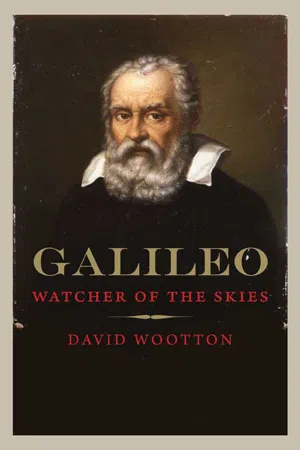
This book is available to read until 15th November, 2025
- 344 pages
- English
- ePUB (mobile friendly)
- Available on iOS & Android
eBook - ePub
Available until 15 Nov |Learn more
About this book
"Demonstrates an awesome command of the vast Galileo literature . . . [Wootton] excels in boldly speculating about Galileo's motives" (
The New York Times Book Review).
Tackling Galileo as astronomer, engineer, and author, David Wootton places him at the center of Renaissance culture. He traces Galileo through his early rebellious years; the beginnings of his scientific career constructing a "new physics"; his move to Florence seeking money, status, and greater freedom to attack intellectual orthodoxies; his trial for heresy and narrow escape from torture; and his house arrest and physical (though not intellectual) decline. Wootton also reveals much that is new—from Galileo's premature Copernicanism to a previously unrecognized illegitimate daughter—and, controversially, rejects the long-established belief that Galileo was a good Catholic.
Absolutely central to Galileo's significance—and to science more broadly—is the telescope, the potential of which Galileo was the first to grasp. Wootton makes clear that it totally revolutionized and galvanized scientific endeavor to discover new and previously unimagined facts. Drawing extensively on Galileo's voluminous letters, many of which were self-censored and sly, this is an original, arresting, and highly readable biography of a difficult, remarkable Renaissance genius.
Selected as a Choice Outstanding Academic Title in the Astronautics and Astronomy Category
"Fascinating reading . . . With this highly adventurous portrayal of Galileo's inner world, Wootton assures himself a high rank among the most radical recent Galileo interpreters . . . Undoubtedly Wootton makes an important contribution to Galileo scholarship." — America magazine
"Wootton's biography . . . is engagingly written and offers fresh insights into Galileo's intellectual development." — Standpoint magazine
Tackling Galileo as astronomer, engineer, and author, David Wootton places him at the center of Renaissance culture. He traces Galileo through his early rebellious years; the beginnings of his scientific career constructing a "new physics"; his move to Florence seeking money, status, and greater freedom to attack intellectual orthodoxies; his trial for heresy and narrow escape from torture; and his house arrest and physical (though not intellectual) decline. Wootton also reveals much that is new—from Galileo's premature Copernicanism to a previously unrecognized illegitimate daughter—and, controversially, rejects the long-established belief that Galileo was a good Catholic.
Absolutely central to Galileo's significance—and to science more broadly—is the telescope, the potential of which Galileo was the first to grasp. Wootton makes clear that it totally revolutionized and galvanized scientific endeavor to discover new and previously unimagined facts. Drawing extensively on Galileo's voluminous letters, many of which were self-censored and sly, this is an original, arresting, and highly readable biography of a difficult, remarkable Renaissance genius.
Selected as a Choice Outstanding Academic Title in the Astronautics and Astronomy Category
"Fascinating reading . . . With this highly adventurous portrayal of Galileo's inner world, Wootton assures himself a high rank among the most radical recent Galileo interpreters . . . Undoubtedly Wootton makes an important contribution to Galileo scholarship." — America magazine
"Wootton's biography . . . is engagingly written and offers fresh insights into Galileo's intellectual development." — Standpoint magazine
Frequently asked questions
Yes, you can cancel anytime from the Subscription tab in your account settings on the Perlego website. Your subscription will stay active until the end of your current billing period. Learn how to cancel your subscription.
No, books cannot be downloaded as external files, such as PDFs, for use outside of Perlego. However, you can download books within the Perlego app for offline reading on mobile or tablet. Learn more here.
Perlego offers two plans: Essential and Complete
- Essential is ideal for learners and professionals who enjoy exploring a wide range of subjects. Access the Essential Library with 800,000+ trusted titles and best-sellers across business, personal growth, and the humanities. Includes unlimited reading time and Standard Read Aloud voice.
- Complete: Perfect for advanced learners and researchers needing full, unrestricted access. Unlock 1.4M+ books across hundreds of subjects, including academic and specialized titles. The Complete Plan also includes advanced features like Premium Read Aloud and Research Assistant.
We are an online textbook subscription service, where you can get access to an entire online library for less than the price of a single book per month. With over 1 million books across 1000+ topics, we’ve got you covered! Learn more here.
Look out for the read-aloud symbol on your next book to see if you can listen to it. The read-aloud tool reads text aloud for you, highlighting the text as it is being read. You can pause it, speed it up and slow it down. Learn more here.
Yes! You can use the Perlego app on both iOS or Android devices to read anytime, anywhere — even offline. Perfect for commutes or when you’re on the go.
Please note we cannot support devices running on iOS 13 and Android 7 or earlier. Learn more about using the app.
Please note we cannot support devices running on iOS 13 and Android 7 or earlier. Learn more about using the app.
Yes, you can access Galileo by David Wootton in PDF and/or ePUB format, as well as other popular books in Technology & Engineering & Science & Technology Biographies. We have over one million books available in our catalogue for you to explore.
Information
PART ONE
THE MIND'S EYE
Methinks I see my father … in my mind's eye.
Shakespeare, Hamlet
A professor teaching in Padua thought he had made some new discoveries and was dismayed that no one had painted up graffiti honouring him. So, being bold, he decided to go out one night with a ladder and paint up in all the public places, ‘Long live Distinguished Professor So-and-So!’ Unfortunately the police came upon him while he was up his ladder, and thinking he was a thief, they were about to take him off to prison. If they had not noticed the paint bucket tied to his waist and the paint brush in his hand, which pretty clearly indicated the nature of his madness, things might have turned out rather badly for him. But nowadays the discoverers of new things are virtually deified.1
Lodovico delle Colombe, Polite Refutations (1608)
1
His father's son
Galileo's father Vincenzo (c.1525–91) was a Florentine musician. In 1562 he appears in Pisa, where he marries and sets up a music school. We do not know whether he first moved there for love or for money, though we may suspect that neither the marriage nor the music school flourished. The marriage took place on 5 July 1562, and Galileo, the eldest child, was born on 15 February 1564.2 Surviving documents include accounts supplied by a good friend of Galileo's father, Muzio Tedaldi, who handled his affairs during 1573 (when Galileo was aged nine – Muzio's expenses include the purchase of a football), while Vincenzo was based in Florence, and another document in which Vincenzo made his sister-in-law his attorney in a dispute over payment owing for some silk fabric which had originally belonged to her.3 This, and the fact that Vincenzo had received part of his wife's dowry in cloth, suggests that he had married into a family that dealt in silk, cotton and wool, and that either he had taken up a role in the business to supplement his income as a musician, or his wife was trading under her husband's name.4 One contemporary source claims that Galileo was originally intended for the wool business – for his mother's world rather than his father's. All sources agree that the family was, and always would be, impoverished; they were living from hand to mouth. Galileo, the eldest son, would later stress that he had inherited nothing from his father.
Something of the frustration and bitterness which must have overshadowed his early life is reflected in an annotation that Galileo made many years later, in 1619, in a book by Orazio Grassi, a prominent Jesuit critic of Galileo who had published under the pseudonym of Sarsi:
Sarsi is like someone who wants to buy a piece of cloth made of pure silk and takes it out of the shop into the open air, and there goes over it bit by bit looking for the slightest stain or smallest flaw; and if they find the tiniest defect they run down the whole piece of cloth, find fault with it, and beat down the price, taking no account of the enormous care, patience, and time and trouble that went into making all the rest of it so perfectly; and what is even more barbarous and inhumane, having made a fuss about the slightest stain or pulled thread in that piece of cloth, when they wear it, they have it chopped up, mangled, cut into a thousand times; and they wear it to a masked ball, or to go gambling, or to the theatre, knowing that before the evening is over it will be completely smeared with mud and torn into pieces.5
When Galileo wanted to conjure up a vivid image of someone not being given their due, he went back in his mind to the Pisa of his childhood, to his parents' unsuccessful attempts to make money from the cloth trade.
The young lad quickly showed himself to be interested in making little mechanical models – of ships and watermills. He learnt to play the lute to a professional standard, as one would expect of his father's son. And he showed considerable aptitude for drawing and painting; in later life he spent much time in the company of painters, and said he would have been an artist if he had not become a philosopher.6 Galileo's willingness to work with his hands (in an age when manual labour was regarded as demeaning) was crucial to his later success: for twenty years his telescopes were the best simply because he ground his own lenses, while other astronomers purchased lenses from spectacle makers.7
There is an episode from later in Galileo's life which neatly illustrates the ambiguity in social standing that resulted from his willingness to work with his hands. In 1630 the Florentine ambassador in Madrid promised the king of Spain a Galilean telescope. A Florentine diplomat, travelling to Madrid, was instructed to learn how to use it and bring it with him, but he evidently regarded the matter as a low priority, and was too pressed for time to comply with his instructions. When he got to Spain he was very surprised to find himself pestered by the king for the telescope, and was obliged to write off to Florence to arrange for it to be sent after him. Soon after its eventual arrival the objective lens fell out and broke, and he was instructed to obtain another one as quickly as possible. The letters he wrote to Florence provoked an impatient, even haughty, response. He did not seem to have adequately conveyed to the Spanish government, he was told, that the maker of the telescope was not some sort of artisan, to be ordered about, but a great philosopher and a great man, to be approached with due deference.8 In Florence, which had a mercantile nobility, the idea of a great man who used his hands was just about comprehensible to some people (though not, it seems, to Esaù del Borgo, the unhappy diplomat who had completely failed to grasp the value of Galileo's telescope for the king of Spain); not in Spain, however, where the king presumably thought Galileo had the same social status as the engineer and painter Cosimo Lotti, who, before moving from Florence to Madrid, had sometimes been employed making fancy cakes for the grand duke's dinner parties.
The young Galileo acquired the standard humanist education of the day – Latin, Greek, Aristotelian logic – from schoolteachers, first in Pisa, and then in Florence, where he moved around the time of his tenth birthday with his mother and his sister Virginia (born a year before, in 1574) to join his father, who was slowly making his way at the Medici court. Young Galileo also spent some time as a novice in a monastery at Vallombrosa, forty miles east of Florence, presumably in order to obtain a free education, and was about to take his vows (so perhaps he was fourteen) when his father, who surely wanted his eldest son to pursue a career rather than abandon the world, came and took him away, claiming he needed urgent medical treatment for an eye infection. When we get to know Galileo's mother Giulia better we will find that she was the sort of woman who would have wanted a monk for a son (and indeed Galileo was never to marry), so here we may guess at a struggle between Galileo's parents over what should become of their child. In later years Galileo must have told his friends how close he had come to a life of poverty, chastity and obedience: the subject surely came up when he returned to teach at Vallombrosa in 1588.9 One friend, turned enemy, chose ‘sfrattato’, unfrocked monk, as his preferred insult, scribbling the word repeatedly in the margin of Galileo's testimony in a court case. Perhaps, at times, Galileo regretted his father's decision to rescue him from a monastic life: he was puzzled that his sister preferred marriage to a convent, and he chose to consign his two acknowledged daughters to a nunnery.10 He may have thought that he had their best interests at heart when he did so. By the time he died, though, he had changed his attitude to the religious life. In his last will he disinherited any descendant who entered a monastery or nunnery.11
When Galileo was sixteen his father resolved to find the money to put him through university in Pisa. His plan was for him to become a doctor: indeed he had named him Galileo after a famous ancestor who had been a doctor; this was the original Galileo from whom the Galilei family claimed descent. Galileo was to live in Pisa in the home of his father's old friend Muzio Tedaldi – although there was a rather striking condition: Tedaldi must first marry the woman with whom he was living, or else break off with her. Since Tedaldi's mistress (if she was his mistress – he vigorously denied that theirs was a sexual relationship) was a relative of Galileo's mother, to whom respectability mattered greatly, we can guess that this was Giulia's condition rather than Vincenzo's. Later, when Galileo had a mistress of his own, he did not live with her, and there is no sign that he ever considered marrying her.
Galileo's father must have been an important influence upon the young Galileo. Vincenzo was the author of a significant work of musical theory, the Dialogue on Ancient and Modern Music (1581):12 Galileo was following in his father's footsteps when he wrote dialogues in Italian. In later life Galileo had copies of this book lying around – we find him lending one to a friend.13 In his study of musical harmony, Vincenzo conducted experiments, and Galileo certainly knew of these and may have helped set them up. Vincenzo showed that it was not just the length of a string that determined the note it played, but its material, diameter and tension; this involved a simple experimental apparatus where weights were hung from strings of different materials. But of course every lute player already knew that you can raise the note of a string either by shortening it – by pressing down on a fret – or by tightening it; Vincenzo would also have known that a new string requires a new tuning. So his experiments, as we now call them, were really ways of illustrating what he already knew. He was impatient with people he called Pythagoreans, who thought that music could be explained by simple mathematical ratios, and insisted that all knowledge must pass the test of experience. We can be confident that he told the young Galileo to distrust abstract theorising. Galileo was always a musician's son. When he wants to describe the reform he is trying to introduce into philosophy he compares it to tuning an organ. But at the same time he was always (at least after 1597) quick to insist that he was a Pythagorean: not only did he believe in the power of mathematical abstraction, but Pythagoras had first proposed the view that the earth went round the sun. Every time Galileo declared himself to be a Pythagorean, Galileo disowned his father.
The elder Vincenzo may well have symbolised failure to his son; he certainly presented him with a model of thwarted ambition. Vincenzo saw himself as a great man who, for all his modest success at court, had never been given his due. Galileo's obdurate refusal to submit to censorship, to sink back into anonymity, may be interpreted as a refusal to relive his father's failure. But Vincenzo's most significant example to his son may lie elsewhere. The culture of late sixteenth-century Italy was one obsessed with the imitation of the ancients. In philosophy, in medicine, in law, in sculpture, the ancient models were still the ones to follow. In music the situation was more complicated. Vincenzo accepted the current view that ancient music was monodic, while modern music was polyphonic. Ancient music, he thought, spoke directly to the soul and was far superior to anything produced by the moderns. But while he experimented with monody in a number of compositions (none survive, but they are thought to have been precursors to recitative in opera), for the most part he wrote ‘modern’ music.
It has been claimed that Vincenzo's acute awareness of the unattainability of the classical ideal makes his own music the first that is self-consciously modern, and that his idealisation of what was lost meant that he was trapped in an intellectual world that was confused and contradictory.14 The young Galileo was to opt for a simpler world. Renaissance mathematicians claimed to be able to do what the ancients had done, only better. They believed, quite straightforwardly, in progress. To the young Galileo, impatient with his father's angst, this must have seemed a deeply attractive idea. Here at last was a world in which you could be proud of what you had achieved.
It might be thought that the idea of progress is anachronistic as applied to the world of Galileo's youth, and certainly, outside the fields of painting and mathematics, the idea was tenuous indeed in the late sixteenth century.15 But it became stronger as the decades went by. The 1630s saw the publication in Venice of a major two-volume treatise designed to show the superiority of the moderns to the ancients: Secondo Lancellotti's Nowadays, or Today's Minds as Good as Ever.16 In 1635 Fulgenzio Micanzio, reporting the invention of a new pump to power fire hoses, expressed the view that people were getting cleverer all the time.17 In 1637 a friend of Galileo's claimed that the discovery of the circulation of the blood would revolutionise medicine, as the invention of the telescope had revolutionised astronomy, the compass had revolutionised navigation, and gunpowder had revolutionised warfare.18
And yet, despite placing himself firmly on the side of progress, Galileo's ultimate fate would be to repeat what his father had done. Vincenzo Galileo rejected the Pythagorean notion of a harmony that ran through the cosmos and implied that there could be no music of the spheres: sounds are the imperfect products of particular physical objects. His son was to end up destroying the natural correspondences that were supposed to exist between the microcosm (the little world of man) and the macrocosm (the divinely ordained universe), and was to remap the cosmos so that heaven and hell could no longer be located in physical space. He was to leave many of his readers longing for a past that was no longer attainable, just as Vincenzo's readers must have done.
2
Florence
Galileo was born in Pisa, spent much of his childhood there, went to university there, and got his first proper job there. But Viviani thought it important to stress that his father was a Florentine gentleman (albeit one who had fallen on hard times) who just happened to spend a few years in Pisa and marry there. Throughout his life Galileo referred to himself as a Florentine gentleman, ‘nobil fiorentino’.1 Italians frequently identify people by the towns they come from – Leonardo da Vinci, Pietro Perugino – and the Pisans (and some others too) naturally call Galileo ‘il pisano’. This would not have pleased him. Pisa was a sleepy backwater. It had once been a free and independent city, a bustling port on the river Arno; but now the population had declined to a mere ten thousand, the streets were half-empty, the university had only a local reputation. Florence was the capital of Tuscany, with a population of eighty thousand. There power was concentrated and fashions were set. Galileo inherited his father's conviction that Florence was and always would be his true home. He went back to Pisa as a student, to the world of his mother's family, with no sense that he was going home. In the university register he was entered as ‘Florentinus’, from Florence, not ‘Pisanus’, from Pisa.2 In later years it was commonly assumed that he had been born and raised in Florence;3 but there was gossip to the contrary. An enemy, denouncing him to the Inquisition, said that he represented himself as a Florentine, but that he was in fact a Pisan.4
Galileo remained an inhabitant of a small part of northern Italy throughout his life. Take a map and a pair of compasses and draw a circle with Florence at its centre and with a radius of 275 kilometres or 170 miles: Galileo never stepped outside that circle. Genoa (with a population of 60,000) to the north and west, Venice (150,000) and Loreto to the east, and Rome (110,000) to the south mark the limits of his travels. In a telling phrase, he once described someone who had been to Genoa, Rome and Milan as having seen the world.5 His brother went to Poland in search of work as a musician; Galileo stayed close to home. It is true that he talked of travelling further – to Naples, even to Spain.6 When he did so he always looked south, not north. The books he wrote made the long journey across the Alps, but he did not. In Padua he taught students from all over Europe, but he never went to visit them. A generation before, the philosopher Giordano Bruno had lectured in Oxford and lived in Paris and London, returning to Italy to be condemned as a heretic and burnt alive. Galileo had no intention of following his example.
But during Galileo's long life the world changed. When he was four the Dutch revolt began. Six...
Table of contents
- cover
- galileo
- title
- copyright
- dedication
- epigraph
- contents
- list of illustrations
- acknowledgements
- Introduction: Conjectural history
- Part one: The mind's eye
- Part two: The watcher of the skies
- Part three: The eagle and the arrow
- Part four: Prisoner to the inquisition
- Coda: Galileo, history and the historians
- notes
- bibliography
- index