
eBook - ePub
Available until 15 Nov |Learn more
The Invention of News
How the World Came to Know About Itself
This book is available to read until 15th November, 2025
- 453 pages
- English
- ePUB (mobile friendly)
- Available on iOS & Android
eBook - ePub
Available until 15 Nov |Learn more
About this book
"A fascinating account of the gathering and dissemination of news from the end of the Middle Ages to the French Revolution" and the rise of the newspaper (Glenn Altschuler,
The Huffington Post).
Long before the invention of printing, let alone the daily newspaper, people wanted to stay informed. In the pre-industrial era, news was mostly shared through gossip, sermons, and proclamations. The age of print brought pamphlets, ballads, and the first news-sheets. In this groundbreaking history, renowned historian Andrew Pettegree tracks the evolution of news in ten countries over the course of four centuries, examining the impact of news media on contemporary events and the lives of an ever-more-informed public.
The Invention of News sheds light on who controlled the news and who reported it; the use of news as a tool of political protest and religious reform; issues of privacy and titillation; the persistent need for news to be current and for journalists to be trustworthy; and people's changing sense of themselves and their communities as they experienced newly opened windows on the world.
"This expansive view of news and how it reached people will be fascinating to readers interested in communication and cultural history." — Library Journal (starred review)
Long before the invention of printing, let alone the daily newspaper, people wanted to stay informed. In the pre-industrial era, news was mostly shared through gossip, sermons, and proclamations. The age of print brought pamphlets, ballads, and the first news-sheets. In this groundbreaking history, renowned historian Andrew Pettegree tracks the evolution of news in ten countries over the course of four centuries, examining the impact of news media on contemporary events and the lives of an ever-more-informed public.
The Invention of News sheds light on who controlled the news and who reported it; the use of news as a tool of political protest and religious reform; issues of privacy and titillation; the persistent need for news to be current and for journalists to be trustworthy; and people's changing sense of themselves and their communities as they experienced newly opened windows on the world.
"This expansive view of news and how it reached people will be fascinating to readers interested in communication and cultural history." — Library Journal (starred review)
Frequently asked questions
Yes, you can cancel anytime from the Subscription tab in your account settings on the Perlego website. Your subscription will stay active until the end of your current billing period. Learn how to cancel your subscription.
No, books cannot be downloaded as external files, such as PDFs, for use outside of Perlego. However, you can download books within the Perlego app for offline reading on mobile or tablet. Learn more here.
Perlego offers two plans: Essential and Complete
- Essential is ideal for learners and professionals who enjoy exploring a wide range of subjects. Access the Essential Library with 800,000+ trusted titles and best-sellers across business, personal growth, and the humanities. Includes unlimited reading time and Standard Read Aloud voice.
- Complete: Perfect for advanced learners and researchers needing full, unrestricted access. Unlock 1.4M+ books across hundreds of subjects, including academic and specialized titles. The Complete Plan also includes advanced features like Premium Read Aloud and Research Assistant.
We are an online textbook subscription service, where you can get access to an entire online library for less than the price of a single book per month. With over 1 million books across 1000+ topics, we’ve got you covered! Learn more here.
Look out for the read-aloud symbol on your next book to see if you can listen to it. The read-aloud tool reads text aloud for you, highlighting the text as it is being read. You can pause it, speed it up and slow it down. Learn more here.
Yes! You can use the Perlego app on both iOS or Android devices to read anytime, anywhere — even offline. Perfect for commutes or when you’re on the go.
Please note we cannot support devices running on iOS 13 and Android 7 or earlier. Learn more about using the app.
Please note we cannot support devices running on iOS 13 and Android 7 or earlier. Learn more about using the app.
Yes, you can access The Invention of News by Andrew Pettegree in PDF and/or ePUB format, as well as other popular books in History & European History. We have over one million books available in our catalogue for you to explore.
Information
PART ONE
THE BEGINNINGS OF NEWS PUBLICATION
CHAPTER 1

Power and Imagination
MAXIMILIAN I, Holy Roman Emperor between 1493 and 1519, was not the most astute of rulers. Despite a whirlwind of travel, diplomacy and optimistic dynastic alliances, he never succeeded in asserting control over his large and dispersed dominions. Even before his election as emperor, he had so inflamed opinion in the Low Countries that in 1488 the people of Bruges held him hostage for seven months until he capitulated to their demands. Always chronically in debt, on one other occasion he was forced to flee his German creditors by slipping out of Augsburg under cover of darkness. This was neither very dignified nor very imperial.
Yet Maximilian usually seemed to triumph over adversity. A combination of extraordinary resilience and restless scheming ensured that his grandson, Charles V, would inherit from Maximilian an even more formidable collection of territories, encompassing a large part of the European land mass. Maximilian also had imagination. He harnessed the power of the innovation of printing more effectively than any contemporary ruler.1 And in 1490 he embarked on a project that would have enormous resonance for the history of communication: he determined to create an imperial postal service.
At this time Maximilian ruled over an unusual combination of territories. As co-administrator with his father, Emperor Frederick III, he ruled the Habsburg lands in Austria and south Germany; through his first wife, Mary of Burgundy, he was also effective ruler of the Netherlands as regent for his young son Philip. A later marriage, to the daughter of the Duke of Milan, opened the prospect of further dynastic aggrandisement but also brought him into persistent conflict with the kings of France, inevitable rivals for supremacy in Italy. Juggling these complex possessions and constantly on the move, Maximilian needed to have the most up-to-date political intelligence. It was with this in mind that in 1490 he summoned to Innsbruck two members of an Italian family of communications specialists, Francesco and Janetto de Tassis.2 The two men were the sons of Alessandro Tassis, who had built his reputation by organising the papal courier service, the Maestri dei Corrieri. Francesco had subsequently gained experience with similar projects in Milan and Venice. Now Maximilian engaged the two sons to establish a regular postal service that would cross Europe: from Innsbruck in Austria to his Netherlandish capital at Brussels. The agreement made provision for the establishment of regularly spaced and permanently manned stages: the couriers were to ride at an average speed of 7.5 kilometres per hour, covering up to 180 kilometres per day. In 1505 a new contract extended the range of this network to embrace stations in Spain, at Granada and Toledo, where Maximilian's son Philip now resided as co-ruler.
Like so many of Maximilian's grand schemes, this was only partly successful. It would take another hundred years before the imperial postal network was fully functioning. But from these beginnings would eventually emerge a communications network that underpins much of what we will encounter in this book: the beginnings of a commercial market for news, and the first regular serial news publications.
It is hard to know what inspired Maximilian to take this momentous step, but in creating such an ambitious scheme he, like so many of his Renaissance contemporaries, sought inspiration from the ancients. With the help of Francesco de Tassis, Maximilian had the chance to recreate a plausible imitation of the postal network of the old Roman Empire – until this point the most spectacularly successful communications system known to civilisation.
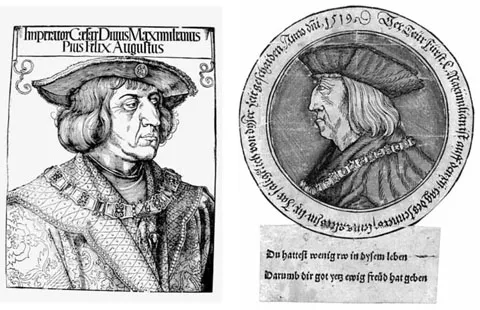
1.1 Two portraits of the Emperor Maximilian. The Habsburgs were not a handsome family, though the artistry of Albrecht Dürer could at least invest Maximilian with a certain majesty.
The passage of time had done much to obliterate the physical remains, if not the memory, of the Roman Empire; but the imprint of the Roman communications system had proved remarkably enduring. It would be the ghostly presence hovering in the background as medieval Europe gradually began to construct its own system of news and communication.
The Ghosts of Vindolanda
Like so much of what had been created during the Roman Empire, the Roman postal service was an achievement of breathtaking imagination and administrative ambition. The Roman road network had been designed to move large bodies of troops around a militarised domain that stretched from Spain to Germany and from Britain to Asia Minor. A high-speed courier service was an essential part of the information and administrative infrastructure that underpinned this system. Although much of the engineering work was in place under the Republic, the postal service itself only became fully established during the reign of Emperor Augustus.3 Couriers travelled by horse or by carriage. The main stage posts were established eight miles apart, with night quarters at every third stage. This suggests that a courier would normally progress at the rate of about 25 miles a day. Fifty miles would be possible if the news was especially urgent, but the journey would take a terrible toll on the messenger if the distance to be travelled was very large.
Normally a single courier would carry the message the entire length of the journey. In principle a relay of messengers could travel in greater comfort, but many messages were so confidential that they could only be entrusted to a particular individual. Very often the written message was little more than an introduction, confirming the credentials of the bearer; the substance would then be delivered verbally. The same messenger could then take back a reply. According to Suetonius, Augustus, who took a personal interest in the establishment of the post, also regularised the practice of dating letters, even to the exact hour, to document when they had been despatched.
The imperial postal service was created explicitly to serve the purposes of the vast Roman administrative machine. The upkeep of the service was extremely expensive, particularly after the development of more elaborate rest stations (mansiones), where travellers could find accommodation, stabling and a change of horses. The system was not generally open to the public. Yet the management of the Empire demanded the transport of a large quantity of military freight along the roads, alongside the express courier service, and it seems that this more mundane traffic provided plentiful opportunities for the citizens of the Empire, dispersed around the distant outposts, to maintain a surprising level of written communication.
The full extent of this can only be guessed at: most of the evidence has long since disappeared. But a glimpse into this lost world opened up quite recently, thanks to a remarkable find at Hadrian's Wall, near the northern British frontier of the Roman Empire. In 1973 a team of archaeologists was continuing routine excavations at Vindolanda, one of the military camp settlements adjacent to the wall. Excavating a trench they came across a mass of leather, textiles and straw, mixed with bracken and wood. Some of the wood was in small, thin fragments. When they inspected these slivers, it became apparent that these were covered in writing. What had been discovered were the first of nearly two thousand writing tablets, all written in ink on a wooden veneer – somehow miraculously preserved in the anaerobic soil of Northumberland.4
The wooden tablets found in this excavation have transformed what is known of the writing culture of the northern Empire. Britain was as far away as it was possible to be from the production centres of papyrus, the versatile reed that provided the cheapest and most abundant writing material in Roman times. Where papyrus was not available, officials used waxed wooden tablets, where notes could be inscribed in the wax. A large number of these were also found in the Vindolanda excavation, though with little or nothing still legible once the wax had disappeared. The slivers of wood discovered at Vindolanda, subsequently confirmed by other finds, reveal a whole new writing medium, and one open to a wide cross section of the general public. The tablets, now in the British Museum, preserve communications from over one hundred writers, from the local governor and his wife to relatively humble members of the garrison community.
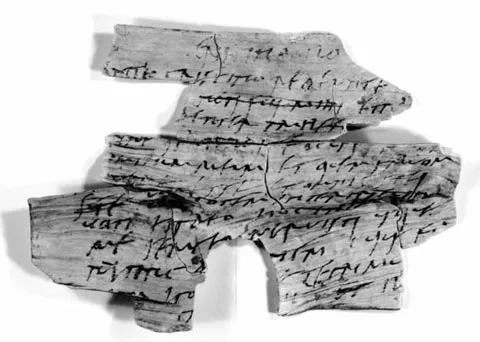
1.2 Fragments of a wooden writing tablet from Vindolanda. This contains the draft of a letter from a prefect of Vindolanda to a certain Crispinus.
The ghosts of Vindolanda are often no more than tiny and incomplete fragments of enigmatic and cryptic messages. Yet they reveal a writing community of depth and breadth even in a frontier outpost at the very edge of the Empire, manned, it should be remembered, not by Roman legionaries but by auxiliaries raised from other subject peoples. We do not know how widespread were the skills of reading and writing in the Roman Empire.5 But what can be inferred from the Vindolanda tablets is that even when societies were not highly literate, systems of government and administration could be built around the assumption that written communication was a normative means of conveying news.
The Romans were of course masters in the exercise of power. The creation of the imperial postal service reflected a recognition that the control of information, and the swift passage of vital news, was essential to the government of widely dispersed and thinly garrisoned possessions. Roman Britain was an archetype of the large province managed by an astonishingly small occupying force. It was only possible because the control of communications meant that a larger, irresistible force could swiftly be marshalled.
The Roman postal service died with the Empire, to be resurrected only by the equally ambitious German emperors at the turn of the sixteenth century. But the main lesson of the Roman communications network, that control of news was an essential attribute of power, was fully grasped in medieval Europe. We will see it reflected in the conduct of all three of the major power brokers in the medieval world: the Church, the State and the merchant class. All three would develop a vivid culture of news.
From the Cloister
The Church was one of the great estates of medieval Europe. Its institutions had played a crucial role in the preservation of learning after the collapse of the Roman Empire. Since membership of the clerical estate was essentially defined by literacy, it was inevitable that the clergy would be the designated record-keepers of early medieval society. As the Church consolidated its reach across the whole of western Europe, it would also be in the forefront in the transition from a culture where inherited wisdom was preserved by memory to one of written record.6 Not that the assumed superiority of writing would go entirely uncontested. In the various confrontations between secular and ecclesiastical power that erupted in the eleventh and twelfth centuries, lay folk were not always prepared to concede that verbal reports were any less authoritative than, as they put it, ‘words written on animal skins’.7 This well-turned insult drew attention to the rather unromantic origins of parchment, which was at this point the only abundantly available writing material. Parchment, made of the dried hide of sheep or calves, was a good, reliable and durable writing surface, but complex and expensive to prepare. The writing surface had to follow the irregular dimensions of the original hide, so notes were often written on thin slips cut from the edges. So for all but the most ceremonial purposes, such as a charter or treaty, there was a strong incentive to keep messages short. Often, as in Roman times, written communications would simply attest to the trustworthiness of the messenger, who could deliver the substance of the message verbally. Parchment could also be reused, but then important documentary information is often lost because a text has been scraped off and overwritten. This means that the information culture of the early medieval period often has to be reconstructed from very fragmentary remains.
Problems of this nature apply even to those at the very apex of medieval Europe's emerging news networks. The Cistercian monk Bernard of Clairvaux, for example, was one of the most distinguished voices of medieval Christianity. He was deeply involved in the major political and theological controversies of his day. He spoke out against the Cathars and the theologian Peter Abelard; he intervened freely in disputes over the election of bishops, and offered his counsels to the French king, Louis VI. Between 1146 and 1147 he preached passionately in favour of the Second Crusade. All of this required close attention to the maintenance of an active network of information, messengers and correspondence.
In the conditions of twelfth-century Europe this was by no means easy, but Bernard possessed one priceless advantage. As Abbot of Clairvaux, the mother house of an extensive network of monasteries, Bernard could call upon the assistance of a willing band of peripatetic and literate churchmen. A remarkable number of Bernard's letters survive – around five hundred – far more than for his contemporary (and rival) Peter the Venerable, Abbot of Cluny.8 These were just the visible remains of an information network that extended far beyond regular communications with Rome, even as far as Constantinople and Jerusalem. The maintenance of such a network was not without its challenges. As was the case with Roman couriers, the written communication was often little more than a letter of introduction, with the substance of the message intended to be conveyed verbally. Bernard would sometimes have to wait patiently for a suitable envoy who could be trusted to deliver a sensitive communication accurately. He was lucky that Clairvaux was a regular stopping place for numerous pilgrims and clerics on official business, situated as it was in prosperous Champagne, between Paris, Dijon and the Alpine passes.
Bernard was, by the standards of the time, exceptionally well informed. But there was still a large element of chance in the individuals who passed by and the news they brought. It was seldom possible to corroborate a report brought by a visitor – Bernard would have to make his own estimate of the reliability of the source. Many of those who brought news – of a disputed episcopal election, for instance – had their own axes to grind. If the news was important enough for Bernard to send his own messenger, it might be many months before he received a reply. Even a journey back and forth to Rome, the hub of Europe's most intensive traffic in information, might take up to four months, as the messenger inevitably had his own business to conduct, and might not be planning a return trip to Clairvaux. Contact with more occasional correspondents was even more sporadic. A complex negotiation, which required the passage back and...
Table of contents
- Cover
- Half Title
- Title Page
- Copyright
- Contents
- List of Maps
- Introduction: All the News that's Fit to Tell
- Part I The Beginnings of News Publication
- Part II Mercury Rising
- Part III Enlightenment?
- Notes
- Bibliography
- Index
- Illustration Acknowledgements
- Acknowledgements