This book is available to read until 15th November, 2025
- 360 pages
- English
- ePUB (mobile friendly)
- Available on iOS & Android
eBook - ePub
Available until 15 Nov |Learn more
About this book
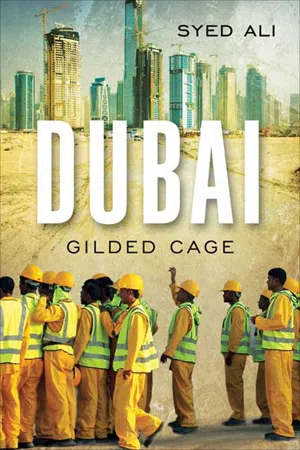
This revealing portrait of the famously wealthy Persian Gulf city investigates the human cost of its miraculous rise to global prominence.
In less than two decades, Dubai has transformed itself from an obscure territory of the United Arab Emirates into a global center for business, tourism, and luxury living. With astonishing skyscrapers and tax-free incomes, its rulers have made Dubai into a playground for the global elite while skillfully downplaying its systemic human rights abuses and suppression of dissent. It is a fascinating case study in light-speed urban development, massive immigration, and vertiginous inequality.
In Dubai: Gilded Cage, sociologist Syed Ali delves beneath the dazzling surface to analyze how—and at what cost—Dubai has achieved its success. Ali brings alive a society rigidly divided between expatriate Westerners enjoying opulent lifestyles on short-term work visas, native Emiratis who are largely passive observers, and workers from the developing world who provide the manual labor and domestic service needed to keep the emirate running, often at great personal cost.
"At last, a comprehensive expose of the economic and sexual exploitation that erected this utopia of greed. Syed Ali has seen the future in Dubai and it doesn't work." —Mike Davis, author of Planet of Slums
In less than two decades, Dubai has transformed itself from an obscure territory of the United Arab Emirates into a global center for business, tourism, and luxury living. With astonishing skyscrapers and tax-free incomes, its rulers have made Dubai into a playground for the global elite while skillfully downplaying its systemic human rights abuses and suppression of dissent. It is a fascinating case study in light-speed urban development, massive immigration, and vertiginous inequality.
In Dubai: Gilded Cage, sociologist Syed Ali delves beneath the dazzling surface to analyze how—and at what cost—Dubai has achieved its success. Ali brings alive a society rigidly divided between expatriate Westerners enjoying opulent lifestyles on short-term work visas, native Emiratis who are largely passive observers, and workers from the developing world who provide the manual labor and domestic service needed to keep the emirate running, often at great personal cost.
"At last, a comprehensive expose of the economic and sexual exploitation that erected this utopia of greed. Syed Ali has seen the future in Dubai and it doesn't work." —Mike Davis, author of Planet of Slums
Frequently asked questions
Yes, you can cancel anytime from the Subscription tab in your account settings on the Perlego website. Your subscription will stay active until the end of your current billing period. Learn how to cancel your subscription.
No, books cannot be downloaded as external files, such as PDFs, for use outside of Perlego. However, you can download books within the Perlego app for offline reading on mobile or tablet. Learn more here.
Perlego offers two plans: Essential and Complete
- Essential is ideal for learners and professionals who enjoy exploring a wide range of subjects. Access the Essential Library with 800,000+ trusted titles and best-sellers across business, personal growth, and the humanities. Includes unlimited reading time and Standard Read Aloud voice.
- Complete: Perfect for advanced learners and researchers needing full, unrestricted access. Unlock 1.4M+ books across hundreds of subjects, including academic and specialized titles. The Complete Plan also includes advanced features like Premium Read Aloud and Research Assistant.
We are an online textbook subscription service, where you can get access to an entire online library for less than the price of a single book per month. With over 1 million books across 1000+ topics, we’ve got you covered! Learn more here.
Look out for the read-aloud symbol on your next book to see if you can listen to it. The read-aloud tool reads text aloud for you, highlighting the text as it is being read. You can pause it, speed it up and slow it down. Learn more here.
Yes! You can use the Perlego app on both iOS or Android devices to read anytime, anywhere — even offline. Perfect for commutes or when you’re on the go.
Please note we cannot support devices running on iOS 13 and Android 7 or earlier. Learn more about using the app.
Please note we cannot support devices running on iOS 13 and Android 7 or earlier. Learn more about using the app.
Yes, you can access Dubai by Syed Ali in PDF and/or ePUB format, as well as other popular books in Social Sciences & Business General. We have over one million books available in our catalogue for you to explore.
Information
CHAPTER ONE
THE ROOTS OF DUBAI
DUBAI'S TRANSFORMATION INTO a brash, upstart global city has occurred in a breathtakingly short time. This was largely made possible by the aftershocks of 9/11 and the second Gulf War. But that is getting ahead of ourselves. Here I lay out the foundations of modern Dubai in its pre-9/11 incarnation and before it had acquired global cachet – its history as a trade and smuggling centre; the building of a tourist infrastructure where none reasonably should exist; and the short-term visa system that regulates how foreigners go about living their lives.
TRADE AND SMUGGLING
Dubai’s modern history dates to 1833, when eight hundred members of the Al Bu Falasah section of the ruling Bani Yas family of Abu Dhabi split off to settle in Dubai. The most important family of the Al Bu Falasah section was the Al Maktoum, from which all the rulers of Dubai have come. By the early part of the twentieth century, Dubai had established itself as the main trading centre of the region, a result of a crafty move by its ruler Sheikh Maktoum bin Hasher to lure Persian-Arab and Indian traders from the Persian port cities to Dubai with promises of no taxes, protection and land. The city developed very quickly, and in 1904 a German traveller noted that the sudden influx of traders from Persia was causing high commercial and residential rents along the creek, which handsomely profited the ruler and some merchants, a situation that greatly resembled Dubai just before the bust in late 2008.1
In the 1950s, after twenty-odd years of relative economic depression following the collapse of the pearl trade, which had been central to Dubai’s prosperity, Dubai witnessed an upsurge of commercial activity, a fair degree of it involving exports between India and Pakistan.2 At the time, relations between these newly independent countries were icy and direct trade was not possible, so goods had to go through a third party, which was Dubai.3 The most profitable aspect of trade with these countries was gold smuggling, indeed it was the most profitable endeavour in Dubai after the collapse of the pearl trade in the wake of the global Great Depression and before the discovery of oil. Gold would be bought in Geneva or London, imported duty free into Dubai, then smuggled to India or Pakistan. While the import and export of gold to and from Dubai was perfectly legal, importing within India and Pakistan was not – hence the use of the term ‘smuggling’.
The gold smuggling trade produced a class of relatively wealthy nationals, which included a who’s who of local citizen merchant families (not all the families were involved, but those that were are still prominent today) and expatriates, particularly of Indians and Iranians. Some Western expatriates were also involved as investors, but generally did not sully their hands directly and thus maintained an air of ‘respectability’.4 Most of the gold was shipped in fast, motorized dhows, some mounted with guns, and the dhow captains engaged in fantastic cat and mouse games with the Indian Coast Guard, often ending in gold being dumped into the Indian Ocean so as to avoid the authorities and sometimes in shootouts with deadly results. In the early 1970s, one smuggler supposedly had killed eighty-two Indian Coast Guard and naval personnel in his career.5 By the early 1970s Dubai was the third largest buyer of gold in the open market, and it was believed there were 130 sterling millionaires active in the gold smuggling trade.6
The gold smuggling trade largely came to an end in 1973. The price of gold at this time was rising dramatically, and quickly went beyond the reach of ordinary Indian families, the end purchasers of the smuggled gold. At the same time, Prime Minister Indira Gandhi cracked down on the smugglers’ agents in Bombay, imprisoning many of them. By June of that year imports of gold hit zero. While there was a minor revival in the late 1970s, the gold smuggling trade never fully recovered.7
While gold smuggling was a high risk/high profit venture and is the stuff that racier books are made of (such as Robin Moore’s 1977 novel, Dubai), more basic to Dubai’s economy from at least the early 1900s to today has been trade, licit and illicit, with Iran. The biggest boost to trade with Iran, and to Dubai’s prominence in global trade, was the Iranian Revolution in 1979. When the American hostages were taken in the US embassy, the United States immediately imposed economic sanctions against Iran. Trade that would have gone directly to Iran was then funnelled through Dubai. While merchants were beginning to profit from this, within the year the Iran–Iraq war started and lasted until 1988, causing great economic hardship for many merchants as a result of the slowdown of trade with Iran, Dubai’s main destination for exports. The war was a boon, however, for the dry docks which had just been completed in 1979, and for salvaging companies who would troll the waters for damaged boats and tow them back to the dry docks.8
The fortunes of Dubai’s merchants improved as the war wound down in 1988 and as the United States imposed a trade embargo with Iran in 1987 – which is still continuing. In spite of the embargo – or perhaps because of it – billions of dollars of goods produced by US-based companies find their way to Iran via Dubai, smuggled by dhows. The goods are often repackaged when they arrive in Jebel Ali Port or Port Rashid to avoid US government scrutiny, though some dhow captains do not bother.9
During the Bush Jr years, which coincided with Dubai’s second oil boom, trade with Iran increased further still, and the number of Iranians living in Dubai may have doubled. The deputy president of the Iranian Business Council of Dubai made the point that many Iranians would not be in Dubai if not for US policy. (It is difficult to assess how many Iranians live in Dubai because, aside from the lack of accurate data generally, many Iranians split their time between Dubai and Iran, so the line between Iranian residents and tourists is especially blurry.)
In large part the smuggling business today works because American companies openly flout US laws. A Middle Eastern analyst said, ‘I think a majority of these companies are well plugged-in in Washington. In DC they are given mixed signals, but they have more reason to believe that the US is not going to take any action against them. So they go ahead and do it.’10
The legal and illegal trade with Iran, India, Pakistan and elsewhere has largely been shaped by the fast development of infrastructure, which started in the late 1950s with Sheikh Mohammed’s father, Sheikh Rashid bin Saeed Al Maktoum. Rashid was keen to develop the city and its economy. The first step to this end was to dredge the creek, the city’s trading lifeblood, which had become so silted that at points it was possible for camels to pass across. The dredging was completed in 1959 and allowed for a greater volume of cargo in and out of the city. One year later Rashid opened an international airport in spite of initial opposition by the British, their colonial overlords.11
The improved creek attracted a great deal of shipping, much of it siphoned off from the neighbouring emirate of Sharjah, which up to this time had also been an important centre of trade, and whose creek had also been silting up. Within a few short years, Dubai’s creek was experiencing a ‘traffic jam’ and plans were made to supplement the creek, which serviced smaller vessels, with a new port that could attract bigger ships. In 1966 work was begun on Port Rashid, which initially had been planned with four berths but at the end of construction in 1971 had sixteen. This was followed five years later by construction of the massive Jebel Ali Port, one of the largest deepwater ports in the world, which on its completion in 1983 had sixty-six berths.
To complete these and other planned projects, a massive influx of workers was beginning to arrive, mainly from Pakistan and India, a necessary result of Rashid’s drive to develop Dubai at breakneck speed. Out of a population of 65,000 in Dubai in 1968, there were 20–25,000 Iranians, 12,000 Pakistanis and 8–10,000 Indians. The 1968 census listed 24,500 inhabitants as ‘economically active’, and more than a third in trades and services, of which a high proportion were merchants and most of the rest labourers.12 Rashid knew that many more expatriate workers were needed for the projects he envisaged, and they would require housing, which was in short stock at the time. To that end, early in the 1960s, he began building in new areas such as Karama and Satwa, with much of the construction being purposely built as low-income housing with buildings for the first time having water directly piped in and being supplied with electricity.13 Some of this housing still exists today with rents at levels far below market rate, though most of the buildings have either been torn down or are earmarked to be torn down to make way for luxury construction. In fact, the entire Satwa area was slated to be razed, but was spared, for the time being at least, as a result of the recession that hit in late 2008.
Dubai’s ascension in the 1980s and early 1990s as the region’s premier port allowed legitimate trade interests to greatly expand, but at the same time made it possible for all sorts of illegitimate transactions to occur as well, as we have just seen. Dubai became the Gulf’s money laundry, and home to various gangsters and terrorists in the process. These types of activity are really an extension of the smuggling trades that had been part and parcel of Dubai’s development. While it has not been shown conclusively that ruling family members have an active hand in any of these illicit activities, Dubai’s rulers have historically given them tacit approval by turning a blind eye in the interests of keeping commerce generally as free and uninterrupted as possible.
Before Dubai’s most recent boom, the smugglers, money launderers, gangsters and terrorists were largely connected with Iran, India or Russia, using Dubai as their safe haven. For example, Bombay’s number one gangster, Dawood Ibrahim, used Dubai as his home base to control his criminal enterprises in India. He came to Dubai in 1984 after being hounded out of Bombay by local police, and subsequently made a fortune as a gold smuggler, as smuggling, though on a much smaller scale than up to the early 1970s (as mentioned above), still proved profitable for some until the early 1990s, when India’s economy was liberalized and many trade restrictions and customs duties were reduced. Dawood operated quite openly in Dubai, holding lavish parties and owning a number of businesses. While in Dubai, he planned and executed a series of bomb blasts in Bombay, which killed over 250 people in March 1993, in revenge for the pogrom against Muslims which had happened just months before. The Indian government put heavy pressure on Dubai to extradite him, but the Dubai government allowed him and his gang to quietly leave for Pakistan. Even so, his lieutenants continued to do business from Dubai.14
Again, the point here is that Dubai’s positioning itself as a place of commerce, and making little in the way of judgement about commerce, has made it the preferred destination for merchants for more than a century. The type of merchandise has been of little concern to the rulers, so long as it does not adversely affect them. When it does, as with the case of Dawood Ibrahim, then the rulers act.
TOURISM
While Dubai has been an important trading centre since the early twentieth century, outside the region – that is, to the West – it was relatively unknown, even though it was indirectly ruled by the British and even though the discovery of oil had made it wealthy. Through the 1990s Dubai was an open space of beaches and desert, with a population of around 750,000 in 1999 largely concentrated on either side of the creek in Bur Dubai and Deira, with wealthier residents further south along the coast in Jumeirah, at the time a ‘suburban’ neighbourhood. In the 1990s, Sheikh Mohammed made a conscious decision to supplement oil revenues, which he and others knew would run out in short time. His father, Sheikh Rashid, had concentrated on improving Dubai’s position as a trading hub by dredging the creek and building two massive ports, as well as building the airport. Sheikh Mohammed continued this approach, further expanding Dubai International Airport (with a second airport close to Jebel Ali Port scheduled to be open in 2010), but added to this a focus on developing tourism, specifically through the creation and expansion of Emirates Airline, and by developing Dubai as a shopping destination. Dubai basically had to create tourism from scratch as there is little to ‘naturally’ attract tourists in terms of culture and history, aside from a small fort dating back to the late 1700s, which today is the site of the Dubai Museum. The museum is tellingly sparse, indicating perhaps a lack of any real interest by the authorities in a non-commercial venture, a theme we will return to shortly.
‘Fly Buy Dubai’
The first necessity for developing Dubai’s tourism industry was simply to get people to Dubai. To this end, Sheikh Mohammed authorized the creation of Emirates Airline, which was launched in 1985 with a USD 10 million loan from the Dubai government.15 It initially leased planes from Pakistan International Airline with just two daily flights to Karachi, but within a year it had added services to Delhi and Bombay – linking Dubai directly to its main sources of blue- and white-collar labour. By the end of the 1980s, Emirates had negotiated landing rights in Singapore, Germany, Hong Kong and the UK. By 1994, Emirates was flying to thirty-three cities, an impressive infrastructural base for the coming tourist hordes. By the end of the decade, it flew to forty-five cities on four continents. Emirates is incredibly profitable, having posted profits every year save one, supposedly without state subsidies, although they do benefit from cheap fuel and cheaper labour.16 Emirates further benefits to a large degree from geography, lying as it does at the intersection of Europe, Africa and Asia. While the newest planes can travel roughly ten thousand miles without refuelling (for example, from New York to Singapore, a nineteen-hour flight), making the need for layovers in international travel redundant, they are not yet that common, especially for connecting emerging markets such as Cairo to Shanghai.
Still, an airline is after all just an amenity and, no matter how new and luxurious the planes are, they do not guarantee that people will actually enter the country. In the 1990s, a mere twenty years removed f...
Table of contents
- Cover
- Title
- Copyright
- Contents
- Dedication
- Preface
- Introduction
- Chapter 1: The Roots of Dubai
- Chapter 2: Becoming a Global Brand
- Chapter 3: Iron Chains
- Chapter 4: Living in ‘FLY-By’ Dubai
- Chapter 5: Guests in Their Own Homes
- Chapter 6: Strangers in Their Own Land
- Chapter 7: This is the Future?
- Notes
- Select Bibliography
- Index