eBook - ePub
Available until 15 Nov |Learn more
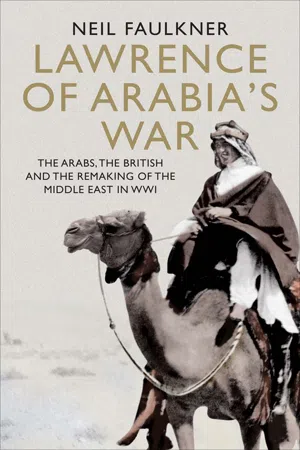
Lawrence of Arabia's War
The Arabs, the British and the Remaking of the Middle East in WWI
This book is available to read until 15th November, 2025
- 573 pages
- English
- ePUB (mobile friendly)
- Available on iOS & Android
eBook - ePub
Available until 15 Nov |Learn more
Lawrence of Arabia's War
The Arabs, the British and the Remaking of the Middle East in WWI
About this book
This radically new perspective on T. E. Lawrence, the Arab Revolt, and WWI in the Middle East provides essential insight into today's violent conflicts.
Archaeologist and historian Neil Faulkner draws on ten years of field research in the Middle East to offer the first truly multidisciplinary history of the conflicts that raged in Sinai, Arabia, Palestine, and Syria during the First World War. Rarely is a book published that revises our understanding of an entire world region and the history that has defined it. This groundbreaking volume makes just such a contribution.
In Lawrence of Arabia's War, Faulkner sheds new light on British intelligence officer T. E. Lawrence and his legendary military campaigns. He explores the intersections among the declining Ottoman Empire, the Bedouin tribes, rising Arab nationalism, and Western imperial ambition. Faulkner arrives at a provocative new analysis of Ottoman resilience in the face of modern industrialized warfare. This analysis leads him to reassesses the relative weight of conventional operations in Palestine and irregular warfare in Syria—and thus the historic roots of today's divided, fractious, war-torn Middle East.
Archaeologist and historian Neil Faulkner draws on ten years of field research in the Middle East to offer the first truly multidisciplinary history of the conflicts that raged in Sinai, Arabia, Palestine, and Syria during the First World War. Rarely is a book published that revises our understanding of an entire world region and the history that has defined it. This groundbreaking volume makes just such a contribution.
In Lawrence of Arabia's War, Faulkner sheds new light on British intelligence officer T. E. Lawrence and his legendary military campaigns. He explores the intersections among the declining Ottoman Empire, the Bedouin tribes, rising Arab nationalism, and Western imperial ambition. Faulkner arrives at a provocative new analysis of Ottoman resilience in the face of modern industrialized warfare. This analysis leads him to reassesses the relative weight of conventional operations in Palestine and irregular warfare in Syria—and thus the historic roots of today's divided, fractious, war-torn Middle East.
Frequently asked questions
Yes, you can cancel anytime from the Subscription tab in your account settings on the Perlego website. Your subscription will stay active until the end of your current billing period. Learn how to cancel your subscription.
No, books cannot be downloaded as external files, such as PDFs, for use outside of Perlego. However, you can download books within the Perlego app for offline reading on mobile or tablet. Learn more here.
Perlego offers two plans: Essential and Complete
- Essential is ideal for learners and professionals who enjoy exploring a wide range of subjects. Access the Essential Library with 800,000+ trusted titles and best-sellers across business, personal growth, and the humanities. Includes unlimited reading time and Standard Read Aloud voice.
- Complete: Perfect for advanced learners and researchers needing full, unrestricted access. Unlock 1.4M+ books across hundreds of subjects, including academic and specialized titles. The Complete Plan also includes advanced features like Premium Read Aloud and Research Assistant.
We are an online textbook subscription service, where you can get access to an entire online library for less than the price of a single book per month. With over 1 million books across 1000+ topics, we’ve got you covered! Learn more here.
Look out for the read-aloud symbol on your next book to see if you can listen to it. The read-aloud tool reads text aloud for you, highlighting the text as it is being read. You can pause it, speed it up and slow it down. Learn more here.
Yes! You can use the Perlego app on both iOS or Android devices to read anytime, anywhere — even offline. Perfect for commutes or when you’re on the go.
Please note we cannot support devices running on iOS 13 and Android 7 or earlier. Learn more about using the app.
Please note we cannot support devices running on iOS 13 and Android 7 or earlier. Learn more about using the app.
Yes, you can access Lawrence of Arabia's War by Neil Faulkner in PDF and/or ePUB format, as well as other popular books in History & Middle Eastern History. We have over one million books available in our catalogue for you to explore.
Information
CHAPTER 1
Holy War?
ON ABOUT 10 December 1913, a letter arrived for the two British archaeologists working on the Carchemish excavations in northern Syria. Would they be willing to join a survey expedition in eastern Sinai over the winter? As a subsequent letter from the chairman of the Executive Committee of the Palestine Exploration Fund explained:
The country, of which the survey is now to be taken in hand, is that south of the previous survey, up to the line of the Egyptian frontier, which extends from Rafa, on the Mediterranean coast about 20 miles south-west of Gaza, in a south-south-east direction, to the head of the Gulf of Aqaba … This country, notwithstanding its proximity to Palestine and Egypt, is but little known, and, though it has been crossed by travellers in certain parts, is to a great extent unexplored.
It was, in fact, a disconcerting cartographic lacuna, a triangle of uncharted land situated between that shown on the Palestine Exploration Fund’s maps of western Palestine and that on the Egyptian Survey Department’s maps of Sinai. The former had been surveyed in the 1870s, the latter more recently, following the British seizure of Sinai – a classic imperial land-grab – in 1906.1 War with Germany looked increasingly likely. The stance of the Ottoman Empire was uncertain. The security of Egypt and the Suez Canal was a vital British interest. The military needed comprehensive map coverage of what might soon become a theatre of operations. The problem was that the unmapped territory was on the Ottoman side of the frontier. Thus the invitation to the two British archaeologists, who were to be the academic cover for an essentially military survey. The real leader of the expedition would be Captain Stewart ‘Skinface’ Newcombe of the Royal Engineers.
Newcombe had anticipated a couple of elderly professorial types. When the pair turned up, he decided they looked about 24 and 18, and that his arrangements for their reception had been too polite: ‘undue deference ceased forthwith’.2 Whatever their ages (they were actually 33 and 25), they worked with professional efficiency, and an academic monograph – The Wilderness of Zin – later appeared. The authors suspected they were stooges, but remained hazy about details. ‘We are obviously only meant as red herrings, to give an archaeological colour to a political job,’ wrote one of them. The work had been gruelling – long days on camel-back, nights sleeping rough and a diet mainly, it seems, of bread and Turkish Delight. The older of the two, Leonard Woolley, found the going particularly hard. ‘Woolley is the more uncomfortable, since he is a flesh-potter,’ his companion explained in a letter to a mutual friend at the Ashmolean Museum. ‘I can travel on a thistle, and sleep in a cloak on the ground.’ The younger man seems to have relished the adventure. The work had also set him thinking: ‘It shows how easy it is in an absolutely deserted country to defy a government.’ So mused a young Oxford archaeologist called Thomas Edward Lawrence.3
* * *
The maps would be needed. A year after the British survey, in January 1915, eastern Sinai had become a routeway to battle: 25,000 Ottoman soldiers of the Canal Expeditionary Force were marching to the Suez Canal, intent on severing the British Empire’s jugular, rousing its Egyptian subjects to Holy War and restoring the sultan’s authority over one of his richest provinces. ‘I want to start an offensive against the Suez Canal to keep the English tied up in Egypt,’ the Ottoman War Minister Ismail Enver Pasha had explained to the man appointed to the command.4
The British had studied their maps and guessed that 5,000 men and 2,000 camels constituted the largest force that might be projected across the 150 miles of desert between Beersheba and the Suez Canal.5 Though it turned out to have been a gross underestimate, it reflected well enough the immense logistical challenge of desert warfare for large conventional armies.
The civilisations of the Nile had been divided from those of the Levant throughout most of human history by the desiccated liminal space of the Sinai Desert. On the map it is a wedge-shaped peninsula extending roughly 240 miles north–south and 120 miles along its base. It is bounded to the west by the Gulf of Suez, to the east by the Gulf of Aqaba and to the north by the Mediterranean. The northern zone comprises a narrow coastal plain, varying from 5 to 25 miles wide, formed largely of sand dunes, but with extensive tracts of salty mud-flat, especially near the coast, and numerous ‘hods’ (stands) of date-palms in the depressions between the dunes, where supplies of brackish water are available in pools, wells and cisterns. The central zone is a wider band of barren, stony, undulating plateau, much of it scrub-covered, rising in places to almost 1,000 metres. The southern zone is a great mass of high, rocky, precipitous, granite mountains, the highest of them, the Mount Sinai group, in excess of 2,500 metres.6
The essentials of desert warfare are water, supplies and mobility – in that order. Sinai in 1915 supported little more than occasional clusters of mud-walled houses around an ancient cistern and scattered encampments of nomadic Bedouin. So few were the native inhabitants of Sinai that the presence of the soldiers of the Canal Expeditionary Force probably doubled the population of the peninsula. The British assumption was that the emptiness of the desert, the hard going on its trackways and the ramshackle logistics of the Ottoman Army would preclude anything more ambitious than a large-scale raid. In fact, by the morning of 2 February, the Ottomans had got the 13,000 men of their advanced strike-force across the wilderness and into position for a direct assault on the canal. Then, mid-afternoon, the wind got up, a violent sandstorm blotted out the sun and, for the time being, military operations ceased.
* * *
Squinting into the dirty brown swirl of the sandstorm from trenches along the west bank of the canal near Tussum were the men of the 62nd and 92nd Punjabis, the 2nd Rajputs and the 10th Gurkhas – regiments of Indian Army sepoys belonging to an expeditionary force recently arrived to guard the link connecting the Raj to the British Isles. Faces were shrouded in flaps of turban and rifle breeches clothed in rags against the blizzard of sand. The defenders knew the enemy were close, but the sentries strained for sound of them in the howling wind.7
Along the 100-mile extent of the canal between Port Said and Suez there were about 30,000 men in total – 24 battalions of infantry, a cavalry brigade, a camel corps and four batteries of artillery. Except for some Egyptian gunners, virtually all were soldiers of the Indian Army. These had recently replaced European troops redeployed from Egypt to the Western Front. The newly arrived 42nd (East Lancashire) Division remained around Cairo, along with various other British, Australian and New Zealand units. Acclimatisation, re-equipment and training were still in progress; in any case, white soldiers were needed near the capital as an internal security force.8
Lacking the strength to defend any part of Sinai, the British had withdrawn behind the canal and were treating it as a defensive moat. It was a formidable obstacle, being 34 feet deep, between 65 and 100 yards wide, and with banks up to 30 feet above the water-level in places. Along some two-thirds of its length, moreover, effective assault was precluded by the presence of lakes.
The 25-mile northern sector between Port Said and Kantara (designated Section 3) ran along the eastern edge of Lake Menzaleh, a shallow but extensive sheet of salt water that would have hemmed in any attackers who succeeded in crossing the canal at this point. The previous November, moreover, the British had closed off this possibility, at least for the winter months, by flooding the low-lying Plain of Tineh on the eastern side of the canal. The southern sector (Section 1) was also difficult for an attacker. The Great Bitter and Little Bitter lakes extended for more than 20 miles, and the final 15-mile stretch of canal down to the sea at Suez passed through a relatively remote region. The logistics and risks involved in trying to bring a large force to bear against Section 1 were prohibitive.
It was the central sector, between Kantara and the Great Bitter Lake (Section 2), that was critical. Lake Timsah accounted for 7 miles of this 30-mile extent, and elsewhere the banks tended to be high and readily defensible. On the other hand, it was here that Ismailia was located, the strategically vital transport and water-supply hub of the entire defence system, and the line of approach from the east was direct, firm-footed and well watered.9 It was opposite Ismailia, then, that some 13,000 Ottoman soldiers of the strike-force massed on the night of 2/3 February, waiting for the sandstorm to pass over.
The coming battle – the first major clash of the war between the Ottoman and British Empires – was to be fought by the subject-peoples of the rival powers. The attackers were mainly Arab peasants conscripted from the villages of Syria, the defenders Punjabi, Rajput and Gurkha regulars from northern India. The Indians were volunteers, but they were fighting a white man’s war far from home. How would they fare amid the cross-currents of conflicting loyalties unleashed by the Great War? How, in particular, would Muslim soldiers of the British Raj view a war against fellow Muslims on behalf of their Christian rulers?
* * *
Suez was the narrowest stretch on the great maritime highway that linked the twin pivots of Britain’s global power: India and the homeland. But when the Government of India declared war on the enemies of the British Empire, it had elicited a less than enthusiastic response from many of its 300 million Indian subjects. For sure, pledges of allegiance and support flowed in from numerous official bodies set up by the British colonial regime, and John Buchan, the writer and wartime propagandist, was able to proclaim that the imperial mission was affirmed as India ‘took the world by surprise and thrilled every British heart’.10
The reality was more complex. Unqualified enthusiasm was restricted to a layer of privileged collaborators, men like the Maharaja of Rewa, who offered his troops, his territory, his private jewels, and ended an official letter with the words ‘What order has my King for me?’11 The majority of Indians in the villages and smaller towns probably knew little of the war and cared less. Their British overlords – jingoes like Buchan notwithstanding – were no doubt content that it was so: since the trauma of the 1857 Mutiny, the Government of India’s policy had been a combination of light touch and deliberate underdevelopment.12 Anything potentially destabilising was to be avoided. Indifference was the ideal.
But the Indian nationalists were now a sizeable minority, and among them the war evoked a more forthright response. Moderate nationalists – like Gandhi – urged support, but largely on the basis that military service would demonstrate good faith and qualify Indians for national independence. Radical nationalists, on the other hand, opposed it outright and saw Britain’s crisis as India’s opportunity.
The Congress Party, a middle-class nationalist organisation founded in 1885, had by now swelled into a mass movement against British rule, fuelled by anger over lack of support for native industry and racial discrimination in government employment. In 1907, a combination of state interference in the freedom of the universities and a decision to partition the ancient province of Bengal gave rise to a wave of nationalist agitation, causing Congress to split into moderate and radical wings, the former still seeking to negotiate change, the latter calling for immediate action.13
Rash Behari Bose emerged as a leading advocate of ‘propaganda of the deed’, arguing that ‘the commission of outrages’ would trigger ‘a strong desire … among the masses for open revolution’.14 A series of terrorist attacks culminated in an attempt on the life of the British Viceroy, Lord Hardinge, in December 1912. Hardinge and his wife were riding on a ceremonial elephant in a procession through the streets to mark the transfer of the imperial capital from Calcutta to New Delhi. A homemade bomb was hurled at their howdah and exploded behind them. Hardinge was injured across much of his back by fragments of metal. The gang of three assassins were later hunted down and executed.15
The main centres of radical nationalism were Bengal and the Punjab, and by the outbreak of war its primary expression was the Ghadar Party, a network of revolutionary groups organised around an illegal newspaper published abroad and smuggled into the country. Hardinge detected a sinister conspiracy to overthrow the Raj. Ghadar, in his view, was an ‘anarchist’ organisation whose ‘predominant plan is to reduce the province to chaos by the murder of police and officials’; it was, he claimed, ‘encouraged by a few crazy people in the United States and western Canada, and probably subventioned by Germany’.16 That German agents were active in India during the war is certain. At the end of 1915, Hardinge’s police exposed a conspiracy to launch a full-scale revolt, claiming ‘ample evidence that German assistance, financial and otherwise, has been given to agitators’.17
* * *
The British took the risk of Indian nationalist revolution very seriously. After the Mutiny – the central event of nineteenth-century Indian histor...
Table of contents
- Cover
- Half Title
- Title Page
- Copyright
- Contents
- List of Maps and Illustrations
- Note on the Text
- Acknowledgements
- Introduction
- 1 Holy War?
- 2 Young Turks
- 3 Little Mehmet
- 4 For Sultan and Caliph
- 5 Sinai Bridgehead
- 6 The Battle of Romani
- 7 The Arab Revolt
- 8 A Crusader, an Unknown Desert and a New Way of War
- 9 The Gates of Palestine
- 10 Aqaba
- 11 Bull Loose
- 12 The Railway War
- 13 The Third Battle of Gaza
- 14 Jerusalem
- 15 The Mountains of Moab
- 16 Special Operations
- 17 Armageddon
- Epilogue
- Endnotes
- Timeline
- Bibliography
- Index