“A marvelous slim book [that] weaves . . . ideas, facts, images, and histories into a whole about . . . the ecology of the manmade world.” —Rebecca Solnit
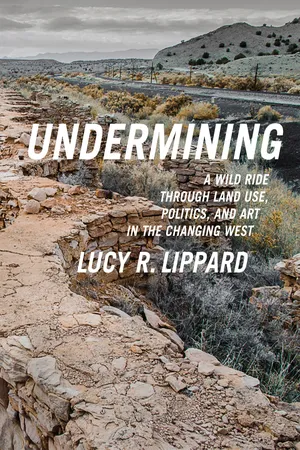
In Undermining, the award-winning author, art historian and social critic Lucy R. Lippard delivers “another trademark work” that combines text and full-color images to explore “the intersection of art, the environment, geography and politics” (Kirkus Reviews).
Working from her own experience of life in a New Mexico village, and inspired by the gravel pits in the surrounding landscape, Lippard addresses a number of fascinating themes—including fracking, mining, land art, adobe buildings, ruins, Indian land rights, the Old West, tourism, photography, and water. In her meditations, she illuminates the relationship between culture, industry, and the land. From threatened Native American sacred sites to the history of uranium mining, she offers a skeptical examination of the “subterranean economy.”
Featuring more than two hundred gorgeous color images, Undermining offers a provocative new perspective on the relationship between art and place in a rapidly shifting society.
“[Lippard’s] strength lies in the depth of [her] commitment—her dual loyalty to tradition and modernity and her effort to restore the broken connection between the two.” —Suzi Gablik, The New York Times Book Review
eBook - ePub
Undermining
A Wild Ride Through Land Use, Politics, and Art in the Changing West
- 240 pages
- English
- ePUB (mobile friendly)
- Available on iOS & Android
eBook - ePub
About this book
Information
Topic
ArtSubtopic
Art GeneralUNDERMINING

Gregory Sholette, Torrent, February 2013. Video installation, window of Printed Matter, artists’ bookstore in New York City, after its basement archive was flooded by Superstorm Sandy. “Books float, documents sink, and memories are laundered” (Photo: Matthew Greco).

Robert Dawson, Drying Rye Patch Reservoir, western Nevada, 1994, dye color print.

Edward Ranney, Cloud Terrace, Southern Creston, 2009. Petroglyph by Tano (Southern Tewa), Galisteo Basin, NM, c. 1300–1500. This stepped form, associated with life-giving rain and the cloud home of ancestors and deities, also appears in many of today’s Pueblo ceremonies, where women dancers often wear stepped headdresses.

Tom Martinelli, Cloud Terrace Graffiti, New York City, 2006.

Cloud Terrace, Galisteo Basin.

Peter Goin, Mushroom Cloud, 2001. This modern petroglyph from the Black Rock country of northern Nevada is by the eccentric artist DeWayne Williams, who decorated over a mile of roadside with engraved rocks, arranged artifacts, and pop culture monuments.
I LIVE IN ONE OF THE LOWER LEVELS OF A PIT, AN ARID ANCIENT seabed in northern New Mexico called the Galisteo Basin, where clouds of moisture circle the mountains and then ignore us, going on to other high places. The Tano (Southern Tewa) people lived “down country” for some five centuries (circa 1250–1782) in the eight huge pueblos scattered throughout the basin. Once two or three stories high, these impressive buildings are now pits and mounds of melted adobe covered by grass and cactus. In their ceremonies, the Tanos evoked clouds, rain, mountains, and springs—the underworld from which their people emerged and the heights where ancestors and deities awaited their prayers. They used gravel as mulch in their gardens to capture warmth and water for the crops.
Gravel—an aggregate formed by water—became the unlikely inspiration for this book, a collage of concerns about the ways humans intersect with nature in the arid Southwest. The humble gravel pit offers an entrance to the strata of place, suggesting some fissures in the capitalist narrative into which art can flow. The title, Undermining, has been attached to the project since its haziest inception: undermining literally—as in pits and shafts that reflect culture, alter irreplaceable ecosystems, and generate new structures; undermining’s physical consequences, its scars on the human body politic; undermining as what we are doing to our continent and to the planet when greed and inequity triumph; undermining as a political act—subversion is one way artists can resist. The elements play their part: earth (mining, land art, adobe, archaeology), air (breath, pollution, death), fire (global warming) and water (from above, stored below). Water and natural resources, and their unnatural exploiters—developers, along with the coal, uranium, gas, oil, gravel, and other industries—offer both vertical and horizontal images, wells and rain, underground aquifers, drilling equipment, mountain runoff, irrigation and ditches . . . and the kitchen sink.

John Ganis, Landscaping Stone, Flagstaff, AZ, 1995, chromogenic print. In a poem accompanying Ganis’s images, anthropologist Stanley Diamond writes: “A culture is its refuse. . . .” (See Ganis, Consuming the American Landscape. Stockport, UK: Dewi Lewis Publishing, 2003.) In this case, nature itself is the refuse, or product.
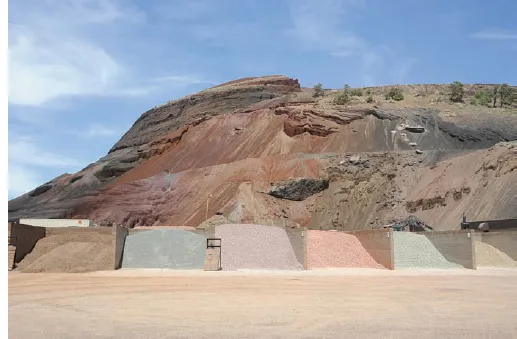
Center for Land Use Interpretation Photo Archive, Sheep Hill Cinder Cone, AZ, 2012. James Turrell’s nearby Roden Crater, a massive, experiential, sky-and light-viewing earthwork in a long-extinct volcano, has been in process in a similar cinder cone since 1979.
Gravel pits provide a dialectical take on the relationship between my own three-and-a-half decades in the Lower Manhattan activist/avant-garde art community and two decades in Galisteo—a tiny New Mexico village (population 250). An influential few years were spent part time in the foothills of the Colorado Rockies, where my maternal grandparents were raised, and where I began to explore indigenous pasts. And for three decades contemporary Native (American) artists have challenged many of my Yankee predispositions. Sometimes the tools I bring from a lifetime in and on the edge of the arts are pretty useless when confronting land use and abuse. During roughly twenty-five years in the western United States, I’ve learned a new vocabulary, or perhaps forgotten the old one. It’s a stretch to squeeze modernism, modernity, post-modernity, and the shifting mainstreams of the art world into the framework of my current lived experience, which is what I always work from. John Fraser Hart defined geography as “curiosity about places.” Once in the West, I began to write about “place” and landscape, encompassing history and archaeology. Eventually, thanks to growing involvement in local politics, I realized that “land use” could be a more realistic replacement for the too easily romanticized notion of “land” and “earth” as in landscape, land art, and earthworks. So this book is more concerned with land use than with landscape, more focused on what we learn from living in place than what we see when we look out the windows.

Peter Goin, Kiva N Complex, Chetro Ketl, 2000, Chaco Culture National Historical Park, NM. Chetro Ketl is the second largest of Chaco Canyon’s monumental “great houses,” built by Ancestral Puebloans from around 850–1200. It has some four hundred rooms, possible Mesoamerican architectural influences, and numerous kivas, or subterranean gathering places. This “great kiva” accommodated large numbers of people, possibly for periodic ceremonies involving the entire “Chaco world.”
Beginning with gravel pits and archaeology, I’m trying to see what art will finally fit in my baggage as I cross disciplines and wander further afield. Because of course I have baggage, and a lot of packing and unpacking to do as I travel the roads between local and global, rural and metropolitan, stopping at historical markers and the roadside attractions of photography and land art. Symbiotic pits and erections—riffs on the vertical reversed, negative and positive, ups and downs, past and present—kept emerging to form the grid (or conceit) on which this parallel visual/verbal narrative is constructed. The book is less about the many subjects covered as it is about the connections between them. The challenge is keeping the warps and wefts on the loom. My methodology is simple and experiential: one thing leads to another, as in life. Arthur Rimbaud put it more viscerally: “thought latching on to thought and pulling.”

Author’s longtime loft home in Lower Manhattan, 2013.

Galisteo, NM, 2013. A classic northern New Mexico juxtaposition: a nineteenth-century adobe ruin, a modernist rastra home (designed by Beverly Spears), and the author’s neo-traditional house in the right background (Photo: Ethan Ryman).
Cultural history and cultural geography are the operative factors here—the base for digressions into more technical information. I agonized about the role of statistics in this story, cutting them out, putting them back in. We are susceptible to the sea of numbers engulfing us, and they are, like maps, easily manipulated. Yet even in their volatility, they do convey the enormity of some of the problems our lands and people are confronting. So I have retained some—not as thorough or indisputable data so much as suggestions of what we are up against.

Peter Goin, Helms Gravel Pit, Sparks, NV, just north of the Truckee River, 1990. In 1987, a 250'-wide oil slick from a tank farm and railyard seeped into this 120'-deep gravel pit, preventing millions of gallons of oil from reaching the river. The oil companies paid for remediation but Helms went bankrupt. During the New Year’s Day flood of 1997, the Truckee River flowed into the pit, eroding and closing Interstate 80 for several days, but ironically facilitating the emergence of the Sparks Marina Park.
MY ACCIDENTAL PREOCCUPATION WITH GRAVEL PITS BEGAN in 2000 when I wrote an editorial in my community newsletter bemoaning the incursion of gravel mines west of our rural village. I was taken aback when the local earth mover—a progressive guy who’s also a painter and a skeptical environmentalist—reproved me. He said (in so many words): Hell, you used gravel for your road. Everybody wants gravel, but they don’t want gravel mines. Robert Baker [a friend’s pseudonym for an unpopular local gravel tsar] is a son of a bitch, but he’s our son of a bitch. If you’re going after gravel miners, take on Lafarge, a multinational gravel mining company. They’re taking over the American West, putting the locals out of business.
That was a surprise. I’d naively considered gravel pits, when I considered them at all, as the epitome of local enterprise. Mom and Pop have some otherwise unproductive land and a pickup, they need money, and they go for it. I’m told this is the way it used to be. Global takeovers are harder to imagine. Scale is a big issue, visually and economically, even in the once open-ended West. Most landscapes are actually designed by culture at the hands of anonymous amateurs who work by t...
Table of contents
- Cover
- Title Page
- Copyright
- Dedication
- Epigraph
- Contents
- Acknowledgments
- Undermining
- Notes
- Selected Readings
Trusted by 375,005 students
Access to over 1.5 million titles for a fair monthly price.
Study more efficiently using our study tools.
Frequently asked questions
Yes, you can cancel anytime from the Subscription tab in your account settings on the Perlego website. Your subscription will stay active until the end of your current billing period. Learn how to cancel your subscription
No, books cannot be downloaded as external files, such as PDFs, for use outside of Perlego. However, you can download books within the Perlego app for offline reading on mobile or tablet. Learn how to download books offline
Perlego offers two plans: Essential and Complete
- Essential is ideal for learners and professionals who enjoy exploring a wide range of subjects. Access the Essential Library with 800,000+ trusted titles and best-sellers across business, personal growth, and the humanities. Includes unlimited reading time and Standard Read Aloud voice.
- Complete: Perfect for advanced learners and researchers needing full, unrestricted access. Unlock 1.5M+ books across hundreds of subjects, including academic and specialized titles. The Complete Plan also includes advanced features like Premium Read Aloud and Research Assistant.
We are an online textbook subscription service, where you can get access to an entire online library for less than the price of a single book per month. With over 1.5 million books across 990+ topics, we’ve got you covered! Learn about our mission
Look out for the read-aloud symbol on your next book to see if you can listen to it. The read-aloud tool reads text aloud for you, highlighting the text as it is being read. You can pause it, speed it up and slow it down. Learn more about Read Aloud
Yes! You can use the Perlego app on both iOS and Android devices to read anytime, anywhere — even offline. Perfect for commutes or when you’re on the go.
Please note we cannot support devices running on iOS 13 and Android 7 or earlier. Learn more about using the app
Please note we cannot support devices running on iOS 13 and Android 7 or earlier. Learn more about using the app
Yes, you can access Undermining by Lucy R. Lippard in PDF and/or ePUB format, as well as other popular books in Art & Art General. We have over 1.5 million books available in our catalogue for you to explore.