This “thought-provoking” military history considers the influence of General Sherman’s Civil War tactics on American conflicts through the twentieth century (The New York Times).
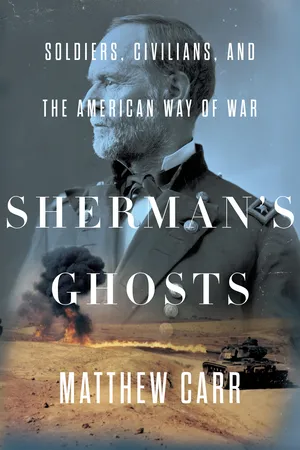
“To know what war is, one should follow our tracks,” Gen. William T. Sherman once wrote to his wife, describing the devastation left by his armies in Georgia. Sherman’s Ghosts is an investigation of those tracks, as well as those left across the globe by the American military in the 150 years since Sherman’s infamous “March to the Sea.”
Sherman’s Ghosts opens with an epic retelling of General Sherman’s fateful decision to terrorize the South’s civilian population in order to break the back of the Confederacy. Acclaimed journalist and historian Matthew Carr exposes how this strategy, which Sherman called “indirect warfare,” became the central preoccupation of war planners in the twentieth century and beyond. He offers a lucid assessment of the impact Sherman’s slash-and-burn policies have had on subsequent wars and military conflicts, including World War II and in the Philippines, Korea, Vietnam, and even Iraq and Afghanistan.
In riveting accounts of military campaigns and in the words of American soldiers and strategists, Carr finds ample evidence of Sherman’s long shadow. Sherman’s Ghosts is a rare reframing of how we understand our violent history and a call to action for those who hope to change it.
- 212 pages
- English
- ePUB (mobile friendly)
- Available on iOS & Android
eBook - ePub
About this book
Information
PART I
The March
1
The Iron Hand of War
When General P.G.T. Beauregard, the first commander of the newly formed Confederate Army, ordered the batteries at Charleston harbor to open fire on the U.S. Army garrison at Fort Sumter on April 12, 1861, few Americans on either side predicted the ferocity and duration of the conflict that was about to unfold. It was a moment that had often been imagined on both sides, not only because an “effusion of blood” was seen by Northerners and Southerners alike as the only means of resolving an abrasive political confrontation that had dragged on for decades, but also because many men and women on both sides had come to regard war itself as a beneficial and cathartic event. In July 1861, the Rome (Georgia) Weekly Courier hailed the “salutary influence of the war upon the popular mind in all the civil, moral, and social relations of life,” and predicted that it would have an uplifting and reinvigorating impact on an egotistical and materialistic Southern society.
Similar views were expressed in the North. In a lecture to the Alumni Society at the University of Pennsylvania in November 1861, the physician and professor of medicine Alfred Stillé described the “hideous features” of war as an antidote to the “progressive decline of national virtue” and the “national degradation” of the prewar years. Sounding more like an early-twentieth-century Italian futurist than a nineteenth-century physician, Stillé hailed the societies of the past whose creative energies had been released by “warlike engines,” in which the “flash, and blaze, and roar, and the tears of blood they wring from human hearts, prepare a harvest of heroic deeds, of soaring thoughts, of generous and humane sentiments . . . which raise a nation higher than before in the scale of mental and moral power.”1
Such romanticism was an indication of the prevailing concept of war in nineteenth-century America at the outbreak of the “War of the Rebellion” or the “War Between the States,” as it later became known in the South. Both sides anticipated a European-style war whose outcome would be decided by set-piece battles between orderly lines of uniformed armies, with cavalry charges and stirring demonstrations of élan.
Yet there were those on both sides who imagined a different kind of war. “I only pray God may be with us to give us strength to conquer them, to exterminate them, to lay waste every Northern city, town and village, to destroy them utterly,” wrote one Tennessee woman to a friend in May 1861. “All the means legitimate in civilized warfare must be freely employed,” declared the Chicago Tribune in April that year. “If necessary to burn, kill and destroy, let there be no hesitation. Temporizing is out of place, and, in the end, more destructive of life than vigorous and decisive measures.” That same month, a Boston preacher, Reverend Andrew Leete Stone, urged Union armies to “widen the streets through riotous cities” and “Raze the nests of conspirators with ax and fire. . . . Let the country burn this ulcer out.”2
Such views did not reflect the official position of the recently inaugurated administration of Abraham Lincoln, whose election the previous year had triggered the secessionist revolt. As the war unfolded, Lincoln remained initially committed to a policy of moderation and restraint that was intended to win back the population of the South to the Union through persuasion rather than coercion. The day after the fall of Fort Sumter, the president issued a call for 75,000 volunteers to “repossess the forts, places, and property which have been seized from the Union,” while simultaneously reassuring Southerners that these efforts would “avoid any devastation, any destruction of, or interference with, property, or any disturbance of peaceful citizens in any part of the country.”3
By “property,” Lincoln also meant that Southerners could keep their slaves—a concession that he was willing to make in order to woo ambivalent citizens and border states with large slave-owning populations from joining the Confederacy. By the time Sherman led his armies into Georgia three years later, Lincoln had reached very different conclusions, and American society had become familiar with a very different kind of war than the one that so many Americans had anticipated.
The Unwinnable War
The U.S. Department of Defense currently defines strategy as “a prudent idea or set of ideas for employing the instruments of national power in a synchronized and integrated fashion to achieve theater, national, and/or multinational objectives.” At the beginning of the Civil War, the respective “national” strategic objectives of the two sides were clear enough. In order to win the war, the Confederacy had to avoid losing it and sustain itself for long enough to obtain recognition from the major European powers and force the North to accept the existence of the Confederate States of America (CSA). To restore the Union, the Federal government had to invade the South and decisively defeat its armies. On paper at least, the North had more “instruments of national power” at its disposal to achieve these objectives. With a population of 20,275,000 whites, compared with 5,500,000 in the South, the Union would never run short of soldiers, and its factories and workshops would always be able to outproduce the largely agricultural South in terms of war matériel.
The balance of forces was not as unequal as it seemed. To subdue the South, the Union was obliged to conquer a vast territory of more than 750,000 square miles that included two distinct theaters of war more than a thousand miles apart in terrain often barely accessible, poorly mapped, or not mapped at all. In addition, the fact that the South had 4 million slaves at its disposal meant that virtually the entire white male population of military age was available to fight, while public support for the war in the North was often lukewarm and inconsistent. Whereas the Union was obliged to operate across extended “exterior lines,” the Confederate armies were fighting, for the most part, inside their own territory, in defense of their lands and homes.
At the beginning of the conflict, the U.S. Army consisted of just over sixteen thousand soldiers and naval personnel, in addition to volunteer state militias that could be called upon in times of national emergency, although the militias’ main priorities were the defense of America’s coasts and frontiers and the expansion of the Western frontier. Within a year, Lincoln’s “ninety-day men” had become a combined army and naval force of seven hundred thousand, while the CSA’s forces grew from a hundred thousand to just short of four hundred thousand. In total, approximately nine hundred thousand men served in the Confederate Army and nearly 2 million on the Union side in the course of the war.
American history provided no obvious strategic models for fighting a war on such a scale. Apart from the 1846–48 Mexican-American War, the army had not fought a major conflict since the War of 1812 against the British. The American officer class was steeped in European military strategies disseminated at West Point and other military academies, which emphasized the Napoleonic “decisive battle” and the principle defined by Antoine-Henri, Baron Jomini, the foremost exponent of Napoleonic military doctrine in the early nineteenth century, that “the best means of accomplishing great results was to dislodge and destroy the hostile army, since states and provinces fall of themselves when there is no organized force to protect them.”4 In the aftermath of Fort Sumter, the Union Army was commanded by General Winfield Scott, the seventy-five-year-old hero of the Mexican-American War, who proposed to defeat the South through a naval and land blockade that would “envelop” the Confederacy and cut its commercial links to the outside world.
Scott’s “Anaconda plan,” as the Northern press called it, was never formally adopted, though Lincoln did proclaim a blockade that became increasingly effective as the war wore on. Initially, however, the Confederacy was the more successful of the two protagonists; it was able to field a more effective and motivated army that quickly learned to equip itself by blockade running and rapid development of a homegrown armaments industry. In the summer of 1861, Lincoln’s volunteer army was routed at the First Battle of Bull Run, also called the First Battle of Manassas Junction, on July 21, 1861, fueling Confederate expectations that the Union would quickly fold.
Instead, the war continued to intensify as the two armies clashed repeatedly in the bloodiest battles ever fought on American soil. On April 6–7, 1862, at Shiloh, or Pittsburg Landing, 23,746 soldiers from both sides were killed in two days. In a single twelve-hour period on September 17, 1862, some 22,000 Union and Confederate troops were cut down at the Battle of Antietam Creek—the single most catastrophic day in all of America’s wars. At Gettysburg in 1863, the death toll was 43,000 over three days. Tens of thousands of soldiers died away from the battlefield, in field hospitals, army camps, and overcrowded prisoner-of-war stockades. In all, 623,026 soldiers and fighting men died, and 471,427 were wounded on both sides.
This death toll was even more shocking in that it had no obvious impact on the outcome of the war, as tactical victories failed to translate into strategic outcomes for either side. For the first two years, the North built its strategy on the conquest of the Confederate capital, Richmond, and Union armies made various skillfully executed incursions into Virginia that were thwarted by nimble Confederate generalship and the excessive caution of Federal commanding officers. Few Union generals were more inflicted with “the slows” than the gifted George B. McClellan, who replaced Winfield Scott as commander in chief of the Union armies in November 1861. In March 1862, the “Little Napoleon” took charge of the Army of the Potomac during the Peninsula Campaign. After an extraordinarily well-executed amphibious operation, which eventually placed some 120,000 Union troops south of the Confederate capital, McClellan was roundly defeated in late June and early July at the Seven Days Battles, and his army was forced to withdraw. Impatient with this progress, Lincoln appointed General John Pope as commander of the newly formed Army of Virginia to assist McClellan’s operations in Virginia and promoted General Henry W. “Old Brains” Halleck, the commander of the Department of the Mississippi, as overall commander in chief of the Union armies in McClellan’s stead.

Battles without victory: Confederate dead at Antietam, Alexander Gardner. Courtesy of the Library of Congress.
A dogged administrator and the army’s foremost military intellectual, Halleck proved himself to be no less ponderous as a field commander than his predecessor, but he nevertheless forged a crucial relationship with Brigadier General Ulysses S. Grant, commander of the Army of the Tennessee, that was to change the strategic direction of the war. In February 1862, Grant’s forces captured the key Confederate outposts of Fort Henry and Fort Donelson on the Tennessee and Cumberland Rivers, creating a springboard for further operations along the vital Mississippi waterway and into central Tennessee.
Grant’s ascendancy coincided with McClellan’s fall from grace. When Pope was defeated at the Second Battle of Bull Run, McClellan was reinstated to take charge of the defense of Washington. He was then sacked again in November for his failure to follow up his victory at Antietam; he was replaced as commander of the Army of the Potomac by Major General Ambrose Burnside. When Burnside launched his army into a bloody defeat at Fredericksburg, he too was replaced, by General Joseph “Fighting Joe” Hooker, who proved equally ineffectual against the armies of Lee and Thomas “Stonewall” Jackson at Chancellorsville in May 1863.
In June Lincoln appointed General George G. Meade as the Army of the Potomac’s fourth commander in less than a year; Meade repulsed the Confederate Army in the great Union victory at Gettysburg the following month. That same month, Grant captured the strategic fortress-city Vicksburg, on the Mississippi River, in a dazzling campaign that electrified the Northern public and established complete Union control over the Mississippi from Saint Louis to New Orleans. The fall of the Confederacy’s “Gibraltar” confirmed Grant as Lincoln’s foremost “fighting general” and shifted the focus of the war to the Western theater. In March 1864, Grant was promoted to lieutenant general and Union general in chief. By that time, the tide of war appeared to be moving irresistibly in the North’s favor. The South was now cut in half; Union armies had seized key enclaves on the Atlantic coast; and Union armies were advancing ever deeper into the Mississippi Valley and Tennessee. Yet despite these reversals, the Confederacy was far from defeated, and the inability of the two sides to achieve a decisive victory on the battlefield had begun to change the strategic direction of the war.
Beyond the Battlefield
The Civil War was an internal conflict between two groups of Americans, and it was also a relatively new kind of war whose implications were only just becoming apparent in the nineteenth century. “It was a war between the States, or better still, a war between two nations,” wrote the Georgia scientist and prominent proslavery theorist Joseph LeConte. “For each side it was really a foreign war . . . let it be distinctly understood, that there never was a war in which were more thoroughly enlisted the hearts of the whole people—men, women, and children—than were those of the South in this. To us it was literally a life and death struggle for national existence.”5
Such support was not as universal as LeConte and others imagined; the popular truism “a rich man’s war but a poor man’s fight” expressed a more ambivalent attitude toward the conflict among the Southern lower orders that its more fervent supporters rarely acknowledged. The North viewed the war in similarly existential terms. The violence of such wars tends to spill out beyond the battlefield, and the Civil War was no exception. The historian James McPherson has estimated that as many as fifty thousand civilians may have died of violence, hunger, and disease in sieges of towns and cities or punitive raids and reprisals by soldiers and guerrillas. During the siege of Vicksburg, women and children lived for weeks in snake-infested caves dug into the fortified hills, living on dogs, cats, horses, and rats during the daily artillery barrages from Grant’s armies. In the Shenandoah Valley in Virginia and in Missouri, Kentucky, and Tennessee, Federal troops and Union loyalists fought a vicious tit-for-tat war with Confederate guerrillas and bushwhackers, in which farms, towns, and villages were burned and their inhabitants made homeless or reduced to poverty and starvation. In the divided state of Missouri, Union troops and pro-Union irregulars, the Kansas “Jayhawkers,” traded blows with Confederate raiders in a war of reciprocal murder and atrocity in which the dividing line between civilians and combatants often disappeared.6 Thousands of fugitive slaves, or “contrabands,” died in the refugee camps established behind Union lines, which often lacked food, shelter, and basic sanitation.
The Civil War also exposed Americans for the first time to the environmental devastation of war. Forests were stripped and cut down to make breastworks, trench fortifications, and chevaux-de-frise or set on fire in the course of battles. Armies burned crops and slaughtered livestock to deny food to their opponents or reduce besieged cities to starvation. Entire districts in the South were laid waste by foraging Union armies, who burned and stripped barns and fences and consumed grain and livestock,...
Table of contents
- Cover
- Title Page
- Copyright
- Dedication
- Contents
- Introduction: From Georgia to FM 3-24
- Part I: The March
- Part II: Legacies
- Epilogue
- Notes
- Index
- About The Author
- Publishing in the Public Interest
Trusted by 375,005 students
Access to over 1.5 million titles for a fair monthly price.
Study more efficiently using our study tools.
Frequently asked questions
Yes, you can cancel anytime from the Subscription tab in your account settings on the Perlego website. Your subscription will stay active until the end of your current billing period. Learn how to cancel your subscription
No, books cannot be downloaded as external files, such as PDFs, for use outside of Perlego. However, you can download books within the Perlego app for offline reading on mobile or tablet. Learn how to download books offline
Perlego offers two plans: Essential and Complete
- Essential is ideal for learners and professionals who enjoy exploring a wide range of subjects. Access the Essential Library with 800,000+ trusted titles and best-sellers across business, personal growth, and the humanities. Includes unlimited reading time and Standard Read Aloud voice.
- Complete: Perfect for advanced learners and researchers needing full, unrestricted access. Unlock 1.5M+ books across hundreds of subjects, including academic and specialized titles. The Complete Plan also includes advanced features like Premium Read Aloud and Research Assistant.
We are an online textbook subscription service, where you can get access to an entire online library for less than the price of a single book per month. With over 1.5 million books across 990+ topics, we’ve got you covered! Learn about our mission
Look out for the read-aloud symbol on your next book to see if you can listen to it. The read-aloud tool reads text aloud for you, highlighting the text as it is being read. You can pause it, speed it up and slow it down. Learn more about Read Aloud
Yes! You can use the Perlego app on both iOS and Android devices to read anytime, anywhere — even offline. Perfect for commutes or when you’re on the go.
Please note we cannot support devices running on iOS 13 and Android 7 or earlier. Learn more about using the app
Please note we cannot support devices running on iOS 13 and Android 7 or earlier. Learn more about using the app
Yes, you can access Sherman's Ghosts by Matthew Carr in PDF and/or ePUB format, as well as other popular books in History & Military Biographies. We have over 1.5 million books available in our catalogue for you to explore.