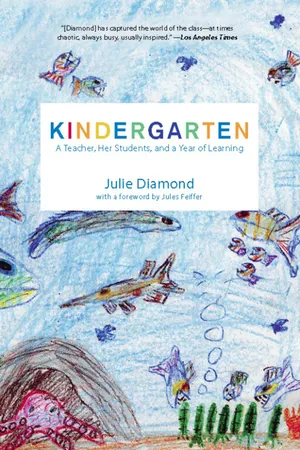
“[Diamond] has captured the world of the class—at times chaotic, always busy, usually inspired”— Essential reading for parents and teachers alike (Los Angeles Times).
Hailed by renowned educator Deborah Meier as “a rare and special pleasure to read,” Kindergarten explores a year in the life of a kindergarten classroom through the eyes of the gifted veteran teacher and author Julie Diamond. In this lyrical, beautifully written first-person account, Diamond explains the logic behind the routines and rituals children need to thrive. As she guides us through all aspects of classroom life—the organization, curriculum, and relationships that create a unique class environment—we begin to understand what kindergarten can and should be: a culture that builds children’s desire to understand the world and lays the foundation for lifelong learning.
Kindergarten makes a compelling case for an expansive definition of teaching and learning, one that supports academic achievement without sacrificing students’ curiosity, creativity, or development of social values. Diamond’s celebration of the possibilities of classroom life is a welcome antidote to today’s test-driven climate. Written for parents and teachers alike, Kindergarten offers a rare glimpse into what’s really going on behind the apparent chaos of a busy kindergarten classroom, sharing much-needed insights into how our children can have the best possible early school experiences.
“As a classroom insider, Diamond pulls back the curtain and allows parents and others a view of how an effective classroom actually works.” —Library Journal
“An extraordinary resource for parents and teachers at all stages. It is honest and masterful, engrossing and unique. And it is utterly real.” —Ruth Sidney Charney, author of Teaching Children to Care
- 386 pages
- English
- ePUB (mobile friendly)
- Available on iOS & Android
eBook - ePub
About this book
Information
Topic
Didattica1

August: Beginning the Year
Opening Up the Room
The rituals of beginning are very satisfying—the sense that I know how to do this. At the start of the day or the year—opening the door, looking around. Bare walls, empty floor. It’s my room, even today, with everything packed away.a
For the last thirteen years, I’ve taught kindergarten in the same classroom. My school year begins in late August, one week before teachers are officially due back. Ate breakfast with Linda, who’s teaching second grade this year. We didn’t talk about school, but about other things—her family, mine. The hallways are dark and quiet, although a number of other teachers are back. I open the classroom door; I use the wooden window pole to open all the windows. I plug in the fan, the radio, and the clock, set the clock to the right time, and hang it back on the wall.
This week is my own. Sometimes I just sit and look around the room, deciding what to do next. I move boxes and crates off the countertops, look in the closets for the coffee can in which I keep the “teacher pens.” Repeating these acts every August, opening up the room, I conjure up the teacher self I’d left behind in June, the person who occupies this classroom: I have to change back, from having what I see as my own life, to being the teacher. Beginning at this slow pace is a luxury, but an essential one. I’m relaxed: I forget how hard the job really is.
For the next week and a half, I get the room ready. Certain assumptions govern my thinking about the arrangement of the room: I want it to have a spare appearance, because the children’s work will fill it; I don’t want either the organization or decoration to be fussy and distracting. When children enter the room, I want them to feel—in their bones—this is their room. The room must be open enough to allow for a degree of flow of activities and materials, yet not so open that it erases all boundaries between areas. If the spaces work, the organization of the room will ground me, too.
The stages in getting the room ready are always the same: first, an empty floor with everything stacked on the countertops, then I spread things out. I pile stuff up on the tables and floor, wash the plastic baskets, bins, cubes, and block animals. I make a list of the areas of the room and the activities that children will be pursuing:
math
journals
writing folders? writing materials
science exhibit, science books
art
music?
games
blocks
pretend
rug and library
children’s tables
my chair and table.
journals
writing folders? writing materials
science exhibit, science books
art
music?
games
blocks
pretend
rug and library
children’s tables
my chair and table.
How will these fit in the room? Which areas should be adjacent, which separated? Although I’ve set up this room for years, I start by making a plan on paper. Certain activities demand to be in certain places: the rug and class library are in one corner; the block-building area gets the opposite corner; both need space and protection. Art activities near the sink. Shelves for plants go near the window. Where to put the rabbit’s cage, turtle tank, listening center? I build on last year’s plan, but change details, enlarging the science area this year: I add chairs and a bookcase just for science books. I want the science area next to the wall, so there’s a place for children’s science drawings. But when I change one thing, everything else has to shift.
From the hardware store, I get paint for the bookshelves and traps for the mice, who multiply over the summer. I paint the bulletin boards and bookshelves dark blue. I think about the functions of different pieces of furniture. A low table that borders the rug is used for writing, drawing, and puzzles, and children sit on it at meeting time. A low shelf, made from milk crates and a board, faces the block area and holds block accessories; it doubles as an extra table or bench for children playing in the adjacent pretend area, a space for their dramatic play. The shelves that separate the pretend area from the tables are open at the front and the back, permitting materials to be taken from either side.
I think about how children will move around the room. There’s more than one pathway to the rug, so it can be approached from different directions. Paper and writing materials are accessible in several places: there are paper trays, markers, and pencils in the art area and also on a set of shelves near the low table; there’s a basket with clipboards and writing pads in the pretend area; and later in the year, I’ll add index cards and markers to the block area. The organization of the room is simple and uncluttered; it is easily comprehended. I want the children to be able to read the environment, to find what they want, to know where to put things away. I move things and then switch them, and at various moments of indecision ask colleagues from down the hall to come in. They’ll see things with fresh eyes and give me good advice. I’m decisive about certain choices, when my reasoning is a result of my goals and my experience: I leave space around the rabbit cage, because I know children will want to sit or stretch out next to the cage. Finally, I put the rug down, move the last pieces of furniture into place, and the room is pulled together.
I search for the right-size basket to put materials in. The room should look good—balanced, colorful, appealing, with enough but not too much stuff—baskets of crayons, containers of markers, cans of sharpened pencils, paper in paper trays, games, some puzzles, a few tubs of brightly colored math and construction materials. In the block area, trucks, toy zoo animals, and Duplos; in the pretend area, dolls in newly washed doll clothes, trays with cups and saucers, and telephones. Baskets of books on the library shelves that rim the rug.
All that I add by way of decoration, along the walls at the back and front of the room, and on the bulletin boards on the coat closets, are large photographs from calendars: sea shells, parent and baby animals, reproductions of Amish quilts. No charts, posters, computer-generated pictures: nothing “cute.” In time, the room will reflect the children themselves, their interests and purposes. This is a place for children’s work; that’s the message. If we need a chart, later in the year, the text will be their words, and it will be illustrated with their drawings. In many classroom, walls and bulletin boards are plastered with charts and posters; the rooms are filled with images and text even before the children have arrived. If I’ve done a good job, the organization and simple decor of the room will be enough.
I’m committed to a definition of the classroom as laboratory, workshop. The room should function as a setting to “stimulate the active inquiry of the children themselves,” in the words of the twentieth-century British psychologist and educator Susan Isaacs.1 In order to study children’s social and cognitive development, Isaacs ran a school in Cambridge, England, in the 1920s. Her extensive daily records of children’s actions and talk, which form the heart of her books Intellectual Growth in Young Children and Social Development in Young Children, constitute perhaps the first qualitative school research project. Although Isaacs’s interest was theoretical, of great practical usefulness for educators are the sections in Intellectual Growth that describe the school’s environment and educational aims; these provide a vivid picture of what school can be.2
In this kind of classroom, the goal is the development of children’s intrinsic interests. The stuff that’s made available—the books, the science, math and art materials, the animals—as well as the organization of space that allows children to use the stuff, are intended not only to teach a specific bit of knowledge (rabbits are mammals, and mammals are born alive), but to give children perspectives on the world. Children arrive at their understandings through actions, through representations and discussion, undertaken as individuals and as a group, with the active participation of the teacher. If I believe this, the room will announce it, as much because of what it doesn’t have—its emptiness—as for what has been made available. It’s a stage set, waiting for the actors.
Names
On the way to school, Linda and I talk about this period of time before school starts. She says, Right now we know nothing; she’s “a blank slate”—because of not knowing these particular children. It’s all anticipation, all getting ready. Like the line in Hamlet, “Readiness is all.”
I get my class list from the office. Last name, first name, boy or girl, date of birth, ethnicity. I look at the list, struck by the mystery that these names represent. The first thing I do is rewrite the names in alphabetical order by first name. This is how I’ll write the names on my class list, and this is how I’ll see the names in my mind all year. Soon enough, a face and personality will go with each name. As I get to know the children, it will be impossible to imagine those names not associated with those personalities.
I’m always eager to get the class list. My future is there, in those names. I may know a name or two—siblings, whom I’d seen before as babies. But for the most part, the names are all I have. I rewrite them a second time, this time by month of birth, seeing how many “old” children I have, those born January through April, how many young ones, born September through December, and how many in the middle. From one year to the next, there can be great variation in how the birthdays are spread out: I remember one year when thirteen children—mostly boys—were born in September or later. Thirteen children (around half the class) who’d entered kindergarten at age four, and who—the boys, particularly—naturally loved rolling around; it was physically impossible for them to come to the rug without at least one tumble.
It’s intriguing to know the names but not the children. Some of them may not turn up (the no-shows), and I may get other children. As we get closer to the first day of school, I print the names on yellow oaktag. All these preparations, around a central core that’s missing: Getting the room physically ready, sharpening the pencils, labeling the cans. As I’m setting up the room, I’m aware of my state of mental readiness, of being, as Linda put it, a blank slate. Tolerating readiness. Tolerating, because anxiety is a component of this state. My dreams wake me with anxiety: school opens, and I’ve got eighty kids in the room; school opens, and the room is totally unready. But anxiety is part of not knowing, and not knowing is essential: I have to make a space, I have to not be my summer self—active, occupied with my own interests. Emptying myself, in a way. Being a blank slate is work, takes effort. I’m struck by Linda’s analogy. Traditional education pictures children as the slates, teachers doing the writing. If we’re receptive—to children, to what they bring to school—the relationship is reversed. We’re the slates, they do the writing. Just as I create a space in the room for the work children will do, I have to find it in myself.
This isn’t to say that I don’t prepare. I may be a blank slate, but I also leave nothing to chance. I carry with me whole textbooks of knowledge, everything I’ve done at the start of other school years, years of workshops, and everything I know about five-year-olds. I check my notebooks from previous years. I make decisions about what materials will be out, choosing some things that will probably be familiar to the children from nursery school (puzzles, play dough, games that are easy to play), and a few things that may be new (the math materials). I’m thoroughly, emphatically organized: I have plans, a schedule for the first few days; I get the materials ready. The books I choose to read the first week are simple and repetitive: a simple folk tale—The Three Billy Goats Gruff—or Little Blue and Little Yellow, with its theme of separation and reunion. I decide which songs and chants I’ll teach, choosing, again, something probably familiar from preschool (the fingerplay Open Them, Shut Them), and something that will probably be new (the chant Crackers and Crumbs). With all this in hand, I’m prepared to be flexible. I know that I don’t know exactly what will happen. During these days before school actually begins, before the kids appear, I carry around this absence in my mind. It starts when I get the names and only ends when I meet the children, when they come into the room with their parents, and I hear who they are and finally get to put faces to names.
Taking Time
On Saturday I go in for two hours of final chores, setting out seashells, sea glass, and a bird’s nest on trays on the science table, taping up a list of the supplies I’m asking parents for (tissues and liquid soap). I bring in a big pot of purple chrysanthemums and put it on a bookshelf by the window.
Teachers are officially due back on the Tuesday after Labor Day, the start of a week that allows no leisure. Staff meetings on Tuesday and Wednesday last all morning: A different week—mandatory, not voluntary. Each A.M. begins with hours of sitting and listening. Voices in the air. The meetings go on too long, and I resent them for taking time that I want to spend in my room. I stay late Friday, and go in Saturday, to do last-minute jobs—making a large masking-tape X across the block shelves and adding a sign, CLOSED, because the block area won’t be open right away. I don’t get everything done, and at some point, I just put everything extraneous out of sight.
I’m in bed early on Sunday night. But I can’t sleep; I’m no less anxious than the children probably are. It’s the first morning I’ll wake up with an alarm since June. In unconscious rebellion, I set the alarm for 6:45 instead of 6:15. I end up having to hurry to school. Teachers in the city system no longer have to punch a time clock, but time continues to impose itself. All year, the institutional timetable makes its demands: the children must be in the cafeteria at 11:05, out to the yard for dismissal at 2:45. Schools run on tight schedules: I try to arrive promptly at the classrooms of the teachers who give me “prep” periods. Being on time is a perennial struggle for me; on too many afternoons I’m the last teacher out at dismissal, once more apologizing to waiting parents and babysitters. It’s not just a time-management problem, but also a desire to give children the time for whatever they’re doing. When they’re productive and happy, I think, I’ll give them a few extra minutes. I often have the feeling—it’s something teachers complain about all the time, and I suppose nonteachers feel it too—there’s never enough time.
I want to give the children time to think, time to make decisions; to give them the same luxury that I took for myself in setting up the room. Just as I want to give them the floor space to stretch out in front of the rabbit’s cage, I want to give them time to develop an idea or project, time to develop friendships. I want time for myself to observe them, time to figure out what questions to ask.
The luxury of time is not, in fact, a luxury. It’s not only a practical need but a necessity required by the ultimate purposes of education. The relationship between classroom time and educational values is described by the Italian educator Carlina Rinaldi, writing about the educational philosophy of the municipal preschools of Reggio Emilia. An innovative approach to learning and teaching has been developed in these schools, one that has become well known to educators around the world: children and teachers essentially collaborate on extended explorations of subjects being studied. Looking at the principles behind the approach, Rinaldi states that “for a school to be a place of life, then it needs the time of life, and that time of life is different, for example, to the time of production.... In a school what is important is the process, the path we develop. The educational relation needs to be able to make time.... It needs empty time. It is . . . about having the courage to rediscover the time of human beings. [It is] not only . . . a right, but . . . a social and cultural value.”3
American educator Patricia...
Table of contents
- Title Page
- Dedication
- Foreword
- PERMISSIONS
- Acknowledgements
- Introduction
- 1 - August: Beginning the Year
- 2 - Routines and Rituals: Making the Room Theirs
- 3 - Collages: Making Art
- 4 - Finding Curriculum: A Study of Squirrels
- 5 - The Uses of Literacy: Constructing Knowledge
- 6 - The Uses of Literacy: Reading and Writing
- 7 - Midwinter Doldrums and Quarrels
- 8 - Welcome to the Aquarium: Knowing One Child
- 9 - June: Meanings and Metaphors at the End of the Year
- 10 - Postscript: Being a Teacher
- NOTES
- CHILDREN’S BOOKS CITED
- INDEX
- THE NEW PRESS TITLES OF RELATED INTEREST
- Copyright Page
Trusted by 375,005 students
Access to over 1.5 million titles for a fair monthly price.
Study more efficiently using our study tools.
Frequently asked questions
Yes, you can cancel anytime from the Subscription tab in your account settings on the Perlego website. Your subscription will stay active until the end of your current billing period. Learn how to cancel your subscription
No, books cannot be downloaded as external files, such as PDFs, for use outside of Perlego. However, you can download books within the Perlego app for offline reading on mobile or tablet. Learn how to download books offline
Perlego offers two plans: Essential and Complete
- Essential is ideal for learners and professionals who enjoy exploring a wide range of subjects. Access the Essential Library with 800,000+ trusted titles and best-sellers across business, personal growth, and the humanities. Includes unlimited reading time and Standard Read Aloud voice.
- Complete: Perfect for advanced learners and researchers needing full, unrestricted access. Unlock 1.5M+ books across hundreds of subjects, including academic and specialized titles. The Complete Plan also includes advanced features like Premium Read Aloud and Research Assistant.
We are an online textbook subscription service, where you can get access to an entire online library for less than the price of a single book per month. With over 1.5 million books across 990+ topics, we’ve got you covered! Learn about our mission
Look out for the read-aloud symbol on your next book to see if you can listen to it. The read-aloud tool reads text aloud for you, highlighting the text as it is being read. You can pause it, speed it up and slow it down. Learn more about Read Aloud
Yes! You can use the Perlego app on both iOS and Android devices to read anytime, anywhere — even offline. Perfect for commutes or when you’re on the go.
Please note we cannot support devices running on iOS 13 and Android 7 or earlier. Learn more about using the app
Please note we cannot support devices running on iOS 13 and Android 7 or earlier. Learn more about using the app
Yes, you can access Kindergarten by Julie Diamond in PDF and/or ePUB format, as well as other popular books in Didattica & Biografie nell'ambito delle scienze sociali. We have over 1.5 million books available in our catalogue for you to explore.