Conversations on sustainability, renewable energy, and other pressing issues: “A level of intellectual discussion all too absent in our national discourse.” —Booklist
A co-founder of Physicians for Social Responsibility, named one of the most influential women of the twentieth century by the Smithsonian Institute, Helen Caldicott presents a valuable collection of her interviews with prominent figures and environmentalists—in which she:
*Scrutinizes our unsustainable dependence on nuclear energy
*Explores how the United States could transition to renewable energy
*Raises awareness about issues such as deforestation and sea-level rise
Extending well beyond the scope of conventional environmental discussions, this book gives us Martin Sheen on grassroots movements and unionized labor; Chris Hedges on the costs of standing up for your morals; and award-winning actress Lily Tomlin on contemporary politics, in a sarcastic and witty exchange at once hilarious and inspiring—and also includes interviews with Maude Barlow, Bill McKibben, Jonathan Schell, Daniel Ellsberg, Lester Brown, Frances Fox Piven, Bob Herbert, and more.
“A treasure trove of anecdotes featuring high-profile politicians, academics, and celebrities . . . Surprising statistics about nuclear waste storage, rising sea levels, and military spending serve as an alarm, but Caldicott and her collaborators also offer many innovative solutions.” —Publishers Weekly
“God bless Helen Caldicott.” —Los Angeles Times
eBook - ePub
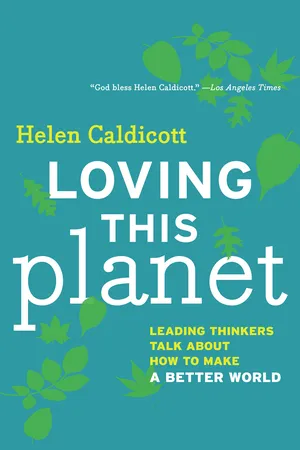
Loving This Planet
Leading Thinkers Talk About How to Make A Better World
- 269 pages
- English
- ePUB (mobile friendly)
- Available on iOS & Android
eBook - ePub
About this book
Information
JANETTE
SHERMAN-NEVINGER
Dr. Janette Sherman-Nevinger, a specialist in internal medicine and toxicology, is the author of the books Life’s Delicate Balance: Causes and Prevention of Breast Cancer and Chemical Exposure and Disease: Diagnostic and Investigative Techniques. She is a contributing editor of the book Chernobyl: Consequences of the Catastrophe for People and the Environment. Janette Sherman has been an adviser to the National Cancer Institute on breast cancer and to the Environmental Protection Agency on the Toxic Substance Control Act and on pesticides. She was an adjunct professor at the Environmental Institute at Western Michigan University and a research associate and lecturer with the Radiation and Public Health Project. She is a resource person, adviser, and speaker for universities and health advocacy groups concerning cancer, birth defects, pesticides, toxic dump sites, and nuclear radiation.

HELEN CALDICOTT: I read the Chernobyl book. It’s extremely important; over five thousand scientific and medical papers have been interpreted. Would you give us a history of the way the nuclear industry, the International Atomic Energy Agency, and the World Health Organization have really not told the truth about data, nor explored what’s happened to the people in Europe, Russia, Belarus, and Ukraine, etc., post-Chernobyl?
JANETTE SHERMAN-NEVINGER: The WHO and the IAEA covered only articles written in English when they came out with a report saying there really wasn’t that serious a problem from Chernobyl. What has happened, however, was that Alexey Yablokov, who was an adviser to Gorbachev and Yeltsin and was instrumental in getting the nuclear testing stopped, and Vassily Nesterenko, who was head of the Ukrainian nuclear department, started collecting articles on Chernobyl. They collected something like thirty thousand. The five thousand they translated and abstracted are in the book that was recently published by the New York Academy of Sciences and Wiley-Blackwell, and these show an entirely different story than what the WHO and IAEA came out with. These articles were written by people on the ground who witnessed Chernobyl, largely the people from Belarus, Ukraine, and Russia, and also quite a few articles from Europe, Greece, and a few from the United States. They put together what they were seeing. These people were from various fields—social scientists, physicians, nurses, statisticians, epidemiologists—and when you look at the total picture from these many articles you’ve got a pattern of injury and environmental degradation.
HC: First of all, let’s talk again about the relationship between the International Atomic Energy Agency and the World Health Organization, both of which are UN organizations. Why have they obscured the data and not looked at articles that were not written in English?
JSN: WHO and the IAEA have an agreement, which they signed in 1959, requiring each of them to get the approval of the other before they can release any information.
HC: Information about nuclear accidents?
JSN: Yes, nuclear accidents or the effects of nuclear accidents, nuclear radiation.
HC: Can you explain the philosophical morality, if you will, or amorality, of this agreement, and the fact that they have really never examined the profound medical consequences of the worst nuclear power accident in the world?
JSN: I don’t think very many people have actually addressed it or looked at the agreement. Yablokov and his associates did. Rosalie Bertell has in the past, but very few people have evidently looked into it and questioned it.
HC: So it’s imperative that we get this information out. As an epidemiologist, a toxicologist, and a specialist in radiation biology, first of all let’s talk about the “liquidators.” Tell us what liquidators were, what they did, what they are exposed to, and the medical consequences of that work that they did.
JSN: The liquidators were young men and women who were conscripted across the old Soviet Union and invited in by other countries. These young people worked directly on Chernobyl after the explosion to try and contain the radiation and the accident. Unfortunately, now, twenty-four years later, 80 percent of them are sick, and many have died. About 25 percent of the eight hundred thousand liquidators have died, and it’s a tragedy.
HC: What have they died from?
JSN: All kinds of diseases: cancer, heart disease, pulmonary disease, brain damage. We’ve heard for years that radiation causes cancer and birth defects, but also the radioisotopes that were ingested by these young men and women, or inhaled, damaged the interior of their blood vessels, causing heart disease, and were transported to the brain, causing brain disease and, essentially, caused diseases throughout their bodies. The liquidators have had terrible health outcomes, as have their children.
HC: What are we seeing in their children?
JSN: We’re seeing small birth weights, small head sizes, small chest sizes, mental retardation, and chronic ill health.
HC: Would that be a result of the ova and sperm being radiated and damaged before the babies were conceived?
JSN: Yes. There was lots of radiation in the bodies of these people. They left the site and went back to their hometowns, and they carried with them big doses of radiation.
HC: So many of those radioactive elements would have crossed the placenta into the developing fetus?
JSN: They certainly could have.
HC: Can you describe what the eight hundred thousand liquidators were asked to do? That’s nearly a million people who were brought in, and there had to have been intensely radioactive material lying around the site.
JSN: They were doing cleanup work, welding, doing concrete work. They tried to cover the Chernobyl reactor with as much concrete and all the materials that they could, but twenty-four years later they’re still talking about building a sarcophagus, a big metal dome over the top of Chernobyl. These workers were called in to work while the reactor was extremely radioactive.
HC: And extruding huge amounts of radiation as they were there. I believe that that reactor is still in trouble, because the remediation was so inexact and done so fast, with a sense of urgency. There is still a possibility that the Chernobyl reactor could have a meltdown again.
JSN: Let us hope not. Even if they get the reactor covered, we will have to be concerned about the bottom of the reactor, which they can’t cover and which is leaking.
HC: Leaking? Into the water supplies? Leaking radiation?
JSN: Yes, of course.
HC: Then there are the helicopter pilots who dumped 6,720 tons of lead onto the reactor to try and stop the reaction from proceeding, the fission reaction. Were those helicopter pilots followed up with about health consequences in later years?
JSN: I’m not aware of any follow-up with the helicopter pilots. I do know that the lead that they dropped on the reactors landed on top of this extraordinarily hot radioactive mess and became vaporized along with the radioactive isotopes, so it was not only giving off radioactive materials, it was also giving off lead, which added to the poisoning of the whole area.
HC: In your Chernobyl book you write that lead can synergize or aggravate or potentiate the effects of radioactive materials in the body. Is that correct?
JSN: You’re absolutely correct, yes.
HC: There is a thing called acute radiation illness, which we as physicians didn’t know about until the bombs were dropped upon Hiroshima and Nagasaki. Would you describe the symptoms of acute radiation illness, what sort of radiation levels cause it, and therefore how many people died in Europe, Belarus, Ukraine, and Russia as a result of that acute initial dose of radiation?
JSN: I don’t think we know the entire number of those who died very soon after. Certainly the control operators, there were several of them who died very quickly. The main thing that occurs is the complete depression of a person’s bone marrow, so they get bleeding and infection. It’s really quite a rapid death. But the thing I think is most important is the chronic low doses of radiation to which so many were exposed.
HC: People usually only talk about cesium 137, and about 40 percent of the European landmass is still contaminated with it, which lasts for about 300 to 600 years and is very carcinogenic. But so many other elements escaped and were measured, in fact, all around the northern hemisphere, including: silver 210, which has a half-life of 250 days; chlorine 36, with a half-life of 30,000 years; technetium 99, with a half-life of 23,000 years; and plutonium. A lot of plutonium got out, which has a half-life of 24,400 years. I could go right down the list, describing the radioactive iodine and all sorts of other terribly dangerous things. In other words, the whole inventory of radioactive materials escaped from Chernobyl, some short-lived and some very long-lived. Would you like to extrapolate on that?
JSN: The issue with this is the half-life. It takes about ten half-lives for an isotope to completely decay, so if you have a thirty-year half-life you multiply that by ten years, and we’re talking about three centuries. Not only do we worry about the physical half-life of these isotopes, but one of the big issues is that they are brought down with rain and snow, go into the soil, the trees, and the plants, which absorb the isotopes, carry them back up the trees to the leaves, or in the plants to the leaves of the fruit and vegetables; the leaves fall again, they’re highly radioactive, and then, of course, it rains and snows on them, and the isotopes go back into the soil, and then are picked up again by the plants. You have a biological recycling of these isotopes. Then, if there are forest fires, you have to worry about the transport of...
Table of contents
- Cover
- Title Page
- Dedication
- Copyright
- Contents
- Introduction: Delivering the Message to Love This Planet
- Maude Barlow
- Bill McKibben
- Lester Brown
- Janette Sherman-Nevinger
- Hugh Gusterson
- Chris Hedges
- Diane Curran
- Vini Gautam Khurana
- David Krieger
- Carole Gallagher
- Jonathan Schell
- William Hartung
- Michael T. Klare
- Daniel Ellsberg
- Antony Loewenstein
- John Church
- Rhett Butler
- Martin Sheen
- Arjun Makhijani
- Lily Tomlin
- Michael Madsen
- Bob Herbert
- Frances Fox Piven
- Denis Hayes
- Phil Radford
- Celebrating 20 years of Independent Publishing
Trusted by 375,005 students
Access to over 1.5 million titles for a fair monthly price.
Study more efficiently using our study tools.
Frequently asked questions
Yes, you can cancel anytime from the Subscription tab in your account settings on the Perlego website. Your subscription will stay active until the end of your current billing period. Learn how to cancel your subscription
No, books cannot be downloaded as external files, such as PDFs, for use outside of Perlego. However, you can download books within the Perlego app for offline reading on mobile or tablet. Learn how to download books offline
Perlego offers two plans: Essential and Complete
- Essential is ideal for learners and professionals who enjoy exploring a wide range of subjects. Access the Essential Library with 800,000+ trusted titles and best-sellers across business, personal growth, and the humanities. Includes unlimited reading time and Standard Read Aloud voice.
- Complete: Perfect for advanced learners and researchers needing full, unrestricted access. Unlock 1.5M+ books across hundreds of subjects, including academic and specialized titles. The Complete Plan also includes advanced features like Premium Read Aloud and Research Assistant.
We are an online textbook subscription service, where you can get access to an entire online library for less than the price of a single book per month. With over 1.5 million books across 990+ topics, we’ve got you covered! Learn about our mission
Look out for the read-aloud symbol on your next book to see if you can listen to it. The read-aloud tool reads text aloud for you, highlighting the text as it is being read. You can pause it, speed it up and slow it down. Learn more about Read Aloud
Yes! You can use the Perlego app on both iOS and Android devices to read anytime, anywhere — even offline. Perfect for commutes or when you’re on the go.
Please note we cannot support devices running on iOS 13 and Android 7 or earlier. Learn more about using the app
Please note we cannot support devices running on iOS 13 and Android 7 or earlier. Learn more about using the app
Yes, you can access Loving This Planet by Helen Caldicott in PDF and/or ePUB format, as well as other popular books in Politics & International Relations & Environment & Energy Policy. We have over 1.5 million books available in our catalogue for you to explore.