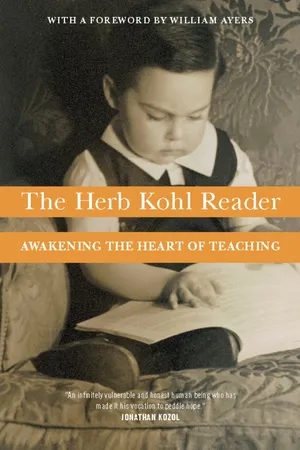
The best writing from a lifetime in the trenches and at the typewriter, from the renowned and much-beloved National Book Award–winning educator.
In more than forty books on subjects ranging from social justice to mathematics, morality to parenthood, Herb Kohl has earned a place as one of our foremost “educators who write.” With Marian Wright Edelman, Mike Rose, Lisa Delpit, and Vivian Paley among his fans, Kohl is “a singular figure in education,” as William Ayers says in his foreword, “it’s clear that Herb Kohl’s influence has resonated, echoed, and multiplied.” Now, for the first time, readers can find collected in one place key essays and excerpts spanning the whole of Kohl’s career, including practical as well as theoretical writings.
Selections come from Kohl’s classic 36 Children, his National Book Award–winning The View from the Oak (co-authored with his wife Judy), and all his best-known and beloved books. The Herb Kohl Reader is destined to become a major new resource for old fans and a new generation of teachers and parents.
“Kohl has created his own brand of teaching . . . [He is] a remarkable teacher who discovered in his first teaching assignment that in education he could keep playing with toys, didn’t have to stop learning, and could use what he knew in the service of others.” —Lisa Delpit, The New York Times
“An infinitely vulnerable and honest human being who has made it his vocation to peddle hope.” —Jonathan Kozol
- 339 pages
- English
- ePUB (mobile friendly)
- Available on iOS & Android
eBook - ePub
About this book
Information
Topic
PedagogíaSubtopic
Educación generalPart I
Becoming a Teacher
The selections in Part I focus on my personal journey and how it led to my becoming a lifelong educator. This part also focuses on the more specific question of how one learns on the job to teach well, and how an understanding of teaching and learning develops through classroom practice. This is not to say that teacher preparation is irrelevant, but very little one does at teachers college is useful in facing one’s own classroom of children who are initially strangers.
For that reason, teacher knowledge evolves through teaching and from direct involvement with individual students. Every classroom is a miniature social world set in family, community, cultural, social, and historical contexts. Managing the complex life within the classroom and creating a convivial learning community in which everyone participates willingly is a formidable challenge. It took me from three to five years to feel comfortable with my teaching style, with authority and discipline in the classroom, and with the adaptation and creation of curriculum that is challenging, exciting to students, and comes up to high standards of learning.
In addition to mastering these aspects of teaching, I found myself having to learn about the parents of my students, the community, and the complex social and historical influences on everyday practice. Certainly this is a lot to demand of a young teacher, and the narratives in this part of the reader make it clear what a struggle it is to become a good teacher. But what I hope to convey above and beyond the difficulty of learning to teach well is a sense of the wonderful rewards of facilitating children’s growth and earning their respect, admiration, and affection. When I first entered teaching, I felt I was embarking on a privileged and honored vocation. Now, many years later, I feel that there is no more rewarding way I could have spent my life.
The first selection in Part I is from an essay I wrote in order to help myself understand how my passion to become a teacher developed. It also illustrates how my love of storytelling became a central part of my teaching repertoire.
The second selection talks about my early teaching experiences at a school for the emotionally disturbed and as a substitute teacher in the New York City public schools. What I tried to do in telling stories about these experiences is to share aspects of becoming a teacher that I think other people, setting out on teaching careers even now, forty years later, can relate to and learn from.
The third selection is from perhaps my most well known book, 36 Children. The book is about my first full year of having my own class, teaching thirty-six children in a public school built in 1898 and perhaps not repaired since. In that environment of falling plaster and leaking windows, having only thirty-five desks for my thirty-six students, I worked about twelve hours a day, within the classroom and at my apartment, to be of use to my students. The students did creative and complex work beyond my imagination and also taught me that even in a failing school in a poor and depressed community, great achievement and creativity can emerge. I also learned about the intelligence and resilience of the students and their parents and about the strengths their African American heritage provided them when it was recognized and respected in the classroom. It was during that year that my marriage with education was consummated. During that year, I also met my wife and got married. It was a year of dual blessings.
The final selection, from my career autobiography The Discipline of Hope, jumps about thirty years ahead and is an illustration of one of the bolder integrated programs I developed. I hope it shows that I did learn some things over the years. I know I am still learning.
THE TATTOOED MAN: CONFESSIONS OF A HOPEMONGER
From “I Won’t Learn from You”: And Other Thoughts on Creative Maladjustment
It was in November or December of 1949, in the early afternoon, about one-thirty or two, just when the grey Bronx dusk of early winter reminded me that asthma was only a few hours away. My afternoons those days were overpowered by fear of an attack, the same fear that brought on the attacks. Seventh-graders had to go to the library for a lesson on the Dewey decimal system. We all followed along, paying no attention to Mr. Robertson, who was probably drunk as usual. He wasn’t in a rush either—going to the library meant one less teaching period for him.
The librarian went on about numbers and indexes, and talked about how wonderful reading was, or something. I was lost studying the nuances of my anxiety, wondering why it was worse this time of year, so bad sometimes that I almost cried on the way home from school. Those days anxiety and asthma settled around me like river fog, and I had no language or concepts to understand them.
Our assignment was to find a book, any book, return to our places at one of the tables, and fill out the Dewey decimal number, title, author, and some other information. Another walk-through assignment. I went to a shelf in the farthest corner of the room and picked a book at random: The Tattooed Man by Howard Pease, an intriguing title stolen from my dreams and an author whose name was foreign and mysterious, not Jewish or Irish or Italian, but what? Where do people get such names? Pease and the tattooed man were equally intriguing. I knew tattooed men and masked men and invisible people. I read the subtitle, A Tale of Strange Adventures Befalling Tod Moran, Mess Boy of the Tramp Steamer “Araby,” Upon His First Voyage from San Francisco to Genoa, via the Panama Canal, thinking of my own fantasies and dreams, my personal twists on the heroes and heroines that I followed on radio and in comic books.
My attention wandered back to the table, to Dewey decimal numbers, only instead of filling out the work sheet I wrote down the book’s dedication “For Guard C. Darrah: This memory of rain-swept decks off Panama and the marching roads of France,” feeling the rain, thinking how sweet it must be to be wandering, wondering about marching roads and rain-swept decks. I never finished the assignment and to this day have resisted learning how the Dewey decimal system works.
There have only been a few times in my life when I was certain that a book was positioned in a library or bookstore for the sole purpose of my discovering it. This was one. I never begged a librarian to borrow a book before that day, but succeeded in getting The Tattooed Man loaned to me for two weeks though students were not allowed to check out books and take them home. That was barely enough time, for I’ve never been able to read a book that I loved quickly. My style is to linger over the words, question the text, stop reading when my mind is full or when I want time to understand the ideas, guess the writer’s next trick, or anticipate the characters’ next responses.
That night after homework I picked up the book and joined Tod Moran in San Francisco, where “sea fog hazed like spindrift along the San Francisco waterfront.” I couldn’t figure out what spindrift was from the context, and only recently looked up its meaning. The word feels right to me when I think of Tod Moran and remember that night when I was drawn into his world and traveled with him to a city smothered in mist, listening with him to “the distant clang of cable cars, the hoar crys of newsboys, the dull rumble of trucks and drays passing in the gloom like ghosts.” That sentence stopped me. I read it over, then over again, and spoke it out loud, quietly so my parents and brother couldn’t hear. It conjured up a picture in my mind that was more intense than most of my dreams. Howard Pease’s words created a world; they were magic and set me on fire with a burning desire to become a writer.
Since that night the necessity of writing has never left me. I still can’t explain how or why it happened and often wonder whether the need to write was always in me waiting for some—any—beautiful words to activate it or whether, if my junior high school librarian had not decided to acquire a copy of The Tattooed Man, I would still be waiting to be inspired.
I was twelve, San Francisco was a dot on the map of the United States, and drays and cable cars were unreal vehicles contiguous with the horses and submarines of my dream adventures. Only Tod Moran was not like my dream companions. He had a real brother who had mysteriously disappeared at sea. On a ship called the Araby he met a tattooed man who knew of his brother. And Tod knew that he, the younger brother, had to find and redeem his older brother. This was not the stuff of comic book dreams. It was reality, the reality of literature, more dimensional, deeper, and more moving than anything I had encountered in comic books.
Tod Moran went to sea and he wasn’t even seventeen. That meant only five years for me to wait. When, on page 20, I learned that Tod got a job as mess boy on the Araby, I stopped reading for five days and thought about my future, which had suddenly become real to me and not merely composed of heroic fantasies and halfhearted plots to run away from home. I began to think of the actual world as bigger, more variable, and more accessible than I had imagined and realized that I too could change my life and live in different ways and in different places. My imaginings didn’t have to be confined to unreal and unrealizable domains.
From the time I was about eight until I was twelve, I often put myself to sleep with guided fantasies of romance and adventure. These fantasies never intruded upon my daytime existence and were called forth by a specific ritual. First tuck under the bedcovers; next turn on my back and look up at the ceiling for the reflection of the Lexington Avenue elevated subway.
On Jerome Avenue the subway was elevated several stories above ground. The apparent contradiction between being elevated and underground was resolved for me every weekend when on my trip to Manhattan I stood at the window of the front car of the train and experienced its plunge underground at the station past Yankee Stadium. At that moment the lights went out, and the dark interior of the train became one with the darkness of the tunnel. I imagined, and I know my friends also imagined, demons and dybbuks and spirits unleashed on the train for that forty-five seconds that the whole world was dark. When I was about thirteen, I thought of writing a science fiction story about a train from the Bronx to Manhattan that became suspended in time the moment it went underground.
The el was part of my thinking as well as part of my nighttime ritual. It was a metaphor of passage, from the Bronx to Manhattan, and from daytime into my nighttime adventures and fantasies. Once I was in the right position to see the el’s reflection on my bedroom wall, I had to wait. The third part of my ritual couldn’t begin until I heard the train leave the 176th Street station and saw the lights reflected by each of the train windows pass over my bed, sometimes outlined so distinctly that I could make out the silhouettes of the people sitting at each window. After the magic lights had passed, I closed my eyes and called forth my fantasy companion and teacher, the Masked Rider. Sometimes he immediately appeared in dream time and I was already there with him. Other times he was waiting and it seemed as if I walked into the dream and joined him.
I have tried to reconstruct some of the feelings of that experience, and remember that the Masked Rider was faceless and rode a dark horse. He was friendly, very skillful with weapons, but nonviolent, and had many adventures during the three or four years he was willing to come when I summoned him. I was his companion, and on particularly good nights I experienced myself stepping into my dream or fantasy and asking him where we were going that night. Most of our adventures involved a sweet, accepting young woman who could like you without controlling you. I’m not sure that I was aware that my dreams were experiments with love outside the family, but in retrospect they were preparing me for leaving home spiritually as well as physically.
I remember somehow knowing about the Masked Rider’s past, though he never explicitly talked about it. He was found as a child wandering across a vast plain wearing a dark mask. No one was bold enough to unmask him and he never showed his face to anyone. He had never even seen his own face. He lived on a dark edge of the world, alone with a bundle of sacred objects, a sword, and a rope. He had stones that resembled faces, a root that was a clenched fist, four beautiful steel knives, a few empty jars, and a vial of black sand. The most sacred object was a small clay head worn featureless by time, a faceless relic the Masked Rider found when he was a child. He sometimes rode a black, featureless horse. At those times they were one, horse-and-rider, all in black.
During the day I listened to Captain Midnight on the radio. I also listened to The Shadow, The Lone Ranger, and The Thin Man. The Masked Rider was my personal reconstruction of the freedom and power these programs represented for me. My encounters with the Masked Rider were not like other dreams over which I had no control. I was both in a fantasy world and semi-awake outside of that world, aware of what was going on. I could at times experience the adventures we had together and at other times witness my own adventures. I could even give advice to the me in the dream, and somehow in dream logic it made sense for me to exist on both planes simultaneously, within and outside the fantasy. My double and I lived through all of those adventures together.
During our adventures the Masked Rider rescued the young, nurtured them for their own sake, and left them to grow strong. And he showed me how to be caring and tough at the same time. There are times when I’ve wondered whether the dream of being a teacher of young children, which I’ve nurtured since I was twelve or thirteen, isn’t intimately connected with my admiration for the Masked Rider and my desire to be as nurturing to others as he was to me.
I never told anyone about the Masked Rider, for two reasons. First, I was afraid he would disappear; and second, I was afraid people would think I was crazy.
With both The Tattooed Man and the Masked Rider, I was learning to move through and beyond the world as I knew it and imagine other, more congenial and exciting possibilities. Over the years, I’ve also encouraged my students to learn how to dream beyond the world they lived in and imagine ways in which life can be made fuller and more compassionate. The ability to see the world as other than it is plays a major role in sustaining hope. It keeps part of one’s mind free of the burden of everyday misery and can become a corner of sanity as one struggles to undo the horrors of an unkind and mad world.
Nurturing children’s abilities to imagine ways in which the world might be different is a gift we owe all children. This can be done in many ways. Telling children stories, for example, allows them to enter worlds where the constraints of ordinary life are transcended. The phrase “enter into” is not merely a metaphor: children step into good stories, just as I stepped into the world of the Masked Rider, and listen as if in a trance. Phrases like “Once upon a time” or “Long ago in a land far away” are ritualistic ways of informing children that reality is being suspended and fantasy taking over. When I’ve taught kindergarten, story time was sacred. If someone came in and interrupted an absorbing story, the children would look up as if awakened from a dream and would often chase intruders away. It seemed as if a violation of their inner space had occurred, some involuntary awakening from another world.
Those times I’ve taught high school, poetry has been my vehicle for honoring the imagination. The legitimate breaking of the bonds of factuality offered by poetry has helped me overcome adolescent cynicism about the power of fairy tales and myths.
I remember making up stories and telling them to my three children when they were young. The stories I had heard from my grandparents at their ages didn’t seem right for my children. The stories I wanted to tell involved the children themselves or at least surrogate characters who represented them. The stories revolved around four characters. Three—Mimi, Tutu, and Jha—were modeled on the children: Mimi on Erica, who was six at the time; Tutu on Tonia, who was seven; and Jha on Joshua, who was four. The fourth character was called Overall. He lived underground in a worldwide network of sewers that went under oceans, deserts, and mountains as well as cities. He appeared as steam and spoke wi...
Table of contents
- Cover
- Title
- Copyright
- Dedication
- Contents
- Foreword
- Acknowledgements
- Introduction
- Part I: Becoming a Teacher
- Part II: Teaching and Learning
- Part III: Being a Parent
- Part IV: Speculations on Education, Learning, and Politics
Trusted by 375,005 students
Access to over 1.5 million titles for a fair monthly price.
Study more efficiently using our study tools.
Frequently asked questions
Yes, you can cancel anytime from the Subscription tab in your account settings on the Perlego website. Your subscription will stay active until the end of your current billing period. Learn how to cancel your subscription
No, books cannot be downloaded as external files, such as PDFs, for use outside of Perlego. However, you can download books within the Perlego app for offline reading on mobile or tablet. Learn how to download books offline
Perlego offers two plans: Essential and Complete
- Essential is ideal for learners and professionals who enjoy exploring a wide range of subjects. Access the Essential Library with 800,000+ trusted titles and best-sellers across business, personal growth, and the humanities. Includes unlimited reading time and Standard Read Aloud voice.
- Complete: Perfect for advanced learners and researchers needing full, unrestricted access. Unlock 1.5M+ books across hundreds of subjects, including academic and specialized titles. The Complete Plan also includes advanced features like Premium Read Aloud and Research Assistant.
We are an online textbook subscription service, where you can get access to an entire online library for less than the price of a single book per month. With over 1.5 million books across 990+ topics, we’ve got you covered! Learn about our mission
Look out for the read-aloud symbol on your next book to see if you can listen to it. The read-aloud tool reads text aloud for you, highlighting the text as it is being read. You can pause it, speed it up and slow it down. Learn more about Read Aloud
Yes! You can use the Perlego app on both iOS and Android devices to read anytime, anywhere — even offline. Perfect for commutes or when you’re on the go.
Please note we cannot support devices running on iOS 13 and Android 7 or earlier. Learn more about using the app
Please note we cannot support devices running on iOS 13 and Android 7 or earlier. Learn more about using the app
Yes, you can access The Herb Kohl Reader by Herbert Kohl in PDF and/or ePUB format, as well as other popular books in Pedagogía & Educación general. We have over 1.5 million books available in our catalogue for you to explore.