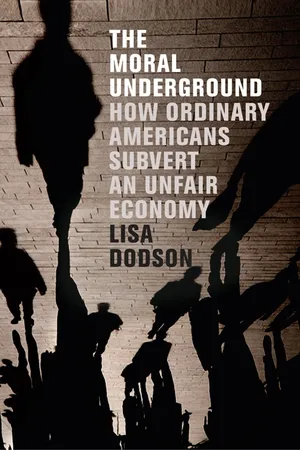
A “fascinating” look at the disconnect between corporate policies and workers’ real lives—and the everyday heroes who try to help (Publishers Weekly).
For the poor, there are challenges every day that they don’t have extra money to solve: a sick kid, car trouble, an unexpected dentist bill. The obstacles can make it harder to hold on to a job—but a job loss would be catastrophic. However, there are countless unsung heroes who bend or break the rules to help those millions of Americans with impossible schedules, paychecks, and lives make it from paycheck to paycheck. This book tells their stories.
Whether it’s a nurse choosing to treat an uninsured child, a supervisor deciding to overlook infractions, or a restaurant manager sneaking food to a worker’s children, middle-class Americans are secretly refusing to be complicit in a fundamentally unfair system that puts a decent life beyond the reach of the working poor.
In this tale of a kind of economic disobedience—told in whispers to Lisa Dodson over the course of eight years of research across the country—hundreds of supervisors, teachers, and health care professionals describe intentional acts of defiance that together tell the story of a quiet revolt, of a moral underground that has grown in response to an immoral economy. It documents a whole new phenomenon—people reaching across America’s economic fault line—and provides an account of the human consequences and lives behind the business-page headlines.
“If only this book had been published in 2007. Then the hundreds of people interviewed by Lisa Dodson would have been able to pass along an important piece of advice: What’s good for business is not necessarily good for America.” —Time
- 242 pages
- English
- ePUB (mobile friendly)
- Available on iOS & Android
eBook - ePub
About this book
Information
PART ONE
ETHICS AT WORK
The news at the grocery store is grim for many. According to the U.S. Department of Agriculture, food prices rose by 4 percent last year [2007], the largest increase in seventeen years. And the USDA predicts they will rise another 4 percent this year. Eggs are up 40 percent in the past year; milk up 26 percent a gallon; a loaf of standard bread, 20 percent.
—Bill Moyers Journal, “Hunger in America,” April 11, 20081
A lot of food passed through Ned’s hands over the course of a week at work—if not directly through his hands, then under his watch. And some of the “product” that didn’t quite pass muster didn’t go back to the company that produced it, as regulated; it was detoured to low-wage employees. In 2003, Ned said, “There’s always some product that gets damaged, like the packaging or [cans] get dented coming off the truck. And there’s the stuff that comes in, you know, fresh produce, that’s probably not going to pass. … I guess you could say I make the most of that. I make the most of it. I don’t see it as a scam. It’s not for me, it’s for them. … At the end of the month … that’s all they have.”
Work is a core class intersection in American life because, every day, millions of low-wage and middle-income people come together to do their jobs. They often get to know each other, their family concerns, hopes, and plans, and in this research clearly some employers got to know their employees pretty well. Of course, some did not; some said they had no interest in low-wage workers and others said that low-wage people have only themselves to blame for being poor. But most employers thought that working people should get a fair day’s pay and be able to keep their families fed and housed. A few went beyond concern, like Ned in the quote above. They found a little opening, a little chink in the system, and used it to treat working people better. Part 1 explores the range of views, judgments, and moral choices among employers.
1
EMPLOYING PARENTS WHO CAN’T MAKE A LIVING
Do we have any responsibility for what happens to them?
—Ellen, a manager in a company that employed many low-wage workers, 2002
Ellen raised this question during a community conversation with other employers from a variety of businesses in the Milwaukee area. They had been talking about common problems they faced with “entry-level” employees. Together they came up with a list of inconveniences and disruptions that come with people “who are disorganized” and bring that disarray to the workplace. They are absent too much, come to work late, get calls that distract them, or leave early, and they are often just “not focused on the job.” They said that there always seems to be some problem going on that complicates getting work done; their lives “just aren’t organized” or “they don’t have that work ethic.”
Most of the employers at this meeting supervised workers who were mothers, and they spoke at length about “family problems.” Eventually, their description of these troubles turned into a discussion about how inconvenient it was that these workers had families at all, because raising children is so time demanding. With some honesty, members of this group acknowledged that if you make $18,000—even $30,000—a year and have kids, “family life is going to create a problem” for those who employ you. Frequently, employers who discussed such issues were raising families themselves and had intimate knowledge of how much time— or in lieu of time, money—it takes to keep kids on a schedule; manage all their schooling, extracurricular, and emotional needs; and just keep a stable family routine. If you can’t be home to make sure all this is taken care of and you can’t buy substitute care, well, “it’s just a mess,” said one young manager, herself a mother of two.
On this day, the five men and two women started examining an idea that reemerged in employer conversations over the years that followed. They raised the notion that if you pay people wages that guarantee they can’t really “keep things organized at home” and then, because of that, the flow of work is disrupted, well, is that only the employee’s problem? Or is it just built into this labor market? And if it is wired into America’s jobs, as Ellen, a middleaged white woman, asked the others, “do we have any responsibility for what happens to them?” Over the course of hundreds of interviews and discussions this question was often at the center.
Inequality at Work
During the 1990s and into the first part of the first decade of the millennium, the United States saw a surge in wealth among the richest Americans. But that decade of economic gain was largely limited to those at the very top. Today, one in four U.S. workers earns less than $9 an hour—about $19,000 per year; 39 percent of the nation’s children live in low-income households.1 The Economic Policy Institute reported that in 2005, minimum-wage workers earned only 32 percent of the average hourly wage.2 And African American and Latino families are much more likely to be poor or low-income and are less likely to have assets or home equity to offset low wages.3 Furthermore, the living standards for households in the middle relative to the previous decade have seen a decline, particularly “working-age households,” those headed by at least one adult of working age.4 Thus the nation increasingly became divided into acutely different ways of life: millions of working families—the economic bottom third—that cannot make a living, millions in the middle clinging to their standard of living, and the very top economic tier of ever-greater wealth.
This America is not lost on ordinary people. As a Midwestern father of two who drives a “big rig” across states for a living said, “That money [gained by the richest people] came from somewhere, didn’t it? It came out of my pocket and my kids’ mouths.” While most busy working people don’t sit down to study the macro economy, many understand the rippling effects that shake their world.
At the university where I teach about poverty issues, I always ask students if they think that it matters if wealth increases for a few while others lose ground. For example, does it matter if that dad, driving his truck eighteen hours a day and seldom seeing his family, is able to buy less now than he could five years ago, when his days were shorter? Yes, of course it matters to him, his spouse, and his children. But does it matter beyond their private world? And always students point out that “maybe he’s not driving as well” after eighteen hours. Thus, certainly with many jobs, there is a danger effect of low wages and overwork, causing damage that can spread. But a fair number of other students ponder harm beyond self-interest and even our public interest in avoiding a forty-ton truck slamming down the highway with a sleepy driver. Do losses to a family, probably an extended family, maybe even a community eroded by mounting poverty-induced problems— does all that matter in a larger way? Even assuming that we can avoid all those trucks, is America harmed when our workers and their families are ground down by an economy that has been funneling wealth to only a few?
There is always a range of responses to this challenge to the way the economy distributes its resources. Many young people particularly believe that we can do better, and they are ready to get on board. In every class that I have ever taught some students speak of wanting the chance to devote real time—years, not just term breaks—to working for another kind of democracy. They are part of a deep, still untapped well of commitment to an economically just society—not the only source by any means, but a very valuable one. As young people have pointed out, this is the world they will take on and they should make it a more equitable one.
Alongside that sentiment, some young people point out that there is also a sound business management argument that doing better by our lower-wage workers means that we all gain, because both the society and businesses do better. This “high road” argument counsels investing in better wages, decent schedules, and benefits for low-wage workers because, ultimately, this pays off for companies and the nation.5 Others also point out that investing in lower-income families will mean that millions of children are better prepared for school, are healthier, and have more stable families, all of which build the nation.6 Essentially, this is the argument that other nations use to invest public funding in families raising children and guarantee a minimum family income. So there is a defensible set of arguments—albeit not a winning one in the United States, but a compelling one—that we ought to pay people a decent income because it takes care of our people, serves productivity, and upholds the nation as a whole.
Yet, talking with employers, students, and many others, I found another public impulse largely left outside most economic debate. Sometimes middle-class people talked about a sense of obligation—a social obligation—at the core of their individual identity and their understanding of being part of this country. And many talked about their jobs—the work they do each day— as key to fulfilling the sense of being part of something bigger.
This idea of work was almost always explained to me personally, not as a philosophical stand. Middle-income people would describe relationships with others at work whose earnings were so low that if you decided to think about it, you knew there was no way they could support a family. Managers, business owners, and other professionals told me about getting to know certain people who seemed to be doing everything they possibly could, but that wasn’t enough. And so all kinds of personal and family troubles would mount up, spill over, and eventually turn up at work. I heard about how when you hire, supervise, or even just work next to working-poor people—and, like it or not, get close to them— the harms they live with can start leaking into your world too.
A question would be raised: do we have some responsibility for people to whom we are connected through our jobs and economic role in their daily lives, and indirectly, the families that count on them? Do we have some obligation to others—not just our family, but those who are co-workers, neighbors, part of our society, and who are being diminished? I found nothing near a consensus. But a wide array of people diverse in background, religion, profession, race, ethnicity, and geography spoke of this reflection as part of their workaday lives, where they are connected to those who are working hard but living poor.
As a young mother who was a sales clerk in Denver in 2001 put it, “This took everything … just to keep this job. You know, you’re a single mother, you’re not born with a silver spoon in your mouth. … My child keeps calling me [while the child is home alone] and begging me to quit. … This is my responsibility.”
“I Couldn’t Help Feeling Like I Was Almost to Blame”
Bea was a fortyish white woman in a flowery blouse and pink slacks; she wore a square plastic badge that read BEA, FLOOR MANAGER. In 2004 she agreed to talk to me over a cup of coffee near the store where she was a manager of “about thirty-five” employees. It was a well-known low-end retail chain, a “big box.” She had worked there for five years. She described the workforce as largely local people, and that meant “almost all white, mostly women, and with maybe high school diplomas, for the most part.” Bea herself had lived in that general area of Maine all her life.
After many interviews, my questions had been honed for gathering information about how it is to manage a workforce and what if any conflicts arise. Bea quickly focused on the dilemma of “knowing too much” about the personal lives of the people who worked for her and how that contrasted poorly with what she understood as the model of how a professional manager behaves.
“Some of what they teach you in this business is to learn to think of them as part of the job … the way to try to get the job done. That means being friendly [to the workers], learning everybody’s name; that’s very important. But you keep people … it’s important to keep a distance. You do that to keep it professional. But I think … it is also how to keep it clean.”
“What does that mean?”
“It can get messy quickly if you start encouraging people to tell you what is going on, because they all have these problems. They have child care problems, problems with someone is sick … there’s domestic abuse. They have a lot of crises. It’s better not to ask because it opens the door to all that and then you have to tell them they have to stay late or you have to cut hours or someone wants a raise … all of that other comes up in your mind.”
“And that makes it hard to … ?”
“That makes it hard to flip back into the business mode. I have to keep in mind my job is to serve the business, which is serving the public. We serve the public.” This phrase, often repeated among the managers I met, seemed like a mooring, something to grab on to when human matters started to rock the boat.
“And … these people … aren’t really … the public?”
“No, in business the public is the people who pay … It isn’t
the public, really, it is the customer, the paying public.”
“So … how does this work, for you?”
Bea’s capitulation was immediate.
“Not very well really. I actually break my rules all the time. I know a lot more about a lot of people than I should. I get involved more than I should. I am that kind of person; my husband is always telling me that. Not that he really blames me; he does the same thing at [a local lumber business]. But, like before … when we were talking about what they pay … ?” Bea and I had discussed the company wages of $6–8 an hour. “I know that when someone asks for a raise, they really need it.” At that point Bea started reciting the needs of many of these workers. Clearly she had annihilated her dictate to “keep it clean.”
Here is just one of the stories that she told.
“‘ Nancy’ has two kids, her husband’s on disability, and she couldn’t buy her daughter a prom dress. This kid has worked very, very hard to graduate.” Apparently Nancy’s daughter had been employed throughout most of her high school years to help the family. “I’m like, ‘ How is it fair that this family can’t buy her a prom dress?’”
Bea looked away, out the window. She disconnected from me for a few seconds as though recalling and applying manager rules. But it didn’t work. When she looked back at me, she was teary. And she seemed a little angry too.
“I remember how much my prom meant to me. I don’t know about where you live, but around here, it’s a big deal. The girls … we all hope for a big wedding someday but your high school graduation, that’s something you have earned. You want to look glamorous—not just good, but runway good. No way was Edy going to have the dress, the hair, the manicure. And I couldn’t help but feeling that I was almost to blame, or partly. Nancy doesn’t make what she deserves. … I am not saying they all work that hard, but … really, many do.”
Bea was quiet for a while, and I began to think that was the end of the story. I tried to think of how to draw out what was being said, to hear more about this balance of roles and rules and Bea’s conflict. She had started with her manager badge. But then she moved along a spectrum of moral thinking that I was to hear about many times. Bea put it simply. “Actually we sell prom dresses in this store. … Did you see them?” I had not.
Again Bea was silent and she looked at my tape recorder. I asked, “You want me to turn it off?”
Bea said, “No, that’s okay. … Well, let’s just say … we made some mistakes with our prom dress orders last year. Too many were ordered, some went back. It got pretty confusing.”
When Bea looked me in the eye this time, there were no tears and no apology.
I thought I knew my line. “So … Edy looked good at her prom?” Bea laughed, with a touch of gratitude I thought. “She knocked them dead,” she said.
Over this and another conversation, Bea talked about how she could not make up for even a small par...
Table of contents
- Cover
- Dedication
- Title
- Copyright
- Contents
- Preface
- Acknowledgements
- Introduction
- Part One: Ethics At Work
- Part Two: Troubling Children
- Part Three: The Sickening EFFECTS OF POVERTY
- Part Four: Raising A Moral Underground
- Addendum: Research as Democracy
- Notes
Trusted by 375,005 students
Access to over 1.5 million titles for a fair monthly price.
Study more efficiently using our study tools.
Frequently asked questions
Yes, you can cancel anytime from the Subscription tab in your account settings on the Perlego website. Your subscription will stay active until the end of your current billing period. Learn how to cancel your subscription
No, books cannot be downloaded as external files, such as PDFs, for use outside of Perlego. However, you can download books within the Perlego app for offline reading on mobile or tablet. Learn how to download books offline
Perlego offers two plans: Essential and Complete
- Essential is ideal for learners and professionals who enjoy exploring a wide range of subjects. Access the Essential Library with 800,000+ trusted titles and best-sellers across business, personal growth, and the humanities. Includes unlimited reading time and Standard Read Aloud voice.
- Complete: Perfect for advanced learners and researchers needing full, unrestricted access. Unlock 1.5M+ books across hundreds of subjects, including academic and specialized titles. The Complete Plan also includes advanced features like Premium Read Aloud and Research Assistant.
We are an online textbook subscription service, where you can get access to an entire online library for less than the price of a single book per month. With over 1.5 million books across 990+ topics, we’ve got you covered! Learn about our mission
Look out for the read-aloud symbol on your next book to see if you can listen to it. The read-aloud tool reads text aloud for you, highlighting the text as it is being read. You can pause it, speed it up and slow it down. Learn more about Read Aloud
Yes! You can use the Perlego app on both iOS and Android devices to read anytime, anywhere — even offline. Perfect for commutes or when you’re on the go.
Please note we cannot support devices running on iOS 13 and Android 7 or earlier. Learn more about using the app
Please note we cannot support devices running on iOS 13 and Android 7 or earlier. Learn more about using the app
Yes, you can access The Moral Underground by Lisa Dodson in PDF and/or ePUB format, as well as other popular books in Business & Business Ethics. We have over 1.5 million books available in our catalogue for you to explore.