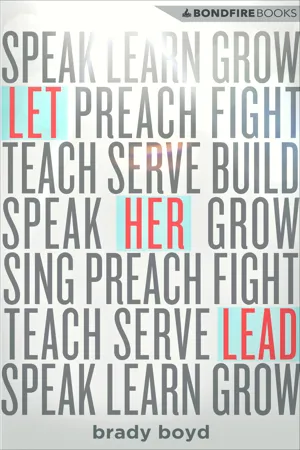
A pastor's inspiring message for Christian women—and those who love them.
Let her be her. And let her be heard. For Pastor Brady Boyd, these are the two main wishes for his young daughter and the world she'll encounter as a woman.
In
Let Her Lead, Boyd calls on the church and the wider world to let women be who they are and speak their voice with confidence and conviction. The question of women in leadership remains touchy for many people, especially church people. In this brief and engaging book, Boyd defuses the tension by offering a fresh, practical, and biblical perspective and revealing the leadership roles women play at New Life Church in Colorado Springs. Through it all, Boyd imagines a bright future that could be awaiting his daughter and what she may be invited to do. And he shows all of us—men and women alike—the roles we can play to create that better reality.
eBook - ePub
Let Her Lead
About this book
Information
Topic
Theology & ReligionSubtopic
Christian ChurchChapter 1: Let Her Be Her
A woman’s worth has been substantial all along. A quick read of the first chapter of Genesis reveals three helpful truths about humankind—women, as well as men—and while we may debate the timing, order, and priority of the creation scene, what’s known for sure is that divinity, unity, and diversity were involved. Men and women were created in God’s divine image; men and women walked in unity with God, and also with each other; and men and women were men and women. They were different one from another, per God’s perfect plan.
Divinity
God’s original posture toward humanity was not at all ambivalent: he created them—male and female alike—in his glorious image, and he purposed them—again, male and female alike—for three primary tasks. They were to reign over the animal kingdom; they were to fill the earth and subdue it; and they were to enjoy the creation around them, this paradise laid out by a loving and generous God.
The triple occurrence of “they” here is important. God did not create only man in his image; he created woman that way too. God did not task only man with dignified work; he tasked woman that way too. “They” ruled together, sharing authority and dominion equally. Which is kind of ironic, because before the curse of the fall made people power-hungry and petty and corrupt, nobody had any use for authority, dominion, and clout. “Both men and women were responsible to fulfill their ministries of service for God’s glory,” my friend Bill Hybels says, “in the manner God had gifted them and to the degree to which they had been apportioned faith.”4
In other words, women were not created as afterthoughts, add-ons, or additives, like the kind I put in my truck’s gas tank, to give me a little boost. No, they were an integral part of the deal, from the very beginning of time. God welcomed his first divine daughter in a pretty powerful way: he referred to her by the Hebrew term ezer kenegdo, which translates in English to “helpmeet” or “helpmate.” As the NIV version of the famous verse has it: “The Lord God said, ‘It is not good for the man to be alone. I will make a helper suitable for him” (Genesis 2:18).
But before your mind rushes to Aha! I knew it! This guy wants all women to only serve men! Barefoot and pregnant and submissive and subdued. I knew this is what a man would suggest!—let me note two key items.
First, let’s keep in mind that if God intended woman’s sole role to be nothing more than an obedient, subservient sidekick to her husband, then any woman existing in a state of singleness would be living outside of God’s will. Obviously, this is not the case.
And second, of the twenty-one times the phrase ezer kenegdo is used throughout Scripture, sixteen of them are used to refer to God himself. For example:
“Hear, Lord, and be merciful to me. Lord, be my help.” (Psalm 30:10)
“We wait in hope for the Lord; he is our help and our shield.” (Psalm 33:20)
“House of Aaron, trust in the Lord—he is their help and shield.” (Psalm 115:10)
“Blessed are those whose help is the God of Jacob, whose hope is in the Lord their God.” (Psalm 146:5)5
God uses the same name for Eve that he uses for himself, which means that unless God had a massive inferiority complex, he had something more in mind than woman as congenial add-on to man.
Rather than referring to Eve as a second-class citizen, he says, “Think of it this way: I am what Eve was meant to be for Adam. And I am the great I Am!” Listen, Eve was created to show up for her mate. She was meant to do more than submit. I love how one author puts it: “If Adam must think for, decide for, protect, and provide for the woman, she actually becomes a burden on him—not much help, when you think about it. The kind of help man needs demands full deployment of her strengths, her gifts, and the best she has to offer. His life will change for the better because of what she contributes to his life.”6
“Helpfulness,” in the Genesis sense of the term, is about as far as you can get from the idea of woman as lesser-than, dumber-than doormat/assistant/slave. Women, according to God, are valuable. They matter deeply to him. And therefore deeply matter to us.
~ ~ ~
I’m from the south, which is often a wonderful thing and sometimes a perplexing one. Perhaps perplexing things happen up north; I know for sure they do down south. For example, in various southern states whose identities I’ll keep to myself, I have seen firsthand this troubling dynamic: A mom and a dad have both a teenage daughter and a teenage son. Sometimes the boy is older; sometimes the girl. Both are—relatively speaking—responsible, reliable kids. Both get good grades, or both excel at sports. Both tend to run with “good kids.” Both customarily show respect and kindness and love. But despite all these similarities and good qualities, the daughter is treated differently than the son. The daughter has a twelve-o’clock curfew; the son can stay out as late as he wants. The daughter is told no when she asks for a cell phone, but the son is handed a slick new iPhone, because the boys get the toys, right?
The daughter has to bum rides off friends every weekend; the son is freely given the keys to his parents’ cars. The daughter is encouraged to find a “nice young man” to marry; the son is slipped college applications left and right. At social gatherings, the daughter is asked to “join the women” in the kitchen; the son is invited to play pool or watch sports. The daughter is kept on an ultra-short leash, while the son is left to explore the world.
As I say, maybe this kind of backward behavior is at work in places such as Montana and Michigan and Maine as well, in which case, mea culpa to my southern friends. To all people in all geographies: Stop the madness. Please.
We are saying something about the value of a woman when we diminish her experience of life on this earth, especially while simultaneously elevating the experience of men. And if you think this differentiation of young boys and young girls is harmless and has no bearing on future behavior, think again. In research compiled for her book Lean In, author Sheryl Sandberg found that in a clinical test, “if you ask men and women questions on totally objective criteria, men inaccurately assess their performance slightly high, while women inaccurately assess their performance slightly low.”7
Women do not believe they are valuable. Which stands to reason, given we have told them this is so.
When by our assumptions and our actions we ask women to be seen but not heard, to be pretty but not powerful, to be courteous but not challenging, to be amiable but not ambitious, to be submissive but not smart…when we expect them to merely cook and clean and change diapers, to show up but not speak up, to wear doilies on their heads during church services and whatever you do, keep your thoughts to yourself, we are saying something weighty about their value, about the worth of their very lives. And what we’re saying, in my view, just ain’t that great.
But the inverse is also true. When we prioritize the divinity in people, we esteem them—men and women alike. We honor them—men and women alike. We raise up their God-given value—men and women alike. We practice mutual surrender, mutual submission—as men, and as women, alike. We buck the trends of our wayward culture, which demands that a woman’s value equates to her chest size, her sex appeal, her charm. And it’s happening younger and younger these days. If you’ve seen the reality show Toddlers and Tiaras, then you know exactly what I mean. When overzealous parents are trotting out three- and four-year-old girls in fishnets and full makeup and asking them to glance coyly over their shoulder so that the judges will boost their scores, we’ve got a problem on our hands. Here’s what we’re telling those future women: “If you want the world’s attention, you’ll have to be overtly sexual to get it. If you expect to compete in this ‘man’s world,’ if you ever hope to be valued or heard, then swinging your hips and shimmying your shoulders is really your only choice.”
When we minimize the worth of women, we minimize the worth of her Maker. This is never a wise thing to do. Jesus says, “I came for the sake of freedom.” We’re to be about freedom too—freedom from suppression, freedom from marginalization, freedom from bondage, freedom from anything that lessens the value of womankind.
We enslave women and girls not just when we trick them into lives of destitution and servitude or when we trade them across borders as sex slaves—and for more than 20 million, tragically, this is their current lot—but also when we leave them feeling trapped in a world that values them only for the size of their breasts. We begin to free them when we plant more helpful seed, and then water it until a useful harvest bursts forth: “You are the apple of your Father’s eye!” we can affirm. “And your value is not lost on me. What you see is valid, and what you’re experiencing is meaningful. The thoughts you think? The que...
Table of contents
- Let Her Lead: Creating a Better Future for Women in the Church
- Let Her Lead
- Copyright
- Introduction
- Chapter 1: Let Her Be Her
- Chapter 2: Let Her Be Heard
- Afterword: To Ordain or Not to Ordain?
- Notes
- About the Author
- About Bondfire Books
Trusted by 375,005 students
Access to over 1.5 million titles for a fair monthly price.
Study more efficiently using our study tools.
Frequently asked questions
Yes, you can cancel anytime from the Subscription tab in your account settings on the Perlego website. Your subscription will stay active until the end of your current billing period. Learn how to cancel your subscription
No, books cannot be downloaded as external files, such as PDFs, for use outside of Perlego. However, you can download books within the Perlego app for offline reading on mobile or tablet. Learn how to download books offline
Perlego offers two plans: Essential and Complete
- Essential is ideal for learners and professionals who enjoy exploring a wide range of subjects. Access the Essential Library with 800,000+ trusted titles and best-sellers across business, personal growth, and the humanities. Includes unlimited reading time and Standard Read Aloud voice.
- Complete: Perfect for advanced learners and researchers needing full, unrestricted access. Unlock 1.5M+ books across hundreds of subjects, including academic and specialized titles. The Complete Plan also includes advanced features like Premium Read Aloud and Research Assistant.
We are an online textbook subscription service, where you can get access to an entire online library for less than the price of a single book per month. With over 1.5 million books across 990+ topics, we’ve got you covered! Learn about our mission
Look out for the read-aloud symbol on your next book to see if you can listen to it. The read-aloud tool reads text aloud for you, highlighting the text as it is being read. You can pause it, speed it up and slow it down. Learn more about Read Aloud
Yes! You can use the Perlego app on both iOS and Android devices to read anytime, anywhere — even offline. Perfect for commutes or when you’re on the go.
Please note we cannot support devices running on iOS 13 and Android 7 or earlier. Learn more about using the app
Please note we cannot support devices running on iOS 13 and Android 7 or earlier. Learn more about using the app
Yes, you can access Let Her Lead by Brady Boyd in PDF and/or ePUB format, as well as other popular books in Theology & Religion & Christian Church. We have over 1.5 million books available in our catalogue for you to explore.