Winston Churchill recounts the end of WWII and its aftermath, in the conclusion of his majestic six-volume history.
In
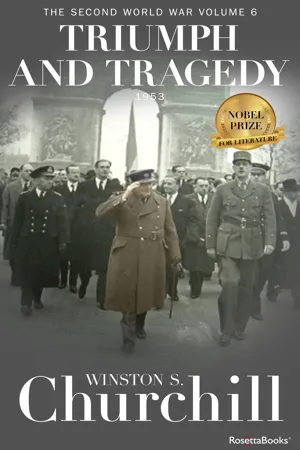
Triumph and Tragedy, British prime minister Winston Churchill provides in dramatic detail the endgame of the war and the uneasy meetings between himself, Stalin, and Truman to discuss plans for rebuilding Europe in the aftermath of devastation.
Beginning with the invasion of Normandy, the heroic landing of the Allied armies and the most remarkable amphibious operation in military history, Churchill watches as the uneasy coalition that had knit itself together begins to fray at Potsdam, foreshadowing the birth of the Cold War.
Triumph and Tragedy is part of the epic six-volume account of World War II told from the viewpoint of a man who led in the fight against tyranny, and enriched with extensive primary sources including memos, letters, orders, speeches, and telegrams, day-by-day accounts of reactions as the drama intensifies. Throughout these volumes, we listen as strategies and counterstrategies unfold in response to Hitler's conquest of Europe, planned invasion of England, and assault on Russia, in a mesmerizing account of the crucial decisions made as the fate of the world hangs in the balance.
- 768 pages
- English
- ePUB (mobile friendly)
- Available on iOS & Android
eBook - ePub
Triumph and Tragedy
About this book
Information
Subtopic
Political BiographiesIndex
HistoryBOOK II
THE IRON CURTAIN
CHAPTER XX
PREPARATIONS FOR A NEW CONFERENCE
The Advance of the Red Army—The Struggle in Italy—Political Problems in Eastern Europe—Correspondence Between the President and Stalin About Poland—The Need for a Three-Power Conference—I Agree to the Proposal—My Telegram to Mr. Roosevelt of January 1, and His Reply—My Efforts to Arrange a Meeting of the Combined Chiefs of Staff—Harry Hopkins Comes to London, January 21—Doubts About Yalta—I Fly to Malta, January 29—The Scene in Valletta Harbour, February 2—The Discussions Between the British and American Chiefs of Staff—A Cold Flight to Saki—The Drive to Yalta.
Earlier chapters have traced the advance of the Soviet armies to the borders of Poland and Hungary. After occupying Belgrade on October 20 the Russians had resumed their thrust up the valley of the Danube, but resistance stiffened the farther they penetrated across the Hungarian plain. They forced a bridgehead on November 29 over the Danube eighty miles below Budapest, and struck north. By the end of December the capital was completely surrounded, and for six weeks endured some of the grimmest street-fighting of the war. On the shores of Lake Balaton solid German resistance and violent counter-attacks also brought the Russian advance to a halt until the spring.
In Poland the Russians spent the autumn months in building up their forces after the extraordinary advances of the summer. In January they were ready. Striking westwards from their bridgeheads about Sandomir, at the end of the month they had crossed the German frontier and pierced deep into the great industrial basin of Upper Silesia. Farther north, crossing the Vistula on both sides of Warsaw, they captured the city on January 17, and, investing Posen, fanned out towards the lower reaches of the Oder and towards Stettin and Danzig. Simultaneously they crushed East Prussia from east and south. By the end of January they were in complete possession, except for the heavily defended fortress of Königsberg. Here, as at Danzig, the garrison was to continue a stubborn but hopeless defence until April. The German forces cut off in Courland remained there till the surrender, as Hitler refused to let them come away.
The Soviet High Command, with a superiority of perhaps three to one on land and dominance in the air, used a strategy which recalls Foch’s final victory in 1918. A series of battles, now here, now there, along a wide front punched successive holes until the whole line was forced to recoil.
***
Our own campaign in the West, though on a smaller scale, had equally brought us to the frontiers of Germany, so that at the end of January 1945 Hitler’s armies were virtually compressed within their own territory, save for a brittle hold in Hungary and in Northern Italy. There, as has already been recorded, Alexander’s skilful but hopelessly mutilated offensive had come to a halt. In November the strategic and tactical air forces had opened a six-months’ campaign against the railways from the Reich to Italy. By destroying transformer stations a great part of the Brenner line was forced from electric to steam traction, and elsewhere the movement of enemy reinforcements and supplies was severely impeded. It is not possible to record the strenuous day-by-day operations of the Allied tactical air forces, commanded by General Cannon under the U.S. General Eaker, the Air Commander-in-Chief. Quelling their opponents, in spite of atrocious weather, they had done great things to help the autumn campaign, and they well deserved this tribute from General Alexander’s dispatch:
I cannot speak too highly of General Cannon’s gifts as a leader or of the encouragement which his assistance and support always gave me. The measure of his achievement can be seen in the complete immunity we enjoyed from enemy air attacks, the close and effective support enjoyed by the ground forces, and the long lines of destroyed enemy vehicles, the smashed bridges, and useless railways found by my armies wherever they advanced into enemy territory.
Nevertheless the liberation of Italy was not to be completed till the spring.
Such was the military position on the eve of the impending Triple Conference.
***
The political situation, at any rate in Eastern Europe, was by no means so satisfactory. A precarious tranquillity had indeed been achieved in Greece, and it seemed that a free democratic Government, founded on universal suffrage and secret ballot, might be established there within a reasonable time. But Roumania and Bulgaria had passed into the grip of Soviet military occupation, Hungary and Yugoslavia lay in the shadow of the battlefield, and Poland, though liberated from the Germans, had merely exchanged one conqueror for another. The informal and temporary arrangement which I had made with Stalin during my October visit to Moscow could not, and so far as I was concerned was never intended to, govern or affect the future of these wide regions once Germany was defeated.
The whole shape and structure of post-war Europe clamoured for review. When the Nazis were beaten how was Germany to be treated? What aid could we expect from the Soviet Union in the final overthrow of Japan? And once military aims were achieved what measures and what organisation could the three great Allies provide for the future peace and good governance of the world? The discussions at Dumbarton Oaks had ended in partial disagreement. So, in a smaller but no less vital sphere, had the negotiations between the Soviet-sponsored “Lublin Poles” and their compatriots from London which Mr. Eden and I had with much difficulty promoted during our visit to the Kremlin in October 1944. An arid correspondence between the President and Stalin, of which Mr. Roosevelt had kept me informed, had accompanied the secession of M. Mikolajczyk from his colleagues in London, while on January 5, contrary to the wishes of both the United States and Great Britain, the Soviets had recognised the Lublin Committee as the Provisional Government of Poland.
***
The President had already told me about his exchanges with Stalin. They were as follows:
| Marshal Stalin to President Roosevelt | 27 Dec 44 |
… A number of facts which took place during the time after the last visit of Mikolajczyk to Moscow, and in particular the radio communications with Mikolajczyk’s Government intercepted by us from terrorists arrested in Poland—underground agents of the Polish émigré Government—with all palpability prove that the negotiations of M. Mikolajczyk with the Polish National Committee served as a screen for those elements who conducted from behind Mikolajczyk’s back criminal terrorist work against Soviet officers and soldiers on the territory of Poland. We cannot reconcile with such a situation when terrorists instigated by Polish emigrants kill in Poland soldiers and officers of the Red Army, lead a criminal fight against Soviet troops who are liberating Poland, and directly aid our enemies, whose allies they in fact are. The substitution of Mikolajczyk by Arciszewsky, and in general transpositions of Ministers in the Polish émigré Government, have made the situation even worse and have created a precipice between Poland and the émigré Government. Meanwhile the Polish National Committee has made serious achievements in the strengthening of the Polish State and the apparatus of Governmental power on the territory of Poland, in the expansion and strengthening of the Polish Army, in carrying into practice a number of important Governmental measures, and, in the first place, the agrarian reform in favour of the peasants. All this has led to consolidation of democratic powers of Poland and to powerful strengthening of authority of the National Committee among wide masses in Poland and among wide social Polish circles abroad.
It seems to me that now we should be interested in the support of the Polish National Committee and all those who want and are capable to work together with it, and that is especially important for the Allies and for the solution of our common task—the speeding of the defeat of Hitlerite Germany. For the Soviet Union, which is bearing the whole burden for the liberation of Poland from German occupationists, the question of relations with Poland under present conditions is the task of daily close and friendly relations with a Power which has been established by the Polish people on its own soil and which has already grown strong and has its own army, which, together with the Red Army, is fighting against the Germans.
I have to say frankly that if the Polish Committee of National Liberation will transform itself into a Provisional Polish Government, then, in view of the above-said, the Soviet Government will not have any serious ground for postponement of the question of its recognition. It is necessary to bear in mind that in the strengthening of a pro-Allied and democratic Poland the Soviet Union is interested more than any other Power, not only because the Soviet Union is bearing the main brunt of the battle for liberation of Poland, but also because Poland is a border State with the Soviet Union and the problem of Poland is inseparable from the problem of security of the Soviet Union. To this I have to add that the successes of the Red Army in Poland in the fight against the Germans are to a great degree dependent on the presence of a peaceful and trustworthy rear in Poland. And the Polish National Committee fully takes into account this circumstance, while the émigré Government and its underground agents by their terroristic actions are creating a threat of civil war in the rear of the Red Army and counteract the successes of the latter.
On the other hand, under the conditions which exist in Poland at the present time there are no reasons for the continuation of the policy of support of the émigré Government, which has lost all confidence of the Polish population in the country, and besides creates a threat of civil war in the rear of the Red Army, violating thus our common interests of a successful fight against the Germans. I think that it would be natural, just, and profitable for our common cause if the Governments of the Allied countries as the first step have agreed on an immediate exchange of representatives with the Polish National Committee, so that after a certain time it would be recognised as the lawful Government of Poland after the transformation of the National Committee into a Provisional Government of Poland. Otherwise I am afraid that the confidence of the Polish people in the Allied Powers may weaken. I think that we cannot allow the Polish people to say that we are sacrificing the interests of Poland in favour of the interests of a handful of Polish emigrants in London.
Mr. Roosevelt’s reply was reported in a message to myself.
| President Roosevelt to Prime Minister | 30 Dec 44 |
I have to-day sent the following to Stalin. You will see that we are in step.
“I am disturbed and deeply disappointed over your message of December 27 in regard to Poland, in which you tell me that you cannot see your way clear to hold in abeyance the question of recognising the Lublin Committee as the Provisional Government of Poland until we have had an opportunity at our meeting to discuss the whole question thoroughly. I would have thought no serious inconvenience would have been caused your Government or your armies if you could have delayed the purely juridical act of recognition for the short period of a month remaining before we meet.
“There was no suggestion in my request that you curtail your practical relations with the Lublin Committee, nor any thought that you should deal with or accept the London Government in its present composition. I had urged this delay upon you because I felt you would realise how extremely unfortunate and even serious it would be at this period in the war in its effect on world opinion and enemy morale if your Government should formally recognise one Government of Poland while the majority of the other United Nations, including the United States and Great Britain, continue to recognise and to maintain diplomatic relations with the Polish Government in London.
“I must tell you with a frankness equal to your own that I see no prospect of this Government’s following suit and transferring its recognition from the Government in London to the Lublin Committee in its present form. This is in no sense due to any special ties or feelings for the London [Polish] Government. The fact is that neither the Government nor the people of the United States have as yet seen any evidence either arising from the manner of its creation or from subsequent developments to justify the conclusion that the Lublin Committee as at present constituted represents the people of Poland. I cannot ignore the fact that up to the present only a small fraction of Poland proper west of the Curzon Line has been liberated from German tyranny; and it is therefore an unquestioned truth that the people of Poland have had no opportunity to express themselves in regard to the Lublin Committee.
“If at some future date following the liberation of Poland a Provisional Government of Poland with popular support is established the attitude of this Government would of course be governed by the decision of the Polish people.
“I fully share your view that the departure of M. Mikolajczyk from the Government in London has worsened the situation. I have always felt that M. Mikolajczyk, who, I am convinced, is sincerely desirous of settling all points at issue between the Soviet Union and Poland, is the only Polish leader in sight who seems to offer the possibility of a genuine solution of the difficult and dangerous Polish question. I find it most difficult to believe from my personal knowledge of M. Mikolajczyk and my conversations with him when he was here in Washington and his subsequent efforts and policies during his visit at Moscow that he had knowledge of any terrorist instructions.
“I am sending you this message so that you will know the position of this Government in regard to the recognition at the present time of the Lublin Committee as the Provisional Government. I am more than ever convinced that when the three of us get together we can reach a solution of the Polish problem, and I therefore still hope that you can hold in abeyance until then the formal recognition of the Lublin Committee as a Government of Poland. I cannot from a military angle see any great objection to a delay of a month.”
Stalin had answered:
| Marshal Stalin to President Roosevelt | 1 Jan 45 |
I have received your message of December 30.
I greatly regret that I have not been able to convince you of the correctness of the Soviet Government’s attitude towards the Polish question. I nevertheless hope that events will convince you that the Polish National Committee has always rendered and will continue to render to the Allies, and in particular to the Red Army, considerable assistance in the struggle against Hitlerite Germany, whereas the émigré Government in London assists the Germans by creating disorganisation in this struggle.
I naturally fully comprehend your suggestion that the Soviet Government’s recognition of the Provisional Government of Poland should be postponed for a month. There is however a circumstance here which makes it impossible for me to fulfil your wish. The position is that as early as December 27 the Presidium of the Supreme Soviet of the U.S.S.R. informed the Poles in reply to an inquiry on the subject that it proposed to recognise the Provisional Government of Poland as soon as the latter was formed. This circumstance makes it impossible for me to fulfil your wish.
Permit me to send you my greetings for the New Year and to wish you health and success.
***
I now received from Stalin a direct message on Poland.
| Marshal Stalin to Prime Minister | 4 Jan 45 |
You are of course already aware of the publication by the Polish National Council in Lublin of the decision to which it has come regarding the transformation of the Polish Committee of National Liberation into the National Provisional Government of the Polish Republic. You are also well aware of our relations with the Polish National Committee, which in our view has already acquired great authority in Poland and is the lawful exponent of the will of the Polish nation. The transformation of the Polish National Committee into a Provisional Government seems to us entirely opportune, especially since Mikolajczyk has ceased to be a member of the émigré Polish Government and the latter has thus ceased to possess any semblance of a Government. I consider it impossible to leave Poland without a Government. Accordingly the Soviet Government has consented to recognise the Polish Provisional Government.
I much regret that I was unable completely to convince you of the correctness of the Soviet Government’s attitude towards the Polish question. I nevertheless hope that futu...
Table of contents
- Cover
- Title Page
- Copyright
- Moral of the Work
- ACKNOWLEDGMENTS
- PREFACE
- Theme of the Volume
- TRIUMPH AND TRAGEDY
- TABLE OF CONTENTS
- BOOK I: THE TIDE OF VICTORY
- BOOK II: THE IRON CURTAIN
- APPENDICES
- MAPS AND DIAGRAMS
- Endnotes
Trusted by 375,005 students
Access to over 1.5 million titles for a fair monthly price.
Study more efficiently using our study tools.
Frequently asked questions
Yes, you can cancel anytime from the Subscription tab in your account settings on the Perlego website. Your subscription will stay active until the end of your current billing period. Learn how to cancel your subscription
No, books cannot be downloaded as external files, such as PDFs, for use outside of Perlego. However, you can download books within the Perlego app for offline reading on mobile or tablet. Learn how to download books offline
We are an online textbook subscription service, where you can get access to an entire online library for less than the price of a single book per month. With over 1.5 million books across 990+ topics, we’ve got you covered! Learn about our mission
Look out for the read-aloud symbol on your next book to see if you can listen to it. The read-aloud tool reads text aloud for you, highlighting the text as it is being read. You can pause it, speed it up and slow it down. Learn more about Read Aloud
Yes! You can use the Perlego app on both iOS and Android devices to read anytime, anywhere — even offline. Perfect for commutes or when you’re on the go.
Please note we cannot support devices running on iOS 13 and Android 7 or earlier. Learn more about using the app
Please note we cannot support devices running on iOS 13 and Android 7 or earlier. Learn more about using the app
Yes, you can access Triumph and Tragedy by Winston S. Churchill in PDF and/or ePUB format, as well as other popular books in History & Political Biographies. We have over 1.5 million books available in our catalogue for you to explore.