The
New York Times bestseller that gives "readers with an entrepreneurial turn of mind . . . road maps on how millionaires found their niches" (
USA Today).
The author of the blockbuster bestseller
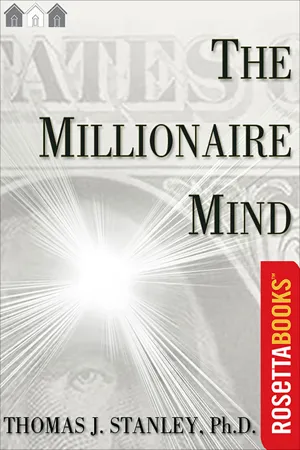
The Millionaire Next Door: The Surprising Secrets of America's Wealthy shows how self-made millionaires have surmounted shortcomings such as average intelligence by carefully choosing their careers, taking calculated risks, and living balanced lifestyles while maintaining their integrity. Dr. Thomas J. Stanley also builds on his research from
The Millionaire Next Door and takes us further into the psyche of the American millionaire.
Stanley focuses in on the top one percent of households in America and tells us the motor behind the engine; what makes them tick. His findings on how these families reached such financial success are based on in-depth surveys and interviews with more than thirteen hundred millionaires.
"A very good book that deserves to be well read." —
The Wall Street Journal
"Worth every cent . . . It's an inspiration for anyone who has ever been told that he wasn't smart enough or good enough." —Associated Press
"A high IQ isn't necessarily an indicator of financial success . . . Stanley tells us that the typical millionaire had an average GPA and frugal spending habits—but good interpersonal skills." —
Entertainment Weekly
"Ideas bigger than the next buck." —
Orlando Sentinel
- 419 pages
- English
- ePUB (mobile friendly)
- Available on iOS & Android
eBook - ePub
The Millionaire Mind
About this book
Information
Topic
Personal DevelopmentSubtopic
Personal Finance1

An Introduction to
the Millionaire Mind
They live in lovely homes located in fine neighborhoods. Balance is their approach to life. They are financially independent, yet they enjoy life—they are not “all work, no play” type of people. Most became millionaires in one generation. Neither their lifestyle nor their wealth was generated from being highly leveraged financially. They are not credit junkies. How did they accomplish this? How did they balance their need to become wealthy and economically productive with their need to enjoy life? They have the millionaire mind.
Early in my career of studying wealthy people, I had a glimpse of this segment of the millionaire population. In 1983 I was asked to interview sixty millionaires from Oklahoma. What I learned from them was simple, yet the message had a lasting impact on me: You cannot enjoy life if you are addicted to consumption and the use of credit. These Oklahoma millionaires were just the opposite, as demonstrated by one focus group of ten. All ten were seasoned business owners, executives, or professionals. All were first-generation wealthy. Some were credit-dependent earlier in their careers, but they eventually saw the light. They went cold turkey, breaking the cycle of borrowing to consume, earning to consume, and borrowing more and more money. Others never became addicted to credit or the need to display their success.
All ten were multimillionaires. They lived in fine homes in well-established, older neighborhoods. They drove American-made motor vehicles. They enjoyed life. They were not workaholics. They spent a lot of time with their families and friends, borrowed little money, and became wealthy, in most cases, before they were forty-five years old. My interview with this group was scheduled to last about two hours, but it actually went on for nearly four hours. I only had to ask a few questions—the members enjoyed telling their own stories about becoming wealthy. If there were a Focus Group Hall of Fame, all ten of these millionaires would be inducted during the first round.
There were many important points made about how one can become an economic success, but one statement was riveting. It was made by Gene. He mentioned that those who are “credit-dependent” are in fact controlled by someone else, some institution.
Gene was in his late forties at the time. He listed his occupation as “owner of a salvage business.” He purchased or “salvaged” real estate from various financial institutions. These institutions “have loans that are in default… six months or more.”
Just a few weeks prior to the interview, Gene “salvaged” sixty-eight homes, a commercial shopping center, and five multifamily apartment complexes from a financial institution with which he’d had many previous dealings. Immediately after the deal was signed, the senior credit officer of the institution signaled to Gene and walked with him over to the large window in the officer’s top-floor office. It was a tall building—they could see for miles and miles. There were thousands upon thousands of commercial buildings all around. Gene could even see some of the residential neighborhoods on the horizon.
As he looked out the window, the officer pointed to all the buildings, homes, offices, garages, shops, and so on, and said the words that made a lasting impression on Gene:
We [the lenders] own it all… all of it. The business out there?… You [borrowers] just run these businesses for us. You guys run them for us, the financial institutions.
How many people today in America run “their businesses,” “their professional practices” but actually work for or are being controlled by lenders? How many live in luxury homes yet work hard to make payments to the ultimate owner of the mortgage? How many people take care of autos they lease from the real owner? Too many. But Gene is not among them, nor were any of the other members of his focus group. All possessed the millionaire mind. None had a private credit officer doling out cash. All lived in fine homes, but not one had a “jumbo mortgage.”
The lesson I learned from Gene was repeated many times over by the millionaires surveyed for this book. They all have the millionaire mind, yet they believe it’s possible to enjoy life and still become wealthy. They believe that financial independence and much economic success can be achieved without adopting a Spartan lifestyle. But there must be certain constraints, as discussed later in this book.
Some people are not controlled by credit institutions. For them it is just the opposite—they are controlled by greed. They are misers. They even shortchange their spouses and children. Money is their God. These people are not of the millionaire mind. Another millionaire who has the proper perspective said:
I taught my sons and daughters that money is not their God. You control it… not let it control you.
Most of the people profiled in this book became economic successes in one generation. They came from economic ground zero. Most inherited no money. They never received the proceeds of an estate or income from a trust account. How did they do it? Again, they are of the millionaire mind.
You may never be able to generate the sizable incomes that many of these millionaires have earned. You may not become a multimillionaire in a few short years. But you can still benefit from understanding how these people maintained an enjoyable lifestyle at the same time they were accumulating wealth. Only a few people, even those with high incomes, know how this can be accomplished. Those with the millionaire mind know how, and they are profiled in this book.
THE SEARCH
The research conducted for my earlier book, The Millionaire Next Door, and the results reported therein have expanded the knowledge about the characteristics of America’s most affluent people. I decided to broaden the size and scope of my next study to include many more participants from a significantly wealthier population base. The new survey also focused on a different set of attributes and lifestyles, designed to project a deeper, more comprehensive look at the millionaire mind. The results of that study are presented in the following chapters.
It is a lot easier to profile the characteristics of people who have the millionaire mind than it is to find them. Why not survey all the households in America? Because only about 4.9 percent of the households in this country have a net worth of $1 million or more. Nor can you just survey all the people who live in expensive homes. Often these “big-home owners” are what I call Income Statement Affluent. They have big incomes, big homes, big debt, but little net worth. They are experts at preparing loan applications, most of which do not ask about one’s real level of net worth.
In sharp contrast there are those whom I call Balance Sheet Affluent. These people are of the millionaire mind. They focus upon accumulating wealth. Their assets greatly exceed their credit liabilities. Often they have little or no outstanding credit balances.
If I surveyed people who live in fine homes nationwide, what would I find? Too many Income Statement Affluent respondents. Yet I always believed that certain types of neighborhoods attract the Balance Sheet variety and retain those wi...
Table of contents
- Cover
- Title Page
- Copyright
- Dedication
- Contents
- Tables
- Acknowledgments
- Chapter 1 - An Introduction to: the Millionaire Mind
- Chapter 2 - Success Factors
- Chapter 3 - School Days
- Chapter 4 - The Relationship Between Courage and Wealth
- Chapter 5 - Vocation Vocation Vocation
- Chapter 6 - Choice of Spouse
- Chapter 7 - The Economically Productive Household
- Chapter 8 - The Home
- Chapter 9 - The Lifestyles of Millionaires: Real vs. Imagined
- Chapter 10 - A Final Note About the Millionaire Mind
- Appendix 1 - In Search of the Balance Sheet Affluent
- Appendix 2 - Businesses Owned and Managed by Millionaires (National Geodemographically Based Sample)
- Appendix 3 - Businesses Owned and Managed by Millionaires (Ad Hoc Sample)
- Author’s Note
- Endnotes
Trusted by 375,005 students
Access to over 1.5 million titles for a fair monthly price.
Study more efficiently using our study tools.
Frequently asked questions
Yes, you can cancel anytime from the Subscription tab in your account settings on the Perlego website. Your subscription will stay active until the end of your current billing period. Learn how to cancel your subscription
No, books cannot be downloaded as external files, such as PDFs, for use outside of Perlego. However, you can download books within the Perlego app for offline reading on mobile or tablet. Learn how to download books offline
Perlego offers two plans: Essential and Complete
- Essential is ideal for learners and professionals who enjoy exploring a wide range of subjects. Access the Essential Library with 800,000+ trusted titles and best-sellers across business, personal growth, and the humanities. Includes unlimited reading time and Standard Read Aloud voice.
- Complete: Perfect for advanced learners and researchers needing full, unrestricted access. Unlock 1.5M+ books across hundreds of subjects, including academic and specialized titles. The Complete Plan also includes advanced features like Premium Read Aloud and Research Assistant.
We are an online textbook subscription service, where you can get access to an entire online library for less than the price of a single book per month. With over 1.5 million books across 990+ topics, we’ve got you covered! Learn about our mission
Look out for the read-aloud symbol on your next book to see if you can listen to it. The read-aloud tool reads text aloud for you, highlighting the text as it is being read. You can pause it, speed it up and slow it down. Learn more about Read Aloud
Yes! You can use the Perlego app on both iOS and Android devices to read anytime, anywhere — even offline. Perfect for commutes or when you’re on the go.
Please note we cannot support devices running on iOS 13 and Android 7 or earlier. Learn more about using the app
Please note we cannot support devices running on iOS 13 and Android 7 or earlier. Learn more about using the app
Yes, you can access The Millionaire Mind by Thomas J. Stanley in PDF and/or ePUB format, as well as other popular books in Personal Development & Personal Finance. We have over 1.5 million books available in our catalogue for you to explore.