Start living the life you were meant to lead with this indispensable guide to getting unstuck and creating a meaningful career.
Afraid of letting another year go by in a job that drains the life out of you? What if you had a clear vision for work that would tap your natural strengths, allow you to be yourself, and make a difference in the world?
Just Give Me Meaningful Work helps those who are stuck in the wrong job break free, find their calling, and finally feel great about themselves.
Certified co-active coach Julie P. Boyer helps readers see what's blocking their path to successful change. Her tools have helped numerous people land their dream job, negotiate a better title at work, or even start their own business.
Just Give Me Meaningful Work shows you how your current frustrations can reveal your true purpose. It helps readers get off the hamster wheel and move forward with focus and confidence. Boyer guides readers towards getting their energy and optimism back and feeling alive and inspired once again.
eBook - ePub
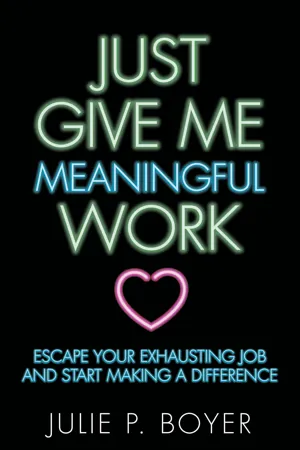
Just Give Me Meaningful Work
Escape Your Exhausting Job and Start Making a Difference
- 188 pages
- English
- ePUB (mobile friendly)
- Available on iOS & Android
eBook - ePub
About this book
Information
Topic
Personal DevelopmentSubtopic
Careers
Where the Struggle Begins
Mel’s struggle is the story of so many of us. I’ve lived it in my own way, as have my clients and friends. You’re not the only one who’s ever been in this tunnel without a light at the end, and you don’t have to stay here.
I’ve written this book because I believe that Mel – and you – are capable of creating the sense of fulfillment and ease at work that you wish for. In fact, not only are you capable of creating the change you want, but you’re being called to. The frustration you’ve been feeling isn’t a sign that your only choice is to endure and make the best of your life now. It’s a sign that now is the time to discover what’s holding you back, uncover what you really want, and relieve yourself of this frustration so you can do the work you’re really meant to do.
I, too, have known what it’s like to yearn for more but also be too tied up in knots of stress and frustration to do anything about it. I’ve been so stuck that I didn’t feel like I knew myself anymore. I’ve been so frustrated that I forgot all about my natural strengths, which made me feel doubtful that I had the capacity to create any change in my life. I used to look around and see everyone else having a much easier time finding and excelling at work that fulfilled them, and wonder why, for me, this was such an indecipherable riddle.
You’re not doomed to stay bored, held back, or stuck forever. As you’ll see in this book, the changes you long for seem, for right now, like they’re much harder and more improbable to achieve than they actually are. But all that is about to change.
My Story
Everyone encounters a moment or dramatic event in their teen years that changes their understanding of themselves and the world, and this new understanding can influence the course of your future. It doesn’t have to be dramatic or qualify as traumatic in the eyes of others, but nonetheless it causes a great shift in your perception of the world. It can dictate what you think is possible and what you believe your personal limitations are. It can also be positive, for it can plant a seed for what later becomes your purpose in life. As you’ll see, that certainly was true for me.
What I Learned Early On
When I was thirteen, my father got promoted, and I moved from a relaxed, casual, public school experience to a high-pressure, all-girls private school and a much more formal, upperclass neighborhood. This meant l left my entire life – community, family stability, and group of friends – at a time that was socially awkward and confusing to begin with. Since I wasn’t raised with the kind of intellectual preparation my new peers had, I struggled to keep up, and lived with an intense level of underlying stress.
At the beginning of my second year there, my understanding of myself and who I needed to be in the world changed, just as I was starting to feel comfortable and relaxed. It happened when I was called into the head of middle school’s office for cracking jokes in class and getting a C- on a science test. Fearing authority, and feeling like I was failing at being accepted in my new life, I decided that there was no room for a sensitive, creative, idiosyncratic nature in this new life. My teenage mind made up that it was dangerous to just be myself, for it meant I could lose all sense of belonging and community. From then on, my experience of the world became organized around my new belief that, in order to belong and in order to be loved, I had to be intellectual, I had to fit in, and I had to hide my sensitivity and idiosyncrasy.
The Confusion That Followed
I share this experience with you because it formed the basis of my struggles around finding meaningful work later in life. Instead of trusting and growing to know that my innate gifts of sensitivity, creativity, and community-building made me valuable in the working world, I operated from an ongoing sense of inadequacy. It kept me in a state of doubt and confusion. I couldn’t, for the life of me, figure out how I could have a job where I could be myself and also be valued, as well as get paid. To get one, I had to give up the other: I could be myself after hours, but when it came to my career, I needed to get serious, work hard, and give everything, without regard for how it was affecting me.
Over the years, I became a martyr. And I watched my health decline. With everything I did, I gave my heart and soul: trying to make the most of it and trying to be patient and wait for the moment when I would feel proud of who I was. But I never did reach a point where I felt at ease and in my element, or like I was fulfilling my real potential through my work. Because my actions and choices were based on a flawed premise – that I had to earn my value by changing or trying to please others and wasn’t of value as I was – those actions and choices led me in circles. I stayed stuck. I felt trapped, confused, and angry. I’m more than this I would think.
I knew viscerally that I wasn’t living at my potential – work only skimmed the surface of what I knew I was capable of – and that didn’t feel right to me. I couldn’t say what it was, but for some reason, something always felt off. No matter what good work I was doing in the various jobs that I had – even when I had my own business – it wasn’t enough. And at the same time, I’d look at my life on paper and think I should be happy with this. Am I selfish for wanting more? Am I just self-absorbed?
As I got older, this didn’t change, and I couldn’t deny that I was unhappy on the inside. The further I went down this road, the more disappointed I felt. I knew on a deep level that I wanted to make an impact on the world around me, and I wanted to experience joy and fulfillment through my work. I also wanted to feel peaceful and settled as a result. I wanted to feel good about myself. I wanted to feel like I was myself. I was tired of hustling and working myself to the bone, and tired of all the internal tension I felt from struggling to figure out where I belonged. The fact that I hadn’t figured out where I belonged by my mid-thirties felt embarrassing.
A Pivotal Moment
Later, as a result of a culminating life crisis (which I’ll describe in Chapter 10), I found my way into the coaching field. There, I miraculously found a community where I made total sense. I breathed relief, quickly and instinctively knowing I was on the right track. I didn’t know exactly where coaching would lead me, or what it meant that I felt so comfortable there, but this was the right direction. I signed up for a year-long leadership intensive, which I hoped would help me break through the intimidating stack of insecurities I’d accumulated over the years that had stopped me from doing things I’d wanted to try – like leading workshops, for example.
About three-quarters of my way through the program, something happened that disrupted my understanding of myself again, and opened up the world of possibility and fulfillment I’d wanted for so long. It turned out that I wasn’t crazy, selfish, or self-absorbed for wanting more. I really did have a way of making an impact in the world, and there really was a way for me to live with a deep sense of purpose and fulfillment.
The pivotal moment happened after my leadership cohort did an exercise. We were a group of about 20, and had gotten to know one another intimately. One night, without facilitation from our leaders, we were to share honest feedback about our leadership barriers and potential as individuals.
When we finished that night, there was a steady hum of tribe mates expressing how bolstered they felt, and it continued the next morning. Each person felt the tribe had seen more leadership qualities in them than they had seen in themselves, and it was empowering. There was a palpable change in the atmosphere, and it had to do with the deepened trust between everyone. Well, everyone except me.
While everyone else was on a high, I was scratching my head and drawing back emotionally in disappointment. I’d been the quiet one in the group, and it had taken a lot for me to show any vulnerability I had up until that point. I thought I’d shown myself enough for people to know me. But I hadn’t felt bolstered or challenged or championed, like everyone else did as a result of that exercise. I didn’t hear anything new at all, in fact. I could barely believe it, but this group didn’t see me.
It was supposed to be the other way around (or so I thought): a case where others see your capacity and cause you to wake you up to it. I loved these people, which made it so disappointing to discover that they didn’t see my capacity, my real gifts.
The next day, I brought it up with the group in our facilitated discussion. What came out of me then was a truth-telling about what it is like to be a highly sensitive person, why I am quiet most of the time, what I am feeling most of the time that’s not evident to anyone else, and what that means to me. I talked about how I carry ginger with me for nausea, because I feel so much – and often so much of other people’s feelings – that it’s frequently overwhelming. I told them that I feel emotions deeply, but that doesn’t at all mean that I am frail or fragile. In fact, it makes me tough. I don’t shy away from experiences I want to have; I battle through them as best I can. And when I feel the feelings that are in the room, that’s data that I’m getting. It’s information. And it’s important information. Being sensitive is a form of heightened perception. It isn’t equal to being weak. My capacity to experience vulnerability makes me strong and scrappy, if not fearless at times. Tears flowed as I talked, and people handed me tissues. Our facilitator asked me to look around the room and see my impact. What I saw was a room full of loving eyes. I felt silence that had a yummy warmth to it. These people saw me, because I let myself be seen, and they loved me. I hadn’t meant to create that impact, but by trusting them enough to reveal how I really felt, I did create one.
What followed blew my mind. At least three tribe mates approached me in the next two days to thank me. They each said, in their own way, but each with a tone of revelation, that I was speaking for them. They, too, had that level of sensitivity and had always fought it, tried to disown it, or at least ignore it. At some point they got the idea that to reveal themselves wasn’t a good idea, or that they wouldn’t belong if they did. I couldn’t believe it. I had thought I was completely alone in this. I was so grateful for them coming forward that it still makes me cry to tell the story. I can’t tell you how much I love them.
After that, I had a new understanding of myself. I could no longer hold as true that my sensitivity was a liability, and that it meant that I couldn’t speak in groups or crowds, or I that I had to hide my vulnerability. I also realized that I had assumed that leaders are not vulnerable by nature. I now saw that this was wholly untrue. Vulnerability powers leadership. Vulnerability powers change. Vulnerability also powers love and connection.
As I let go of my misunderstandings about myself and my value, so much of my internal resources – ones I’d had all my life – came flooding back in. I felt as though my creativity was unleashed in a whole new way – I no longer had barriers holding me back, making everything such hard work. I remembered who I was: A core part of me that had always been there was now speaking up, and so many natural strengths and gifts resurfaced. I had a visceral knowing of what my future would be: that I would be a leader in my life, that I would create what I wanted, and that I would help others like me break out of their own limiting status quo and into their real potential.
Change Is Possible
Even though I never would have guessed how it would happen, what I wanted did happen. I got the change I was looking for, and was finally able to create work I truly loved and that made me feel great about myself. This is to say that, while you may not have any idea how you’ll create the changes you want or how you’ll find peace and joy in your work if that’s what you’re after, what you want is possible. You may, like I did, have emotional skills and instincts that you’re unaware of. Your own sensitivity to emotion, heightened perception, or high standard for honesty and authenticity may be your greatest strengths. You may try to hide entire parts of yourself, thinking that they don’t belong, when actually, embracing them is key to feeling at ease in your own skin.
The school I learned to fit into is in some ways a mirror of the status quo in our culture. You too may have experienced your own turning point where you decided that your emotions, your empathy toward others, or your intuition weren’t as valuable as your intellect. You may now be experiencing the same frustration in your job that I experienced, and you may feel as though you could be doing more than what you are right now. You may find it impossible to let go of this nagging need for something more satisfying, work that brings you a sense of purpose and fulfillment. You may long for real connection, or to be seen, or to be comfortable in your skin, or to have a real impact on the people around you. You may, like I did, harbor secret dreams that feel so far-fetched you haven’t shared them, yet at the same time you know they are real.
Why I Created This System
It’s so hard to see what’s stopping you when you’re in this place. It feels like the world is unfairly confusing, or that it’s conspiring to keep you miserable. How on earth can you imagine change from here?
You don’t have to be able to imagine how you’ll find the work you’re meant to do, or how you’ll summon the courage to try. You don’t have to currently know that it’s possible. I didn’t, and yet I got exactly what I longed for.
In this book, I’m going to share with you the tools I’ve collected that will help you create the changes and experiences you long for. This group of tools is informed by my coach training at Coaches Training Institute, my experience coaching women just like you, and my own personal experiences of transformation, creativity, and change-making. Once you learn how change really works, and gain the necessary skill set, your perspective on change and how hard it is will shift. Change, as you’re experiencing it now, is like trying to make potato salad with a set of woodshop tools. It just seems confusing and impossible, and you’re getting hurt in the process. But once you have the right tools and put them to use, every step becomes doable. Soon you’ve made the potato salad, and not only do you see that it’s possible for you to make potato salad, but you instantly see how you can make any salad, or soup, or casserole for that matter.

Three Essential Steps of Creating Change
If you’re like I was about eight years ago, you think your situation is more complicated than most, maybe even too complicated for anyone to help you, and that finding work that’s right for you may just be impossible. You know what I love about this thought? It makes what you’re about to learn extra exciting!
I completely understand how hard it is to feel held back from something you want, when you’re a highly intelligent person who should be able to create any change you want, let alone find a job you love. Dealing with these pesky internal barriers like fear, confusion, doubt, resistance, emotional overwhelm, and frustration – overcoming those barriers is my specialty. I understand how change works, and I’ve created enough miracles for myself (even healing my persistent migraines!) that I’m confident I can help you get what you want.
I’ve created a program to walk you through how to clear your head, firm up your intention, and feel the conviction to break out of your work and experience work you love. I’ve broken the process into three steps:
- 1.Believe that what you want is possible
- 2.Believe that you are capable of achieving it
- 3.Choose to act on your beliefs
You don’t have to currently believe that getting what you want is possible. You don’t have to believe you’re capable of making it happen. This book will offer you all the skills you need to get there.
This isn’t about willing yourself forwar...
Table of contents
- Cover
- Title
- Copyright
- Table of Contents
- Introduction: Trapped in the Wrong Job
- Chapter 1: Where the Struggle Begins
- Chapter 2: Three Essential Steps of Creating Change
- Step One in Creating Change: Believe That What You Want Is Possible
- Step Two in Creating Change: Believe That You Are Capable of Achieving Your Dream
- Step Three in Creating Change: Choose to Act on Your Beliefs
- Acknowledgements
- About the Author
- Thank You
Trusted by 375,005 students
Access to over 1.5 million titles for a fair monthly price.
Study more efficiently using our study tools.
Frequently asked questions
Yes, you can cancel anytime from the Subscription tab in your account settings on the Perlego website. Your subscription will stay active until the end of your current billing period. Learn how to cancel your subscription
No, books cannot be downloaded as external files, such as PDFs, for use outside of Perlego. However, you can download books within the Perlego app for offline reading on mobile or tablet. Learn how to download books offline
Perlego offers two plans: Essential and Complete
- Essential is ideal for learners and professionals who enjoy exploring a wide range of subjects. Access the Essential Library with 800,000+ trusted titles and best-sellers across business, personal growth, and the humanities. Includes unlimited reading time and Standard Read Aloud voice.
- Complete: Perfect for advanced learners and researchers needing full, unrestricted access. Unlock 1.5M+ books across hundreds of subjects, including academic and specialized titles. The Complete Plan also includes advanced features like Premium Read Aloud and Research Assistant.
We are an online textbook subscription service, where you can get access to an entire online library for less than the price of a single book per month. With over 1.5 million books across 990+ topics, we’ve got you covered! Learn about our mission
Look out for the read-aloud symbol on your next book to see if you can listen to it. The read-aloud tool reads text aloud for you, highlighting the text as it is being read. You can pause it, speed it up and slow it down. Learn more about Read Aloud
Yes! You can use the Perlego app on both iOS and Android devices to read anytime, anywhere — even offline. Perfect for commutes or when you’re on the go.
Please note we cannot support devices running on iOS 13 and Android 7 or earlier. Learn more about using the app
Please note we cannot support devices running on iOS 13 and Android 7 or earlier. Learn more about using the app
Yes, you can access Just Give Me Meaningful Work by Julie P. Boyer in PDF and/or ePUB format, as well as other popular books in Personal Development & Careers. We have over 1.5 million books available in our catalogue for you to explore.