"Offers a foundation for both providers and consumers to find the balance, and move to a world from provider-centered care to patient-centered care." —Stefan Gravenstein, MD, MPH, Professor of Medicine, Case Western Reserve University
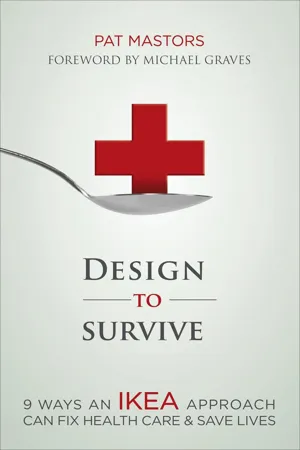
The US spends the most in the world on health care and research, yet our outcomes are among the worst in industrialized nations. Hundreds of thousands die every year from medical harm. Imagine a world where health care took a page from the IKEA furniture company—where expenses were streamlined, quality was predictable, customers participated, and everyone shared in the cost savings.
Through colorful analogies, stories from families and top doctors, and the author's quest to find out what happened to her own father,
Design to Survive serves up key strategies for patients, families and providers, with the conviction that we can do better.
"Had me hooked from the first page . . . chock-full of stories, vital information, checklists, links, and resources . . . a must own for both clinicians and patients." —Fred Lee, author of
If Disney Ran Your Hospital
"A tremendous toolkit for getting safe care . . . Mastors' is a wonderfully pragmatic mind. There is a lot we physicians can learn from her." —Marty Makary,
New York Times–bestselling author of
The Price We Pay
"Brilliant . . . the ideas unfold superbly . . . this could be the book that changes things." —"e-Patient Dave" deBronkart, author of
Let Patients Help
"I couldn't put this book down . . . sensible and practical advice never before shared." —Ilene Corina, The Cautious Patient Foundation
- 195 pages
- English
- ePUB (mobile friendly)
- Available on iOS & Android
eBook - ePub
About this book
Information
1
If IKEA designed health care…

we would always feel welcome
Like any store, we hope our customers will want to come back. It is the role of customer service co-workers to encourage this, by…being tuned in to the customers’ needs—before, during, and after a purchase… It’s not only about being friendly and helpful to customers, but concerns store accessibility, rest and recreation areas, diaper-changing facilities, and call centers.
—from the IKEA website
IKEA is doing something right. Customers have made it the world’s largest furniture retailer. Founded in 1943 by seventeen-year-old Ingvar Kamprad in Sweden, there are 338 stores in 40 countries (including 38 stores in the United States). In the fiscal year ending August 2012, 776 million visitors worldwide plunked down 27.5 billion euro ($36.4 billion US dollars). That’s nearly enough money to hand a five-dollar bill to every man, woman, and child on earth. The company published 212 million catalogs in 29 languages—the most widely circulated publication in the world.46 It’s estimated up to one in ten Europeans is conceived in a bed made by the company. And in the UK, market analyst Mintel estimates that more than two-thirds of Brits visit IKEA more regularly than they go to church.47
Today, IKEA founder Ingvar Kamprad, nearly 88 at this writing, lets his three sons mostly run the place, but IKEA is still very much a reflection of his vision and values.48 While other Swedish boys were reading comics, young Ingvar Kamprad pored over mail order catalogs. He began to sell matches and fish, and in 1943, at the age of seventeen, registered his own mail-order firm under the name IKEA—an acronym of his name and the farm (Elmtaryd) and parish (Agunnaryd) where he grew up. He started out selling pens, Christmas cards, and seeds from a shed on his family’s farm in southern Sweden. In 1951, the first catalog appeared. He soon decided to concentrate on furniture, and an empire was launched.
Never been to an IKEA store? They’re big-box stores, painted blue and yellow on the outside (the colors of the Swedish flag). Cavernous showrooms display furniture as though you’re walking into someone’s house—because they want you to feel at home.
When you enter, you pick up a pencil and paper, a map, a measuring tape, and a catalog (at some stores, a friendly greeter hands them to you). You can also grab a cart and an oversized bag for your purchases. If you forget any of this stuff—no worries. They’re placed conveniently throughout the store. If you choose, you can drop off the kids at “Smaland”, where they can watch a movie, color pictures, or play with toys. There’s a secure check-in process, and parents get an armband and a pager. They’ll alert you if little Johnny needs you sooner than expected.
Stroll along the designated path painted on the floor, displayed on the signage, and outlined in your map. You won’t get lost, but it will take you past every corner of the store (there are shortcuts, shown on the map). Signs encourage you to linger over, touch, and try out each product, to flop on the chairs and stretch out on the sofas. Each item is clearly marked with a bold, black-on-white price tag. Want to buy it? Write down the aisle and bin number (also on the tag) on the paper grid provided. The wide-open spaces where customers stroll—nicely lit and filled with fully decorated rooms showcasing clever use of space—means no bumping your ankles around too-tight corners, and no worries about blocking the way for the shoppers behind you. Sit and linger at any time you choose. There’s a colorful, hands-on kids’ section, and a cafeteria selling food that’s “tasty, uncomplicated and GOOD FOR YOU!”
Chat in our kitchens. Lie in our beds. Play with our elephants.
—from the IKEA website
Toward the end of the journey is an open-shelf “Market Hall” for smaller items. Then it’s on to the “Self Serve” furniture warehouse to collect the stuff whose description and location you wrote down along the way (it’s all stacked to the ceiling in flat-pack form). Finally, you maneuver your cart to a cash register and pay for it (no bags or bagging; it’s do-it-yourself, but they’ll sell you big cloth bags with their logo), and load your booty into or on top of your car (twine provided free in a dispenser). Once home, armed with simple tools and an instructional pamphlet, you build the furniture yourself.49
Why do people put up with going through what one anonymous blog comment called “a retail digestive tract”? Well, it’s cheap! You can get an 18-piece FARGRIK dinnerware service for 6 for $24.99, a HELMER 6-drawer chest for $39.99, or an entire 108-square-foot kitchen with appliances for $3,119.
But IKEA did not build its empire on “cheap” alone. Its other company mantras are high quality and good design. That’s how IKEA has become the darling of newlyweds, college students (and their parents), people living on a budget, and anyone who just likes its clean design lines, efficiency, and “green” sensitivity.50
Icons are always targets for potshots, and IKEA is no exception. One observation is that “IKEA” is Swedish for “particleboard,” though comedienne Amy Poehler reportedly said it’s Swedish for “argument” (because that’s what assembling the furniture can lead to). Cartoons discovered on the web show an IKEA sign stuck in a field of new-fallen snow boasting “free snowmen,” and an IKEA do-it-yourself leather couch that comes with two parts: a cow and a saw. Pranksters have offered up do-it-yourself assembly instructions online on how to make a HOUS, a BABI, or even a DILORIANN. Some of IKEA’s Swedish product names have amusing or unfortunate connotations in other languages. The company has responded by quietly withdrawing them, including these products from English-speaking markets: the “Jerker” desk, “Fukta” plant spray, and “Fartfull” workbench.
IKEA fans are quirky and imaginative: there’s a website called IKEAfans.com, unaffiliated with the company but devoted to, well, fans of IKEA, their questions and projects. Then there’s IKEAhackers.net, a site connecting and showcasing the work of “hacks” who cobble together unique masterpieces from various furniture and product components. There’s even the “Swedish Furniture Name Generator” at Blogadilla.com, where you enter your first name and it creates your Swedish furniture name. (I tried it; I am PATRYKA, a plain wooden dining chair.)
IKEA has evolved to be not just a company, but a culture:
Perhaps more than any other company in the world, IKEA has become a curator of people’s lifestyles, if not their lives. At a time when consumers face so many choices for everything they buy, IKEA provides a one-stop sanctuary for coolness. It is a trusted safe zone that people can enter and immediately be part of a like-minded cost/design/environmentally-sensitive global tribe. There are other would-be curators around—Starbucks and Virgin do a good job—but IKEA does it best.
If the Swedish retailer has its way, you too will live in a BoKlok home and sleep in a Leksvik bed under a Brunskära quilt. (Beds are named for Norwegian cities; bedding after flowers and plants.) IKEA wants to supply the food in your fridge (it also sells the fridge) and the soap in your shower.
—Bloomberg BusinessWeek, November 2005
Kamprad describes the objectives for the Swedish furniture maker’s “democratic design” as the trinity of attractive form, inexpensive production, and high function. That idea, combined with what Kamprad calls “the underdog’s obsession with always doing the opposite of what others were doing,” impelled him and his young, risk-taking associates along a path of constant innovation and experimentation.
Compare this mission to the “Triple Aim” of health care, as described by the Cambridge-based Institute for Healthcare Improvement (IHI), a leading voice in health care quality: “Improving the health of the population, enhancing the patient-care experience, and reducing the per capita cost of care.” Interestingly, whether by accident or cosmic alignment, the goals of good health care have, at least on paper, a striking commonality with the goals of IKEA.
IHI: “The Triple Aim” | IKEA: “The Trinity” |
Improve Health of the Population | High Function |
Enhance the Patient-Care Experience | Attractive Form |
Reduce the Per Capita Cost of Care | Inexpensive Production |
IKEA stores, with their abundant, clearly marked customer parking; warm, inviting showrooms; smell of cinnamon buns baking as you enter; and attention to customers’ needs throughout their visit project a feeling of welcome.
Hospitals vary widely in the ways their environments and staff project that “welcome feeling.” However, too many have cheerless environments, poorly marked signage, and other traits that project an institutional, intimidating feel. The experience of David Goldhill, related in his article “How American Healthcare Killed My Father” will sound sadly familiar to many51:
Keeping Dad company in the hospital for five weeks had left me befuddled. How can a facility featuring state-of-the-art diagnostic equipment use less-sophisticated information technology than my local sushi bar? How can the ICU stress the importance of sterility when its trash is picked up once daily, and only after flowing onto the floor of a patient’s room? Considering the importance of a patient’s frame of mind to recovery, why are the rooms so cheerless and uncomfortable? In whose interest is the bizarre scheduling of hospital shifts, so that a five-week stay brings an endless string of new personnel assigned to a patient’s care? Why, in other words, has this technologically advanced hospital missed out on the revolution in quality control and customer service that has swept all other consumer-facing industries in the past two generations?
Where true, there are many reasons for this, some relating to the notion that the insurance company, and not the patient, is the true customer of health care (more on that in chapter 6). But we’d be remiss not to point out that there are exceptional hospitals today that make the IKEA “welcome” pale in comparison.
The Dell Children’s Medical Center of Central Texas, for instance, welcomes patients with healing, interactive artwork; a constellation of stars on the ceiling (and little telescopes along the railings); an aquarium; water elements; and no less than seven gardens, one of them spanning three acres and including a reflecting pond and bridge. Florida Hospital for Children in Orlando has a Disney partnership; Mickey and Donald Duck often drop in to visit. For adults and children, the Planetree organization insists on exacting standards for its hundreds of member hospitals. Its flagship hospital in Derby, Connecticut has a saltwater aquarium, music lounge, and a healing garden. Pediatric patients are whisked to procedures in bright red, cushioned Radio Flyers. (Planetree hospitals also empower patients by inviting them to read their own medical charts at any time and ask questions of their physician and nurse about what they read.)
More and more hospitals are offering valet parking, glass-and-granite lobbies, plush furnishings, upscale cafes, and for those who can afford it, much more. Singer Beyonce’s VIP hospital suite, where she gave birth to baby Blue Ivy in January 2012, featured clubby furniture, a kitchenette, and flat-screen TV (actually four TVs; apparently she booked four suites together). Cedars-Sinai Medical Center in Los Angeles promises “the ultimate in pampering” in its $3,784 maternity suites. One wing in New York Presbyterian/Weill Cornell has a penthouse wing with Frette bed linens, marble bathrooms, uniformed butlers, and elegant menu choices like hand-sliced smoked salmon with cucumber-yogurt-dill sauce, and filet of cod rollatini baked in lemon wine sauce.52 Such lavish amenities are meant to attract top-paying patients (like the Saudi King who reportedly booked the entire fourteenth floor of the hospital in late 2011).53
But more often, hospitals face challenges in improving the “customer-facing” aspects of their institutions. Upgrades and staff’ cost money. Belt-tightening from non-reimbursed care and new regulations mean many hospitals are operating with the thinnest of profit margins. Some hospitals are stuck with aging infrastructures (anyone who’s rehabbed an old house knows how pricey and tricky renovations can be). Buildings went up before the need for big parking lots, meaning a patient may have to park a great distance from the entrance, perhaps risk a parking ticket, and then wind their way throug...
Table of contents
- Cover
- Title
- Copyright
- Dedication
- Contents
- Foreword by Michael Graves
- Preface
- Introduction: My Story
- 1 we would always feel welcome
- 2 instructions would be understandable to a fifth grader
- 3 a one-stop website would help us learn, connect, and plan
- 4 we’d get tools for success when we walked in the door
- 5 we customers would have to roll up our sleeves and help
- 6 prices would be clearly marked…and we’d pay our own bills
- 7 the team that serves us would act more team-like
- 8 hackers (the good kind) would thrive
- 9 it would live to innovate
- Final Thoughts
- Afterword by Pat Mastors and Michael Millenson
- Resources
- Acknowledgments
- About the Author
- Endnotes
Trusted by 375,005 students
Access to over 1.5 million titles for a fair monthly price.
Study more efficiently using our study tools.
Frequently asked questions
Yes, you can cancel anytime from the Subscription tab in your account settings on the Perlego website. Your subscription will stay active until the end of your current billing period. Learn how to cancel your subscription
No, books cannot be downloaded as external files, such as PDFs, for use outside of Perlego. However, you can download books within the Perlego app for offline reading on mobile or tablet. Learn how to download books offline
Perlego offers two plans: Essential and Complete
- Essential is ideal for learners and professionals who enjoy exploring a wide range of subjects. Access the Essential Library with 800,000+ trusted titles and best-sellers across business, personal growth, and the humanities. Includes unlimited reading time and Standard Read Aloud voice.
- Complete: Perfect for advanced learners and researchers needing full, unrestricted access. Unlock 1.5M+ books across hundreds of subjects, including academic and specialized titles. The Complete Plan also includes advanced features like Premium Read Aloud and Research Assistant.
We are an online textbook subscription service, where you can get access to an entire online library for less than the price of a single book per month. With over 1.5 million books across 990+ topics, we’ve got you covered! Learn about our mission
Look out for the read-aloud symbol on your next book to see if you can listen to it. The read-aloud tool reads text aloud for you, highlighting the text as it is being read. You can pause it, speed it up and slow it down. Learn more about Read Aloud
Yes! You can use the Perlego app on both iOS and Android devices to read anytime, anywhere — even offline. Perfect for commutes or when you’re on the go.
Please note we cannot support devices running on iOS 13 and Android 7 or earlier. Learn more about using the app
Please note we cannot support devices running on iOS 13 and Android 7 or earlier. Learn more about using the app
Yes, you can access Design to Survive by Pat Mastors in PDF and/or ePUB format, as well as other popular books in Medicine & Pharmaceutical, Biotechnology & Healthcare Industry. We have over 1.5 million books available in our catalogue for you to explore.