"An incredibly powerful account of a little-known chapter in the Vietnam War saga" written by a CIA veteran who fought in the Secret War (
Booklist, starred review).
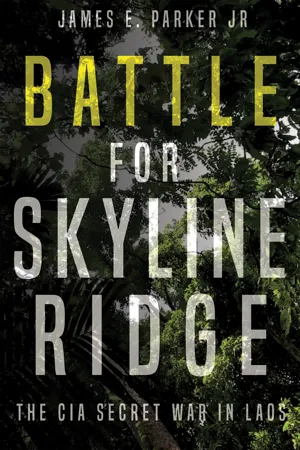
In the 1960s and '70s, the Laotian Civil War became a covert theater for the conflict in Vietnam, with the US paramilitary backing the Royal Lao government in what came to be known among the CIA as the Secret War. In late 1971, the North Vietnamese Army launched Campaign Z, invading northern Laos on a mission to defeat the Royal Lao Army. General Giap had specifically ordered the NVA troops to kill the CIA army and occupy its field headquarters in the Long Tieng valley.
The NVA faced the small rag-tag army of Vang Pao, mostly Thai irregulars recruited to fight for the CIA. But thousands more were quickly recruited, trained, and rushed into position in Laos to defend against the impending NVA invasion. Despite overwhelming odds in the NVA's favor, the battle raged for more than one hundred days—the longest battle in the Vietnam War. In the end, it all came down to Skyline Ridge. Whoever won Skyline, won Laos.
Historian James E. Parker Jr. served as a CIA paramilitary officer in Laos. In this authoritative and personal account, Parker draws from his own firsthand experience as well as extensive research into CIA files and North Vietnamese after-action reports in order to tell the full story of the battle of Skyline Ridge.
- 225 pages
- English
- ePUB (mobile friendly)
- Available on iOS & Android
eBook - ePub
About this book
Information
Topic
HistoireCHAPTER 1
Origins
It has become cliché to call Laos a buffer. But, at its core, that’s hardly wrong. It is a landlocked geographic “comma” of land that for half a century provided convenient stand-off space between the French-held Vietnamese colonies to the east, Britain’s Burmese interests to the west, and the assertive Thai kingdom to the southwest. The French colonialists created the protectorate of Laos in the final decade of the 19th century. Not surprisingly, the peoples inside those arbitrary boundaries had little concept of a unitary nation-state. The lowland Lao that populated the east bank of the Mekong River were the more pastoral cousins of the Thai on the opposite bank. Like the Thai, they had given rise to local, albeit less opulent, royalty. Scattered to the south were pockets of Lao Theung, a generally darker people believed to be descendant from the original inhabitants of the area that had migrated south in prehistoric times. And sprinkled among the hills of the north was a patchwork of dozens of tribes from later southern migrations out of China.
Working with what they had, the French elevated the royal family in Luang Prabang to national-level monarchs for all of Laos. They made some minimal efforts to develop the towns along the Mekong, with Vientiane made the administrative capital; more often than not, they brought in hard-nosed Vietnamese to handle civil servant jobs. The mountainous countryside was largely afforded benign neglect, which suited the fiercely independent tribesmen just fine.
This situation persisted until World War II, when the spark of nationalism in Indochina was stoked by the Imperial Japanese. This spread like wildfire among the Vietnamese, though to a lesser degree in the Lao and Cambodian territories.
When World War II ended and the bloodied French attempted to reassert a grip over their far-flung colonies, they clashed head-on with these Southeast Asian nationalists. Complicating matters, the nationalists were mostly in the communist camp, which suddenly gave France’s pacification effort new urgency in the context of the Cold War.
The ensuing struggle in Indochina did not go well for the French. Despite pouring in troops and equipment, France’s war effort always seemed a step behind. By contrast, the communist Vietnamese forces, known as the Viet Minh, went from strength to strength. By 1952, the Viet Minh were coordinating multi-division operations—a far cry from their guerrilla origins less than a decade earlier.
During the second quarter of 1953, the French had been able to stave off—just—the Viet Minh invasion of northern Laos. Later that fall, intelligence indicated the Vietnamese were again marshaling near the Dien Bien Phu valley. It did not take much of a crystal ball to deduce their intention to once again sally down the Nam Noua and slice into the Lao heartland.
To counter this, beginning in November 1953, French paratroopers began dropping into Dien Bien Phu to preemptively make a series of interlocking hedgehog defenses. Their hope was that they could draw out the Viet Minh for a setpiece battle, then obliterate them with superior firepower. But this hinged on the provision of adequate aerial resupplies—a gamble considering their distance from French airfields to the east.
In the end, the gamble failed. First, the French misjudged their ability to disrupt the Viet Minh supply chain to the battlefield. Dien Bien Phu was 50 miles from the Chinese border through dense and rugged terrain. The French had thought this was a sufficient deterrent for resupplies, but they were wrong. Tens of thousands—possibly hundreds of thousands—of Chinese and Vietnamese porters were mobilized to move munitions and weaponry south. The tops of trees were tied together to form canopied tunnels that hid supply routes from aerial view; log bridges were built below the surface of rivers to conceal them; bicycle companies were organized where men pushed as much as 400 pounds of rice across hundreds of miles of newly cut jungle pathways. French pilots could bomb daily, but still the communist supplies were reaching Dien Bien Phu.
Second, the Viet Minh were able to bring in deadly effective antiaircraft guns. This forced the French pilots to sacrifice the accuracy of their drops—or cancel them outright. For the paratroopers on the ground, shortages began to mount.
Third, the Viet Minh began to exploit their biggest advantage: manpower. Entire divisions began to materialize in the hills around the valley, causing one Foreign Legion captain to compare Dien Bien Phu with a sports stadium:
“The stadium belongs to us, but the bleachers in the mountains to the [Vietnamese].”1
By the end of December 1953, the 12,000 French troops in the Dien Bien Phu valley were staring up at Giap’s 40,000 men dug into the hills that surrounded the valley. The latter bid their time for an entire quarter, painstakingly digging concealed artillery positions and stocking ammunition. They finally kicked off a massive bombardment in March 1954, immediately followed by a ground assault. As this cycle repeated, the French saw their perimeter slowly contract with each attack. Meantime, antiaircraft fire was taking a toll, making for fewer resupplies.
Fierce fighting raged through April, the French losing ground almost every day. They persisted until May 7 before succumbing to the inevitable. Trapped in dwindling number of bunkers, the remaining 10,000 French troops were overwhelmed and captured, many of them with horrific wounds.2
A quarter of a world away, senior diplomats gathered in Geneva on May 8 to discuss unresolved issues in Korea and Indochina. Not surprisingly, the fall of Dien Bien Phu dominated conversation. That same day Dien Bien Phu fell in Vietnam, in Paris, the French government resigned, and the new prime minister supported France’s complete withdrawal from Indochina.
With new urgency, the focus at the Geneva Conference became hammering out a roadmap for the future of Indochina. The resulting accords signed on July 21 partitioned Vietnam roughly into two zones divided at the 17th Parallel. The northern half was to be administered by the communist Democratic Republic of Vietnam (DRV) based out of Hanoi, while the southern half was to become the Republic of Vietnam, headed initially by former Emperor Bao-Dai in Saigon, though soon controlled by the Catholic mandarin Ngo Dinh Diem.3
This separation was supposed to be temporary. The communist attendees at the conference insisted that the two zones be reunited through national elections in 1956. The U.S. and South Vietnamese delegates waffled, both because most of the population lived in the north and because they felt the dictatorial northern administration would not allow free polls. Moreover, they believed the new government in the south needed more time to get its footing.
In the end, the U.S. refused to ratify the Accords but pledged to abide by its stipulations. For one, U.S. President Dwight Eisenhower saw some merit in the agreement. Ever the general, he realized the clear military vantage if North Vietnam could only directly threaten the non-communist south from across a 60-mile-wide demilitarized zone at the 17th Parallel. This, of course, hinged on Laos remaining outside of Hanoi’s orbit and the U.S. retaining the ability to exert some influence over that kingdom. Eisenhower himself had presaged this a year earlier when he observed, “[If Laos is lost] we will likely lose the rest of Southeast Asia and Indonesia.”
Suddenly on its own, land-locked, backwater Laos was thrust into the spotlight on the world stage.

The Geneva Accords allowed a 300-day grace period, ending on May 18, 1955, in which people could move freely between the two Vietnams before the border was sealed. Over the course of that period a mass migration of northerners to the south was facilitated by the French, who transported an estimated half a million indigenous civilians and soldiers, most of the latter veterans of the colonial army. The U.S. Navy assisted in lifting an additional 310,000 people, while untold others found their own way out of North Vietnam. All told, a million left the DRV, including 60 percent of the north’s Catholics.
Once the grace period expired, there were limited options for travel between the two Vietnams. Stealing across the heavily patrolled and mined demilitarized zone was hardly viable. The sea route was barely better, as the South seemed up to the task of monitoring its coastline.
As Eisenhower had observed earlier, the remaining option was a land route snaking through Lao territory. When the Geneva Accords were promulgated in 1954, all that existed down the Lao panhandle were primitive footpaths susceptible to the mercies of the rainy season. But just as they had proved at Dien Bien Phu, Hanoi was up to the geographic challenge and, slowly at first, began moving limited numbers of men down the spine of Laos during the second half of the 1950s.
Complicating matters was the political situation in Laos itself. Suddenly independent, the Kingdom of Laos had to struggle with building an infrastructure in a land dominated by mountains. They needed to cobble together an effective military in a neighborhood stacked with bigger and better armies. They needed to instill a sense of nationalism among a largely indifferent population led by novice politicians.
Worse, Hanoi had been patiently nurturing a communist Lao proxy, colloquially known as the Pathet Lao. As per Geneva, the Pathet Lao were to gather within Sam Neua and Phongsaly provinces before disbanding. In reality, just two months after Geneva the North Vietnamese established a covert advisory group in Sam Neua to train and equip more armed Pathet Lao allies. Rather than leaving as stipulated in the Accords, the Vietnamese continued their training mission unabated.
The Eisenhower administration generally recognized these challenges and saw the important role that Laos needed to play on mainland Southeast Asia. Too, Washington acknowledged the need to tread softly because, despite its humiliating defeat, the French stubbornly viewed Laos as within their ongoing sphere of influence. This was abetted by Geneva, which recognized France’s sole right to maintain a military training mission in the kingdom.
The solution, decided Washington, was to honor the spirit of Geneva while sometimes hedging on its letter. To circumvent a prohibition on setting up a military advisory group, in 1955 the embassy in Vientiane established a Programs Evaluation Office (PEO) with military men sheep-dipped as civilians. They soon began arranging for the delivery of equipment for the Royal Lao armed forces. The French—and everyone else—saw through the PEO’s weak façade, but welcomed the supply effort as a corollary to their own military training mission.
On a somewhat more discreet basis, in June 1955 the handful of Central Intelligence Agency (CIA) case officers targeting Laos were whipsawed by a wide range of tasks. Some of their time was spent mentoring the fledgling Lao intelligence service. Other time was spent engaging with an anti-communist Young Turks movement that had taken shape in 1958, talent spotting from among the crop of young, enthusiastic, and in the main, pro-American politicians, civil servants, and army officers.
Still other case officers had their focus directed toward civic action programs in the countryside. This was being done both to win hearts and minds ahead of upcoming local polls, and to identify and mold promising officials across the outlying districts. It was during one such civic action foray into the mountainous northeast that a case officer named Stu Methven struck pay dirt.4
CHAPTER 2
Enter Vang Pao
As part of a civic action effort supported by the CIA, Stu Methven in early 1960 began a series of rural jaunts, to include Xieng Khouang Province. One of those trips would take him to Ban Ban, a tiny dot of a village off the northeastern edge of the Plain of Jars (Plaine des Jarres, or PDJ). Some 300 square kilometers, the wind-swept PDJ was a strategic crossroads surrounded by rugged mountains in the center of Xieng Khouang. As its name implied, it was dotted by hundreds of massive stone jars dating back to a forgotten Iron Age civilization. The original purpose of the jars is unknown, though a common theory holds that they were burial urns.
The mountains around the PDJ were the land of the Hmong, hearty hill tribesmen who had drifted down from China over the centuries and had diversified into different clans while maintaining linguistic ties that transcended national boundaries. The clans were often identified by the colorful dress and headdress styles of their womenfolk. This made for Green, Blue, Black, Striped, White, Flower and Red Hmong scattered across the mountaintops from northern Burma, to northern Laos, northern Vietnam and southern China.
The White Hmong hill tribe dominated the area around the PDJ. Their political leader was Touby Lee Fong. His military counterpart was a short, wiry officer named Vang Pao. Born around 1928 (the Hmong usually did not keep birth records), Vang Pao hailed from Nong Het, a village northeast of the Plain of Jars just a stone’s throw from the North Vietnamese border. As a teenager near the end of World War II, he had assisted the French in keeping the Viet Minh at bay in Xieng Khouang. Showing promise, in 1951 he was the first Hmong allowed to attend the officer training school the French created for the fledgling Lao army (which after a pair of name changes came to be known as Forces Armées du Royaume, or FAR) at Dong Hene in southern Laos. As a newly commissioned lieutenant, he was assigned to a FAR unit back in Xieng Khouang. But as the sole Hmong officer, he took on an additional role as leader among the pro-French hill tribe partisans around the Plain of Jars. He was part of the guerrilla relief column dispatched toward the doomed Dien Bien Phu garrison in 1954; though the mission fell short, Vang Pao burnished his credentials as a fearless leader in combat.
As of early 1960, Vang Pao sported the rank of major and had been placed in charge of the 10th Infantry Battalion on the Plain of Jars. When Methven arrived at Ban Ban and met the major he was immediately impressed. “Although [Vang Pao] had been walking for two days to get there, he didn’t seem tired.” Indeed, the Hmong major seemed full of energy, shifting back and forth on the balls of his feet.
Speaking halting French, Methven launched into his political pitch about nation building. Vang Pao, however, was having none of it. Holding up his hand, he said he wanted to discuss the grave situation for his Hmong. Pinning blame on the French, who he said had disarmed thousands of partisans and left them to the tender mercies of the communists, he appealed for American help. In particular, the residents of his home village, Nong Het, were cold and hungry after marauding North Vietnamese had wrangled their few herds of cattle.
Methven sympathized with the forceful hill tribesman, but did not want to oversell his ability to help. He told Vang Pao that he could not feed the Hmong nation, nor could he send out a retaliatory posse against the North Vietnamese rustlers. Vang Pao’s face visibly fell flat. Sensing their conversation was heading south, Methven offered some modest alternatives. He could look to supply rice—perhaps a few tons—as well as blankets, some medical kits, radios, and maybe some carbines and pistols for the Hmong village chiefs.
Vang Pao was agreeable, but had one further special request. “Une enclume,” he told the CIA advisor.
Methven struggled, his comprehension of French insufficient to grasp the term. Looking to make himself understood, Vang Pao began to pantomime. He wanted an object that was like a block, flat on top, pointed at one end. Methven slap...
Table of contents
- Cover
- Title
- Dedication
- Contents
- Author’s Note
- Preface
- Chapter 1: Origins
- Chapter 2: Enter Vang Pao
- Chapter 3: Spanner in the Works
- Chapter 4: Test of Concept
- Chapter 5: Air America
- Chapter 6: Geneva Accords, 1962
- Chapter 7: The Secret War Takes Form
- Chapter 8: Relegated to the Shadows
- Chapter 9: LS 36 and LS 85
- Chapter 10: The Mighty Ravens
- Chapter 11: 1968
- Chapter 12: About Face
- Chapter 13: 1970
- Chapter 14: The Royal Thai Army’s 13th Infantry Regiment
- Chapter 15: The Tahan Sua Pran
- Chapter 16: Campaign 74B
- Chapter 17: St Valentine’s Day Massacre and the Thai Irregulars to the Rescue
- Chapter 18: Back to the PDJ
- Chapter 19: PDJ Fight
- Chapter 20: Phase II Skyline
- Chapter 21: January 14, 1972
- Chapter 22: Phase II Skyline
- Chapter 23: VP’s End-Around
- Chapter 24: Hill 1800
- Chapter 25: Sam Thong and CC Pad Falls
- Chapter 26: Final Showdown at CC and CB
- Chapter 27: So What Happened?
- Epilogue
- Appendix The Aircraft over Northern Laos
- Notes
- Bibliography
- Copyright
Trusted by 375,005 students
Access to over 1.5 million titles for a fair monthly price.
Study more efficiently using our study tools.
Frequently asked questions
Yes, you can cancel anytime from the Subscription tab in your account settings on the Perlego website. Your subscription will stay active until the end of your current billing period. Learn how to cancel your subscription
No, books cannot be downloaded as external files, such as PDFs, for use outside of Perlego. However, you can download books within the Perlego app for offline reading on mobile or tablet. Learn how to download books offline
We are an online textbook subscription service, where you can get access to an entire online library for less than the price of a single book per month. With over 1.5 million books across 990+ topics, we’ve got you covered! Learn about our mission
Look out for the read-aloud symbol on your next book to see if you can listen to it. The read-aloud tool reads text aloud for you, highlighting the text as it is being read. You can pause it, speed it up and slow it down. Learn more about Read Aloud
Yes! You can use the Perlego app on both iOS and Android devices to read anytime, anywhere — even offline. Perfect for commutes or when you’re on the go.
Please note we cannot support devices running on iOS 13 and Android 7 or earlier. Learn more about using the app
Please note we cannot support devices running on iOS 13 and Android 7 or earlier. Learn more about using the app
Yes, you can access Battle for Skyline Ridge by James E. Parker in PDF and/or ePUB format, as well as other popular books in Histoire & Histoire de l'armée et de la marine. We have over 1.5 million books available in our catalogue for you to explore.