- 256 pages
- English
- ePUB (mobile friendly)
- Available on iOS & Android
eBook - ePub
About this book
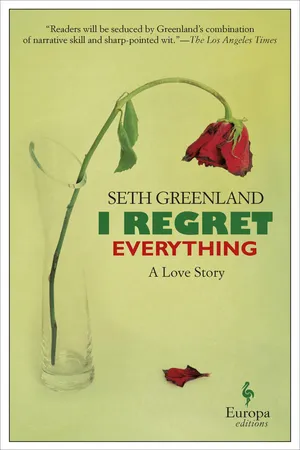
From the author of The Angry Buddhist: "An intoxicating and ultimately moving modern romance . . . A story that's all the sweeter for its shadows" ( Los Angeles Review of Books).
I Regret Everything confronts the oceanic uncertainty of what it means to be alive, and in love. Jeremy Best, a Manhattan-based trusts and estates lawyer, leads a second life as published poet Jinx Bell. To his boss's daughter, Spaulding Simonson, at thirty-three years old, Jeremy is already halfway to dead. When Spaulding, an aspiring nineteen-year-old writer, discovers Mr. Best's alter poetic ego, the two become bound by a devotion to poetry, and an awareness that time in this world is limited. Their budding relationship strikes at the universality of love and loss, as Jeremy and Spaulding confront their vulnerabilities, revealing themselves to one another and the world for the very first time.
A skilled satirist with a talent for biting humor, Seth Greenland creates fully realized characters that quickly reveal themselves as complex renderings of the human condition—at its very best, and utter worst. I Regret Everything explores happiness and heartache with a healthy dose of skepticism, and an understanding that the reality of love encompasses life, death, iambic pentameter, regret, trusts, and estates.
"Affecting and funny." — The New York Times
"Edgy and sweet, witty and wise, I Regret Everything is rollicking good fun. It's also, in the end, a deeply moving love story between two unforgettable characters discovering what it means to truly be alive." —Maria Semple, New York Times–bestselling author of Where'd You Go Bernadette
"A poignant story of dreams and the way they can crash into the reality of the dreamers." — Booklist
Trusted by 375,005 students
Access to over 1.5 million titles for a fair monthly price.
Study more efficiently using our study tools.
Information
Brodsky: Poet. Poet and translator.
Judge: Who said you were a poet? Who assigned you that rank?
Brodsky: No one. Who assigned me to the human race?
—from the trial of the poet
JOSEPH BRODSKY
JEREMY
Trusts and Estates
It would be easy to say my troubles began when a mysterious woman walked into the office but that would ignore the time freshman year in college when Aunt Bren called to let me know my mother had removed all of her clothes in the furniture department at Macy’s and been taken to Bellevue. Besides, a sentence like my troubles began when a mysterious woman walked into the office veers into private-eye territory and my work did not in any real way resemble that of a private eye. As an attorney with a trusts and estates practice, courage and love of danger did not thrum in my breast, only caution and prudence. Clients relied on me to structure their assets in such a way that by the time they were no longer living, every opportunity had been taken to protect their heirs, charities, and legacies. Generation-skipping trusts, real estate trusts, blind trusts, wills, codicils, prenuptial agreements, and tax planning were my territory. I counseled captains of industry, advised widows and offspring. Life with an unstable parent taught me there were times a person’s affairs were a baffling wilderness. It was my job to tame the anarchic trees, mutating vines, and proliferating stinkweed into a fragrant, orderly garden through which the beneficiaries could one day stroll.
Running parallel to my legal work, albeit at a more leisurely clip, was my career as a poet. These seemingly divergent fields appear irreconcilable but there was more overlap than one would think. If a poet crafted something eternal out of the chaos of the universe, so, too, did the writer of a last will and testament. All of an individual’s doubts, certainties, accomplishments, failings, accumulations, divestments, judgments, values, and, finally, wishes for the future were distilled into the lucid prose of a binding document. There was no brief to be made for the aesthetic magnificence of such a text, but as something that wrung order from the unruliness of life, it had its own subtle beauty.
Like the law, poetry was a competitive endeavor. There were hierarchies, cliques and claques; the same kind of snaky infighting and competition found in most professions. I lost a pitched battle for the editorship of the literary magazine at Sarah Lawrence to an (admittedly, equally qualified) African-American lesbian who employed a virtuosic campaign of implication and innuendo to convince our well-meaning colleagues that my heterosexual orientation marked me as a congenital oppressor. There was a terrific collection of talent on the staff yet few of the aspiring scribblers had the stomach to make a profession of it (my former nemesis went on to become a consultant for McKinsey). To me literature was more than just a viable if challenging vocation. It was a mission, a statement about the manner in which I intended to live: heightened, luminous, and free of the constraints that bound my more timorous classmates. My student loans were Himalayan but there would be time enough to pay them back.
In the poetry racket, anyone that aspired to be taken seriously had to get an MFA. I was accepted to the program at the University of Iowa but dropped out in the spring of my first year due to an entirely avoidable imbroglio with my advisor. Immediately, I returned to New York and got a sublet on the Lower East Side. A job as a proofreader on the lobster shift gave me time to write and with a handful of published poems meant to compensate for a nonexistent MFA, I applied for university teaching positions. But this youth-inflamed enthusiasm proved to be temporary because after much sobering cogitation on the realities of academia (teaching posts were not forthcoming), a growing uncertainty about devoting my entire life to a quixotic dream, and my former graduate school advisor’s vow to do everything in his power to prevent me from ever obtaining employment, I was forced to change course.
Despite my professional shift from literature to law, I kept a foot in both worlds but with a twist. Although my given name was Jeremy Best, my poetry was published (in the kind of literary review whose prestige exists in inverse proportion to its circulation) under the name Jinx Bell. Simple. American. And the same initials as my real name. This might strike one as odd, or at the very least eccentric, since we live in an age whose defining characteristic is an unrestrained mania for self-promotion. But for me, keeping this aspect of my existence private heightened its value. Imagine having thousands of gold coins hidden in a safe. I was rich and the world none the wiser. My co-workers and clients had no idea I was a poet.
On a humid June afternoon a scrim of rain obscured the buildings across Third Avenue just north of 63rd Street. My twentieth-floor office was standard for a senior associate, a boxy white-walled space overlooking southern Manhattan. There were no framed degrees, no art on the walls. Nestled in the corner of a bookshelf next to the annually issued compendium of all New York Surrogate’s Court rules, regulations, and statutes in the trusts and estates area known as “the Greenbook” was a row of first editions signed by famous poets, the sole intimation of my other life.
A hefty Indian-American woman, thirty years old, stood in front of my desk. She wore a loud floral print sleeveless dress from which a white bra strap protruded. Reetika Mehta, member of Actors’ Equity and currently appearing at Thatcher, Sturgess & Simonson as my secretary. We had been working together for five years. As a poet with a little bit of money, I believed in supporting other artists. I fantasized about creating a grant-giving organization—the Best Foundation—but since that hadn’t yet happened, Reetika Mehta was my beta version. If she was in a show at a nonprofit theater, I would buy a ticket and make a generous contribution. Whenever there was an audition, if at all possible, it was break a leg and off you go.
Reetika informed me that one client was coming in to discuss a bequest to the New York Philharmonic, another to set up a trust. A mother and her adult son wanted to talk about a Fifth Avenue co-op they had inherited.
“They’re the co-owners per the will, her husband, his father,” Reetika said. “Mrs. Fitzwater wants to sell, her son doesn’t.”
This was our routine. Because I did not like surprises, Reetika briefed me a day ahead of time. Since I had not married and currently did not have a girlfriend, I welcomed the intimacy my job afforded me. A trusts and estates attorney traffics in people’s deepest desires, secrets, and fears. This father favors his daughter over his son? I will glean it. That wealthy wife loves the child of her first marriage more than her current husband? She might not tell me outright but I will know. The anxious uncle of the profligate nephew, the adult child fretting over a mother with incipient dementia whose age-spotted hands still hold the financial reins in a death grip, the devoted husband with a mistress of thirty years’ standing that he does not want to leave out of his will? Each saga was revealed.
“Can’t the Fitzwater family see a therapist?”
“I’ll suggest that in an email.” Reetika raised an eyebrow and I nodded in acknowledgment. Her presence brightened the essential dreariness of a law office. I rooted for her to get cast in a show but lived in fear of her leaving. Reetika could have been a lawyer but she chose to battle it out with auditions, improv classes, and the relentless disappointment that accumulates in any creative career. It was brave, admirable, and an irritating reminder of my own failure to walk the tightrope without a net.
A few minutes later, while in the middle of drafting a letter to the heirs of my client Brenda Vendler, recently deceased, to inform them of the modest financial bequests coming their way, I looked up and saw the figure of a young woman standing in the hall outside my office. She asked what I was doing, but not in a way that suggested she actually cared.
“Working on the disposition of a will.”
“Your own?”
“Why would you ask that?”
“Because you’re so old.” Her smile was like a basket of kittens just learning to use their claws. “Is it boring?”
She leaned against the doorjamb then glanced down the hall as if she were expecting someone. Turning her attention back to me, she said, “I’m Spaulding Simonson.” It took me a moment to realize this was the daughter of Ed Simonson, managing partner of the firm. We had met at a party her father threw for new associates. She must have been fourteen at the time.
“I know.”
That revelation was taken entirely in stride, Of course you know, everyone in this place knows, why shouldn’t you? “You’re Mr. Best, right?” I was amazed she could recall the name of an adult casually encountered in the context of a function her father probably forced her to attend. Her voice had dropped an octave since then and had a slightly rusted quality, like she was just getting over a cold contracted on the slopes of Aspen. She was tall, maybe 5’8”, and wore a loose green cardigan sweater over a white tee shirt, black leggings, and ballet slippers. Her hair, the burnished gold found on coins and in youth and thereafter in bottles, fell in thick ringlets over her shoulders and down to the middle of her back in the manner of a silent movie ingénue. Light freckles dusted her pale cheeks and chocolate eyes peered from behind tortoiseshell glasses. A multihued purse that appeared to be constructed from the kind of handcrafted fabric rhapsodized over in design magazines hung from her shoulder.
“You have a secret identity,” she said.
Before I could react—How could this exemplar of adolescent cold blood, one whose cultural vectors pointed toward Williamsburg and obscure Internet file-sharing sites, possibly know about my other life?—Spaulding slinked into my office and settled on the couch against the wall perpendicular to my desk.
“You’re Jinx Bell.”
This...
Table of contents
- I Regret Everything
- Acknowledgments
- About the Author
Frequently asked questions
Yes, you can cancel anytime from the Subscription tab in your account settings on the Perlego website. Your subscription will stay active until the end of your current billing period. Learn how to cancel your subscription
No, books cannot be downloaded as external files, such as PDFs, for use outside of Perlego. However, you can download books within the Perlego app for offline reading on mobile or tablet. Learn how to download books offline
Perlego offers two plans: Essential and Complete
- Essential is ideal for learners and professionals who enjoy exploring a wide range of subjects. Access the Essential Library with 800,000+ trusted titles and best-sellers across business, personal growth, and the humanities. Includes unlimited reading time and Standard Read Aloud voice.
- Complete: Perfect for advanced learners and researchers needing full, unrestricted access. Unlock 1.5M+ books across hundreds of subjects, including academic and specialized titles. The Complete Plan also includes advanced features like Premium Read Aloud and Research Assistant.
We are an online textbook subscription service, where you can get access to an entire online library for less than the price of a single book per month. With over 1.5 million books across 990+ topics, we’ve got you covered! Learn about our mission
Look out for the read-aloud symbol on your next book to see if you can listen to it. The read-aloud tool reads text aloud for you, highlighting the text as it is being read. You can pause it, speed it up and slow it down. Learn more about Read Aloud
Yes! You can use the Perlego app on both iOS and Android devices to read anytime, anywhere — even offline. Perfect for commutes or when you’re on the go.
Please note we cannot support devices running on iOS 13 and Android 7 or earlier. Learn more about using the app
Please note we cannot support devices running on iOS 13 and Android 7 or earlier. Learn more about using the app
Yes, you can access I Regret Everything by Seth Greenland in PDF and/or ePUB format, as well as other popular books in Literature & Literature General. We have over 1.5 million books available in our catalogue for you to explore.