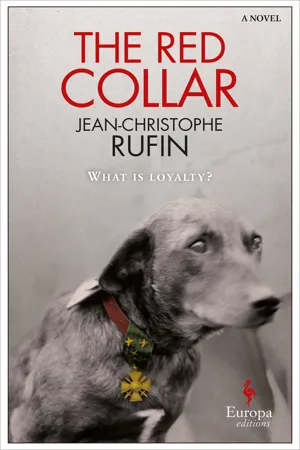
"A beautifully memorable and unusual story about war and what it does to us" from the bestselling author and founder of Doctors Without Borders (
The Independent).
In 1919, in a small town in the province of Berry, France, under the crushing heat of summer, a war hero is being held prisoner in an abandoned barracks. In front of the door to his prison, a mangy dog barks night and day. Miles from where he is being held, in the French countryside, a young extraordinarily intelligent woman works the land, waiting and hoping. A judge whose principles have been sorely shaken by the war is traveling to an unknown location to sort out certain affairs of which it is better not to speak.
Three characters. In their midst, a dog who holds the key both to their destinies and to this intriguing plot.
Full of poetry and life,
The Red Collar is at once a delightfully simple narrative about the human spirit and a profound work about loyalty and love.
"A superbly crafted little gem that does everything a novel can do in less than 150 pages . . . It's a lucky reader who gets to experience the power of
The Red Collar." —
Shelf Awareness
"A graceful, unpretentious little miracle, a morality play of immense skill." —
The Irish Times
"In
The Red Collar, a delicate and poetic novel, Rufin examines that which makes us human." —
L'express (France)
"Without special effects, with simplicity and the pure pleasure of telling a story, Jean-Christophe Rufin explores the meaning of faithfulness, loyalty, and honor." —
Le Figaro (France)
- 160 pages
- English
- ePUB (mobile friendly)
- Available on iOS & Android
eBook - ePub
About this book
Information
Topic
LiteraturaSubtopic
Literatura generalCHAPTER I
At one o’clock in the afternoon, with the crushing heat over the town, the dog’s howling was unbearable. The animal had been there on the Place Michelet for two days, and for two days it had barked. It was a big, brown, shorthaired dog with no collar and a torn ear. It wailed methodically, more or less once every three seconds, making a deep sound that was enough to drive you mad.
Dujeux had thrown stones at it from the doorstep of the old barracks block that had been turned into a prison for deserters and spies during the war. But that was no use. When the dog knew a stone was heading its way, it slunk back for a moment, then set off again all the more loudly. There was only one prisoner in the building, and he didn’t seem to want to escape. Unfortunately, Dujeux was the only guard, and, being conscientious, he felt he couldn’t leave the premises. He had no way of chasing the animal off, or of really frightening it.
No one ventured outside in this scorching heat. The barking bounced from wall to wall through the empty streets. Dujeux briefly considered using his pistol. But it was peacetime now; he wondered whether he had any right to fire a shot like that, in the middle of the town, even at a dog. More importantly, the prisoner could have used this as grounds to set the townspeople even more vehemently against the authorities.
It would be an understatement to say Dujeux loathed this particular inmate. The policemen who’d caught the fellow had formed a poor opinion of him too. He’d put up no resistance when they led him to the military prison, but smiled at them a little too sweetly, which they hated. He came across as so confident he was in the right, as if he’d agreed to come of his own free will, as if he alone could have triggered a local revolution . . .
Perhaps he actually could. Dujeux wouldn’t swear to anything. What did he, a Breton from Concarneau, know about this little place in the Bas-Berry region? He didn’t care for it, that much he knew. The weather was damp all year round and too hot in the few weeks when the sun shone all day. In winter and the rainy seasons the earth exhaled unwholesome mists that smelled of rotten grass. In summer a dry dust hovered over every track, and the small town, which was surrounded on all sides by open country, somehow managed—although no one knew why—to stink of sulfur.
Dujeux had closed the door and now held his head in his hands. The barking was giving him a migraine. With the lack of staff, no one ever came to relieve him. He slept in his office, on a straw mattress that he tidied away in a metal cupboard during the day. He’d had no sleep for the last two nights because of the dog. He was getting too old for this. He genuinely felt that, over the age of fifty, a man should be spared this sort of ordeal. His only hope was that the officer appointed to make the investigation would arrive soon.
Perrine, the girl from the Bar des Marronniers, came across the square morning and evening to bring him wine. He needed to hold out somehow. The girl handed the bottles through the window and he gave her the money without a word. The dog didn’t seem to bother her, and on the evening of the first day she’d even stopped to stroke it. The locals had chosen their camp. And it was not Dujeux’s.
He’d put Perrine’s bottles under the desk and helped himself to them surreptitiously. He didn’t want to be caught drinking if the officer turned up unexpectedly. He was so exhausted by lack of sleep that he couldn’t be sure he would hear anyone coming.
In fact, he must have fallen asleep for a moment because there the man was in front of him when he woke up. Standing in the doorway to the office, strapped into a royal blue tunic that was far too thick for the time of year but was nevertheless buttoned up to the neck, was a tall man who stared down at Dujeux sternly. The guard sat up and, all fingers and thumbs, fastened a few buttons on his jacket. Then he rose to his feet and came to attention. He was conscious of his puffy eyes and the smell of wine on him.
“Can’t you get that mutt to stop?”
These were the military investigating officer’s first words. He was looking out of the window, paying no attention to Dujeux who, still standing to attention, was battling with a wave of nausea and thought it best not to open his mouth.
“Mind you, he doesn’t look dangerous,” the major went on. “When the driver dropped me off, he didn’t move.”
So a car had parked outside the prison and Dujeux hadn’t heard a thing. He’d obviously slept longer than he realized.
The major turned to him and said a rather weary “At ease.” He clearly didn’t put much stock in discipline. He behaved quite naturally, apparently viewing the military trappings of the situation as tiresomely quaint. He took a stick-back chair, turned it around and straddled it, leaning over its back. Dujeux relaxed. He would have liked a slug of wine and, with this heat, the officer might have been happy to join him. But Dujeux dismissed the idea and had to settle for swallowing painfully to ease the tightness in his throat.
“Is he in there?” asked the major, tilting his chin toward the metal door that led to the cells.
“Yes, sir.”
“How many do you have at the moment?”
“Just the one, sir. Since the end of the war, it’s emptied out a good deal . . . ”
That was just his luck, poor Dujeux. With only one customer he should have been able to take it easy. But of course there had to be a dog and it had to howl incessantly outside the prison.
The major was sweating. He deftly undid the twenty or so buttons of his tunic. Dujeux realized he must have buttoned them up just before coming in, to impress him. The major was about thirty years old and, with this war they’d just had, it was quite common to see stripes popping up on men that young. His regulation moustache wasn’t up to growing thickly and looked like a couple of eyebrows under his nose. His eyes were a steely blue, but they were gentle, and almost certainly nearsighted. A pair of horn-rimmed spectacles peeped out of a pocket in his vest. Did he not wear them out of vanity? Or did he want his eyes to have this unfocused look that suspects must have found unsettling during questioning? He took out a checkered handkerchief and mopped his brow.
“Your name, master sergeant?”
“Dujeux, Raymond Dujeux.”
“Did you serve in the war?”
The jailer stood a little taller. This was a good opportunity. He could score a few points, override the sloppy way he was dressed and show that he took no pleasure in this position as jailbird-keeper.
“Indeed I did, sir. I was a chasseur. You wouldn’t know now, I’ve cut off my beard . . . ”
The major didn’t smile so Dujeux plowed on with, “Injured twice. First in the shoulder at Marne, and then in the stomach, as we made our way up to Mort-Homme. That’s why, since then, I’ve . . . ”
The officer waved his hand to show he understood, there was no need to say more.
“Do you have his file?”
Dujeux hurried over to a rolltop desk, opened it and handed a folder to the officer. Its hardbound exterior was deceptive. There were in fact only two documents inside: the policemen’s statement and the prisoner’s military record. The major quickly appraised them. They didn’t tell him anything he didn’t already know. He stood up and Dujeux started reaching for the set of keys. But instead of heading for the cells, the major turned back toward the window.
“You should open this, it’s stifling in here.”
“It’s because of the dog, sir . . . ”
The animal was there in the full glare of the sun, barking insistently. When it stopped to catch its breath, its tongue lolled out and it was obviously panting.
“What is it, what sort of breed, do you think? It looks like a Weimaraner.”
“With all due respect, I’d say it’s more likely a mongrel. We see a lot of dogs like that around here. They’re used to guard the flocks. But they’re hunting dogs too.”
The officer didn’t seem to have heard this.
“Unless it’s a Pyrenean Shepherd . . . ”
Dujeux thought it best not to intervene. Just another aristocrat obsessed with hunting and hounds, one of those country squires who’d done so much damage during the war with their airs and graces, and their incompetence . . .
“Right,” the officer concluded laconically, “let’s get on with it. I’m going to hear what the suspect has to say.”
“Would you like to see him in his cell or should I bring him in here, sir?”
The major glanced out the window. The noise the dog was making was no quieter. At least in the depths of the building the barking wouldn’t be so intrusive.
“In his cell,” he replied.
Dujeux picked up the big ring with the keys threaded onto it. When he opened the door that led to the cells a waft of cooler air came into the office. The breeze might have come from a cellar were it not for a hovering stench of bodies and excrement. The corridor was lit from the far end by a transom window that dripped a cold milky light into the darkness. The place was a collection of old barracks rooms, and heavy locks had been added to the doors to turn it into a prison. The doors hung open to show the empty cells. The last cell down at the end was closed, and Dujeux made a lot of noise opening it, like a walker thumping the ground with his foot to wake snakes. Then he showed the officer in.
A man lay full-length on one of the two bunks, his face turned toward the wall. He was motionless. Dujeux wanted to show a bit of enthusiasm and shouted, “On your feet!” The officer gestured for him to be quiet and to leave them, then went and sat on the other bed and waited a while. He seemed to be gathering his strength, not like an athlete preparing to launch and perform, but rather like someone who has to carry out a chore and isn’t sure he will have the energy for it.
“Good afternoon, Morlac,” he breathed, rubbing the bridge of his nose.
The man didn’t move. Judging by his breathing, though, he clearly wasn’t asleep.
“I’m Squadron Leader Lantier du Grez. Hugues Lantier du Grez. We’re going to have a bit of a chat, if you’d like to.”
Dujeux heard these words and shook his head disconsolately as he returned to his office. Nothing was the same since the war ended. Even the military justice system seemed hesitant, weakened, like this over-friendly young investigating officer. Gone were the days when convicts were shot without a by-your-leave.
The jailer sat back down behind his desk. He felt more relaxed, but didn’t know why. Something had changed. It wasn’t the heat, which actually felt more oppressive after he’d been immersed in the cool of the cells. It wasn’t his thirst, which was becoming more and more intense, and which he decided to slake by cautiously taking a bottle from under his desk. In fact, what had changed was the silence: The dog had stopped barking.
After two days of hell, this was the first moment of quiet. Dujeux darted over to the window to see whether the animal was still there. He couldn’t see it at first. Then, by twisting his head, he could make it out in the shadow of the church, sitting on its haunches, alert but silent.
Since the investigating officer had stepped into its master’s cell, the dog had stopped baying relentlessly.
* * *
The major had opened the file and put it on his knee. He’d perched himself on the bedstead, leaning against the wall. It looked as if he planned on staying quite a while; he had all the time in the world. The prisoner hadn’t moved. He still had his back turned, lying there on his hard bed, but it was obvious he wasn’t asleep.
“Jacques Pierre Marcel Morlac,” the major intoned monotonously. “Born June 25, 1891.”
He ran his hand through his hair as he made his calculations. “So that makes you twenty-eight years old. Twenty-eight years and two months, as it’s August.”
He didn’t appear to wait for any reply before continuing with, “Your official domicile is your parents’ farm, the plac...
Table of contents
- CHAPTER I
- CHAPTER II
- CHAPTER III
- CHAPTER IV
- CHAPTER V
- CHAPTER VI
- CHAPTER VII
- CHAPTER VIII
- CHAPTER IX
- CHAPTER X
- CHAPTER XI
- A TRIBUTE
- ABOUT THE AUTHOR
Trusted by 375,005 students
Access to over 1.5 million titles for a fair monthly price.
Study more efficiently using our study tools.
Frequently asked questions
Yes, you can cancel anytime from the Subscription tab in your account settings on the Perlego website. Your subscription will stay active until the end of your current billing period. Learn how to cancel your subscription
No, books cannot be downloaded as external files, such as PDFs, for use outside of Perlego. However, you can download books within the Perlego app for offline reading on mobile or tablet. Learn how to download books offline
Perlego offers two plans: Essential and Complete
- Essential is ideal for learners and professionals who enjoy exploring a wide range of subjects. Access the Essential Library with 800,000+ trusted titles and best-sellers across business, personal growth, and the humanities. Includes unlimited reading time and Standard Read Aloud voice.
- Complete: Perfect for advanced learners and researchers needing full, unrestricted access. Unlock 1.5M+ books across hundreds of subjects, including academic and specialized titles. The Complete Plan also includes advanced features like Premium Read Aloud and Research Assistant.
We are an online textbook subscription service, where you can get access to an entire online library for less than the price of a single book per month. With over 1.5 million books across 990+ topics, we’ve got you covered! Learn about our mission
Look out for the read-aloud symbol on your next book to see if you can listen to it. The read-aloud tool reads text aloud for you, highlighting the text as it is being read. You can pause it, speed it up and slow it down. Learn more about Read Aloud
Yes! You can use the Perlego app on both iOS and Android devices to read anytime, anywhere — even offline. Perfect for commutes or when you’re on the go.
Please note we cannot support devices running on iOS 13 and Android 7 or earlier. Learn more about using the app
Please note we cannot support devices running on iOS 13 and Android 7 or earlier. Learn more about using the app
Yes, you can access The Red Collar by Jean-Christophe Rufin in PDF and/or ePUB format, as well as other popular books in Literatura & Literatura general. We have over 1.5 million books available in our catalogue for you to explore.