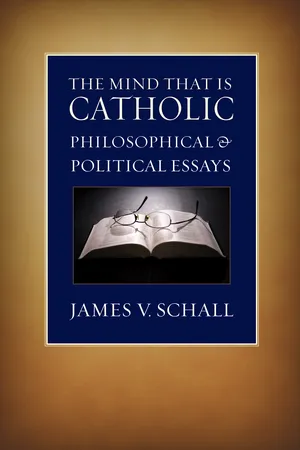
In this wide-ranging collection of philosophical essays, the acclaimed Catholic intellectual presents his vision of Catholic thought applied in the world.
In
The Mind That Is Catholic, political philosopher and Catholic intellectual James V. Schall presents a retrospective collection of his academic and literary essays written in the past fifty years. In these essays, exploring topics from war to friendship, philosophy, politics, and everyday living, Schall exemplifies the Catholic mind at its best.
According to Schall, the Catholic mind seeks to recognize a consistent and coherent relation between the solid things of reason and the definite facts of revelation. It seeks to understand how they belong together, each profiting from the other. It respects what can be known by faith alone, but does not exclude the intelligibility of what is revealed.
In these contemplative and insightful essays, Schall shares a lifetime of study in political philosophy, a wide-ranging discipline and perhaps the most vital context in which reason and revelation meet.
"Father James V. Schall is one of the few renaissance men still among us. His knowledge of various areas of reality and human endeavor is encyclopedic." ?Kenneth Baker, S.J., editor,
Homiletic & Pastoral Review
- 352 pages
- English
- ePUB (mobile friendly)
- Available on iOS & Android
eBook - ePub
About this book
Information
Topic
Theology & ReligionSubtopic
Christian DenominationsPART 1
ON CATHOLIC THINKING
1
THE MIND THAT IS CATHOLIC
This essay was originally intended as a lecture for the Australian Catholic Students' Association Convention in Brisbane in July 2003. Due to illness at the last moment, I was unable to attend. Professor Tracey Rowland kindly read the lecture in my stead. The lecture was published subsequently in Second Spring 7 (2006): 19–25.
The miracles seem in fact to be the great embarrassment to the modern man, a kind of scandal. If the miracles could be argued away and Christ reduced to the status of a teacher, domesticated and fallible, then there'd be no problem. Anyway, to discover the Church you have to set out by yourself…. Discovering the Church is apt to be a slow procedure but it can only take place if you have a free mind and no vested interest in disbelief.
—Flannery O'Connor, “Letter to Cecil Dawkins, July 16, 1957”
The mind is an infinity, even if it is an infinity of nonsense. The mind of man is divine, even in the unfathomable nature of its darkness. Men can think of anything seriously, however absurd it is. Men can believe anything, even the truth.
—G. K. Chesterton, “Fancies and Facts”
I.
Near the end the sixth of C. S. Lewis's Chronicles of Narnia, entitled The Magician's Nephew, the young hero, Digory, has been tempted by the witch to take an apple, contrary to the instructions of Aslan, the Christ-symbolic character in these stories, back to his home.1 There, in England, Digory's mother lies seriously ill with no hope of recovery. He wants to give the apple to his mother. The magic apple will give her an inner-worldly immortality. Like the witch, she will not die. The witch uses this devotion to his mother as the bait for Digory to break the law. The witch herself has already broken the same law in order to possess a kind of hopeless immortality.
Digory, after much struggle, finally rejects the witch's proposal to give his mother disobedient immortality. When we take something good in the wrong way, Aslan explains to Digory and his friend Polly, “The fruit is good, but those who take it loathe it ever after.” Polly thinks that because the witch took the fruit in the wrong way, she could not be immortal. But exactly the opposite is the case, though the witch suffers another kind of punishment. This is how Aslan explains the witch's situation: “Things always work out according to their nature. She [the witch] has won her heart's desire; she has unwearying strength and endless days like a goddess. But length of days with an evil heart is only length of misery and already she begins to know it. All get what they want: they do not always like it.”2
The title of this chapter is “The Mind That Is Catholic.” Though C. S. Lewis was not a Catholic, I think his mind was. I am not interested here in the oft-discussed question, among Catholics, about why Lewis was not a Catholic. But I am most interested in the observation that “all get what they want: they do not always like it.” To understand the import of that principle, we need certain orthodox doctrines on the nature of reality. We need to know that pride is the ultimate sin, the sin of our willingness to create our own world. Too, we need the Greek doctrine of the immortality of the soul and the subsequent punishment for injustice and reward for good, the theme in the last book of the Republic.
Things work out according to our nature. We are free in our wills. The punishment for our sins, for the wrong use of our wills, is not so much external pain inflicted by someone else, God, say, or some alien power. Rather, it is the internal awareness that ultimately we get what we choose. And when what we choose is not according to what we are, not according to the order of things, we eventually find that we do not like what we choose. We do not really want it. What we are is not best explained to us by what we think we are or by what we choose to make ourselves to be, presupposing only ourselves.
This reflection is, if I might put it that way, the Catholic mind at work. The Magician's Nephew is, in a way, the retelling of the Book of Genesis, the story of the Creation and Fall. May I suggest initially that all of our lives, when we come to recount them, are themselves a retelling of this same story, the story of what we choose, the story of whether we ultimately choose what is or ourselves to be the central event in our existence.
II.
During my Roman days in the 1960s, a friend of mine knew the famous Australian novelist Morris West. We'd occasionally be invited, as foreign clerics, to his lovely home, as I recall, out in some distant Roman suburb. In thinking of this Australian visit, I wondered if West was still alive. On the web, I found an interview with him by Ramona Koval on the Australian Broadcasting Company News (1998), about a year before his death in 1999. Koval asked West, at the time in a hospital, to look back on his own life, “at those times in which you think things are just falling apart.” When he thought his own world seemed most confused after his years in the monastery, West realized that it “takes such a long time to learn. And even those who are nearest and dearest to you, you can't teach. You simply have to prepare them, and you have to be there.” West concluded that “life is not about doing good” but “being loving, and…respectful of human nature.”3
Of course, on rereading that passage from Morris West, we know that life is both about doing good and being loving and respectful of human nature, not either one or the other. Though it is a rather popular, catchy notion, the very idea that we can actually love someone without willing his good is simply contradictory. Love means seeking and acknowledging the good in what exists, and doing it for the sake of that good. We can, to be sure, love some good wrongly, but not because it is not good.
We need to understand that we have a nature, an inner configuration, which we did not give to ourselves, that what we are itself points us to what is good and to the love of what is. The enterprise of actively becoming aware of this record, this uniqueness belonging to no one else, constitutes the inner history of each of us. Whether we like it or not, we have, as Augustine said, “restless hearts.” The only thing we cannot do is to deny this truth of ourselves, but even should we try to do so, we know what we deny. The essential content of our intellectual lives is to confront the question of whether there is an object, a good, in which this experienced restlessness ceases.
III.
No one can begin to talk of Catholicism today without first acknowledging the clerical scandals in various places, especially in the United States, that have marred its visage. That similar scandals have happened in the long history of the Church is not particularly consoling, though it needs understanding. Who does not fret about the slowness of Church officials to recognize and do something about what came to public notice not from within the Church but largely from publicity in the world press?
But we can become too discouraged by such events. They may actually indicate that the essential core of revelation was right about what to expect from human nature at all times and places. We need to recall what I take to be the central point of Mel Gibson's The Passion of the Christ, namely, that Christ suffered and died for sinners, prominently numbered among whom we each must first count ourselves. The fact that we are sinners is no comfort, of course. But it also serves to remind us of the purpose of the Incarnation in the first place, namely, to redeem us, to invite us to repent. To my knowledge, no place in Scripture or in Catholic teaching ever suggests that a time will come in this world when this acknowledgment and repentance for our sins do not arise among us.
If we had no need of redemption, the work and events of the Incarnation and the drama of Christ's life and death, as we understand them, would have been unnecessary. The Catholic mind maintains that, in no area of life, personal, political, or religious, are we immune from the results of the Fall or the hope of the Redemption. A secular mind holds that it has no need to account for anything beyond itself and no necessity to account for itself to any standard higher than any it proposes to itself.
How this latter view is a rather boring and deceptive way to picture the reality and nobility of our de facto existence, I will leave you to figure out. The main trouble with an atheistic humanism is not that it is atheist, but that it is not a humanism. The “ground of our being,” to use Eric Voegelin's term, is something already established and that not by ourselves.
The Pharisees in the Gospel were, in one famous incident, engaged in learned debate over the penalty of stoning for the woman caught in adultery. Christ challenged them: “Let him who is without sin cast the first stone.” With this remark, he taught us a graphic lesson, as did the Pharisees, who one by one quietly slipped away, leaving Christ alone with the accused woman. The “go and sin no more” admonition that Christ finally directed to the woman is not necessarily a guarantee of our or her never sinning again even after our acknowledging such sins. This possible “sinning again” is the old problem about delaying baptism till the point of death, as the likelihood of sinning again was so great. Such was a misunderstanding of the sacraments but not of the worrisome proneness of mankind to sin again. It is often helpful to be reminded that the effect of the Fall will ever be present among us, even in the highest of places, perhaps especially there.
IV.
In his “Dialogue concerning Heresies,” Sir Thomas More has a very Augustinian sounding subheading: “Reason, as well as Faith, Is Needed for the Interpretation of Scripture.” Here is More's explanation of this heading:
Now in the study of Scripture, in devising upon the sentence (meaning), in considering what ye read, in pondering the purpose of divers comments, in comparing together divers texts that seem contrary and be not, albeit I deny not but that grace and God's especial help is the great thing therein, yet useth he for an instrument man's reason therein. God helpeth us to eat also but yet not without our mouth.4
This is the classic Catholic mind at work. In one sense, Christ multiplied the loaves. But what caused us to be what we are formed us with mouths whereby to eat such loaves. Christ may have healed the lame to walk. We have to free ourselves from determinist ideologies that claim a priori that miraculous events are impossible, in order to acknowledge what in fact does happen, even a miracle.
Christ did not teach anyone with no legs to walk, though we moderns have restructured our sidewalks without curbs and put the legless in machines with the help of which they can get about in our cities. Thomas More, in this brief passage, has summarized the whole theological method—that is, we first read the Scripture for what it says; we then carefully seek its exact meaning, its words, and situation in place. We look at differing proposed understandings of what is said. We compare various texts that apparently are contradictory. Meanwhile, we know that Scripture cannot contradict itself. Our intellectual task is thus to show, on evident grounds, that it does not in fact do so.
Scripture was given to us as a record that once upon a time, certain lame men were healed by a certain evidently unusual Man. It was also given to us, however, so that, in reading of such events, we ask ourselves whether, in theory, they could have happened naturally. We are not exempt from examining whether, in practice, the witnesses were reliable, whether the structure of the world is such that nothing outside its normal cyclic laws can happen. It is, in other words, one thing for us to know that a miracle happened. It is another thing to have a philosophical understanding of the world that permits such things to happen within it. The miracle of the world is not merely that extraordinary things, outside of normal events, such as the lame walking, can happen in it. It is also the intellectual awareness that ordinary things can also happen within it. The latter may, at bottom, be more impressive than the former. Sir Thomas More was right: “God helpeth us to eat also, but not without giving us a mouth.” This is the Catholic mind at work.
This same Sir Thomas More, himself no mean philosopher, in a “Letter to Dons at the University of Oxford,” dealt with the relation that we Christians have to Greek philosophy, of which he did not claim to be the “sole champion.” This is the reason-revelation question as the Catholic mind sees it, something developed by John Paul II in Fides et Ratio. Many scholars at Oxford, Sir Thomas admitted, did indeed know the usefulness of the Greeks. “For who is not cognizant of the fact that in the liberal arts, and especially in theology, it was the Greeks who discovered or handed on whatever was of value. In the realm of philosophy, with the possible exceptions of Cicero and Seneca, what is there that was not written in Greek or taken directly from the Greeks?”5 Both in this comment about the place of the Greeks in theology and philosophy, and in his comment about heresies, More notes the special place of intelligence, of mind, in thinking about what God has revealed to us.
To this emphasis, I might add, More is not ignoring other intellectual systems, past and present, unknown to Hellas. He praised the Greeks not because they were Greeks but because they were mind. I might also add that, as Socrates, perhaps the most Greek of them all, understood, the Greeks themselves also held this position. Greek philosophy, as Aquinas himself would note, could be wrong on this or that point. But if it was wrong, it was on the grounds that it was philosophy, not that it was Greek. Thus it could be corrected by better philosophy without denying the Greeks their culture. A Catholic mind, reflecting on what is revealed, can see what at times needs philosophic correction. Revelation can make what we already are more manifest to us.
Tracey Rowland, in her insightful book Culture and the Thomist Tradition, has noted what happens when the cultural images and artifacts, the music, the words, the poetry, of Catholicism lose their proportion to their object. Plato had long ago also noted that our souls can become disordered by the music we hear and by the poetry we read.
The very purpose of revelation was not only properly to define God, but to establish forms of response to the divine reality in terms of beauty and order that were worthy of Him. The Mass exists not as a human invention but as a divine one, itself designed to show mankind what it has so long sought to know, namely how God is to be worshiped. This worship includes the right understanding of what goes on in this same Mass.
Both in the Eastern and Western church, we have surrounded the Sacrifice of the Mass with noble and worthy words, gestures, vestments, all designed to express the awe that we experience in beholding the glory that we are given through the Sacrifice of the Cross. Beauty is itself educative in its delight. When it is undermined, when what goes on is no longer worthy, when the great mystery is trivialized, the cultural results are devastating. As Rowland puts it:
By depriving people of these riches through the policy of accommodating liturgical practices to the norms of “mass culture”…the post-Conciliar Church has unwittingly undermined the ability of many of its own members to experience self-transcendence…. As a consequence, plain persons fall into the pit of nihilistic despair and/or search for transcendence in the secular liturgies of the global economy, whereas the more highly educated pursue strategies of stoic withdrawal and individual self-cultivation which are destined to end in despair, and even madness.6
The Catholic mind understands with Aristotle that a small error in the beginning leads to a large error in the end. The historical alternatives to the proper and dignified worship of God as established by God ultimately lead to despair and madness. In our inner souls, we are only made for true worship. Nothing less than everything will give us rest.
VI.
At the beginning of the fifteenth and last book of Augustine's treatise on the Trinity, he briefly sums up what he has written in the previous fourteen books. His overall intention in writing this now famous book is not polemic. He wants to account for the Godhead in such a way that it makes some sense to the human mind. In order to do this, Augustine again calls our attention to the fact that we have a mind, the reflection on which enables us to ...
Table of contents
- Cover Page
- Title Page
- Copyright Page
- Dedication
- Contents
- Acknowledgments
- Introduction. "A Certain Crime Unobserved"
- Part I. On Catholic Thinking
- Part II. Reckoning with Plato
- Part III. The Abiding Implications of Friendship
- Part IV. The Medieval Experience
- Part V. Implications of Catholic Thought
- Part VI. Things Practical and Impractical
- Part VII. Where Does it Lead?
- Conclusion. On Being Allowed to Read Monte Cristo
- Appendix. Political Philosophy's "Hint of Glory": Interview of James V. Schall by Kenneth Masugi
- Bibliography
- Index
- Backmatter
Trusted by 375,005 students
Access to over 1.5 million titles for a fair monthly price.
Study more efficiently using our study tools.
Frequently asked questions
Yes, you can cancel anytime from the Subscription tab in your account settings on the Perlego website. Your subscription will stay active until the end of your current billing period. Learn how to cancel your subscription
No, books cannot be downloaded as external files, such as PDFs, for use outside of Perlego. However, you can download books within the Perlego app for offline reading on mobile or tablet. Learn how to download books offline
Perlego offers two plans: Essential and Complete
- Essential is ideal for learners and professionals who enjoy exploring a wide range of subjects. Access the Essential Library with 800,000+ trusted titles and best-sellers across business, personal growth, and the humanities. Includes unlimited reading time and Standard Read Aloud voice.
- Complete: Perfect for advanced learners and researchers needing full, unrestricted access. Unlock 1.5M+ books across hundreds of subjects, including academic and specialized titles. The Complete Plan also includes advanced features like Premium Read Aloud and Research Assistant.
We are an online textbook subscription service, where you can get access to an entire online library for less than the price of a single book per month. With over 1.5 million books across 990+ topics, we’ve got you covered! Learn about our mission
Look out for the read-aloud symbol on your next book to see if you can listen to it. The read-aloud tool reads text aloud for you, highlighting the text as it is being read. You can pause it, speed it up and slow it down. Learn more about Read Aloud
Yes! You can use the Perlego app on both iOS and Android devices to read anytime, anywhere — even offline. Perfect for commutes or when you’re on the go.
Please note we cannot support devices running on iOS 13 and Android 7 or earlier. Learn more about using the app
Please note we cannot support devices running on iOS 13 and Android 7 or earlier. Learn more about using the app
Yes, you can access The Mind That Is Catholic by James V. Schall in PDF and/or ePUB format, as well as other popular books in Theology & Religion & Christian Denominations. We have over 1.5 million books available in our catalogue for you to explore.