The Russian detective infiltrates a dangerous circle of suicidal poets in this "droll, incisive, and fiendishly clever" series set in nineteenth-century Moscow (
The Seattle Times).
Naive young Masha Mironova arrives in Moscow at the turn of the century determined to shed her provincial Siberian upbringing. Reinventing herself as the reckless and daring Columbine, she soon falls in with a subversive group of poets known as the Lovers of Death. At the home of their leader, the Doge, these seductive bohemians conduct nightly séances to determine who shall be Death's next lover. Once named at a séance, the chosen member must await three signs from Death before taking his or her own life.
The resulting string of suicides have drawn media attention and sparked widespread hysteria in Moscow. As the group's numbers dwindle, the dashing investigator Erast Fandorin goes undercover to join their ranks. But will the gentleman-detective be able to stop Columbine from taking fatal action when she receives her three unmistakable signs?
"A devastatingly attractive combination of Sherlock Holmes, Lord Peter Wimsey and James Bond." —
The Guardian
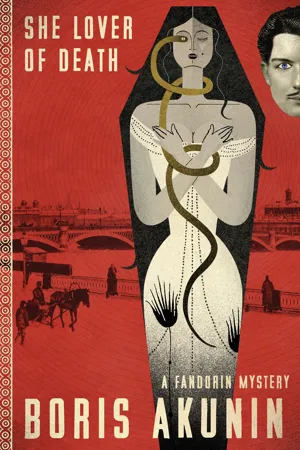
- 263 pages
- English
- ePUB (mobile friendly)
- Available on iOS & Android
eBook - ePub
She Lover of Death
About this book
Information
Topic
LetteraturaSubtopic
Letteratura generaleCHAPTER 1
I. From the Newspapers
The Selfless Devotion of a Four-Legged Friend
Yesterday at shortly after two in the morning the inhabitants of the Goliath company’s apartment building on Semyonovskaya Street were awoken by the sound of a heavy object falling to the ground, which was immediately followed by the protracted howling of a pointer dog belonging to the photographer S., who rented a studio in the attic. On hearing the noise, the yard keeper went outside and, looking up, he saw a lighted window with a dog standing on the window ledge and wailing in a most mournful, harrowing manner. A moment later the yard keeper noticed the motionless body of S. himself lying on the ground below the window. It was evidently the object that had made so much noise in falling. Suddenly, before the astounded yard keeper’s very eyes, the pointer jumped down, landing close beside the body of its master and smashing itself to death against the cobblestones of the street.
Legends concerning canine fidelity are numerous, but selfless devotion that overcomes the very instinct of self-preservation and scorns death itself is extremely rare among animals, and cases of obvious suicide are encountered even less often among our four-legged friends.
The police initially proceeded on the assumption that S., who led a disorderly and not entirely sober life, had fallen from the window by accident: however, a note in verse discovered in the apartment indicated that the photographer had laid hands on himself. The motives underlying this act of desperation are unclear. S.’s neighbours and acquaintances assert that he had no reasons for settling his accounts with life: quite the contrary, in fact; in recent days S. had been in very high spirits.
L. Zh.
Moscow Courier, 4 (17) August 1900, p.6
Mystery of Fatal Junket Solved
Incredible details of the tragic events on Furmanny Lane
As we informed our readers two days ago, the name-day party to which grammar school teacher Soimonov invited four of his colleagues concluded in the most lamentable fashion possible, with the host and his guests all discovered seated, lifeless, around the well-laid table. An autopsy of the bodies revealed that the deaths of all five victims had been caused by a bottle of Castello port wine, which contained an immense dose of arsenic. This sensational news spread to every part of the city, and at the wine merchants’ shops demand for the above-mentioned brand of port, formerly a great favourite with Muscovites, dried up completely. The police launched an inquiry at the Stamm Brothers’ bottling plant, which supplies Castello to the wine merchants.
Today, however, we can state with absolutely certainty that the estimable beverage was not to blame. A sheet of paper bearing the following lines of verse was discovered in the pocket of Soimonov’s frock-coat:
Song of Farewell
Loveless life is mere vexation!
Wary stealth, deliberation,
Hollow mirth, dissatisfaction
Blight and thwart my every action.
Deriders, you have had your fun,
Your time for mockery is done.
Help this valiant fellow now
Set the crown upon his brow.
To her who did reveal to me
The fearsome love that sets one free
I shall cry in that sweet hour:
‘Pluck me like a pining flower!’
The meaning of this farewell missive is vague, but it is entirely clear that Soimonov intended to take his leave of this life and put the poison in the bottle himself. However, the motives for this insane act are not clear. The suicide was a reserved and eccentric individual, although he showed no signs of any mental illness. Your humble servant was able to ascertain that he was not much liked at the grammar school: among the pupils he had the reputation of a strict and boring teacher, while his colleagues decried his acrimonious and arrogant temperament, and several of them mocked his idiosyncratic behaviour and morbid meanness. However, all of this can hardly be considered adequate grounds for such an outrageous atrocity.
Soimonov had no family or servants. According to his landlady, Madam G., he often went out in the evenings and came back long after midnight. Numerous rough drafts for poems of an extremely sombre complexion were discovered among Soimonov’s papers. None of his colleagues were aware that the deceased was in the habit of composing verse, and when some of those questioned were informed of the poetic efforts of this Chekhovian ‘man in a case’, they actually refused to believe it.
The invitation to the name-day party which ended in such a grisly fashion came as a complete surprise to Soimonov’s colleagues at the grammar school. He had never invited anyone to visit him before, and those he did invite were the four people with whom he was on the very worst of terms and who, according to numerous witnesses, mocked him more than anyone else. The unfortunate victims accepted the invitation in the belief that Soimonov had finally determined to improve relations with his colleagues and also (as the grammar school superintendent, Mr Serdobolin, put it) ‘out of understandable curiosity’, since no one had ever been to the misanthrope’s house before. Now we know only too well what their curiosity led to.
It is perfectly clear that the poisoner had decided, not only to draw a line under his own miserable life, but also to take with him those who had affronted him the most, those same ‘deriders’ who are mentioned in the poem. But what might be the meaning of the words about ‘her who revealed the fearsome love’? Could there possibly be a woman behind this macabre story?
L. Zhemailo
Moscow Courier, 11 (24) August 1900, p.2
Is a Suicide Club Active in Moscow?
Our correspondent conducts his own investigation and proposes a grim hypothesis!
The circumstances of an event that shook the whole of Moscow – the double suicide of latter-day Romeo and Juliet, 22-year-old Sergei Shutov and 19-year-old girl student Evdokia Lamm (see, inter alia, our article ‘No sadder story in the world’ of the 16th of August) – have been clarified. Newspapers reported that the lovers shot each other in the chest with two pistols simultaneously – evidently at some signal. Miss Lamm was killed outright and Shutov was seriously wounded in the region of the heart and taken to the Mariinskaya Hospital. It is known that he was fully conscious, but would not answer questions and only kept repeating, ‘Why? Why? Why?’ A minute before he gave up the ghost, Shutov suddenly smiled and said, ‘I’m going. That means she loves me.’ Sentimental reporters have discerned in this bloody story a romantic drama of love, however on closer consideration it appears that love had nothing at all to do with this business. At least, not love between the two people involved in this tragedy.
Your humble servant has ascertained that should the supposed lovers have wished to unite in the bonds of matrimony there were no obstacles in their path. Miss Lamm’s parents are entirely modern people. Her father – a full professor at Moscow University – is well known in student circles for his progressive views. He is quoted as saying that he would never have stood in the way of his beloved daughter’s happiness. Shutov had reached the age of consent and possessed a sum of capital that was not large, but nonetheless perfectly adequate for a comfortable life. And so it turns out that if they had wished, this couple could easily have married! Why, then, would they shoot each other in the chest?
Tormented by this question day and by night, we decided to make certain enquiries, which led to an extremely strange discovery. People who knew both of the suicides well are unanimous in declaring that the relationship between Lamm and Shutov was one of ordinary friendship and they did not entertain any ardent passion for each other.
Well now, we pondered, acquaintances can often be blind. Perhaps this young man and woman had grounds for carefully concealing their passion from everyone else?
Today, however, we came into possession (do not ask in what way – that is a professional journalist’s secret) of a poem written by the two suicides shortly before the fatal volley was fired. It is a poetical work of a highly unusual nature and even, perhaps, without precedent. It is written in two hands – evidently Shutov and Lamm took it in turns to write one line each. What we have, therefore, is the fruit of a collective creative endeavour. The content of this poem casts an entirely different light, not only on the deaths of the strange Romeo and Juliet, but also on the string of suicides that have taken place in the old Russian capital during recent weeks.
He wore a white cloak. He stood on the threshold.
He wore a white cloak. He glanced in the window.
‘I am love’s emissary, sent to you from Her.’
‘You are His bride and I am sent for you.’
Thus spoke he, reaching out his hand to me.
Thus spoke he. How pure and deep was his voice
And his eyes were dark and stern
And his eyes were light and gentle.
I said: ‘I am ready. I have waited very long.’
I said: ‘I am coming. Say that I am coming.’
Nothing but riddles from beginning to end. What does the ‘white cloak’ mean? Who has sent this emissary – She or He? Where was he actually standing, in the doorway or outside the window? And what kind of eyes did this intriguing gentleman actually have – dark and stern or light and gentle?
At this point we recalled the recent and, at first glance, equally motiveless suicides of the photographer Sviridov (see our article of the 4th of August) and the teacher Soimonov (see our articles of the 8th and 11th of August). In each case a poem was left as a suicide note, something which, you must admit, is a rather rare event in this prosaic Russia of ours!
It is a pity that the police did not keep the note written by the photographer Sviridov, but even without it there is certainly more than enough food for thought.
Soimonov’s farewell poem mentions a mysterious female individual who revealed to the poisoner ‘the fearsome love that sets one free’ and later plucked him ‘like a pining flower’. Shutov was visited by an emissary of love from ‘Her’ – an unnamed female individual; Lamm’s emissary was from a certain bridegroom, who for some reason also has to be mentioned with a capital letter.
Is it not, therefore, reasonable to assume that the face filled with love that figures in the poems of the suicides and sets their hearts trembling so reverently is the face of death itself? Many things then become clear: passion urges the enamoured individual, not towards life, but towards the grave – this is the love of death.
Your humble servant is no longer in any doubt that a secret society of death-worshippers has been established in Moscow, following the example of several other European cities: a society of madmen – and women – who are in love with death. The spirit of disbelief and nihilism, the crisis of morality and art and, even more significantly, that dangerous demon who goes by the name of fin de siècle – these are the bacilli of the contagion that has produced this dangerous ulcer.
We set ourselves the goal of discovering as much as possible about the story of those mysterious secret societies known as ‘suicide clubs’, and this is the information that we have managed to glean.
Suicide clubs are not a purely Russian phenomenon, in fact they are not Russian at all. There have never previously been any of these monstrous organisations within the bounds of our empire. But apparently, as we follow Europe along the path of ‘progress’, we are also fated to suffer this malign pestilence.
The first mention in the historical annals of a voluntary association of death-worshippers dates back to the first century BC, when the legendary lovers, Antony and Cleopatra, established an ‘academy of those who are not parted in death’ for lovers ‘who wish to die together: quietly, radiantly and when they choose’. As we know, this romantic undertaking concluded in less than idyllic fashion, since at the decisive moment the great queen actually preferred to be parted from her conquered Antony and tried to save herself. When it became clear that her much vaunted charms had no effect on the cold Octavian, Cleopatra eventually did take her own life, demonstrating a thoughtfulness and good taste truly worthy of antiquity: she deliberated at length over the best means of suicide, testing various different poisons on slaves and criminals, and eventually settled on the bite of the Egyptian cobra, which causes almost no disagreeable sensations apart from a slight headache, which is, in any case, rapidly replaced by ‘an irresistible desire for death’.
But ...
Table of contents
- Cover
- Also by Boris Akunin
- Title Page
- Copyright
- Dedication
- Table of Contents
- Chapter One
- Chapter Two
- Chapter Three
- Chapter Four
- Chapter Five
- Chapter Six
- Back Cover
Trusted by 375,005 students
Access to over 1.5 million titles for a fair monthly price.
Study more efficiently using our study tools.
Frequently asked questions
Yes, you can cancel anytime from the Subscription tab in your account settings on the Perlego website. Your subscription will stay active until the end of your current billing period. Learn how to cancel your subscription
No, books cannot be downloaded as external files, such as PDFs, for use outside of Perlego. However, you can download books within the Perlego app for offline reading on mobile or tablet. Learn how to download books offline
Perlego offers two plans: Essential and Complete
- Essential is ideal for learners and professionals who enjoy exploring a wide range of subjects. Access the Essential Library with 800,000+ trusted titles and best-sellers across business, personal growth, and the humanities. Includes unlimited reading time and Standard Read Aloud voice.
- Complete: Perfect for advanced learners and researchers needing full, unrestricted access. Unlock 1.5M+ books across hundreds of subjects, including academic and specialized titles. The Complete Plan also includes advanced features like Premium Read Aloud and Research Assistant.
We are an online textbook subscription service, where you can get access to an entire online library for less than the price of a single book per month. With over 1.5 million books across 990+ topics, we’ve got you covered! Learn about our mission
Look out for the read-aloud symbol on your next book to see if you can listen to it. The read-aloud tool reads text aloud for you, highlighting the text as it is being read. You can pause it, speed it up and slow it down. Learn more about Read Aloud
Yes! You can use the Perlego app on both iOS and Android devices to read anytime, anywhere — even offline. Perfect for commutes or when you’re on the go.
Please note we cannot support devices running on iOS 13 and Android 7 or earlier. Learn more about using the app
Please note we cannot support devices running on iOS 13 and Android 7 or earlier. Learn more about using the app
Yes, you can access She Lover of Death by Boris Akunin in PDF and/or ePUB format, as well as other popular books in Letteratura & Letteratura generale. We have over 1.5 million books available in our catalogue for you to explore.