- 195 pages
- English
- ePUB (mobile friendly)
- Available on iOS & Android
eBook - ePub
About this book
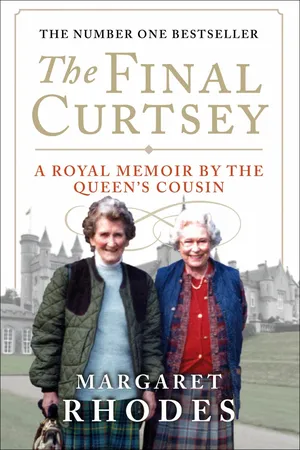
This is the intimate and revealing autobiography of Margaret Rhodes, the first cousin of Queen Elizabeth II and the niece of Queen Elizabeth, the Queen Mother. Margaret was born into the Scottish aristocracy, into a now almost vanished world of privilege. Royalty often came to stay and her house was run in the style of Downton Abbey. In the Second World War years she 'lodged' at Buckingham Palace while she worked for MI5. She was a bridesmaid at the wedding of her cousin, Princess Elizabeth to Prince Philip. Three years later the King and Queen attended her own wedding; Princess Margaret was a bridesmaid. In 1990 she was appointed as a Lady-in-Waiting to the Queen Mother, acting also as her companion, which she describes in touching detail. In the early months of 2002, she spent as much time as possible with her ailing aunt, and was at her bedside when she died at Easter that year. The next morning she went to Queen Elizabeth's bedroom to pray, and in farewell dropped her a final curtsey. This is an enthralling account of a special life, and a unique insight into the intimate moments of the British Royal family. The Queen Mother regarded Margaret Rhodes as her "third daughter", and she has been extremely close to her cousins the Queen and Princess Margaret throughout their lives. The book is full of charming anecdotes, fascinating characters, and personal photographs and is an unparalleled insight into the private life of the British monarchy.
CHAPTER ONE
The Final Curtsey
Saturday 30 March 2002 will be etched in my memory for ever, although it started like any other day at the Garden House, my home in the royal enclave in Windsor Great Park,
which had been granted to me by my first cousin, the Queen, twenty-two years earlier. At that time, my husband Denys had become seriously ill and we thought it sensible to move from our isolated
house on the edge of Dartmoor. The problem had been finding somewhere suitable and affordable. There was not a great deal of money in hand, and therefore I shall never forget the morning when my
prayers were answered. I was out riding with the Queen on the Balmoral estate in Scotland and she suddenly turned in the saddle and said: ‘Could you bear to live in suburbia?’ It
transpired that she was offering us a house in the Great Park at Windsor, the previous occupant of which had been the great horticulturist and landscaper Sir Eric Savill, the former Director of the
Gardens in the Great Park, and architect of the famous Savill and Valley Gardens, which are close by.
Our new home was a short drive from the castle and almost round the corner from Royal Lodge, the weekend retreat of Queen Elizabeth The Queen Mother, who was my mother’s youngest sister
and my aunt. Royal Lodge had been her country retreat since 1932, after King George V gave it to his second son, then the Duke of York and his Duchess. This house was very special as far as Queen
Elizabeth was concerned and she left her mark upon it. Together with her husband she shaped its grounds and gardens and they spent some of the happiest times of their lives there. Their work was
guided by their neighbour Sir Eric Savill. It seemed to me absolutely appropriate that she spent the last weeks of her life there. The present Duke of York and his daughters Princesses Beatrice and
Eugenie live in Royal Lodge now.
Queen Elizabeth The Queen Mother had been part of my life for as long as I could remember, and as the years passed she seemed immortal. She had, however, been unwell since Christmas 2001 and I
suppose I had been steeling myself for the worst. But back to that March Saturday. It was sunny and bright and the usual chores, like exercising the dog had to be undertaken. Then about 11
o’clock the telephone rang. It was Sir Alistair Aird, my aunt’s Private Secretary, warning me that the end seemed close. She had been receiving regular visits from our local doctor,
Jonathan Holliday, the Apothecary to the Household at Windsor, and on the morning of her death he was joined by Doctor Richard Thompson, the Physician to the Queen. They concluded that she would
not last the day.
I had just returned from a cruise with some friends down the Chilean coast and during that time Princess Margaret had died following a complete breakdown in her health. She had her third stroke
on 8 February and developed cardiac problems. A few days before this she had told an old friend that she felt so ill that she longed to join her father, King George VI. My elder daughter Annabel
had telephoned me on board the ship to break that sad news. Queen Elizabeth, although very frail, had bravely insisted on coming down from Sandringham, where she had been staying since Christmas,
for her younger daughter’s funeral in St George’s Chapel, Windsor. After the funeral she returned home to Royal Lodge, and did not leave it again. I felt so sad about Margaret, but
perhaps more for Queen Elizabeth than for anyone else. It is unnatural for a mother to suffer the death of a child, of whatever age, and it compounds the grief. Margaret, the Queen and I had grown
up together and when young, Margaret had such great promise, beauty, intelligence and huge charm. It seemed a life unfulfilled in so many ways. In childhood, and when she was growing up, she was
very indulged, especially by her father. If she did misbehave she invariably diffused the situation by making everyone laugh, so that the misdemeanour was forgotten, if not forgiven. It was hard to
resist her, but she did have the most awful bad luck with men. However the Almighty usually gets the right people to be born first.
I arrived home at the Garden House on 3 March, and found that my aunt was still entertaining visitors. On 5 March she hosted a lawn meet and lunch for the Eton Beagles, and then held her usual
house party for the Sandown Park Grand Military race meeting, but she weakened further in the week before Easter, which that year fell on 31 March.
Since 1991 I had been a Woman of the Bedchamber to my aunt, a mix of Lady-in-Waiting and companion, and in her final weeks I went to Royal Lodge every day, usually around 11 or 12, and had lunch
with her, the meal being set on a card table in the drawing room. I tried to amuse her with snippets of news that might interest her. It was difficult to get her to eat much. About all she could
usually manage was a cup of soup, although her Chef, her Page, and I spent a lot of time trying to think of dishes that might tempt her. But it was wonderful to see her every day, and I would take
her little bunches of early daffodils and primroses; any flower that was really sweet smelling. I loved her so much, and I like to think that she regarded me as her third daughter, once paying me
the compliment of introducing me as such to a visiting Scandinavian monarch.
The days passed in this fashion until that telephone call. As I arrived at Royal Lodge I saw that the Queen’s car was there. I went straight to my aunt’s bedroom and found her
sitting in her armchair. The Queen was beside her, wearing riding clothes. She had been alerted while riding in the Park; her groom always carrying a radio link to the castle. The nurse from the
local surgery and my aunt’s Dresser — or Royal Household speak for Ladies’ Maid — were also there. My aunt’s eyes were shut and thereafter she did not open them or
speak another word. The doctors came and went, but the nurse, the Dresser and I stayed throughout. John Ovenden, the Parish Priest of the Royal Chapel, Windsor Great Park, arrived and went straight
into Queen Elizabeth’s bedroom. He knelt by my aunt’s chair, holding her hand and praying quietly. He also recited a Highland lament: ‘I am going now into the sleep . . .’
He later told me that he was sure she knew what was happening, because she squeezed his hand. She was 101 – such a very great age. She had arrived in the time of horse-drawn carriages and was
leaving it having seen men walking on the moon.
After a while I was persuaded to take a break and went for a walk in the garden. When I came back she had been put to bed. She looked so peaceful. At her bedside was the Queen, accompanied by
Princess Margaret’s children, David Linley and Sarah Chatto. John Ovenden also came back, and we all stood round the bed when he said the prayer: ‘Now lettest thou thy servant depart in
peace.’ We all had tears in our eyes and to this day I cannot hear that being said without wanting to cry. Queen Elizabeth died at 3.15 in the afternoon on 30 March 2002. She just slipped
away and her death certificate said that the cause of death was ‘extreme old age’. I returned home soon after, thinking that it was strangely significant that she had died on Easter
Saturday, the day before the Resurrection. It had been a long and emotionally exhausting day, and I was so touched when David Linley telephoned to say that the Queen would like me to spend the
night at the castle.
That evening passed in rather a blur. We had dinner and talked about more or less normal things. We went to bed quite early and next morning we attended communion in the Castle chapel. Later I
went to Matins in the Park chapel, and then drove over to Royal Lodge, to make sure all was well with the staff. The Dresser asked me if I would like to see my aunt. She looked lovely and almost
younger, death having wiped the lines away. I knelt by her bed and said a prayer for her.
Then I stood up and gave her my final curtsey.
* * *
Later, I was deputed to register my aunt’s death at the Windsor Registrar’s office. I was shown into the room of a rather fierce-looking lady and we went through
the formalities while she ticked the relevant boxes.
At a certain point, she fixed me with a beady eye and asked, ‘Right, what was the husband’s occupation?’ It seemed a superfluous question; however, after a second’s
hesitation, I answered, ‘King’. I think Queen Elizabeth might have found that almost amusing.
CHAPTER TWO
Upstairs and Downstairs
It seems strange that I once lived in what would turn out to be the last days of a long lost world of seemingly unassailable privilege. Although when it is happening it all seems perfectly normal — especially to a small child as I was. The First World War signalled the threatening clouds and the death throes had done their deed by the end of the Second World War. In the year of my birth — 1925 — the Charleston hit town, and twelve months later the General Strike generated a class war that almost split Britain. The TUC had called out the workers, but the impact did not reach the middle of Scotland. My mother was still receiving the cook every morning to discuss the day’s menus. The staff ate in two separate dining rooms, one for the senior members such as the butler, housekeeper, ladies’ maid and the head housemaid. If there were visiting valets or ladies’ maids, they were included. All the other staff ate together in another room, as in the television series ‘Downton Abbey’. Before the war, in many grand houses, lady guests would be expected to change clothes three times a day, from morning dress to afternoon dress, and finally long evening dress, with decorations and tiaras. The housemaids had to conform as well, wearing some sort of white overall outfit in the mornings, when all the heavy cleaning was done, and black dresses with little white aprons, rather like the uniform once worn by the waitresses in Lyons Corner Houses — they were called ‘Nippies’ — in the afternoon and evening.
When Queen Mary came to stay with my family, I was given strict instructions by my mother on the required protocol. This entailed kissing her on the cheek, followed by kissing her hand and then curtseying. Of course, I muddled it up, getting it all in the wrong order, finally rising from my obeisance to biff Her Majesty under the chin with the top of my head, as her face lent forward to receive a kiss, which I had forgotten. Luckily this misadventure did not ruffle the calm of the grand old lady. Later in the same year King George II of Greece arrived and I curtseyed deeply to his imposing equerry and shook hands firmly with the King. How was I to know which was which.

Silly games were often played by the grown-ups and enjoyed by spectators, such as ‘Are you there Moriarty?’ Two people, blindfolded, lie on the ground with cushions, trying to hit each other when they answer.
There were many other, more light-hearted family occasions, when my aunt, the Duchess of York and her husband, with the two Princesses, visited us. They played some pretty odd and boisterous games, with distinguished visitors rolling round on the ground being beaten round the head with cushions or with newspapers which had been folded into batons, playing the game known as ‘Are you there, Moriarty?’ We three girls were surprised at the curious goings on of the grown-ups.
Cocooned in the nursery I, of course, knew nothing about the social convulsions gripping the country, and neither did my first cousin, Princess Elizabeth, who was born a year after I was in 1926, that tumultuous strike year, just thirteen days before the mass walk outs started. I learned very much later that her father, then Duke of York, and after the abdication of King Edward VIII, King George VI, was intensely worried about the crisis, and frustrated because his position prevented him from offering any advice, despite his knowledge of industrial affairs and his deep interest in the welfare of working men and women. He was President of the Industrial Welfare Society, and, when asked whether he wanted to take the job on, typically said: ‘I’ll do it provided there’s no damned red carpet about it’.

My father, the 16th Lord Elphinstone

May, my mother – gardening as usual
His personal contribution to breaking down social barriers was through his camps, at which thousands of boys aged between seventeen and nineteen, from widely differing backgrounds, mixed, worked, and played together. He came to be known as ‘the Industrial Prince’ and, sometimes less kindly by his brothers as ‘the Foreman’.
My father, the 16th Lord Elphinstone, was born in 1869. For some odd reason I was rather proud that he had come into the world exactly halfway through Queen Victoria’s long reign. I love facts that telescope history. For instance my father’s sister had a Godmother who was married to one of Napoleon’s ADCs, the Comte de Flahaut, who was the illegitimate son of that great survivor of revolutions, Talleyrand, bishop and turncoat aristocrat, who somehow dodged the guillotine and always managed to end up on the winning side. I have quite lately discovered what I think is a fascinating historical fact. When the Queen visited Normandy recently, she was met with cries of ‘Vive le Duc’, as if she were the living embodiment of the Duke who invaded us in 1066.
My father had been destined for the diplomatic service and was in attendance at the court of the last Tsar of Russia, Nicholas II, in St Petersburg at the turn of the nineteenth century. I have always been fascinated that I had this tiny, tenuous link with Russia before the revolution, and I remember as a child my father telling me about the opulence of the Russian Imperial court, the Fabergé style brilliance of St Petersburg’s high society, and his glimpses of the Imperial family who, despite the formal grandeur of their official position, in private lived very simply, the children being brought up in a very English, austere way, as befitting the great grandchildren of Queen Victoria.
Of course they were all brutally murdered by the Bolsheviks in July 1918, but years later I was told that during their imprisonment they displayed striking courage in the face of the tragedy of their situation, and the letters, diaries and memoirs of those who were in contact with them during the last year and a half of their incarceration unanimously attest to this. The Emperor Nicholas at first hoped that his family would be able to leave Russia for exile in Britain, but his cousin King George V was advised by his ministers that there was strong opposition to this proposal among his people, and the offer of a refuge with their British relatives was withdrawn. The best motives of kings and queens are often constrained by realpolitik, but George V continued to seek assurances through the British ambassador in St Petersburg concerning the safety of the Imperial family, and always hoped that they would find safety. He was devastated by their cruel deaths, and in his diary wrote: ‘May [Queen Mary] and I attended a Service at the Russian Church in Welbeck Street in memory of dear Nicky who I fear was shot last month by the Bolsheviks. We can get no details, it was a foul murder, I was devoted to Nicky, who was the kindest of men, a thorough gentleman, who loved his Country and his people’. A photograph of the Emperor, signed ‘Nicky’ is displayed on a side table at Sandringham.
In the spring of 1919 the King sent the Royal Navy cruiser Marlborough to the Crimea to rescue the Romanov survivors. There were only a few, and among them was the Tsar’s sister, the Grand Duchess Xenia, who spent forty years in exile in Britain and who Queen Elizabeth liked. I encountered the Grand Duchess in 1940, when she was staying at Craigowan, a house on the Balmoral estate, often used by the Royal Family for short private visits to avoid opening up the castle.
I cannot remember much about her, but indelibly printed in my memory is the image of her severe Lady-in-Waiting, a Russian Orthodox nun called Mother Martha, who wore black robes and black boots. When Princess Elizabeth, Princess Margaret and I were in the vicinity of Craigowan we would break into the Volga boat song, a traditional Russian folk number associated with the peasant barge-haulers on the mighty Volga river. I only hope the Grand Duchess never heard us, because we would surely have been on the receiving end of a rocket if we had been reported to higher authority. We thought that the serenade would remind her of her homeland, but looking back I suppose our behaviour was less than sensitive, bearing in mind her tragic experiences during the revolution. Her son-in-law was Prince Felix Yusupov, one of the murderers of that degenerate mystic Rasputin, who had exerted such an unhealthy influence over the Tsarina.
Somehow, I never really knew why, a career in the diplomatic corridors of power eluded my father. Instead he travelled all over the world, big game hunting and exploring. I suppose his philosophy seemed to be ‘have gun, will travel’. He potted grizzly bears in Alaska and Canada and I grew up with a stuffed eight foot high grizzly standing on its hind legs in the hall at Carberry, ten miles south of Edinburgh, one of our two homes in Scotland. I loved every inch of Carberry, but after 1961, when my mother died, my brother John handed it over to the Church of Scotland as a conference centre. They found it too expensive to keep up, and it passed to an organisation called the Friends of Carberry who run it in a more ecumenical fashion. After the family left I never returned because I want to remember it as it was — every stick and stone of it. It had been in the ownership of my family since coming to the Elphinstones through marriage. We also had a smaller house in Surrey, Maryland, my father’s wed...
Table of contents
- Cover
- Author biography
- Title page
- Copyright page
- Dedication page
- Acknowledgements
- Contents
- Foreword
- Chapter 1 The Final Curtsey
- Chapter 2 Upstairs and Downstairs
- Chapter 3 Wartime with the Windsors
- Chapter 4 Secret Army
- Chapter 5 Love and Marriage
- Chapter 6 On Top of the World
- Chapter 7 African Adventure
- Chapter 8 In-Waiting
- Chapter 9 Afterwards
- List of Plates
Trusted by 375,005 students
Access to over 1.5 million titles for a fair monthly price.
Study more efficiently using our study tools.
Information
Publisher
BirlinnYear
2012Topic
Social SciencesPrint ISBN
9780954127565
Subtopic
Historical BiographieseBook ISBN
9780857901910
Index
Social SciencesFrequently asked questions
Yes, you can cancel anytime from the Subscription tab in your account settings on the Perlego website. Your subscription will stay active until the end of your current billing period. Learn how to cancel your subscription
No, books cannot be downloaded as external files, such as PDFs, for use outside of Perlego. However, you can download books within the Perlego app for offline reading on mobile or tablet. Learn how to download books offline
Perlego offers two plans: Essential and Complete
- Essential is ideal for learners and professionals who enjoy exploring a wide range of subjects. Access the Essential Library with 800,000+ trusted titles and best-sellers across business, personal growth, and the humanities. Includes unlimited reading time and Standard Read Aloud voice.
- Complete: Perfect for advanced learners and researchers needing full, unrestricted access. Unlock 1.5M+ books across hundreds of subjects, including academic and specialized titles. The Complete Plan also includes advanced features like Premium Read Aloud and Research Assistant.
We are an online textbook subscription service, where you can get access to an entire online library for less than the price of a single book per month. With over 1.5 million books across 990+ topics, we’ve got you covered! Learn about our mission
Look out for the read-aloud symbol on your next book to see if you can listen to it. The read-aloud tool reads text aloud for you, highlighting the text as it is being read. You can pause it, speed it up and slow it down. Learn more about Read Aloud
Yes! You can use the Perlego app on both iOS and Android devices to read anytime, anywhere — even offline. Perfect for commutes or when you’re on the go.
Please note we cannot support devices running on iOS 13 and Android 7 or earlier. Learn more about using the app
Please note we cannot support devices running on iOS 13 and Android 7 or earlier. Learn more about using the app
Yes, you can access The Final Curtsey by Margaret Rhodes in PDF and/or ePUB format, as well as other popular books in Social Sciences & Historical Biographies. We have over 1.5 million books available in our catalogue for you to explore.