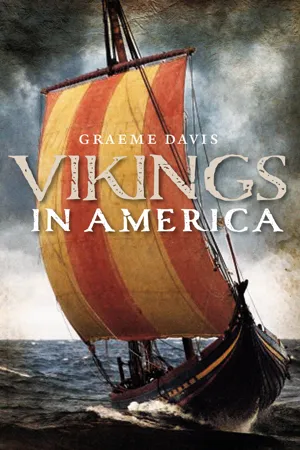
Discover the evidence that Vikings walked on American soil—centuries before Columbus.
When Columbus claimed to have discovered America in 1492 and the Borgia pope declared it a New World for Catholic Spain, the Vatican started a five-hundred-year conspiracy to conceal the true story of Viking America.
In this groundbreaking new work by the author of
The Early English Settlement of Orkney and Shetland, the true extent of the Viking discovery and colonization of the eastern seaboard of North America is fully examined, taking into account the new archaeological, linguistic, and DNA evidence that supplements the historic account. For four centuries or more, from their first visits around AD 1000 to the eve of the Columbus voyages, the Vikings explored and settled thousands of miles of the coasts and rivers of North America. From New York's Long Island to the Canadian High Arctic, the New World was a playground for Viking adventurers. And, he argues, the name the Vikings gave to this New World was
America.
- 224 pages
- English
- ePUB (mobile friendly)
- Available on iOS & Android
eBook - ePub
Vikings in America
About this book
Trusted by 375,005 students
Access to over 1.5 million titles for a fair monthly price.
Study more efficiently using our study tools.
Information
1
Vikings to America
In fourteen hundred and ninety-two
Columbus sailed the ocean blue.
He had three ships and left from Spain:
He sailed through sunshine, wind and rain.
SO goes the school-room jingle, and so most people today perceive the dawn of European exploration and settlement of America. Yet it is not Columbus but the Vikings who should be credited with the first significant European exploration and settlement of America.
Around five centuries before Columbus, the Vikings both explored and settled in America. The archaeological remains at L’Anse aux Meadows in Newfoundland leave no doubt that they established a substantial presence on the American east coast. Today we know for sure that the Vikings were there. Yet in popular perception the story of the Vikings in America remains at the margins of history. As a result the Vikings and their exploration of what they called Vinland is now presented as little more than a footnote in world history. The implicit assumption is that their remarkable achievement had no lasting impact on the history of either Europe or America.
The picture is changing. In recent years academics working in many different disciplines have been finding fragments of evidence which taken together tell a far bigger story of the Vikings in America. This is the story presented here.
For the Vikings did a lot more than just visit a few places in Newfoundland or elsewhere on the American east coast. From their base in the Viking colony of Greenland – itself strictly part of the American continent – we now know that the Vikings explored in three different directions. A thousand miles south from Greenland is the archaeological site of L’Anse aux Meadows, a staging post on the journey to what they called Vinland, east-coast America. A thousand miles north from Greenland the Vikings reached the High Arctic. Here Viking archaeological remains have been found in some of the most unlikely locations, in lands no-one would have dreamed the Vikings could ever have reached. Today we must accept the evidence of that the Vikings, against all expectations, in fact reached the High Arctic. Furthermore, 1,000 miles west from Greenland in Hudson Bay and its vicinity we have evidence of Viking presence, and can place the Vikings at the centre of the North American continent. Viking Greenland emerges as the starting point for exploration of three widely separated areas of the American continent: the east coast, the far north and Hudson Bay.
The Viking presence in America was no brief interlude, but something that lasted as long as the Viking Greenland colony – a little short of 500 years. Most of the voyages to America were made to bring back to Greenland and Europe cargoes of raw materials – but some resulted in over-wintering and some in settlement. Today we must accept that the Vikings played a noteworthy role in the exploration and development of America.
Stories of America came back to Europe. Yet for a variety of reasons – largely a mix of commercial sensitivity and bad conscience – Europe turned its back on these stories. This virtual conspiracy of secrecy is the canvas on which was written the fiction of the Columban discovery of America. Yet at a time when Mediterranean Europe was promoting the Columbus myth, northern Europe, particularly Britain, was demonstrating a continuing tradition of sailing directions that went back to the Viking explorers, as shown in the British search for a north-west passage. Without the Vikings, the post-Columban re-exploration of North America would have been very different in its character.
In researching Vikings in America I found a great mass of firm evidence, but also an almost equal volume of what may best be described as fiction.1 Ideas that the Vikings reached California or were somehow linked with the Templars or any other Masonic group are, in my view, without any justification, and have not been considered here.2 I have, however, looked at a whole range of doubtful evidence which may or may not give information about Vikings in America. In all cases I have sought to be clear that there are doubts, but also to avoid the temptation to discard theories out of hand. At least some of the disputed materials will, in my view, come to be accepted as reliable.
The most controversial legacy of Viking America presented in this book is that the name ‘America’ is of Viking origin. The old view that America takes its name from the explorer Amerigo Vespucci is a tired idea now so totally discredited that it cannot be maintained today – though still taught in many American schools. It may be that in discarding the Amerigo Vespucci hypothesis we should simply say that we do not know where the name ‘America’ comes from. Yet we must also note that ‘America’ is a regular phonological development of a name we know the Vikings used in their Old Norse language for this part of the world. Either the Vikings named America, or by some strange coincidence America gained from an unknown alternative source a name which resembles that used by the Vikings. The Vikings are certainly the first European settlers of America; they may also be the people who named the continent.
The Columbus Myth
The established view of history sets out that in 1492 Christopher Columbus set out from Spain with three ships, sailed across the unknown ocean with his sailors in fear of falling off the edge of a flat world, and discovered America. Today we may note that he didn’t know he had discovered America, but thought instead that he was many thousands of miles away in India. For that matter, he failed to establish trade with the lands he visited, or to found any lasting settlements there. Surprisingly – if his role as first European discoverer were to be maintained – the New World is named not after him but supposedly after his contemporary, Amerigo Vespucci. All these limitations on Columbus’s achievement are well known, but do not detract from the central role that history has given him as the discoverer of America. American history pretty much starts with Christopher Columbus – and because we were taught about Columbus in our early school years, we tend to hold to the story almost as an item of faith. In 1492 Christopher Columbus discovered America.
Yet today we know for sure that this is wrong. If we stop for one moment to think about it we realise that no European is the first discoverer of America. Rather the Americas were discovered many thousands of years ago by the Asiatic peoples who crossed the Bering Strait from Asia and made their lives in the Americas, the ancestors of the Native Americans who still inhabit the continent. At the very most, the role of Christopher Columbus is that of the first European to reach America.
Yet even this more limited role for Columbus we now know is simply not true. For 50 years or so there has been a popular awareness of academic evidence that many Europeans saw America before Columbus. No-one today can reasonably doubt that the Irish made it across the Atlantic and back to Ireland nearly a millennium before Columbus, and told plenty of stories of finding a land to the west across the Atlantic. There is now widespread acceptance that the story of the Irish St Brendan’s voyage in a coracle from Ireland to America and back again is a record of an actual voyage. Probably other peoples made their way across the Atlantic well before Columbus. For example, the supposition that the Basques, in search of Atlantic fishing grounds, ventured ever further west and found America is persuasive. They certainly reached the rich fishing grounds of the Grand Banks in the northwest Atlantic, just a few hundred miles from the American shore, and it beggars belief that in the hundreds of years that they fished the Grand Banks no ship was ever driven by storms those extra few miles to sight the coast of America. Yet neither the Irish nor the Basques seem to have settled in the new world of America, and their voyages there were sporadic. It is reasonable to conclude that the Irish and the Basques visited America before Columbus, but that they did little more than see the land from the sea, or at most just step ashore. They had no real impact on America.
As well as voyages by the Irish and the Basques, we now also know that some Vikings made the journey to America around five hundred years before Columbus, and since the 1950s and 1960s we have had conclusive archaeological evidence of their presence on Newfoundland. The Viking voyages to America have now become a staple of history books. There are no grounds whatsoever to dispute the central idea that the Vikings reached America. As well as the archaeological evidence from Newfoundland and now from elsewhere in North America we have a rich body of stories about the first Viking explorers, preserved in the Icelandic sagas. From these sagas we hear of the Viking adventurer Leif Eiriksson leading a ship of Vikings from Iceland to Greenland to Vinland. Exactly where Vinland might be is a matter for debate, but it is certainly somewhere on the east coast of North America, and equally certainly not Newfoundland. The Vikings established some sort of settlement in what they called Vinland as well as in Newfoundland.
This popular perception of Vikings in America is correct as far as it goes, but marginalises the Viking contribution to American history. The conclusion that is drawn is that the Vikings visited America, but did not alter the course of history of America, nor was their discovery much known in Europe so it didn’t influence European history either. Therefore the Viking discovery of America scarcely matters. With a few footnotes for the voyages by the Irish, the Basques and the Vikings, the great myth of both European and American history can be reasserted – in 1492 Columbus discovered America.
It is time for the myth to be demolished. Evidence for Viking discovery and settlement of North America has been stacking up, but has not previously been presented in a popular book in a unified form. This book does just that. Archaeology, genetics, Icelandic literature and the archives of Europe give a coherent picture which contradicts the myth. The Viking voyages to North America were not the footnote to history that would signify an occasional visit by tiny groups of Vikings. Rather, tens of thousands of Vikings made the journey to America before Columbus, and some of them settled. American goods moved to Europe centuries before Columbus – and European goods to America. Much was known about America before Columbus visited – indeed the voyages of Columbus and his successors show detailed knowledge of the Viking discoveries. Instead of a Columbus myth, we should have the real story of the Vikings in America.
That the Columbus myth has developed and become accepted should be a cause for concern, as it is a substantial falsification of history. The evidence for a Viking presence in America before Columbus has been expanded in recent years through archaeology and genetics, but even without these sources there have always been overwhelming documentary materials. The knowledge that mediaeval Europe had of America was fuzzy – but so was its awareness of Asia or Africa. The merchants and seamen of ports on the west coast of Europe certainly knew America existed, just as they knew of Asia or Africa, though they rarely visited these continents. The Vatican knew of America – through the Middle Ages the Popes appointed 17 bishops to Greenland and lands to the west of Greenland, all well before Columbus. Our continuing credence in the story of Columbus as discoverer of America perpetuates a fifteenth-century deception. For when Columbus described his first voyage to the king and queen of Spain, and through them to the Pope, all the key players knew that this was not a new discovery. Columbus had previously spent the winter of 1477–78 in Iceland with Icelanders who had been to America – as recorded in local ‘parish’ records from Olafsvik, Iceland – and he was as aware as anyone that his discovery was not new. The king of Spain was aware of the stories of Basque fishermen. The Pope knew that his predecessors had ministered to Greenland and the lands to the west as part of the diocese of Hamburg, and had appointed bishops and collected taxes. All Columbus could truly report was a successful voyage from Spain to America and back again, one building on hundreds of years of transatlantic voyaging. Yet such an unremarkable achievement would have been of interest to no-one. By treating this voyage as a new discovery, Spain was able to lay claim to America. The Pope supported this claim. Spain was then the bastion of Roman Catholic orthodoxy, the darling of the papacy, riding high on its success in the crusade against the Moors in Grenada; by contrast, Hamburg and northern Europe were at the edge of the Roman Catholic world, doctrinally suspect, and within a generation to be sundered from the Roman Catholic church by the Reformation. Spain and the popes benefited from claiming Columbus as the discoverer of America, and in doing so chose to forget the Vikings and the part played by seafarers of northern Europe.
Two sorts of stories need to be told. The first story is of the great extent of Viking exploration of North America, and their settlement there. Alongside this is the equally remarkable story of the European conspiracy to cover up their role, a fabrication which even today is reflected in European and American school curricula, and in popular belief in the Columbus myth.
The Viking Achievement
So what really happened? What is the story of the Vikings in America, and how can the cover up be exposed?
The context for the Viking voyages to North America is a part of the much larger history of the Viking exploration of the North Atlantic, Europe and western Asia. This Viking Age took the world by surprise. Before it, Europe hardly knew of the Vikings, inhabiting as they did a remote location and a tough environment in the far north of Europe, right up as far as the Arctic Circle. They were farmers in an environment where farming was marginal, where agriculture and animal husbandry could only just sustain a settled lifestyle, a little-known people struggling for survival in a harsh environment. They lived alongside the fjords of what is now Norway, on the coast and lake-land of Sweden, and on the marshy islands of what is now Denmark, in small communities never far from the sea. The Viking Age started abruptly in the late eighth century AD, when an unremembered craftsman made a breakthrough in shipbuilding that produced the most sea-worthy ships the world had ever seen. With these magnificent ships began an expansion which amazed the world. In the centuries that followed, Vikings travelled far to the east and the south. They moved down the great rivers of Russia, founding the first Russian kingdom as they went. They reached Baghdad and Constantinople, served as crack mercenary troops to the Byzantine emperors,3 visited Jerusalem, carved runic graffiti on a statue in Athens. To the west the Vikings moved into what is now France, creating the North-man’s-land of Normandy. In England they were checked for a generation by the English hero King Alfred, but went on to conquer all England, and rule first through the Canute dynasty, then through the dynasty of the Viking duke of Normandy, William the Conqueror. In Ireland they created the great Viking city of Dublin, where Viking power and Celtic art coalesced to create the Irish nation. Their expansion continued north and west, across the Atlantic. First the islands of Orkney and Shetland were settled by the Vikings, then the Faroe Islands and Iceland, as the Vikings marched across the stepping stones of the North Atlantic. From Iceland it is but a short hop to Greenland, itself part of the North American continent, and the Vikings established their settlements there around 1,000 years ago. From Greenland they voyaged yet further west.
The Greenland colony, created in AD 986, was no settlement at the edge of the world. Greenland flourished. The land the Vikings discovered was then unpopulated – the Inuit Greenlanders who live there today arrived after the Vikings. For nearly 500 years Greenland was the place to be. Skeletons of colonists excavated in Greenland show they enjoyed excellent health and remarkable longevity compared with Europeans, and grew an average two inches taller than their Viking cousins in northern Europe. Greenland had a vibrant culture, both as shown by the high culture of church ornament and the low culture of the form of dress of the people – the latest European fashions, no less. The two main settlements, both well south of the Arctic Circle, supported agriculture and husbandry. The population was scattered in around 500 farmsteads, and would have totalled no more than 5,000 people – fortunate people enjoying a level of health and political stability unmatched by their relatives in Europe. The Greenland the Vikings found was – and is today – a magnificent land. Viking Greenland prospered.
The one thing missing from Greenland was timber. Even the best efforts of our age have scarcely produced in Greenland trees more than six feet high in experimental plantations, while for the Vikings, trees were confined to the knee-high scrub of dwarf birch and dwarf willow. Driftwood does sometimes float onto beaches in Greenland, and while it is of use as firewood, its condition is such that it is not suitable for building houses or ships. The Viking Greenlanders had an enormous need for wood, and finding this resource drove their expansion.
It is a short voyage from Greenland to Canada’s Baffin Island, a short voyage from there to Labrador, a short voyage from there to Newfoundland. The Vikings made it to Newfoundland and beyond by about the year 1000, just fourteen years after establishing their colony in Greenland. There they found the timber they needed in abundance. From Iceland we have sagas which tell of some of the first voyages to this new land. The Vikings explored what they called Markland – Forest Land – which is usually identified with southern Labrador and the island of Newfoundland. The land is therefore named after the resource that the Vikings were seeking. Further south is the land they called Vinland, usually regarded as New England. L’Anse aux Meadows, the most remarkable American Viking archaeological site, is in Newfoundland; not in Vinland as often suggested, but rather in Markland.
Over the years the Greenland colony developed. There were two major settlements there – both on Greenland’s mild west coast facing the Davis Strait, and called simply the East Settlement and the West Settlement. Between them a smaller settlement later developed – the Middle Settlement. These settlements comprised farmsteads that were widely scattered, each farming many square miles of the coastal strip between sea and ice cap. They had their religious institutions provided through several dozen churches, the appointment of a bishop, and the development of both a monastery and a nunnery. Politically Greenland functioned as a commonwealth. Each farmstead appointed a representative – usually the head of the household – to periodic local meetings, which in turn appointed representatives to a yearly parliament. The system is an early democracy, a style of government shared with Iceland and some of the more isolated Viking settlements in the Faroe Islands, Shetland, Orkney, Scotland’s Western Isles and the Isle of Man. Contact with Europe was maintained, with Greenlanders taking part in the Crusades, and European ideas finding expression in Greenland. Trade from Greenland brought the resources of the Arctic – furs, ivory, oil – to the countries of Europe, while ensuring that the Greenlanders kept abreast of the latest European fashions, and received the manufactured goods of the European High Middle Ages. Ultimately Greenland became a part of the Norwegian kingdom, and later the Danish kingdom. This distant rule appears ...
Table of contents
- Cover
- Title Page
- Copyright
- Contents
- List of Maps
- List of Illustrations
- 1. Vikings to America
- 2. Stepping Stones to America
- 3. The Greenland Base
- 4. Vikings to Vinland
- 5. Viking Exploration of the High Arctic
- 6. Viking Hudson Bay
- 7. Vikings and Inuit
- 8. Memories of Vikings in America
- 9. Legacy of the Vikings in America
- Appendix 1 A Note on Methodology
- Appendix 2 Bishops of Greenland
- Appendix 3 Mediaeval Kings of Norway
- Bibliography
- References
- Index
- Plates
Frequently asked questions
Yes, you can cancel anytime from the Subscription tab in your account settings on the Perlego website. Your subscription will stay active until the end of your current billing period. Learn how to cancel your subscription
No, books cannot be downloaded as external files, such as PDFs, for use outside of Perlego. However, you can download books within the Perlego app for offline reading on mobile or tablet. Learn how to download books offline
Perlego offers two plans: Essential and Complete
- Essential is ideal for learners and professionals who enjoy exploring a wide range of subjects. Access the Essential Library with 800,000+ trusted titles and best-sellers across business, personal growth, and the humanities. Includes unlimited reading time and Standard Read Aloud voice.
- Complete: Perfect for advanced learners and researchers needing full, unrestricted access. Unlock 1.5M+ books across hundreds of subjects, including academic and specialized titles. The Complete Plan also includes advanced features like Premium Read Aloud and Research Assistant.
We are an online textbook subscription service, where you can get access to an entire online library for less than the price of a single book per month. With over 1.5 million books across 990+ topics, we’ve got you covered! Learn about our mission
Look out for the read-aloud symbol on your next book to see if you can listen to it. The read-aloud tool reads text aloud for you, highlighting the text as it is being read. You can pause it, speed it up and slow it down. Learn more about Read Aloud
Yes! You can use the Perlego app on both iOS and Android devices to read anytime, anywhere — even offline. Perfect for commutes or when you’re on the go.
Please note we cannot support devices running on iOS 13 and Android 7 or earlier. Learn more about using the app
Please note we cannot support devices running on iOS 13 and Android 7 or earlier. Learn more about using the app
Yes, you can access Vikings in America by Graeme Davis in PDF and/or ePUB format, as well as other popular books in History & European History. We have over 1.5 million books available in our catalogue for you to explore.