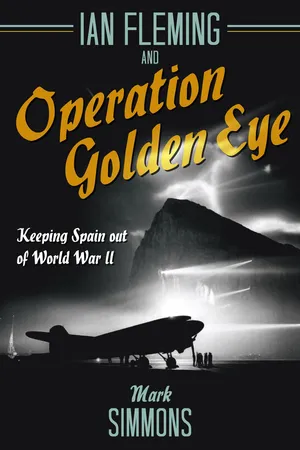
The elaborate Allied schemes to keep Spain and Portugal out of WWII—featuring the real-life spy work of Ian Fleming, creator of James Bond.
Historian Mark Simmons reveals the various Allied operations designed to keep the Iberian Peninsula out of WWII. It is a tale of widespread bribery of high ranking Spanish officials, the duplicity of Adm. Wilhelm Canaris, head of the Abwehr, and an elaborate scheme developed by a Naval Intelligence commander who would later create the iconic spy character.
Ian Fleming and Alan Hillgarth were the architects of Operation Golden Eye, the sabotage and disruption scheme that would have been put in place, had Germany invaded Spain. Fleming visited the Iberian Peninsula and Tangiers during the war, in what was arguably the closest he came to being a real secret agent. It was these visits that supplied much of the background material for his James Bond novels. Fleming even called his home on Jamaica where he created 007 "Goldeneye."
The book begins in October 1940, when Hitler met with Spanish dictator Francisco Franco. At that time, an alliance between Germany and Spain seemed possible. In response, Adm. Godfrey of British Naval Intelligence created Operation
Tracer, in which a listening and observation post would be buried in the Rock of Gibraltar, should it fall to the Germans. Simmons also explores the SIS and SOE operations in Portugal and the vital Wolfram wars. Though Operation Golden Eye was eventually put on standby in 1943, its intrigue and intricacy are both fascinating and enlightening.
- 256 pages
- English
- ePUB (mobile friendly)
- Available on iOS & Android
eBook - ePub
About this book
Trusted by 375,005 students
Access to over 1.5 million titles for a fair monthly price.
Study more efficiently using our study tools.
Information
CHAPTER 1
The Ideas Man
On 13 June 1940 Commander Ian Fleming of the Royal Navy Volunteer Reserve was flown to Le Bourget airfield, near Paris in France. It was not the first time he had gone there in recent weeks. France was lurching toward defeat and Paris was expected to fall soon. The Admiralty in London and Winston Churchill were desperate to know what would happen to the powerful French fleet. Contact had been lost with its commander Admiral Francois Darlan who Churchill described at the time as becoming ‘… very important. My contacts with him had become few and formal.’1
Admiral John. H. Godfrey, Director of Naval Intelligence, wanted to re-establish contact in order to give the First Sea Lord and the PM the best advice. He wanted to go himself but that was impossible. So he sent his personal assistant Ian Fleming.2
Fleming wrote later that it was his suggestion that he, with a wireless operator, should go to France to find Darlan and stay with him: ‘I cannot imagine what made me suggest this, except perhaps my usual desire to escape from Room 39 and get some fresh air.’3 Indeed Godfrey was to write about Fleming: ‘He had plenty of ideas and was anxious to carry them out but was not interested in and would prefer to ignore, the extent of the logistics background inseparable to all projects.’4
In June 1940 Ian Fleming had been in Naval Intelligence less than a year. He was thirty-two and a colleague at NI described him as ‘… tall and dark, elegant in his uniform and elastic-sided sea boots, with the worried down-the-nose look, and the heavy loping gait.’5
Ian Lancaster Fleming was born on 28 May 1908 at 27 Green Street in Mayfair, weighing in at near nine pounds, the son of Valentine and Evelyn Fleming. His father Valentine was the son of the wealthy Scottish banker Robert Fleming. In 1910 he was elected Tory MP for South Oxfordshire, and in 1914 he rode off to war with the Oxford Yeomanry and was soon promoted to Major. On 20 May 1917 Valentine Fleming was killed in action at Gillemont Farm. His last message to HQ was: ‘My squadron holds its locality.’ He was awarded a posthumous DSO. Winston Churchill wrote an appreciation in The Times praising his devotion to duty, observing that: ‘As a young yeomanry officer he always took the greatest pains to fit himself for military duties …’ and ‘… there were few more competent civilian soldiers of his rank.’6 Evelyn St Croix Rose, Ian’s mother, came from Irish, Scots and Huguenot descent. She was beautiful, headstrong and a law unto herself. Robert Harling, a long-time friend of Ian’s, called her a ‘snob’ while Noel Coward thought she was cold.7 Ian had an elder brother Peter, and two younger brothers named Richard and Michael. He also had a half sister Amaryllis, born in 1925, and fathered by the artist Augustus John.8 During the Great War and after the death of her husband Valentine, Evelyn was left to bring up her sons. Ian proved the most difficult. He hated the things the rest loved, like horses and dogs. He loathed family gatherings and holidays in Scotland. In 1915 Ian and Peter were sent to boarding school. In general, Ian disliked the experience but found escape in reading, devouring the likes of Sax Rohmer and his Fu-Manchu books, along with Buchan, Poe and R. L. Stevenson.9
Like his creation James Bond, Ian Fleming went to Eton, but retained few fond memories of the school. He was overshadowed by his elder brother. Peter was a success in most things and in 1926 went off to Christ Church Oxford with a string of honours. Though Ian underperformed academically, he did excel at athletics and was a good football player. He broke his nose in one match and had to have a small plate inserted, which his mother felt gave him the air of ‘battered nobility.’10 He even managed to run a car, an old Standard Tourer, garaged nearby in term-time against school rules, in which he ran illicit trips to London. There was also trouble with girls, again out-of-bounds in term time.11 He avoided being expelled unlike his fictional hero James Bond, whose ‘… aunt was requested to remove him’12 according to The Times obituary in You Only Live Twice. Fleming instead, with his mother’s agreement, left a term early to start cramming for the Royal Military College Sandhurst entry examination, where he passed sixth in the country. Evelyn and Ian held high hopes for his future career in the Army, yet given the strict discipline at the military college and his track record at schools he was almost bound to fail and in May 1927 he duly resigned after a string of troubles. For his mother, the disgrace was acute. However she did not wash her hands of him, and instead sent him to the Villa Tennerhof in Kitzbühel Austria for further education.
Kitzbühel is a small medieval town in the Tyrol named after the river and surrounded by the Eastern Alps. Ernan Forbes Dennis, a former British diplomat and spy, had rented the Villa Tennerhof and made it into a school for those wanting to learn German. Peter Fleming had spent the summer of 1927 there to improve his German. It was then that Ernan learnt of the troubles Ian had suffered and offered to help. Ernan later recalled of Fleming’s arrival: ‘… all he could do successfully was to make a nuisance of himself. For he was a rebel, like most second sons.’13
It was Ernan and his wife, the writer Phyllis Bottome, who got Ian to buckle down and work. Phyllis in particular encouraged him to write some short stories. For his education, they set the main goal as the Foreign Office examination for which competition was fierce, with most places being taken by Oxford and Cambridge students. The course he undertook with Ernan was much wider than any he could have acquired at a university. They instilled a love of books in him, and not just for reading but as an object in their own right, for he would become a keen collector. All these influences would lead him to make a living with his pen. He also found the freedom at Kitzbühel to explore the company of young women without his family breathing down his neck. One of his fellow pupils admired the effect he had on the female sex calling him ‘irresistible to women.’14
His car had made it to Austria but was soon wrecked in a collision with a train at a level crossing. Fleming had been returning from Munich one dusk and a field of tall corn had obscured the railway track. Neither train driver nor Ian saw each other until it was too late. The train sliced off the front of the Standard, engine and all, depositing it fifty yards down the track. Ian was unhurt but was badly shaken. In another adventure he courted death by skiing in a known avalanche zone. He was buried to his shoulders but escaped with only minor injuries. This may well have been the source for the avalanche scene in On Her Majesty’s Secret Service in which the avalanche misses Bond by feet: ‘The ground shook wildly and a deep crashing roar filled his ears. And then it had passed him and given way to a slow, heavy rumble.’15 This gave Ian credence among his fellow students and with the local girls.
After a year Ernan sent Fleming to Munich to stay with a German family and become a day student at the university. At this time, Hitler and the Nazis held some of their biggest rallies in the city and the country but they made little impression on Fleming.
In July 1929 he was back in Kitzbühel. Ernan felt he was nearly ready to sit the Foreign Office exam, but first sent him to Geneva to improve his French. In the Swiss city, Fleming acquired a black Buick two-seater sports car and a fiancée – Monique Panchaud de Bottones, a slim, dark-haired beauty who lived near Lake Geneva. Her father was a respected local landowner and his chateau produced good wine. Fleming now began to take the prospects of the Foreign Office more seriously now that he was thinking of marriage. He took a short-term post with the League of Nations to give him some insight into international affairs. Back in London for Christmas he found his mother hopeful he would become a diplomat, even agreeing to meet his Swiss girlfriend.
Sixty-two applicants sat the Foreign Office exam over ten days in September 1931. There were only three places available and an agonising four-week wait for the results. Fleming came twenty-fifth, and got the lowest marks for his English essay – 20 out of 100.16
It was another bitter pill to swallow, and a bigger blow to his ego than Eton or Sandhurst had been. His mother scuppered his romance, stating they were far too young and she was a distraction for his career prospects. Monique was sent packing back to Geneva in tears. Fleming later told Ralph Arnold, a fellow student at the Villa Tennerhof, ‘I’m going to be quite bloody-minded about women from now on. I’m just going to take what I want without any scruples at all.’17
It was through Evelyn that he obtained a tr ial post at Reuters, the news agency, for six months. He had no journalistic experience but it was a job that suited him. He first worked in the news room but got out to cover motor racing events at Brooklands. Then in 1933 he was sent to cover the trial of six British engineers in Moscow who were accused of espionage and sabotage. They worked for the Vickers Electrical Company installing and supplying heavy electrical machinery. Vickers was one of the few favoured foreign firms working in the Soviet Union. Through the seven days of the trial Ian gained much firsthand experience of this communist state at work, which would fuel his later fiction. At Reuters he became a good reporter and it was there that he ‘learned to write fast and above all, to be accurate.’18 On 23 April he left Russia and on his return to London he was asked to appear at the Foreign Office to report his views on Russia to some mysterious unnamed officials. It was likely his first contact with the Secret Intelligence Service. First though, he had to deal with a huge tapeworm he had picked up in Moscow which left him unable to work for three days. He nicknamed the tapeworm his ‘Loch Ness Monster.’19
Reuters were pleased with his work and offered him the plum job of ‘Far-Eastern Correspondent’ working out of Shanghai. He was excited to go even though the salary at £800 a year was not good given his lifestyle. Sir Roderick Jones of Reuters wanted him to go to Berlin first to see how a foreign office was run and put his good German to use. He might even be able to obtain an interview with Hitler. However, Fleming turned the package down, as he had been offered a job in a merchant bank. His ageing grandfather Robert Fleming was behind it, and he made plain that no special provision was to be made for Ian or his brothers in his will. He regretted his move into banking and later called it a: ‘beastly idea giving up all the fun of life for money’, but that he had been ‘pretty well pushed into it from all sides.’20
Thus began his six years as a merchant banker and then a stockbroker. However, unlike journalism, he had no real natural aptitude in the financial world, but still made a great deal of money from it. He spent it as fast as he could make it, on golf, gambling, and women. He became known as a ‘Glamour Boy’ in the party sect.21 As one fellow stockbroker said of his efforts in that field: ‘As a stockbroker, old Ian really must have been among the world’s worst.’22
In 1939 he returned to Moscow, this time to cover a trade mission for The Times and took leave from his stockbroking firm. He found the Russian capital a depressing city. Sefton Delmer, covering the same event for another paper, thought Fleming was there not only for a newspaper but the government too, given Ian’s thinly veiled comments about secret agents. On the train journey home, Soviet customs at the border went through Ian’s luggage with a fine-tooth comb. They took particular interest in some Russian contraceptives Ian had.23
Back in London on 24 May, four months before Britain went to war, Fleming received an invitation to lunch at the Charlton Grill with Rear Admiral John Godfrey, the new Director of Naval Intelligence, who had been in the job for just three months. The admiral was on the lookout for an assistant. Godfrey was fifty-one in 1939, and tall with a ruddy complexion. Fleming was introduced to his host by a man he knew well, Admiral Aubrey Hugh-Smith, who was the brother of Lance Hugh-Smith, the senior partner in the firm of Stockbrokers he worked for. Fleming had little idea why he was there and the two admirals did not explain much to him.
While captain of the battle-cruiser Repulse, Godfrey was notified in August 1938 that it was intended he should relieve Vice Admiral J. A. G. Troup as Dir...
Table of contents
- Cover
- Title
- Copyright
- Contents
- Dedication
- Foreword and Acknowledgements
- Dramatis Personae
- Glossary and Acronyms
- Prologue
- 1 The Ideas Man
- 2 France 1940
- 3 Naval Attaché
- 4 The Network
- 5 The Wayward Royals
- 6 Felix and Sealion
- 7 Meeting at Hendaye
- 8 Operation Golden Eye
- 9 Operation Tracer
- 10 Portugal
- 11 Isabella-Ilona
- 12 Golden Eye Activated
- 13 The Canaris Factor
- 14 Body at Huelva
- 15 The Ideas Man and 007
- Endnotes
- Bibliography
- Plate section
Frequently asked questions
Yes, you can cancel anytime from the Subscription tab in your account settings on the Perlego website. Your subscription will stay active until the end of your current billing period. Learn how to cancel your subscription
No, books cannot be downloaded as external files, such as PDFs, for use outside of Perlego. However, you can download books within the Perlego app for offline reading on mobile or tablet. Learn how to download books offline
Perlego offers two plans: Essential and Complete
- Essential is ideal for learners and professionals who enjoy exploring a wide range of subjects. Access the Essential Library with 800,000+ trusted titles and best-sellers across business, personal growth, and the humanities. Includes unlimited reading time and Standard Read Aloud voice.
- Complete: Perfect for advanced learners and researchers needing full, unrestricted access. Unlock 1.5M+ books across hundreds of subjects, including academic and specialized titles. The Complete Plan also includes advanced features like Premium Read Aloud and Research Assistant.
We are an online textbook subscription service, where you can get access to an entire online library for less than the price of a single book per month. With over 1.5 million books across 990+ topics, we’ve got you covered! Learn about our mission
Look out for the read-aloud symbol on your next book to see if you can listen to it. The read-aloud tool reads text aloud for you, highlighting the text as it is being read. You can pause it, speed it up and slow it down. Learn more about Read Aloud
Yes! You can use the Perlego app on both iOS and Android devices to read anytime, anywhere — even offline. Perfect for commutes or when you’re on the go.
Please note we cannot support devices running on iOS 13 and Android 7 or earlier. Learn more about using the app
Please note we cannot support devices running on iOS 13 and Android 7 or earlier. Learn more about using the app
Yes, you can access Ian Fleming and Operation Golden Eye by Mark Simmons in PDF and/or ePUB format, as well as other popular books in History & Literary Biographies. We have over 1.5 million books available in our catalogue for you to explore.