A vivid chronicle of the first battle between British and German paratroopers—the unsung battle that prefigured the Battle of Arnhem.
From July 13 to 16, 1943, British paratroopers fought for control of a strategically important bridge in Sicily. Now, the Battle of Primosole Bridge is brought to life in the first narrative solely dedicated to one of the bloodiest and hardest-fought battles for British airborne troops of World War II.
The British paratroopers of the famed 1st Parachute Brigade, known as the "Red Devils," fought their equally esteemed German paratrooper opponents, known as the "Green Devils," during the Allies' first invasion of Hitler's Fortress Europe. The paratroopers found themselves cut off behind enemy lines with dwindling ammunition as they faced ever-growing enemy forces. Yet they courageously maintained the fight until ground forces arrived to capture the bridge before it was destroyed.
The hard-won experience of the 1st Parachute Brigade was then tested only a year later in an almost identical battle on a larger scale: The Battle of Arnhem—the battle christened "a bridge too far." While Arnhem is well documented, the events at Primosole Bridge deserve to be told at last.
- 240 pages
- English
- ePUB (mobile friendly)
- Available on iOS & Android
eBook - ePub
About this book
Information
CHAPTER ONE
‘Maroon Machine’
As the convoy rumbled across the last stretch of the desert the weary men in the back of the trucks could see emerging through the dust cloud ahead of them the faint outline of the tents that were to be their home for the foreseeable future. They weren’t particularly excited to be arriving at their new home. They assumed it would be just another basic military camp that could wait until tomorrow to be explored. Instead the men simply welcomed the chance to rest after their recent exertions on the battlefields of North Africa. These men were the battle-hardened remnants of the 1st Parachute Brigade, an elite fighting formation that already had the distinction of earning the first three battle honours awarded to the Parachute Regiment – Bruneval, Oudna and Tamera; all within a year of the Paras coming into existence. Their reputation now went before them. Whilst they settled down for some well-earned rest and relaxation, plans were afoot for these elite men of the Parachute Regiment and Airborne Forces to once more enter into battle and play a pivotal role in the next Allied move in the liberation of Europe, the invasion of Sicily.
The 1st Parachute Brigade had been formed in late 1941, twelve months after Churchill’s requirement for ‘a corps of at least 5,000 parachute troops’ was issued on 22 June 1940 in response to the recent German Fallschirmjaeger operations in Scandinavia and the Low Countries. Britain’s initial attempts to establish a parachute-trained unit centred on commando-trained No. 2 Commando who had already been earmarked to become parachute-trained and were renamed as 11th Special Air Service Battalion. The first ever British airborne operation was carried out by 11th Special Air Service Battalion, which attempted to destroy the Tragino Aqueduct in Italy. Months later, the German capture of Crete by paratroopers in May 1941 led Churchill to add impetus to the training and expanding of Britain’s parachute troops. The 11th Special Air Service Battalion was immediately expanded to form a parachute-trained brigade, to be designated 1st Parachute Brigade from September 1941. Authority was therefore given to create four parachute infantry battalions (to be designated 1, 2, 3 and 4 Para) along with parachute-trained engineers and signal troops. The call was sent out across the armed forces for volunteers to join this new pioneering airborne unit. Men with good military records and a good level of fitness were encouraged to apply. General Sir Alan Brooke, Chief of the Imperial General Staff (CIGS), appointed Brigadier Richard ‘Windy’ Gale as the first brigade commander of the 1st Parachute Brigade. He in turn appointed his first three commanding officers for each of the battalions (the fourth battalion had not been created at this stage). Lieutenant-Colonel Eric Down would command 1 Para, 2 Para was to be led by Lt Col Edward Flavell and 3 Para by Lt Col Gerald Lathbury (later to command the brigade in Sicily). The Regimental Sergeant Major of the brigade was appointed in the shape of ex-Grenadier Guardsman RSM Lord. It was customary for him to greet newcomers to the 1st Parachute Brigade with his standard introduction. ‘My name is Lord – Regimental Sergeant Major – my initials are J. C. But don’t let that fool you, for I’ll have no mercy on you’.1 The ethos of the Parachute Regiment and Airborne Forces was now beginning to form through strong and professional officers and NCOs being recruited to build the skeleton of the regiment. The toughness of its training clearly marked them out as a unit that would be at the front of any response to beating Hitler. As such, this meant not just anyone would be accepted into the regiment’s ranks. Men were required to pass its tough selection process to prove that they had what it took to serve in the Airborne.
A medical was the first step on the ladder to becoming a paratrooper. It was designed to measure the men’s health and fitness levels met the standards required. Men had to be between 22 and 32 years of age, though senior NCOs could be slightly older. The men also had to weigh no more than 196lb so that they could parachute with enough kit to sustain themselves in the field. An interview process was created for the volunteers for Airborne Forces, where each commanding officer would interview potential recruits for each of their respective battalions. If deemed successful at the interview, the chosen men were told to report to Hardwick Hall near Chesterfield and from there, on to Ringway airport to begin their parachute training. Nearby Tatton Park was used as the drop zone for all training jumps. Whilst at Ringway candidates were assessed on their physical fitness as well as their ability to perform the qualifying number of jumps from both balloons and Whitley aircraft. The men were all volunteers from other infantry regiments. Most men were eager to become part of a newly elite organisation, have the chance to fight back at the Nazis and also benefit from the welcome addition of extra ‘parachute pay’. Initially this was four shillings per day for officers and two shillings per day for other ranks once they had completed their three qualifying jumps. However, this was soon balanced out as two shillings per day for all ranks but only after the number of qualifying jumps was increased to seven. This led to more candidates passing the course than failing, owing to the motivation of men as they fought to join an elite fighting formation and secure the extra ‘para pay’. Airborne troops who travelled to the battlefield in gliders did not qualify for the extra pay though, which caused consternation between the different units within Airborne Forces.
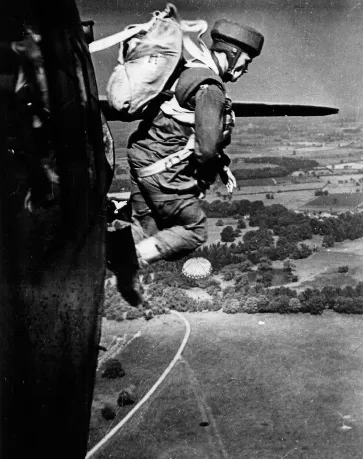
Early paratrooper adopts correct jumping position on exiting the aircraft over Tatton Park. (Courtesy of Air Assault Museum)
Competition was tough between the newly appointed officers and NCOs of the parachute battalions to secure the best recruits for their own battalion as Major John Frost recalls from his time as 2 Para adjutant in charge of selecting men to the ranks of 2 Para:
To me it seemed that I would never be able to get the battalion up to strength, which did not seem to be happening with the 3rd Battalion, who were also at Hardwick. Then I found out my counterpart in the 3rd Battalion had stationed a man at the entrance and told all new arrivals to report to the 3rd Battalion Guardroom. Here their RSM inspected them all and kept the best ones for himself and sent the chaff down to me! I decided to send a few men with a truck to just outside the camp and for them to pick up all the new arrivals. This worked well for a while, till the 3rd’s Adjutant sent a truck even further down the road, we then called a truce and both units started to build up fairly equally.2
Whichever battalion the men finished up in after training, there was a single quality that all ranks of the Parachute Regiment shared, and they still do share, to this day. Lieutenant Martin Willcock remembers ‘the one thing that we all had in common from the Col to the Private – was that we had JUMPED – a unique experience which we would never forget and one which made us feel the battalion was something rather special’.3 Rivalry existed at every level and was a mark of the elite status and constant pursuit of excellence required of paratroopers. Each man was proud of his unit, whether it be his battalion, company, platoon or section, and was fiercely loyal to upholding its standards and reputation.
As Major Victor Dover also recalled when he had finished his training, ‘I did not appreciate at the time (how could I?) the magnificence of the men with whom I had the privilege to serve and to call my friends. Many were to die, many were to suffer serious wounds and a number were to become legends’.4 The volunteers who had met the call to arms for the new airborne elite were trained and at last ready to get back into the fight against Hitler.
As 1 Para had been centred around the previous 11th SAS Battalion, the new recruits, sometimes whole battalions transferred from the line infantry, were mainly placed in 2 and 3 Para. Towards the end of 1941 the battalions were rotating through parachute training a battalion at a time, increasing the numbers of trained parachutists that were now ready for action. The first unit into action would be 2 Para’s C Company, now led by Major John Frost. They were parachuted into France by the RAF and captured vital enemy radar equipment from a house being used as a radar station on the cliffs above the fishing village of Bruneval. They were met on the shore by the Royal Navy and extracted with the captured radar equipment and a sole German prisoner to explain how the kit worked. This was a highly successful raid and proved the potential of inter-service co-operation for parachute- and commando-style raids on Hitler’s Fortress Europe.
After proving the possibilities of parachuting into battle to maximise the element of surprise upon the enemy, the brigade was shipped to North Africa – the main land campaign of the Allied effort after being pushed out of mainland Europe via Dunkirk. The remainder of the brigade were eager to get into action, preferably by parachute, in order to put all their hard work into practice. The chance was soon to come as the Axis Forces were now on the retreat from El Alamein and heading back towards Tunisia chased by Montgomery’s Desert Rats.
In support of Montgomery’s easterly offensive from Egypt and with the American entry into the war after Pearl Harbor, a second front was opened to perform a pincer movement on the Axis from the west of Tunisia. Operation Torch was devised to invade Vichy French North Africa with troops landed directly from the United States. The 1st Parachute Brigade was deployed in support of Torch and conducted a series of battalion-sized parachute operations to underpin the Allied advance by capturing vitally strategic objectives. Both the Allies and Germans quickly identified Tunis as a key to holding Tunisia. Bone airfield was situated halfway between Tunis and Algiers and became the subject of a race between competing airborne forces to parachute and capture it first. On 12 November 3 Para flew towards Bone airfield and only beat the Fallschirmjaeger of 5th Parachute Regiment there by a matter of minutes. As the men of 3 Para began exiting their Dakotas, a fleet of Ju52s with its own cargo of paratroopers was in the distance watching the drop. The Germans promptly about-turned and headed back to base knowing they had lost the race for the airfield. The first clash of British and German paratroopers on the battlefield had been narrowly avoided. However, the success illustrated by the ‘vertical-envelopment’ of a strategic target by only a few paratroopers had been clearly demonstrated and led to further jumps for the brigade.
Four days later, on 16 November, 1 Para was tasked to capture an important crossroads on the road to Tunis at Beja. 1 Para’s Commanding officer, James Hill, flew in the lead Dakota and looked out of the plane’s door for a suitable drop zone near the target as maps of the area had proved insufficient in their detail. Accordingly, when Hill decided to jump, the remainder of the following Dakotas would also despatch their parachutists. In this ad hoc manner the battalion jumped into battle in a relatively small dropping area and secured their objective. During the ensuing actions over the following days, Hill was shot three times in the chest whilst capturing enemy tanks by banging on the turret and demanding their surrender armed with just his pistol and a stick. Whilst Hill convalesced after the battle, Alistair Pearson took command of the battalion. The men of 1st Parachute Brigade were now living the dream as they began to conduct operations behind enemy lines. These airborne operations were what the men had joined the Parachute Regiment for.
A third airborne assault for the brigade was now planned for 29 November and to be led by John Frost’s 2 Para. They were to secure the Oudna airfield in support of a ground offensive towards Tunis. As the planes began to taxi down the runways for take-off, men could be seen running towards the Dakotas carrying a parachute in one hand and their weapon in the other hand. ‘It is not every man who will disobey orders to parachute into battle’.5 This clearly highlights the esprit de corps that had formed amongst the Parachute Regiment soldiers and no man wanted to miss out on operations. 2 Para parachuted close to Oudna but were then given the news that the planned link-up with the advance by ground forces had been cancelled. The entire battalion now found itself cut off miles behind enemy lines. A legendary fighting retreat now ensued as the battalion was surrounded and had to battle against overwhelming odds to regain the Allied font line, albeit at the cost of half the battalion killed, wounded or taken prisoner. The men of 2 Para had taken to keeping a book on the odds of the officers’ fortunes on the battlefield as a bit of entertainment. ‘The Book’, however, proved to be so accurate in North Africa that John Frost banned it. The Parachute Regiment was awarded the battle honour of ‘Oudna’ for this epic fighting retreat. Coupled with the Bruneval battle honour, John Frost had now been at the scene of the Parachute Regiment’s first two battle honours. He, along with the majority of the 1st Parachute Brigade, would soon be at the scene of yet another, Tamera.
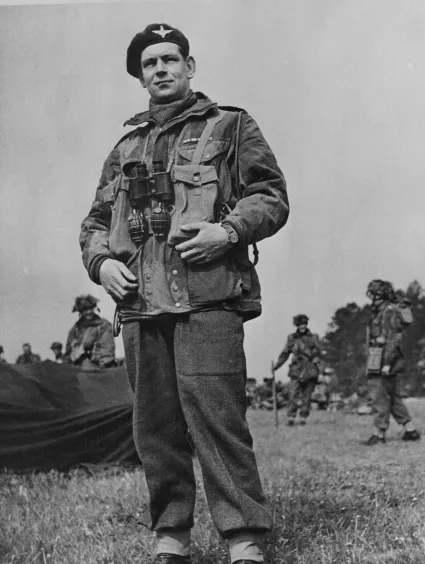
Alastair Pearson, Commanding Officer 1 Para. (Courtesy of Air Assault Museum)
With the Allied push on Tunis requiring ever greater numbers of troops to fight the shrinking perimeter and therefore growing concentration of the Axis forces, the 1st Parachute Brigade now reverted to their standard infantry role and were moved into the line to fight off increasingly desperate German counter-attacks. Fighting from defensive positions astride the main roadway, the paras fought off wave after wave of enemy counter-attacks, often with hand-to-hand fighting to repel World War I-style infantry charges aimed at over-running their trenches. Unknown at the time, the brigade was fighting off a division-sized enemy force, including their Fallschirmjaeger opponents for the first time, at odds of nearly ten to one against. It was here in the Tamera Valley that the paras acquired their nickname. Allied intelligence had picked up radio traffic from the Germans which had referred to the Parachute Regiment defenders of the Tamera Valley as the ‘Red Devils’. The name was taken as a mark of respect and still stands as the regimental nickname till this day. The intercepted message was passed on to the men who had won this hard-fought recognition from their adversaries:
From Major-General Browning to All Para Units: General Alexander directs that 1 Para Brigade be informed that have been given name of ‘Red Devils’. General Alexander congratulates the brigade on achieving this high distinction.6
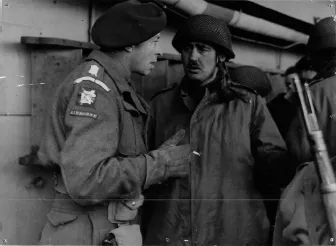
John Frost, Commanding Officer 2 Para, seen here after the Bruneval raid. (Courtesy of Air Assault Museum)
The news was met with pride, in that the Germans had paid them the respect of granting them a nickname, but also tinged with sadness at the memory of the men who had been lost in earning that hard-won respect.
The brigade also developed its war-cry in the Tamera Valley, adopted from the local Arabs who encouraged their mules into action with the call of ‘Waho Mohammed’. Future enemies’ first encounters with the 1st Parachute Brigade were invariably led by this North African war cry followed by a Red Devil on the charge with his weapon levelled, ready for anything. For holding their ground against these overwhelming odds, the battle honour ‘Tamera’ was bestowed upon the Parachute Regiment.
The two North African battle honours had come at a high price. The three infantry battalions of the brigade alone had suffered casualties as high as 1,700 killed, wounded and missing of which 49 officers and 469 other ranks were officially listed as being killed during the North African campaign – effectively a full battalion. In return, the brigade had dished out casualties on the Axis forces as high as 5,000 killed and wounded and a further 3,600 captured. The brigade was one of the most decorated in the British Army earning 8 Distinguished...
Table of contents
- Cover
- Title
- Copyright
- Contents
- Introduction
- 1 ‘Maroon Machine’
- 2 ‘Stepping Stone to Italy’
- 3 ‘Battle Prep’
- 4 ‘The Plan of Attack’
- 5 ‘Green Devils’
- 6 ‘Husky is let off the leash’
- 7 ‘Storming Eagles’
- 8 ‘Death from Above’
- 9 ‘Silent Arrivals’
- 10 ‘Hornet’s Nest’
- 11 ‘Seizing the Objectives’
- 12 ‘Green Devils versus Red Devils’
- 13 ‘Incoming!’
- 14 ‘Dog Fight’
- 15 ‘Tactical Retreat’
- 16 ‘Relief at Last’
- 17 ‘The Race for Messina’
- Conclusion
- Appendix A: 1st Parachute Brigade Order of Battle
- Appendix B: Every Man an Emperor
- Appendix C: Fallschirmjaeger Ten Commandments
- Appendix D: The Parachute Regiment Battle Honours
- Endnotes
- Bibliography
Trusted by 375,005 students
Access to over 1.5 million titles for a fair monthly price.
Study more efficiently using our study tools.
Frequently asked questions
Yes, you can cancel anytime from the Subscription tab in your account settings on the Perlego website. Your subscription will stay active until the end of your current billing period. Learn how to cancel your subscription
No, books cannot be downloaded as external files, such as PDFs, for use outside of Perlego. However, you can download books within the Perlego app for offline reading on mobile or tablet. Learn how to download books offline
Perlego offers two plans: Essential and Complete
- Essential is ideal for learners and professionals who enjoy exploring a wide range of subjects. Access the Essential Library with 800,000+ trusted titles and best-sellers across business, personal growth, and the humanities. Includes unlimited reading time and Standard Read Aloud voice.
- Complete: Perfect for advanced learners and researchers needing full, unrestricted access. Unlock 1.5M+ books across hundreds of subjects, including academic and specialized titles. The Complete Plan also includes advanced features like Premium Read Aloud and Research Assistant.
We are an online textbook subscription service, where you can get access to an entire online library for less than the price of a single book per month. With over 1.5 million books across 990+ topics, we’ve got you covered! Learn about our mission
Look out for the read-aloud symbol on your next book to see if you can listen to it. The read-aloud tool reads text aloud for you, highlighting the text as it is being read. You can pause it, speed it up and slow it down. Learn more about Read Aloud
Yes! You can use the Perlego app on both iOS and Android devices to read anytime, anywhere — even offline. Perfect for commutes or when you’re on the go.
Please note we cannot support devices running on iOS 13 and Android 7 or earlier. Learn more about using the app
Please note we cannot support devices running on iOS 13 and Android 7 or earlier. Learn more about using the app
Yes, you can access The First Bridge Too Far by Mark Saliger in PDF and/or ePUB format, as well as other popular books in History & Military & Maritime History. We have over 1.5 million books available in our catalogue for you to explore.