A concise history of ancient Roman gladiators—how they lived, fought, and died in the Colosseum—by the archeologist, author, and Roman military expert.
Heroic despite their lowly status, the gladiators of ancient Rome fought vicious duels in large arenas filled with baying crowds. Few lasted more than a dozen fights, yet they were a valuable asset to their owners.
Gladiators reveals the fascinating history of these men, how they fought, and how their weapons and techniques developed—debunking myths along the way.
Historian M. C. Bishop examines the different forms of gladiator combat, including simulated naval battles held on large artificial lakes. He also discusses how gladiators were carefully paired against each other to balance their strengths and weaknesses. Although their lives were brutal and short, gladiators were the celebrities of their day, admired for their bravery.
This short history reveals what we know about the gladiators and how we know it: ancient remains, contemporary literature, graffiti, modern attempts to reconstruct ancient fighting techniques, and the astonishing discovery at Pompeii where a complete gladiator barracks was found alongside multiple skeletons, telling their story.
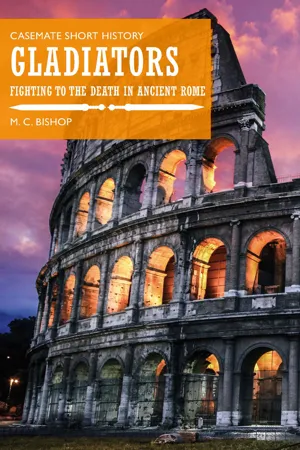
- 160 pages
- English
- ePUB (mobile friendly)
- Available on iOS & Android
eBook - ePub
About this book
Information
Topic
HistoriaSubtopic
Historia antigua romanaCHAPTER 1

INTRODUCTION
History does not permit peoples to be judged by a simple good or bad mark.
Michael Grant, Gladiators
Who was a gladiator?
After all, what has Norbanus ever done for us? He produced some decayed twopenny-halfpenny gladiators, who would have fallen flat if you breathed on them; I have seen better ruffians turned in to fight the wild beasts. He shed the blood of some mounted infantry that might have come off a lamp; dunghill cocks you would have called them: one a spavined mule, the other bandylegged, and the holder of the bye, just one corpse instead of another, and hamstrung. One man, a Thracian, had some stuffing, but he too fought according to the rule of the schools. In short, they were all flogged afterwards. How the great crowd roared at them, ‘Lay it on!’ They were mere runaways, to be sure. ‘Still,’ says Norbanus, ‘I did give you a treat.’ Yes, and I clap my hands at you. Reckon it up, and I give you more than I got. One good turn deserves another.
–Petronius, Satyricon 45
Reading this passage, from one of the first prose novels in the western world, is one way to judge the distance between us and the people of Rome. The familiarity of the speaker with what he is describing – entertainment provided by men fighting for their lives – helps render what he is describing everyday and unsurprising. His tone is that of the football pundit on the couch, which is the thing that strikes an uncomfortable familiarity for us too, because on one level, we can understand this: the team was mostly useless, although the Thracian showed some gumption, and the crowd were not impressed either; the gladiators did not really earn their applause.
The Latin word gladiator originally meant ‘sword-fighter’, deriving from gladius, which meant any sort of sword. Over time, the word gladius was often associated with the classic short sword wielded by Roman legionaries, often known as the gladius Hispaniensis (‘Spanish sword’) and this is indeed what we find many early gladiators using. However, the label gladiator was extended to cover a range of types of performance artists who competed in the life-and-death struggles of the arena, many of them never even using swords. One of the most famous types of gladiator – not least because one was played by Woody Strode in Stanley Kubrick’s Spartacus – was the retiarius or ‘net-man’. Armed with his weighted net and trident (both possibly modelled on the equipment of fishermen), he would attempt to trip or engulf his opponent with his net, whilst keeping him at a distance (and finally dealing a deadly blow) with his trident. There were variants on the type – one who used a lasso instead of a net and one who stood on a platform and threw stones – but there was little doubt in the minds of the Romans that a retiarius, despite his lack of a sword, was a gladiator.
Men who fought each other were not the only type of gladiator. Those who fought wild animals (bestiarii) or participated in hunts in the arena (venatores) were also included, to judge from the fact that they had their own training school. There are even sculpted reliefs showing men equipped as gladiators locked in combat with big cats, so there is no doubt that this was seen as ‘gladiatorial’ by the Romans themselves. It is sometimes difficult for us to distinguish between bestiarii and venatores and it is by no means clear that the Romans were either certain or consistent in making that distinction.
There were also men who fought against each other who were not gladiators. Usually condemned criminals or prisoners of war, they were given none of the training or privileges of gladiators, but instead were expected to fight enthusiastically, usually in recreations of great battles from the past (although normally not major Roman defeats like the Battles of Caudine Forks, Cannae, or Trasimene, for fairly obvious reasons). These might be land battles, complete with scenery, or even (from the time of Julius Caesar onwards) naval engagements known as naumachia. Alongside those condemned to play a part in a gruesome piece of historical re-enactment, there were also those sentenced to be killed ad bestias. Being torn apart by wild animals was yet another form of entertainment provided for the crowd, rendered all too familiar by tales of Christian martyrs forced to die in this way. All of these unfortunates had just one thing in common: nobody was looking for the skill or finesse of the gladiator, they were just there to be slaughtered.
Finally there were gladiators who provided light relief, rather than gory scenes of death, and these included the paegnarii (who fought each other with sticks) or the andabatae, who duelled (or, rather, attempted to do so) in helmets with no eye holes.
All of these categories of more-or-less deadly entertainment were to be found in what we call the ‘games’ but Romans referred to as munera. A munus was another word whose meaning evolved over time. It started out as an obligation or duty, usually on the part of a politician, to provide a service. This developed from providing funeral games in honour of a notable deceased figure into putting on entertainment for the masses. Finally, munera became synonymous with the games and interchangeable with the word ludi (a ludus was a gladiatorial training school, but ludi in the plural were always games). They became staggeringly expensive to stage, could last for weeks and often imposed a logistical strain on the entire Roman Empire just to provide entertainment in the capital. However, the games were an integral and pervasive aspect of Roman life that inevitably impinges on our perception of the people and their time: who can think of Rome without thinking of gladiators?
The fascination of gladiators
What is it about gladiators that fascinates us still? The Romans experienced a perplexing ambivalence towards them, at once once fascinated and revolted by gladiators. The fact that some free men (and even women) chose to sign up for the life demonstrates just how powerful the pull of the arena could be for some. In the most extreme cases, an emperor might choose to join in. However, whilst it was not thought acceptable for an emperor to fight as a gladiator, there seemed to be no objection to training in one of the particular variants of gladiatorial combat. As we shall see, it was thought to be a clear benefit that Roman soldiers were trained in this way. The shame all seems to have come from being seen to compete in public.
Modern ‘civilised’ people like to think that they have risen above this sort of thing and that watching large numbers of people being killed is not something we would do. Yet we are quite content to watch it in the cinema or on television. One famous study from 1976 estimated that, by the time they graduated from high school, the average American child had seen 13,000 simulated deaths on television. Other studies noted that violence in prime-time dramas was often glamorised, whilst in children’s cartoons it was trivialised. In 2012, another study (by an online undertaker) was published, revealing that in 2011 a single week’s viewing of 40 monitored programmes produced 132 simulated dead human bodies.
Of course, we all know these are not real dead bodies and that the actors get up again and go home at the end of a day’s shoot. But are we not a little bit inured to the spectacle of death and just ever so slightly intrigued by the deaths of gladiators, mostly anonymised behind their large, visored helmets? Is it part of the fascination of gladiators that we identify to some extent with those ancient Roman audiences? In other words, are we closer to the crowd attending a gladiatorial contest than we might care to admit?
Modern histories
We have come a long way from when Michael Grant’s Gladiators was about the only popular book available on the subject. Now there are many, but still comparatively few that systematically examine the history of gladiatorial combat from its inception to its end. It is important to consider the historical development of the gladiatorial games, because the nature of the games changed over time, gradually evolving from a funeral rite under the early Republic (509 to 264 BC), through a political tool for the manipulation of the masses under the mid- and later Republic (264 to 27 BC) and into pure entertainment in the Imperial (27 BC to AD 296) and Late Roman (AD 296 to 410) periods.
Thus a historical framework lies at the core of what follows, with digressions to examine the equipment and venues of the gladiatorial games, as well as the everyday life of gladiators and what actually happened in the arena. There is much that such a narrative approach can bring to the fore, such as the fact that the Samnite and Gaul gladiator types were only in use during the Republican period, so they were active for less than half of the period during which we know that gladiatorial combat was popular. Similarly, the retiarius was not introduced until the early Imperial period. More crucially, it can mirror the changes in Roman society as they are reflected in the taste for watching men (and women) kill each other and wild animals in a variety of innovative ways.
Between 2000 and 2001, an exhibition of gladiatorial material was held first in Hamburg in February to June 2000, in Speyer in July to October 2000 and then in the British Museum from October 2000 to January 2001, the accompanying catalogue for which was published as Gladiators and Caesars. In 2002, the exhibition Gladiatoren in Ephesos: Tod am Nachmittag (‘Gladiators in Ephesus: Death in the Afternoon’) was mounted, bringing details of the Ephesus gladiator cemetery to the general public for the first time, at the same time placing the results in the wider context of gladiatorial combat. Such events inevitably have a far-reaching effect and inspire both more reading and more writing about gladiators. For all that is known, there is still much to find out, and this book will hopefully provide both a glimpse of the former and hint at the latter.
CHAPTER 2
ORIGINS
The Gladiators [sic] Art was Infamous for its Barbarity and Cruelty, involving Men in Murder and Bloodshed.
Thomas Bingham
Funeral games
IT MAY BE SURPRISING TO LEARN that the origins of gladiatorial combat can be seen as early as Homer’s Iliad with its account of the funeral games following the death of Patroclus. Immediately before Achilles lights his companion’s funeral pyre, he executes twelve Trojan captives. Next day, the Trojans embark on a series of games, including boxing, wrestling, archery and chariot racing. That passage thereby combines human sacrifice and sporting contest in the context of marking a death and, as such, is seen by many as providing a context for the Roman adoption of gladiatorial combat.
Similarly, there are historical instances recorded of prisoners of war being executed en masse. Greek and Carthaginian prisoners were stoned to death by the Etruscans (a people who lived to the north of Rome) at Caere (Cerveteri, Italy) in the 6th century BC. Then, in 358 BC, more than 300 Roman prisoners of war were executed in the forum at Tarchuna (Tarquinia in Italy), again by the Etruscans. These grisly events provide an association between victory and mass killings, but those survivors taken prisoner could find their agony prolonged when they were forced to fight each other.
The Christian writer Tertullian provided his own interpretation of this, with the benefit of several hundred years of hindsight and through the lens of his particular theological perspective:
The ancients thought that by this sort of spectacle they rendered a service to the dead, after they had tempered it with a more cultured form of cruelty. For of old, in the belief that the souls of the dead are propitiated with human blood, they used at funerals to sacrifice captives or slaves of poor quality whom they bought. Afterwards it seemed good to obscure their impiety by making it a pleasure. So after the persons procured had been trained in such arms as they then had and as best they might – their training was to learn to be killed! – they then did them to death on the appointed funeral day at the tombs. So they found comfort for death in murder. This is the origin of the munus. (Tertullian, On Spectacles 12)
The first gladiators
It is entirely appropriate to stress that most of our source material about the origins of gladiatorial combat is not contemporary with those distant origins. Writers such as Nicolaus of Damascus, Livy and Silius Italicus were working in the late 1st century BC or 1st century AD and thus were writing up to three centuries after the events they were describing. Livy’s history of Rome, known as Ab Urbe Condita (From the City’s Foundation) began from the traditional (and probably spurious) date of 753 BC, but it is worth remembering that historical writing did not actually begin in the classical world until Herodotus, a Greek from Halicarnassus, produced his Historia in the 5th century BC. So a lot of Rome’s early ‘history’ was, technically, prehistory and, for the most part, legendary. Such legends will have been passed on by word of mouth, songs learned by one generation and bequeathed to the next, but these are not the same as documented fact. All of this means that it is sometimes necessary to distinguish between what the Romans who were writing thought happened in the past and what actually occurred. A little caution is always healthy.
The Greek writer Athenaeus (middle of the 2nd century AD) preserved a report by the above-mentioned Nicolaus of Damascus (second half of the 1st century BC) which included the observation that gladiatorial games were inherited by the Romans from the Etruscans (who, unlike most of Italy, did not speak a language derived from Indo-European). Even if Nicolaus was correct (and some scholars feel that there is good reason to doubt it), it is by no means certain that the path for the idea of gladiatorial combat from the Etruscans to the Romans was a direct one, despite the Romans believing that they had been ruled by the Etruscans. After all, it was part of their tradition that they cast out their Etruscan rulers, the Tarquins, and formed the Republic in 509 BC.
Overlooking the literary sources for the time being, the identification of the Etruscans as the originators of gladiatorial games depends upon a number of observations that are not necessarily linked. First there are frescoes from Etruscan tombs which show combat between two warriors. Single combat between important warriors featured in the Iliad too, and there is no obvious reason why the pairs of figures in the wall paintings must be interpreted as men ...
Table of contents
- Front Cover
- Title Page
- Copyright Page
- Table Of Contents
- Timeline
- Technical glossary
- 1. Introduction
- 2. Origins
- 3. Rise of the gladiators
- 4. At the peak
- 5. Hardware and venues
- 6. Life as a gladiator
- 7. The end of the gladiators
- Sources
- Note on Translations
Trusted by 375,005 students
Access to over 1.5 million titles for a fair monthly price.
Study more efficiently using our study tools.
Frequently asked questions
Yes, you can cancel anytime from the Subscription tab in your account settings on the Perlego website. Your subscription will stay active until the end of your current billing period. Learn how to cancel your subscription
No, books cannot be downloaded as external files, such as PDFs, for use outside of Perlego. However, you can download books within the Perlego app for offline reading on mobile or tablet. Learn how to download books offline
Perlego offers two plans: Essential and Complete
- Essential is ideal for learners and professionals who enjoy exploring a wide range of subjects. Access the Essential Library with 800,000+ trusted titles and best-sellers across business, personal growth, and the humanities. Includes unlimited reading time and Standard Read Aloud voice.
- Complete: Perfect for advanced learners and researchers needing full, unrestricted access. Unlock 1.5M+ books across hundreds of subjects, including academic and specialized titles. The Complete Plan also includes advanced features like Premium Read Aloud and Research Assistant.
We are an online textbook subscription service, where you can get access to an entire online library for less than the price of a single book per month. With over 1.5 million books across 990+ topics, we’ve got you covered! Learn about our mission
Look out for the read-aloud symbol on your next book to see if you can listen to it. The read-aloud tool reads text aloud for you, highlighting the text as it is being read. You can pause it, speed it up and slow it down. Learn more about Read Aloud
Yes! You can use the Perlego app on both iOS and Android devices to read anytime, anywhere — even offline. Perfect for commutes or when you’re on the go.
Please note we cannot support devices running on iOS 13 and Android 7 or earlier. Learn more about using the app
Please note we cannot support devices running on iOS 13 and Android 7 or earlier. Learn more about using the app
Yes, you can access Gladiators by M.C. Bishop in PDF and/or ePUB format, as well as other popular books in Historia & Historia antigua romana. We have over 1.5 million books available in our catalogue for you to explore.