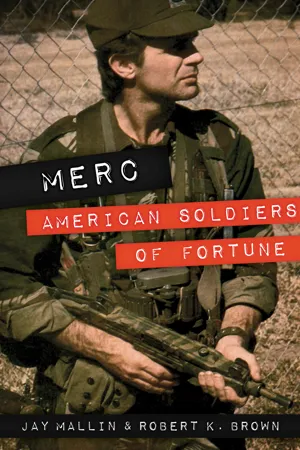
The "fast-paced, fascinating, often shocking" account of hired guns and their heroic adventures in hotspots around the world—includes photos (
Milwaukee Journal).
Merc is a classic; first published in 1979, its characters and stories are as vivid and worthy of retelling today. American soldiers of fortune have seen action on nearly every battlefield in history—from the Revolutionary War to modern times, men like John Early, a member of the famed Selous Scouts who hunted terrorists in Rhodesia. They fight because they enjoy combat, for causes in which they passionately believe, for money, or simply for adventure.
The mercs profiled in this book range from West Point graduates and Harvard poets to former CIA agents and ex-cons. They are men like William Morgan, a guerrilla leader in the Cuban uprising against Fulgencio Batista, later imprisoned and executed by Fidel Castro; David Marcus, raised in New York's Hell's Kitchen, who went on to a brilliant career in law and reform politics and died in 1947 fighting for the survival of a tiny new nation called Israel; William Brooks, Vietnam Special Forces veteran who, down and out in a cheap Paris hotel, joined the French Foreign Legion and ended up in a remote African outpost where he lived on Coke, salt tablets, and paregoric while fighting Somali insurgents; and George Bacon, an ex-CIA operative in Laos with mysterious connections, who died fighting Cubans in Angola.
Because their private histories parallel the larger history of unconventional warfare and political upheaval,
Merc provides insight into global conflicts—but most of all it is a fast-paced, eye-opening account of a little-known but fascinating way of life.
- 224 pages
- English
- ePUB (mobile friendly)
- Available on iOS & Android
eBook - ePub
About this book
Information
CHAPTER 1
Who Are the Mercs?
They call themselves “mercs”—a contraction of the word “mercenaries.” The very word has an unsavory connotation: mercenaries are men who fight for money. The implication is that they fight only for money; they are warm bodies for hire. Did the word “mercenary” (noun) derive from the adjective “mercenary” (“hireling; venal” says the dictionary) or vice versa? Whatever. The soldier who is a mercenary is viewed as a person who fights only for money, and presumably his other morals are equally negotiable.
It is true that many mercenaries have fought and are fighting today primarily for monetary reward. There are, however, two additional important motivations that affect mercenaries: There have been many who have gone to war because of their love of adventure and of fighting. Theodore Roosevelt described this succinctly: “All men who feel any power of joy in battle know what it is like when the wolf rises in the heart.”
A third motive for mercenary activities is belief in a cause. There have been mercenaries who fought because they truly believed in the cause for which they were fighting. Outstanding examples in American history were the Marquis de Lafayette, a Frenchman who came to fight for the American colonies, and Mickey Marcus, an American who went to fight for Israeli independence.
Until the French revolution, when a nation of citizens flocked to the colors and outnumbered the small “professional” military forces each European kingdom had employed, the term “mercenary” did not carry with it a negative connotation. Military personnel of the day were employed directly by the king for money—the average citizen was perceived as not having a stake in the country to fight for.
It was the French Revolution that gave the average citizen a feeling that he had a vested interest in his nation-state. His newfound willingness to fight for his country caused him suddenly to look down his nose at those persons he saw fighting for mere cash—a seemingly baser motivation than patriotism. In fact, each embarrassed the other: the “noble” citizen who took less cash for the job the mercenary was demanding more money for, and the mercenary whose very presence in the same military forces made the citizen’s cause seem a bit baser and more transient. Pragmatism, however, has forced both government and citizen to accept the concept of mercenaries, if not the word, for the duration of whatever conflict in which they find themselves.
The authors could easily fall into the trap of defending the word “mercenary,” or they could use other, more colloquially acceptable terms. In fact, one man’s terrorist is another man’s freedom fighter. A mercenary fighting on one side becomes a “foreign volunteer” or a “military advisor,” while those performing the same task on the other side become “mercenaries” or “enemies of the people” or “whores of war.” The authors feel the term mercenary will outlast the various systems and groups that now ascribe to it negative connotations; it will endure through future centuries as a term describing a condition of fact, without editorial innuendo. But for the time being, mercenary is a “bad” word, even to those who employ mercenaries.
Because of the connotation of the word, it is clearly a disservice to label Lafayette and Marcus and others like them as mercenaries, because their motive for fighting was not money. Let us say, therefore, that all men who fight under foreign colors are “soldiers of fortune,” and that “fortune” in that context refers as much to luck as to gold. Some soldiers of fortune fight for gold, some fight for cause, and some fight for excitement. All mercenaries are soldiers of fortune, but not all soldiers of fortune are mercenaries.
Are soldiers of fortune effective fighters? Niccòlo Machiavelli in The Prince provided this devastating opinion:
Mercenaries and auxiliaries are useless and dangerous, and a leader having his state built on mercenary armies will never be secure. Troops of this sort are disunited, ambitious, undisciplined, and faithless, swaggering when among friends and cowardly in the face of the enemy; they have neither fear of God nor loyalty to men. Ruin is postponed only as long as the assault is postponed; in times of peace you are despoiled by them and in time of war by the enemy. The reason is that they have no other interest or incentive to hold the field, save only their moderate pay, which is not enough to make them willing to die for you. They are pleased to be your soldiers so long as you have no war; when it comes they either run away or leave your employ.
A totally different view was offered by the English poet Alfred E. Housman. Germany’s Kaiser had sarcastically called the British army “an army of mercenaries,” referring to the numerous colonial units it contained. Housman retorted with his “Epitaph on an Army of Mercenaries,” as follows:
These, in the days when heaven was falling,
The hour when earth’s foundations fled,
Followed their mercenary calling
And took their wages and are dead.
Their shoulders held the sky suspended;
They stood, and earth’s foundations stay;
What God abandoned, these defended,
And saved the sum of things for pay.
This brief poem was to play a role in the creation of one of the most famous soldier of fortune units in American history. Mrs. Anna Chennault in her biography of her husband, commander of the World War II Flying Tigers—a mercenary unit —stated that Colonel Chennault felt that “one of the factors that turned the scales” in favor of allowing the formation of this unit in President Roosevelt’s mind was Housman’s poetic defense of mercenaries.
The history of soldiers of fortune is as old as the history of man warring on man. In Biblical times, David, an Israelite, killed Goliath, a Philistine, but later defected to the Philistines and conducted raids for them. Among the earliest mercenaries —predating even David—were the Numidian troops led by the Egyptian pharaoh, Ramses II, in his unsuccessful attempt to capture Kadesh, a Hittite stronghold, in 1294 B.C. The Persian Darius the Great utilized Greek mercenaries; the vaunted Roman legions sometimes included Balearic and Aegean mercenaries, and such great military leaders as William the Conqueror, Tamerlane, and Gustavus Adolphus had mercenaries among the men under their command. Mercenary detachments—St. Bernard of Siena called them “locusts who leap here and there”—were a part of the European military scene for centuries. To this day the popes are guarded by Swiss mercenaries, the Foreign Legion is a part of the French Army, and Indian Gurkhas serve in the British Army.
Thus, in view of the long European tradition of utilizing soldiers of fortune, it was natural that soldiers of fortune would participate on both sides when the American colonies fought to break away from England. The British first considered hiring twenty thousand Russians. A British nobleman commented that the Russians “will be charming visitors at New York and civilise that part of America wonderfully.” Catherine the Great, however, rejected the British plan. So the British accepted the offer of minor German princes to rent them troops—this was a normal way for the princes to obtain revenue. A total of 29,166 Germans from six principalities would serve the British monarch in America, nearly half of them Hessians from Hesse-Cassel. Although the Germans served throughout the Revolutionary War, American history best remembers them for General Washington’s bold and successful strike against the Hessian garrison at Trenton, New Jersey, on December 26, 1776.
On the side of the colonials there was, of course, the young and gallant Marquis de Lafayette, able commander and accomplished diplomat who was instrumental in securing decisive military assistance from France. There were also the Baron von Steuben, who doggedly transformed the American troops from rabble to regulars; Thomas Conway, the Irishman; Johann Kalb, German; and Tadeusz Kościuszko and Kazimierz Pulaski, Poles. All of these were soldiers of fortune; all served the American cause well.
In a little over two centuries of history since the Revolutionary War, the United States has engaged in seven major wars: against England, Mexico, Spain, Germany and its allies, Germany and Japan and their allies, North Korea and North Vietnam, and in a good many lesser military actions. In 1970 a congressional subcommittee published a list of 165 major and minor “instances of use of United States armed forces abroad, 1798–1970.”
Thousands of foreign nationals have served with the U.S. armed forces over the years. Some were drafted (residents of the United States, they were subject to the same laws as American citizens). Many others, however, volunteered for service. Similarly, hundreds of Americans, possibly thousands, have served in the armies, navies, and air forces of other nations. Usually they signed up as individuals. In this century, however, there have been at least four cases of Americans fighting under foreign flags in units composed entirely or largely of Yanks. There were the Escadrille Lafayette of World War I, the Kościuszko Squadron which fought for Poland in the Russian-Polish War of 1920, the Lincoln and Washington battalions of the Spanish Civil War, and the Flying Tigers of World War II.
Since World War II, American soldiers of fortune have found their skills to be most in demand in the small wars of Africa and Latin America. They fought yesterday, they fight today, and they will continue to fight tomorrow. Some never come home; others move up to replace them. The spirit of the soldier of fortune was best expressed by a young American soldier of fortune long ago—July 3, 1915—in a letter he wrote to his mother from France. A most unlikely mercenary, Alan Seeger, Harvard man and poet, was one of the Americans who had flocked to join the Foreign Legion when France entered World War I.
Seeger wrote from the front:
“Had I the choice I would be nowhere else in the world than where I am. Even had I the chance to be liberated, I would not take it. Do not be sorrowful then. It is the shirkers and slackers alone in this war who are to be lamented. The tears for those who take part in it and who do not return should be sweetened by the sense that their death was the death which beyond all others they would have chosen for themselves, that they went to it smiling and without regret, feeling that whatever value their continued presence in the world might be to humanity, it could not be greater than the example and inspiration they were to it in so departing. We to whom the idea of death is familiar, walking always among the little mounds and crosses of the men mort au champ d’honneur know what this means. If I thought you could feel about me as I feel about them, the single self-reproach I have, that of causing you possible unhappiness, would be mitigated.”
On July 4, 1916, Legionnaire Alan Seeger was killed in combat as the Legion attacked the enemy-held village of Belloy-en-Santerre.
There follow the accounts of eight contemporary American soldiers of fortune. Some have come back; some have not.
CHAPTER 2
William Morgan: From Intrigue to Frogs
“I was wearing a two-hundred-fifty-dollar suit, white-on-white shirt, and thirty-seven-dollar shoes. I looked like a real fat-cat tourist—but I only had four dollars in my pocket.” Thus did William Morgan describe his arrival in Cuba during that nation’s civil war in 1957.
Many people believe that Fidel Castro won the Cuban civil war/revolution. Fidel Castro believes it. The fact is, however, that a large number of Cubans from all walks of life participated in that struggle, and a number of these people played significant leadership roles. Castro became a symbol: he was young, charismatic, public relations–conscious, and there was a romantic aura about him. The reality, however, was that Castro was the leader of but one of several revolutionary entities engaged in the war against Dictator Fulgencio Batista.
One of the other military leaders was an American, William Alexander Morgan. If soldiers of fortune can, by the very nature of their calling, be termed “colorful,” none is more aptly described by that word than Morgan. During the course of his career he was a United States soldier, a fugitive from justice, a guerrilla chieftain, the “mayor” of a Cuban city, a master international intriguer, a high-ranking officer in a foreign army—and a frog farmer.
Morgan’s adventures began early in his life. He was born April 18, 1928, in Cleveland, Ohio. Although his father was, in Morgan’s words, a “solid Republican,” Morgan ran with the wrong crowd, “ran away from home so many times,” and finally, at fifteen, ran away from school. In March, 1946, he was picked up by the San Antonio police and a month later by the Toledo police, who suspected him of armed robbery but did not book him. When he was eighteen he enlisted in the Army and after training was sent to serve with the occupation forces in Japan. He married a Japanese girl (and, being truly international, he later married an American girl in the United States and a Cuban girl in Cuba). Not very literate, fond of comic books, Morgan evidently was quite a talker: in the Army he was nicknamed “Gabby.”
In November, 1947, Morgan was arrested for being AWOL and was sentenced to three months at hard labor with forfeiture of pay during that period. At the stockade in Kyoto, Japan, Morgan overpowered a guard, taking his pistol and uniform, and escaped. Recaptured and court-martialed, Morgan was found guilty of escape and armed robbery. His sentence:
To be dishonorably discharged from the service, to forfeit all pay and allowance due or to become due, and to be confined at hard labor, at such place as the reviewing authority may direct, for five (5) years.
Morgan did his time at the federal reformatories at Chillicothe, Ohio and Milan, Michigan. He was not a model prisoner: he was placed in solitary on several occasions for fighting, attempted escape, refusal to work, and attempted arson. (One of Morgan’s nonadmirers would later describe him thus: “Like Fidel Castro, though on a lesser scale, Morgan was a superannuated juvenile delinquent …”)
After leaving prison, Morgan may have worked as a merchant seaman and in some aspect of electronics.
There had been plots and open insurrections against Batista in Cuba for a number of years; civil war was fully launched in November, 1956, with a major uprising in the eastern city of Santiago. One of the groups that organized to fight Batista was the Directorio Revolucionario, the militant arm of the Federation of University Students. It was with this group that Morgan made contact, possibly in Miami. He would later explain that he was impelled to involve himself because a friend had been tortured and killed by Batista’s police. Quite likely Morgan was looking for new adventures; he was joining the rebels for the same reason so many Americans and foreigners have joined the French Foreign Legion.
Most foreigners became involved with Castro’s 26 July Movement in Cuba, but Morgan made contact with the Directorio Revolucionario forces, led by EI’oy Gutierrez Menoyo, in the Escambray mountains bisecting central Cuba.
The American adventurer impressed no one on his inauspicious arrival in the DR camp. As Roger Redondo, one of the original members of the group, recalls, “I was on my back with food for the troops when I heard people [at my camp] talking in English. It sounded to me like words I knew were bad words, like “son-of-a-bitch.” I didn’t speak English at that time. I snuck around trying to find out what the hell was going on in the camp.
“Lázaro Artola was with a great big American, all red, fat … he had no shirt on. His body was stung by this ‘chinicicacea.’ It’s a weed up there that has like a bee sting to it. His body was all puffed up, his eyes were puffed and he had scratches everywhere on him. Artola, who lived in that region for a long time, was immune to the weed, but Morgan was not.
“Artola said the American was an adventurer. He said, ‘I brought him up to see how long he’ll last. Because he’s so fat, I don’t think he’ll last too long. He probably works for the CIA or FBI.’ ”
Menoyo ran the little band of guerrillas up and down the mountains for three days to get in shape. Morgan trudged up and down the mountains with the little twenty-nine-man band, losing weight and building up his strength. He lost thirty-five pounds quickly, since the fast-moving band was starving most of the time.
His military experience began to show. He had the training from the U.S. Army, and he taught the troops discipline. Ten days after they moved into the mountains, the small band encountered and ambushed a five-man Cuban army patrol. The patrol was preceding a major army sweep designed to clear out all revolutionary activity in the Escambray mountains. Flushed with their brief success, believed to be Morgan’s first combat, the band force-marched over two hundred miles back and forth through the mountains for thirteen days, constantly exchanging shots with the larger pursuing force.
Morgan spoke no Spanish, so he had to communicate through Artola. As Redondo recalls: “Morgan would ask, ‘How do you say this in Spanish?’ pointing to everything he could find.
“That’s how he started building his vocabulary, learning what the different things were. By the time the revolution was over, Morgan spoke pretty good Spanish.”
By February 24, the guerrillas felt themselv...
Table of contents
- Cover
- Title
- Copyright
- Contents
- Acknowledgements
- 1 Who Are the Mercs?
- 2 William Morgan: From Intrigue to Frogs
- 3 David “Mickey” Marcus: A True Hero
- 4 The French Foreign Legion: A Tradition of Courage
- 5 William Brooks: The Legion Today
- 6 Brooks in the Legion: Africa and Action
- 7 L. H. “Mike” Williams: Kraals and Galloping Goffles
- 8 George Bacon: Fighting Against Communism
- 9 David Bufkin: Seller of Soldiers
- 10 Two in Nicaragua: William Walker and Mike Echanis
- 11 John Early: Rhodesian Adventures
- 12 American Soldiers of Fortune in History
- Plate section
Trusted by 375,005 students
Access to over 1.5 million titles for a fair monthly price.
Study more efficiently using our study tools.
Frequently asked questions
Yes, you can cancel anytime from the Subscription tab in your account settings on the Perlego website. Your subscription will stay active until the end of your current billing period. Learn how to cancel your subscription
No, books cannot be downloaded as external files, such as PDFs, for use outside of Perlego. However, you can download books within the Perlego app for offline reading on mobile or tablet. Learn how to download books offline
We are an online textbook subscription service, where you can get access to an entire online library for less than the price of a single book per month. With over 1.5 million books across 990+ topics, we’ve got you covered! Learn about our mission
Look out for the read-aloud symbol on your next book to see if you can listen to it. The read-aloud tool reads text aloud for you, highlighting the text as it is being read. You can pause it, speed it up and slow it down. Learn more about Read Aloud
Yes! You can use the Perlego app on both iOS and Android devices to read anytime, anywhere — even offline. Perfect for commutes or when you’re on the go.
Please note we cannot support devices running on iOS 13 and Android 7 or earlier. Learn more about using the app
Please note we cannot support devices running on iOS 13 and Android 7 or earlier. Learn more about using the app
Yes, you can access Merc by Jay Mallin,Robert K. Brown in PDF and/or ePUB format, as well as other popular books in History & Military Biographies. We have over 1.5 million books available in our catalogue for you to explore.