- 363 pages
- English
- ePUB (mobile friendly)
- Available on iOS & Android
eBook - ePub
About this book
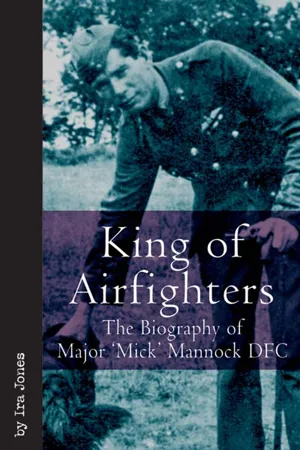
A penetrating study of Britain's top World War I fighter ace, written by fellow pilot Ira Jones, the author of An Air Fighter's Scrapbook.
Ira Jones' biography of Britain's top-scoring ace of the First World War has become the subject of some controversy over the last few years; most notably, it claims seventy-three "kills" for Mannock, making him the number-one-scoring Allied ace of the war. Later research has thrown serious doubt on this assertion, and indeed, Mannock himself only claimed fifty-one kills.
Jones' biography is nevertheless an important account, especially when seen in the context of the time in which it was first written. In particular, the biography delves into the mind of Mannock, portraying the singular nature of his character and the true stress that these pioneer air fighters experienced in the last few months of the war.
Originally published in 1934 by Ivor Nicholson and Watson in London, the book has been reprinted—most recently in the 1990s by Greenhill Books as part of its Vintage Aviation Library—and reproduced from the original 1930s version of the book.
Not a word has been changed in this Casemate edition, but the original, very dated type and page layout have been reworked, as has been the format in which the book is presented, to give a beautiful new treatment to this classic of aviation literature.
Information
I
Early Life—Part I
Corporal Edward Mannock, alias Corringhame, of the 2nd Dragoons (Royal Scots Greys), was the son of a Fleet Street editor. He enlisted, for an unknown reason, under the assumed name of Corringhame, which was his mother’s maiden name. He was a soldier of fine physique. He loved a soldier’s life, and volunteered for any scrap the Empire was engaged in.
In 1881 his regiment was stationed in the barracks of Ballincollig, the quaint little Irish suburb of Cork. There he fell in love, and married a sweet, blue-eyed Irish colleen named Julia O’Sullivan.
A year later the newly married couple carried out the first of their many moves during the husband’s service career. His regiment was transferred to Glasgow and from there to Edinburgh. At this time the Egyptian trouble fostered by Arabi Pasha was brewing, so out to Egypt Corringhame went, leaving his bride to return to Ballincollig to console herself with her tears. “A soldier’s first duty,” he told his wife, “is to fight for his King.” And on this austere principle he conducted his domestic affairs. He never allowed domestic ties to interfere with what he considered to be his duty. He believed in giving the tax-payer his money’s worth.
While in Egypt he served with the Heavy Camel Corps, and took part in the action at Tel-el-Kebir. He returned ten months later wearing the Egyptian Medal and Star, and rejoined his regiment at Edinburgh. During his absence a baby girl had been born—Jess.
In 1886 his regiment moved to the West Cavalry Barracks, Aldershot, and while he was stationed there a son, Patrick, was born. A year later the Corringhame family was at the Preston Cavalry Barracks, Brighton. Here, on May 24th, 1887, was born a son christened Edward, the hero of this book.
From Brighton the regiment moved to Dundalk, Co. Louth, Ireland. During the Curragh Season, which included manœuvres, the father was separated from his family for several months; later he rejoined them when the regiment moved to Newbridge, near Dublin.
At Newbridge, Corporal Corringhame’s time expired; he returned with his family to England and settled at Highgate. He had no pension, but as the result of a compulsory regimental money-saving scheme, whereby two-pence a day was deducted from a soldier’s pay, he received about £40 on leaving.
He pottered about London for a couple of years, but his heart and soul were still in the King’s Service. While on a visit to some relations at Liverpool he suddenly decided to join the Army again. He made a clean breast of his previous service and gave his proper name. His striking personality and soldierly manner soon overcame any obstacles to his reenlistment, and he was sworn in, this time as a trooper in the 5th Dragoon Guards, who were then stationed in India. So out to India he went, leaving his family to join him later. He found his regiment at Meerut, under the command of Colonel Robert Baden-Powell (now Lord Baden-Powell, the beloved Chief of every Boy Scout).
Mrs. Mannock and her family of four arrived in India six months later. Edward was then between six and seven years of age, and with the other children he commenced his scanty education at the Army school. The family remained in India for nearly six years, and during the summer season the mother and children went for six months to the Hill Stations, as the temperature on the plains was too trying for them.
During this early period, Edward displayed a quiet, reserved nature, which was his primary characteristic during his schooling days. He was neither jovial nor quarrelsome. He never romped about with the other children. He pondered a great deal; while his little friends played, he would be found sitting and thinking or reading; he read any book he could lay hands on. Here is a characteristic attitude which intrigued his elders: a book on his left knee, his chin resting in his right hand, and his brow puckered deep in concentration. This pensiveness and love of reading mystified his elders. This desire to study met with a sudden check one day when the child, for some unknown reason, found his sight almost completely gone. Happily this state was a temporary one, lasting only for a fortnight, although the normal vision did not return for many months. This defect, however, recurred in a less serious form in later years.
He was always truthful, and would invariably admit any breaches of discipline rather than tell a lie and so possibly avoid punishment. His recreations were cricket and football—his favourite sports. It is interesting to note that during his childhood and youth he was quite unlike his famous contemporary richthofen, for he despised hunting and shooting wild game or birds, although he loved shooting at a target with an air-gun and bow and arrow. Animals and birds he loved as pets, and kept rabbits and pigeons. Later in his schooldays, when at Canterbury, he developed a passion for fishing, and occasionally stayed out all night poaching with the aid of a lamp to attract the fish. He would divide his catch between his family and the local priest, Father Power, of St. Thomas’s Church. The fish to the former were in lieu of a smacking, while the latter had to be considered in order to adjust his conscience with the Deity!
He revelled in singing, and of musical instruments the kettle-drum and the Jew’s harp were his favourites. Later in life he became passionately fond of the violin. He even took it with him to the war. As a boy he enjoyed good health, although he was not robust; in fact, he was growing into a slim, wiry youth, inclined to be tall—the type of youth who persists in his efforts; the race-horse type, sensitive, ambitious, highly strung, and full of grit. He had good features, jet-black straight hair, blue eyes, and a winsome smile.
Although the 5th Dragoon Guards was not the first unit in India on the roster for active service, as the result of the high standard of efficiency which they had attained in 1898 (Sir George White, the Commander-in-Chief, having declared that it was the best unit of all arms then in the country) the regiment was the first to leave India for the South African War, when a sudden call for reinforcements was received by the Commander-in-Chief.
The elder Mannock (once again a corporal) remained in South Africa until the end of the war, and took part in all the engagements which his famous regiment fought in. His family, now five—two boys and three girls—remained in India. When the war was over, Corporal Mannock’s period of service was nearly completed, so he returned to England, being stationed first at Shorncliffe and later at the Cavalry Depot, Canterbury, where his family joined him. After a few months he was demobilised and he made a home in Military Road. Suddenly, and without apparent reason, he abandoned his family, and he neither rejoined nor supported them ever again. (In spite of this miserable and unforgivable desertion, he was not deterred, nearly twenty years later, from claiming his son’s decorations and medals, and unashamedly receiving them from the hands of the King at Buckingham Palace, although his son had made a will in favour of his other relations.) With the indomitable and characteristic courage of her race and sex, the gallant mother, with the support of the scanty earnings of her two eldest children, succeeded in keeping the home together until the younger children were old enough to fend for themselves. The children in return, as circumstances permitted, did not forget the debt they owed to this virtuous and brave woman.
Edward, now twelve years of age, went to St. Thomas’s School for a short while, but owing to the circumstances already referred to, he very soon had to commence earning a living in order to assist his mother. His brother was already working as a clerk with the National Telephone Company at Canterbury. Young Edward had always shown a tendency for practical jobs, preferably in the open air, and decided to start as a messenger boy; pen-pushing did not appeal to him. His first job was therefore with a local family greengrocer, who paid him the handsome wage of half a crown a week for an average of ten hours’ work a day. The boy found the work too arduous, the hours too long, and the remuneration too little; so, after a few months, he decided to change his calling to that of a barber’s assistant. The pay was doubled, the work less arduous, and the job not so sapping to his strength, although he disliked the thought of being indoors so much. He stuck to it for a while, but eventually decided that the nauseating atmosphere of the shop and alcoholic breaths of many of the regular customers were too much for him. He decided therefore to try some other more congenial occupation.
His brother, Patrick, was doing well as a clerk. He was paid fairly good wages; his hours were not long, and he appeared to be perfectly happy. So Edward decided to try the vocation of a clerk with the same company and in the same office, in the hope of eventually gaining an engineer’s job. For a while this job suited him. His experiences as an errand boy and as a barber’s assistant had given him a taste of the hardships of life in certain vocations, and he was happy and contented with his lot. But after a year or so office life began to affect his health, and the work lost its appeal. He stuck it for several years, until eventually an outdoor vacancy occurred in the, Wellingborough branch of the company; he applied for it and got it. This work was that of a linesman, assistant to the outdoor engineers: Edward’s job was confined chiefly to “climbing telegraph poles,” as he tersely described it later in life!
He was delighted with his transfer, but sorry to leave Canterbury because of his many friends. Since his arrival in the cathedral city he had made himself very popular with the youths of his age. He was an enthusiastic member of the St. Gregory’s Cricket XI and an ardent recruit of the Church Lads Brigade, despite the fact that he was a Catholic. He became the kettle-drummer in the band, a position which was popular and much sought after.
In order to retain his happy connection with the cathedral city, on retiring from the C.L.B., he joined the Home Counties (Territorial) R.A.M.C. Company at Canterbury, so that he could meet his friends at least once a year. He was a keen member of this Company and attended every annual camp. His keenness and proficiency were soon recognised and rewarded, and he was promoted to sergeant rank, before he resigned to go abroad a few years later.
He soon settled down to his work and surroundings; both appealed to him. The outdoor life suited him, and his attractive personality soon made for him a host of friends. He lived with Mr. and Mrs. A. E. Eyles, who eventually became his firmest friends. Mr. Eyles writes:
“Paddy (as he was familiarly referred to in Welling-borough) soon after his arrival became a great favourite among a large section of the populace. He was a keen cricketer, and played for the Wesleyan Cricket Club as wicket-keeper, a position where an eagle eye and quick thinking are essential. He joined the Parliamentary Debating Society, and very soon he was the secretary of the local Labour Party. His sympathy for the under-dog was pronounced, and bred, I think, from personal experience. In spite of his strong political creed, members of opposite creeds had great affection for him. His happy disposition, his cheerful countenance, and his obvious sincerity appealed to them. His death came as a great shock to everyone, and the town looked upon it as a personal loss. Today in the Council Chamber there hangs a full-size portrait of him, as a just tribute to his achievements, popularity, and memory.
I shall never forget his infectious laughter; his kindliness to children; his love of animals; his love of music, poetry, and literature; his great sense of humour; his good temper (only on one occasion did I ever see him roused to anger, and this was when a water-bailiff threatened to man-handle him as he refused to desist from fishing in preserved waters. He considered that, as the water came from God, and as God had not bequeathed it to any particular person, he was entitled to fish unmolested); his rapier thrusts in debate; his pungent Socialistic speeches. He was a young man with high ideals, and with a great love for his fellow-mortals. He hated cruelty and poverty. He was that rare type of young man who would fight to the death for a Cause which he believed in. For a Cause (thank God) he eventually died. No death more befitted him, for he was fighting as he so often told me: ‘For the liberty of our Empire and the World.’
Air fighting to him was not a sport, as it appears to have been to so many other famous pilots. It was a Duty to be done. And he did it.”
These virtues moulded into a character which, at the time of his death, was loved, admired, and honoured by men of unquestionable greatness.
II
Early Life—Part II
Although he was very happy and contented enough at Wellingborough, his ambitious nature saw no immediate prospects of advancement in his present occupation, and so one evening, in January 1914, quite unexpectedly, he informed the Eyles family that he had decided to seek his fortune abroad if he could borrow enough money to make the venture. “I’m going to become a successful engineer, tea planter, or rancher,” he said; “I feel it is the duty of every man to try to raise himself to whatever heights his ideals take him, whether they be spiritual or worldly. It only requires determination to try.”
Mannock’s life-story is one fighting chapter of moving forward and upward, and in the words just spoken we have in a nutshell the creed which elevated this barrack-born lad of humble parentage to a MAN among them. A poor boy who not only dreamt dreams, but converted them into reality.
In February, with the aid of money lent by Mr. Eyles and his brother, he sailed in a tramp steamer, and worked his passage to Turkey, in the hope that he could obtain a suitable and more remunerative appointment with an English telephone company in Constantinople, then employed in Government work. The manager, on hearing his story, was so impressed by his enterprise that he engaged him on the spot as an outdoor engineer. Within six months he had made good and was holding the post of district inspector.
His letters to the Eyles family from Turkey not only illuminate his character, but also throw a sidelight on the conditions which prevailed in that country prior to and during the first few months of the war. They are all written from Stamboul and read:
March 3rd.—Letter ends: “My feet, eyes, and heart ache.”
July 7th.—In a letter thanking his friend for a parcel of clothing he adds:
“The book, too, showed foresight on somebody’s part, as I wanted so very much to read that poem.
No cricket here. Rowing, swimming, and telephone work are my chief recreations, with a little horse-riding now and then to keep my hand in. I have not much spare time, though, you would be surprised how the time flies out here—and the money!”
This letter was not completed until three days later, when he continues:
“I was not able to complete this letter, as you will observe. Work again, and no overtime paid for it. We have another busy time before us shortly, as the company is going to open another large exchange in town, which means over-work and sleepless nights for me.
The exchanges already existing are now running normally, and everything in connection with them is beginning to obtain the normal routine appearance.
There are quite a number of small exchanges in the outlying districts to be installed yet, but we are too busy with the underground cables to worry about those yet. The company is, in every case, building its own premises, which proves there is plenty of money in the firm. I am still in the good books of my chief, and likely to get on. Old B. would feel mad if he could understand the difference between my job at home and this one here. No more climbing irons for me! Diagrams and a blue pencil! I have been using my head out here. I will tell you a little story. About two months ago there appeared in the Electrical Review an advertisement for an Assistant Engineer, for foreign service with the company which I am serving with, but application had to be made to the Headquarters office in London. This, I concluded, was for this branch of the company. In the same issue there was another advert, for an engineer for the Gold Coast Colony—apply by letter to the Crown Agents in London. I applied for this appointment and got a favourable reply, but was asked for credentials from my present employers, which I thought would be the case. Next move. I approached the chief here, telling him of my intention of leaving, but asking him, on the other hand, if there was any likelihood of promotion for me in this present company. It worked. In fact, he would not give me a reference to go to that country, as he thought the job wasn’t worth the risk. He held out good prospects for me here. Scene two. One of the rising young bloods here approached the Chief regarding the advert. in the Review and was told it had been decided to cancel same for a little while longer. I am fairly well sure of my ground now.
How I long sometimes to have a night with you and the old piano. Not much opportunity here for a good song and accompanist [sic]. I am neglecting the little old fiddle too. Your good lady is studying the piano seriously—excellent, for the benefit of my return? I shall want enough music to last me twelve months on that occasion. I miss her cakes and tarts too, and the ginger beer, and all the other nice things I used to have. Woe is me. I sometimes wish I had never left the old place—for the reason of the people I left behind. There are lots of sweet English girls out here too, but I am keeping them at arm’s length by saying I am married. I wear the little old signet ring on the marriage finger (at least I think it...
Table of contents
- Front Cover
- Title Page
- Copyright Page
- Contents
- List of Illustrations
- Dedication Page
- Preface
- Introduction
- I Early Life—Part I
- II Early Life—Part II
- III Learning to Fly, and First Tour of Duty in France With No. 40 Squadron
- IV Second Tour of Duty in France With Nos. 74 and 85 Squadrons
- V King of Air Fighters
- VI L’Envoi
- Author’s Acknowledgments
- Footnotes
Trusted by 375,005 students
Access to over 1.5 million titles for a fair monthly price.
Study more efficiently using our study tools.
Frequently asked questions
Yes, you can cancel anytime from the Subscription tab in your account settings on the Perlego website. Your subscription will stay active until the end of your current billing period. Learn how to cancel your subscription
No, books cannot be downloaded as external files, such as PDFs, for use outside of Perlego. However, you can download books within the Perlego app for offline reading on mobile or tablet. Learn how to download books offline
Perlego offers two plans: Essential and Complete
- Essential is ideal for learners and professionals who enjoy exploring a wide range of subjects. Access the Essential Library with 800,000+ trusted titles and best-sellers across business, personal growth, and the humanities. Includes unlimited reading time and Standard Read Aloud voice.
- Complete: Perfect for advanced learners and researchers needing full, unrestricted access. Unlock 1.5M+ books across hundreds of subjects, including academic and specialized titles. The Complete Plan also includes advanced features like Premium Read Aloud and Research Assistant.
We are an online textbook subscription service, where you can get access to an entire online library for less than the price of a single book per month. With over 1.5 million books across 990+ topics, we’ve got you covered! Learn about our mission
Look out for the read-aloud symbol on your next book to see if you can listen to it. The read-aloud tool reads text aloud for you, highlighting the text as it is being read. You can pause it, speed it up and slow it down. Learn more about Read Aloud
Yes! You can use the Perlego app on both iOS and Android devices to read anytime, anywhere — even offline. Perfect for commutes or when you’re on the go.
Please note we cannot support devices running on iOS 13 and Android 7 or earlier. Learn more about using the app
Please note we cannot support devices running on iOS 13 and Android 7 or earlier. Learn more about using the app
Yes, you can access King of Airfighters by Ira Jones in PDF and/or ePUB format, as well as other popular books in History & Military Biographies. We have over 1.5 million books available in our catalogue for you to explore.