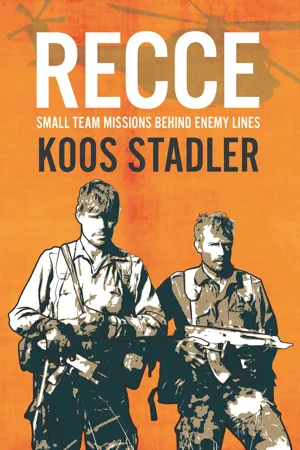
A gripping firsthand account of life and combat operations in the elite South African Special Forces, known as Recces, by a veteran Recce officer.
The South African Special Forces are one of the most effective—and mysterious—military units in the world. Working in secret on covert operations, the legendary Recces have long fascinated, but little is known about how they operate. Now Koos Stadler, a career officer in the South African Special Forces, shares a revealing chronicle of his life and his experiences in the Border War.
Shortly after passing the grueling Special Forces selection course in the early 1980s, Koos Stadler joined the so-called Small Teams group at 5 Reconnaissance Regiment. This sub-unit was made up of two-man teams and was responsible for many secret missions behind enemy lines. Sent to blow up railway lines and enemy fighter jets in south Angola, Stadler and his partner stared death in the face many times.
- 384 pages
- English
- ePUB (mobile friendly)
- Available on iOS & Android
eBook - ePub
About this book
Information
PART 1
Courage and Action
“We fear naught but God”
motto of 5 Reconnaissance Regiment, from the unit’s Code of Honour
1
Target
SILENTLY and with slow, deliberate movements, I slide my pack off. I reach for the first charge and a set of glue tubes. With practised fingers I undo the straps of the pouches and arrange the rest of the charges so I can reach them easily. I feel strangely calm and ready for the task at hand.
The fear I used to experience is absent. Instead, sheer determination has taken over. Deep inside I know that I am well prepared to get the job done and that the stakes are too high for me to fail.
I slip the pack back on and drape my AMD rifle1 in a fireman’s sling down the centre of my back to allow freedom of movement. Then I start the stalk towards the MiG-21 fighter jet, silenced pistol cocked and ready in the right hand, charge in the left and night-vision goggles on my chest.
Ten metres from the aircraft, I stop to observe with the night-vision goggles. The darkness of the night is absolute, as we hoped, but it also means that I cannot see below the fuselage of the aircraft. Not even with the beam of the infrared torch can my goggles penetrate the complete blackness under the belly of the huge aircraft crouched on the tarmac.
The night is dead silent. There is no sound from beneath the plane, nor can I make out any shape under the belly. I realise I need to go low to observe better. Slowly and stealthily I ease forward to move into the blackness under the fuselage so I can look up against the ambient light of the sky. I crouch to move in under the wing.
Then suddenly, without warning, a voice pierces the silence of the night from the darkness underneath the plane. My worst fear has just come true.
“Who are you …?”
The voice is hesitant, restrained by fear. Then stronger, more demanding:
“Who are you?”
The all-too-familiar cocking of a Kalashnikov shatters the fragile night air. Barely three metres away, it cracks invisibly like a rifle shot in the quiet night.
For many years of my adult life I lived in a small world, a world where two people operated in a hostile environment that in a split second could erupt in violence – a world of perpetual vigilance. Sometimes we were hundreds of kilometres into enemy territory, miles away from the comforts of suburban life and the reassuring presence of other people. It was a realm far removed from the normal world, one filled with nagging fear and uncertainty, with hunger and thirst.
Then there was the silence. For long stretches of time I would work in absolute quiet, while communication with my single team member was limited to hand signals or the occasional whisper.
This was the world of the specialist reconnaissance teams, or Small Teams.
For most of my adult life I have been a soldier. Looking back today, I realise I was destined to join the South African Special Forces, or Recces, as they were commonly known, and eventually to become a member of the elite Small Teams. From my early childhood, stalking small game in the dunes of the Kalahari, to my first taste of tactical reconnaissance during a three-year stint at the reconnaissance wing of 31 Battalion (a Bushman unit in the Caprivi), I knew that reconnaissance was what I really wanted to do.
During those three years I spent most of my time on tactical reconnaissance missions behind enemy lines in the southern parts of Zambia and Angola, patrolling for enemy presence and stalking guerrilla bases, honing my skills until they became second nature. Then I did Special Forces selection and fulfilled a lifelong dream: to become part of this elite group. However, this was not my ultimate destination. For a year I battled with the authorities to let me join the specialist reconnaissance teams, at that time stationed at 5 Reconnaissance Regiment at Phalaborwa. Finally, even the system could not hold me back any longer and I walked through 5 Recce’s gates to join Small Teams.
Yet, despite the Honoris Crux on my chest and a whole stack of certificates and commendations, I have been the antithesis of the Special Forces hero. I have been scared – to death. I have had to run away from life-threatening situations more times than I can remember, and certainly more than I would care to acknowledge. At one point, running away became my full-time hobby. I excelled at it. But, with God’s grace, I have never shown my fear, and have always crawled back, often in a literal sense, to complete my mission.
2
Boy Adventurer
I WAS BORN in Upington as the son of a teacher but then became the son of a preacher. At the age of 44 my father enrolled for a seven-year Theology degree at Stellenbosch University and became a minister in the Dutch Reformed Church. My twin sister and I, the youngest of six children, were still very young when our family temporarily relocated to Stellenbosch.
I had a fantastic, joyous youth for which I mostly have my parents to thank. Both of them left immeasurable and unforgettable impressions. At heart my dad was a hunter and adventurer. Although I easily call up a picture of him in the pulpit wearing his toga, the cassock worn by Dutch Reformed ministers in those days, I will always remember him as a man of the bush.
He had an intimate love and passion for the southern African veld, particularly the Kalahari (or Kgalagadi), and had a keen interest in its fauna and flora. He loved the outdoors and was a hunter of the old school. He despised hunting from vehicles, which became popular in the Kalahari in those days, and would sit for hours in the shade of an n’xoi bush, patiently outwaiting and outwitting the game. And he loved his God. Often I stumbled across him earnestly praying behind a bush in the veld.
My mom was a beautiful, soft-spoken and very loyal minister’s wife. In her quiet way she was the bedrock of our family life, providing inspiration to my dad, routine and discipline to her children and solace to everyone even faintly in need of support. I owe to her my aversion to large groups of people and rowdy parties, and I have her to thank for giving me the specific temperament required of a Small Teams operator.
As a boy I used to go with my dad, then minister of the Dutch Reformed congregation at Ariamsvlei in South West Africa (now Namibia) to prayer meetings on the farms. These trips always brought excitement. Often we’d go hunting or camping on one of the farms, and invariably there would be something challenging to make the trip memorable. Once, while driving the International – the eight-cylinder pick-up provided by the congregation – in the rugged area north of the Orange River in South West Africa, the vehicle broke down on a deserted farm road high up in the rocky hills. A prayer meeting on the farm was about to commence and there was no way for our hosts to know that we were stuck.
As my mother and sister were also present, there was only one option: I had to travel the remaining distance on foot, while my dad stayed with them at the vehicle. He explained the route to me: it was a short-cut through the hills and valleys. Then he sent me off, with a reminder to conserve my precious water and maintain my direction with the help of the sun.
After walking for four hours I found the farmhouse. A vehicle was dispatched and the farmers from the surrounding farms quickly put together a salvage team and had the International back at the farmhouse in a matter of hours. I was tired but happy, because I knew it would earn me some respect among the farm boys of the community.
The year was 1972 and I was twelve years old.
Those years at Ariamsvlei offered everything and more a young boy could hope for. We ventured out to the farms bordering the town, swimming in the cement dams and stalking small game. I learned to shoot at an early age and almost every day I used to walk around with my pellet gun, hunting pigeons or shooting at targets. Life was bliss.
In many respects my upbringing was strict, but it taught me valuable lessons. Late one evening, the local police sergeant knocked on the door of the parsonage. Two young men from the community had been in a head-on collision on a secondary road not far from town. It turned out that one of them had overtaken a truck without seeing the oncoming vehicle in the dust column. When my parents arrived at the scene in the International, both men were dying, trapped in their vehicles, but there was time to pray for them.
The community was shocked by the news that two of their promising sons had lost their lives. One young man was buried on his parents’ farm, while the other was to be buried in the local cemetery a few kilometres out of town. Whether my dad felt that we as a family had to display our sympathy by preparing the gravesite, or whether he deliberately wanted to teach me a lesson, I could never figure out, but digging the grave became my responsibility. I did not object, since subconsciously I probably shared my dad’s sentiments and, in any event, I loved the challenge of physical exertion. Armed with pick, shovel and a bottle of water, I was dropped off by my dad. After instructing me on the location and the measurements of the grave, he left.
Within an hour or two my hands were blistered and the grave was barely two feet deep. The rocky earth and the blazing sun of arid South West Africa had taken their toll. Dad arrived with more water and some of my mom’s homemade ginger beer. After seeing my hands he left to fetch some Ballistol, a gun oil that was used as an ointment for just about anything. The Ballistol turned everything into a slippery mess – not only the blisters and boils on my hands but also the pick, the shovel and my face as I tried to wipe off the sweat.
That night every muscle in my body ached. I was sunburnt red like a tomato. My hands were a mess. I was dead tired, but determined to go the full six feet the next day. However, my swollen and blistered hands wouldn’t let me touch a breakfast spoon in the morning, let alone a shovel. Mom objected to me doing any further digging, threatening Dad with all kinds of punishment if he dared take me to the gravesite again. But once she realised that I had no intention of giving up, she wrapped my hands in bandages and covered them with a pair of gloves. Out at the gravesite I managed another few hours of digging. By that afternoon I was at four feet, but then my hands wouldn’t grip any more.
But I simply had to finish, since the funeral was in two days’ time. I decided to take one tiny patch at a time and go the full depth, then move on to the next, steadily working to dig the rest of the grave piece by piece.
This experience taught me that where I had a clear and worthy goal, I needed to apply every ounce of energy to reach it, regardless of the cost. My father arrived that afternoon with a seasoned labourer, who dug the remaining two feet in less than two hours. But that didn’t bother me. I knew that, given time, I would have managed it. My sore body and blistered hands were a kind of reward – and a silent tribute to the two guys who had died.
In 1973 my twin sister and I were sent to boarding school in Upington to start high school. As the only minister’s son among the farm boys from the Kalahari I was an easy target and soon baptised Dominee (reverend), or sometimes even called Dissipel (disciple) or Priester (priest). But I also made good friends and survived fairly easily.
Long weekends and holidays were spent with my folks in South West Africa. Having turned fifteen in March 1974, I would take up my favourite pursuit of stalking small game in the veld, roaming my old haunts outside Ariamsvlei and often hunting with my dad during hunting season. I also started hiking long distances with a crude backpack on the dirt roads leading from the farms, often sleeping over at the houses of my parents’ friends.
The year 1974 also saw change coming to our otherwise quiet town. Large convoys of military vehicles would pass through, often stopping over to refuel or to overnight on the large square next to the BSB (Boere Saamwerk Beperk), the cooperative serving the district’s stock farmers.
Scores of army trucks and armoured cars would be parked in long queues along the square, while hundreds of troops would all of a sudden be walking about, playing ball next to their encampment or just hanging around and chatting with the few curious locals.
I soon learned that there was a war on in Ovamboland along the northern border of South West Africa. Since 1966 insurgents from the South West Africa People’s Organisation (SWAPO) had been infiltrating from neighbouring Angola into the farming areas, killing civilians on the farms and planting landmines on the roads in the northern border areas in their bid for an independent Namibia.
In 1974 the South African Defence Force (SADF) took over the responsibility from the South African Police for guarding the 1 680-km border between South West Africa and its northern neighbours, Angola and Zambia. Although I didn’t take note of it then, in June of that year 22-year-old Lieutenant Fred Zeelie became the first South African soldier to be killed in the Border War. Zeelie was also the first Special Forces soldier to lose his life in the war.
What I also did not know in 1974 was that a massive – and eventually long drawn-out – civil war was looming in Angola. In April of that year, following the so-called Carnation Revolution in Lisbon, Portugal indicated its intention to give up its colonial rule of the country. The three main Angolan liberation movements – Holden Roberto’s FNLA, Jonas Savimbi’s UNITA and the Marxist MPLA of Dr Agostinho Neto – started competing for control. Fighting broke out in November 1974, starting in the capital city, Luanda, and spreading to the rest of the country.
Angola was soon divided between the three groups. The FNLA occupied northern Angola and UNITA the central south, while the MPLA mostly occupied the coastline, the far southeast and, after capturing it in November, the oil-rich enclave of Cabinda. Negotiations between the parties and the colonial power led to the signing of the Alvor Agreement on 15 January 1975, naming the date for independence as 11 November 1975 and setting up a transitional government. The agreement ended the war for independence but marked the escalation of the civil war. Fighting between the three liberation forces resumed in Luanda hardly a day after the transitional government took office. The coalition established by the Alvor Agreement soon came to an end.
I became aware of these events only when convoys of white Portuguese-speaking refugees started passing through Upington, their cars loaded to capacity with all their worldly belongings. The MPLA, backed by the Soviet Union and Fidel Castro’s Cuba, gained control of Luanda on 9 July 1975. Many white Portuguese, having supported the colonial regime, felt threatened and fled the country in great haste, leaving most of their possessions behind. I also could not have known then that within a few years I would be taking part in the Border War, fighting shoulder to shoulder with many ex-Angolans.
In late 1975 the SADF launched Operation Savannah, a large-scale offensive deep into Angola. The operation was initiated in secret on 14 October, when Task Force Zulu, the first of several SADF columns, crossed from South West Africa into Cuando Cubango province. The operation was aimed at eliminating the MPLA in the southern border area, then in southwestern Angola, moving up into the central regions, and finally capturing Luanda.
With the Angolan liberation forces busy fighting each other, the SADF advanced rapidly. Task Force Foxbat joined the invasion in mid-October. The territory the MPLA had gained in the south was quickly lost to the South African advances. In early October South African advisors and antitank weapons helped to stop an MPLA advance on Nova Lisboa (later Huambo). Task Force Zulu captured Villa Roçadas (later Xangongo) then...
Table of contents
- Cover
- Title
- Copyright
- Dedication
- Contents
- Author’s note
- List of abbreviations
- PART 1: COURAGE AND ACTION
- PART 2: THE BUSHMEN
- PART 3: SPECIAL FORCES
- PART 4: SMALL TEAMS
- Epilogue
- Endnotes
- Plate section
Trusted by 375,005 students
Access to over 1.5 million titles for a fair monthly price.
Study more efficiently using our study tools.
Frequently asked questions
Yes, you can cancel anytime from the Subscription tab in your account settings on the Perlego website. Your subscription will stay active until the end of your current billing period. Learn how to cancel your subscription
No, books cannot be downloaded as external files, such as PDFs, for use outside of Perlego. However, you can download books within the Perlego app for offline reading on mobile or tablet. Learn how to download books offline
Perlego offers two plans: Essential and Complete
- Essential is ideal for learners and professionals who enjoy exploring a wide range of subjects. Access the Essential Library with 800,000+ trusted titles and best-sellers across business, personal growth, and the humanities. Includes unlimited reading time and Standard Read Aloud voice.
- Complete: Perfect for advanced learners and researchers needing full, unrestricted access. Unlock 1.5M+ books across hundreds of subjects, including academic and specialized titles. The Complete Plan also includes advanced features like Premium Read Aloud and Research Assistant.
We are an online textbook subscription service, where you can get access to an entire online library for less than the price of a single book per month. With over 1.5 million books across 990+ topics, we’ve got you covered! Learn about our mission
Look out for the read-aloud symbol on your next book to see if you can listen to it. The read-aloud tool reads text aloud for you, highlighting the text as it is being read. You can pause it, speed it up and slow it down. Learn more about Read Aloud
Yes! You can use the Perlego app on both iOS and Android devices to read anytime, anywhere — even offline. Perfect for commutes or when you’re on the go.
Please note we cannot support devices running on iOS 13 and Android 7 or earlier. Learn more about using the app
Please note we cannot support devices running on iOS 13 and Android 7 or earlier. Learn more about using the app
Yes, you can access Recce by Koos Stadler in PDF and/or ePUB format, as well as other popular books in History & Military Biographies. We have over 1.5 million books available in our catalogue for you to explore.