"A fantastic read . . . Whether your interest is armour or history I would highly recommend this book" (
Military Modelling).
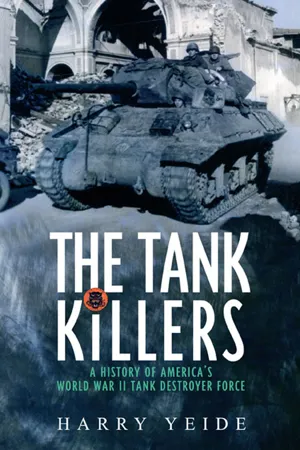
The tank destroyer was a bold—though some would say flawed—answer to the challenge posed by the seemingly unstoppable German Blitzkrieg. The TD was conceived to be light and fast enough to outmaneuver panzer forces and go where tanks could not. At the same time, the TD would wield the firepower needed to kill any German tank on the battlefield. Indeed, American doctrine stipulated that TDs would fight tanks, while American tanks would concentrate on achieving and exploiting breakthroughs of enemy lines.
The Tank Killers follows the men who fought in the TDs, from the formation of the force in 1941 through the victory over the Third Reich in 1945. It is a story of American flexibility and pragmatism in military affairs. Tank destroyers were among the very first units to land in North Africa in 1942. Their first vehicles were ad hoc affairs: halftracks and weapons carriers with guns no better than those on tanks, thin armor affording the crews considerably less protection. Almost immediately, the crews began adapting to circumstances, along with their partners in the infantry and armored divisions. By the time North Africa was in Allied hands, the TD had become a valued tank fighter, assault gun, and artillery piece. The reconnaissance teams in TD battalions, meanwhile, had established a record for daring operations that would continue for the rest of the war.
The story continues with the invasion of Italy and, finally, that of Fortress Europe on June 6, 1944. By now, the brass had decreed that half the force would convert to towed guns, a decision that dogged the affected crews through the end of the war. The TD men encountered increasingly lethal enemies, ever more dangerous panzers that were often vulnerable only to their guns, while American tank crews watched in frustration as their rounds bounced harmlessly off the thick German armor. They fought under incredibly diverse conditions that demanded constant modification of tactics, and their equipment became ever more deadly. By VE-Day, the tank destroyer battalions had achieved impressive records, generally with kill-loss rates heavily in their favor. Yet the army after the war concluded that the concept of a separate TD arm was so fundamentally flawed that not a single battalion existed after November 1946.
The Tank Killers draws heavily on the records of the tank destroyer battalions and the units with which they fought, as well as personal stories from veterans of the force.
- 357 pages
- English
- ePUB (mobile friendly)
- Available on iOS & Android
eBook - ePub
About this book
Information
Chapter One
Seek, Strike, and Destroy
The TD’s motto, “Seek, Strike, Destroy,” won out in a close race with the laconic slogan, “Guns and Guts.”
— “The Tank Killers,” Fortune, November 1942.
The U.S. Army’s Tank Destroyer Force in World War II must rate as one of the most successful “failures” in American military history. The tank killers contributed immensely to the success of American arms under conditions ranging from North African desert to the Italian mountains to north European forests and cities. They performed a remarkably diverse range of jobs, with elements of the tank destroyer battalions fulfilling the roles of antitank weapons, assault guns, artillery, cavalry, and infantry. They often served at the very pointy end of the spear. Yet the Army at the end of the war judged the concept of a distinct Tank Destroyer Force to be so flawed that not a single tank destroyer battalion existed after November 1946. The Tank Destroyer Force existed one month short of five years.
Starved of resources by an isolationist and tight-fisted Congress, the U.S. Army had allowed its tank force to fade into irrelevance after World War I, and most serious thinking about fighting against tanks faded with it. The Germans were brewing blitzkrieg while the U.S. Army dozed. In 1936, the Army’s Command and General Staff School finally published—for instructional purposes—a manual entitled Antitank Defense (Tentative), which anticipated the establishment of antitank companies in the infantry regiments and an antitank battalion at the divisional level. In 1937, the 2d Infantry Division conducted field tests that resulted in a recommendation that all infantry divisions be reorganized into a triangular—or three-regiment—configuration and establish an eight-gun antitank company in each regiment.1 Brigadier General Lesley J. McNair was the chief of staff of the 2d Infantry Division and had been keenly interested in antitank defense for several years.2 He was to have more influence than any other American officer over the evolution of the tank destroyer concept, as well as the way in which the infantry interacted with armor and antitank forces in general.
By 1939, an updated version of the U.S. Army’s manual, now entitled Antimechanized Defense (Tentative), advocated an antitank defense in depth, with divisional antitank battalions that were to be both motorized and supplied with a reconnaissance element so that they could mass quickly against armored thrusts. Yet while thinking was beginning to respond to the demands of the looming modern battlefield, the Army’s organization and equipment were not. When the Germans overran Poland in 1939, the Army had neither antitank units nor an antitank gun in production. In 1940, a copy of the German 37mm antitank gun—already nearing obsolescence—was hurriedly produced.3 McNair recognized this deficiency and in June 1940 told the War Department General Staff that the greatest problem confronting it was to find a way to stop armored divisions, and that a flat-trajectory gun heavier than either the 37mm or 75mm guns in use would be necessary for that purpose.4
Stunned by the Wehrmacht’s romps through Poland and France, Congress found the money, and the Army recreated an Armored Force on 10 July 1940.5 Induction of the National Guard and Reserves followed, along with implementation of a peacetime draft. The rapid German victories, meanwhile, raised fundamental questions about the soundness of a tank defense based primarily on antitank guns, which the highly respected French Army had tried without success. The fact that most American field artillery officers charged with antitank defense had never even seen a tank in action did not help matters.6 Nor did the fact that antiaircraft artillery regiments had not yet practiced antitank fire.7
McNair, for one, kept the faith. In July 1940, he argued in a memo: “When the armored vehicle faces the antitank gun, the combat is essentially a fire action between a moving gun platform in plain view and a small, carefully concealed, stationary gun platform. The struggle is analogous to that between ships and shore guns, and there is no question that the shore guns are superior—so much so that ships do not accept such a contest…. If the gun outmatches the tank, then not only is the gun superior to the tank in antitank defense, but employing armored units against other armored units positively should be avoided whenever possible. The gun, supported properly by foot troops, should defeat hostile armored units by fire and free the friendly armored units for action against objectives which are vulnerable to them.”8
McNair’s arguments were to shape the Tank Destroyer and Armored Forces in fundamental ways. The U.S. Army was to enter the war believing that tanks should not fight tanks, and it selected its equipment on the basis of that doctrinal assumption.
In August 1940, McNair rejected passive antitank defense and first proposed the establishment of mobile antitank groups of three battalions each that would be able to rush to confront a mechanized attack. The next month, the War Department issued a training circular that directed that units concentrate their antitank guns in a mobile reserve and deploy a minimum in fixed initial positions.9 In April 1941, U.S. Army Chief of Staff General George Marshall ordered his operations chief (G-3) to consider the creation of “highly mobile antitank-antiaircraft units as Corps and Army troops for use in meeting mechanized units.” These elements would be in addition to organic antitank weapons.10
The Army, meanwhile, had become mired in a debate over who should manage antitank matters—the infantry or the field artillery (the newly created quasi-branch of armor was uninterested and was being told it should not fight tanks in any event)—and how. The Army authorized antitank companies to the infantry divisions in autumn of 1940. Nonetheless, the next spring McNair—by now the chief of staff at General Headquarters (GHQ)—was moved to complain, “It is beyond belief that so little could be done on the [antitank] question, in view of all that is happening abroad.” He accused the Army of apathy.11
Marshall, in May 1941, moved to cut the Gordian knot; he ordered his G-3 to take charge of antitank development. The G-3, on Marshall’s instructions, immediately established a Planning Branch under LtCol Andrew D. Bruce. This staff, which was to form the core of the tank destroyer brain trust, reaffirmed the need for divisional antitank battalions.
The Army finally ordered the establishment of those units on 24 June—two days after Hitler’s panzer spearheads rolled into the Soviet Union! The first battalions were a heterogeneous lot, but they typically consisted of three to five batteries withdrawn from the field artillery and equipped with 75mm, 37mm, or simulated guns.12 As of the end that month, only a handful of antitank battalions existed: the 93d at Fort Meade, Maryland; the 94th at Fort Benning, Georgia; the 99th at Fort Lewis, Washington; and battalions 101 through 105, which had been inducted into Federal service during the mobilization of the National Guard in January and February of 1941.13
Also in June, GHQ launched the first of a series of large-scale maneuvers. In the first corps-versus-corps wargames, held in Tennessee, MajGen George Patton Jr. deployed his 2d Armored Division in highly successful cavalry-style slashing maneuver. The units opposing him, however, had virtually no antitank capability.14 Indeed, after 10 July, when the 28th Infantry Division Antitank Battalion (provisional) was formed, the men exercised using 3/4-ton weapons carriers as prime movers, with towed “guns” made out of miscellaneous pieces of pipe, wood, and other materials.15 And thousands of miles away in the real war, German antiaircraft and other artillery on the Egyptian-Libyan frontier that same month played a major role in the destruction of more than two hundred British tanks, which caught the attention of the War Department intelligence chief (G-2).16
The next round of maneuvers would be different. On 8 August, and in line with his proposal of one year earlier, McNair ordered Third Army to organize three regiment-sized provisional antitank groups. Each consisted of three antitank battalions (armed with 37mm and 75mm guns), a scout car reconnaissance platoon, three engineer platoons, and three rifle platoons. The groups were to be attached at the field-army level and were trained to execute an “offensive role,” including vigorous reconnaissance, preemptive contact with enemy armor, and destruction of enemy tanks with massed gunfire.17 This rough mix of components and doctrinal orientation would soon provide the foundation for the separate tank destroyer battalions.
The debates were not over, but the die was cast. McNair continued to champion a dramatic expansion of the antitank program.18 On 18 August, the War Department released a detailed memorandum calling for the formation of two hundred twenty antitank battalions, fifty-five of which were to be organic to the divisions, fifty-five pooled at the corps and army levels, and one hundred ten allocated as GHQ assets. McNair praised the boldness of the proposal but withheld his concurrence because he objected to the War Department’s plans to subordinate the antitank units to the Armored Force; to disperse some antitank battalions among divisions, corps, and armies; and to create two hundred twenty battalions, a number he judged excessive. McNair eventually had his way on almost every point.19
In September, Third Army faced Second Army in Louisiana in the largest field exercises in the nation’s history. Two types of makeshift proto-tank destroyers were employed. The first consisted of a 3/4-ton truck with a railroad tie secured across the bed; a 37mm gun with its wheels removed was fixed to the tie and its split tail wired to the corners of the truck bed.20 The second mounted a 75mm gun on a 1-1/2-ton truck.21 Antitank guns—although mostly from the infantry’s organic defenses—stymied Second Army’s I Armored Corps at almost every turn, to McNair’s obvious delight. The rules, however, now gave antitank weapons a tremendous advantage, and armor’s difficulties derived in large part—as subsequent experience would show—from trying to operate with all-tank formations.22 In other words, the maneuvers gave very little idea how American antitank elements might be expected to perform against Germany’s combined-arms blitzkrieg.
On 7 October, Marshall approved the War Department’s estimate for antitank battalion needs and suggested the immediate activation of sixty-three battalions. He also decided to rename the units “tank destroyers” for psychological reasons.23
The final phase of the GHQ maneuvers took place in North and South Carolina in November 1941 and pitted 865 tanks and armored cars from I Armored Corps against First Army’s 764 mobile antitank guns and 3,557 other pieces of artillery. Men from the 1st Provisional Antitank Battalion—later the 601st Tank Destroyer Battalion—would remember the maneuvers for the cold and rain on some days and the dust on others, as well as the first-ever issue of C-rations.24 First Army had received the three GHQ antitank groups and organized three more “Tank Attacker” (TA) groups of its own. TA-1 included the 93d Antitank Battalion, which was outfitted with experimental self-propelled guns constructed from 75mm field pieces mounted on halftracks. In addition to the mix fielded by the antitank groups during the Louisiana maneuvers, it also had an antiaircraft element and observation planes. The tank forces suffered tremendous losses during the wargames. The 1st Armored Division was ruled destroyed, and 983 tanks were “knocked out,” 91 percent by antitank guns. In the most startling incident, TA-1’s self-propelled guns on 20 November charged the bivouac of the isolated 69th Armored Regiment and, taking full advantage of the rules, “annihilated” the formation.25

The Armored Force drew solid lessons from its failures and reorganized the armored divisions to provide more infantry for combined-arms operations, and to reduce the proportion of vulnerable light tanks. McNair and his supporters among antitank thinkers, on the other hand, concluded that they had solved the puzzle. On 27 November, the War Department ordered the activation of fifty-three tank destroyer battalions under GHQ control. On 3 December, it removed all existing antitank battalions from their parent arms, redesignated them tank destroyer battalions, and subordinated them to GHQ as well. Battalions originating in infantry divisions received unit numbers in the 600 series, while those from armored divisions and GHQ field artillery units were given designations in the 700s and 800s, respectively.26
Despite the subordination of the new tank destroyer units to GHQ, the Army initially associated the battalions with their parent divisions as they were activated in December. The 601st through the 609th, for example, were so designated on the basis of co-location with the 1st through the 9th Infantry divisions of the Regular Army. Those attached to the...
Table of contents
- Front Cover
- Title Page
- Copyright Page
- Dedication Page
- Frontis Piece
- Contents
- Maps and Illustrations
- Preface
- Chapter 1: Seek, Strike, and Destroy
- Chapter 2: North Africa: Seeing the Elephant
- Chapter 3: From Gloom to Glory
- Chapter 4: The Tough Underbelly
- Chapter 5: Anzio and Two Roads to Rome
- Chapter 6: Storming Fortress Europe
- Chapter 7: Armored Thunder
- Chapter 8: The Battle for the Border
- Chapter 9: The Battle of the Bulge
- Chapter 10: Sought, Struck, and Destroyed
- Appendix A: Tank Destroyer Battalions by Campaign
- Appendix B: Battalion Profiles
- Glossary
- Notes
- Bibliography
Trusted by 375,005 students
Access to over 1.5 million titles for a fair monthly price.
Study more efficiently using our study tools.
Frequently asked questions
Yes, you can cancel anytime from the Subscription tab in your account settings on the Perlego website. Your subscription will stay active until the end of your current billing period. Learn how to cancel your subscription
No, books cannot be downloaded as external files, such as PDFs, for use outside of Perlego. However, you can download books within the Perlego app for offline reading on mobile or tablet. Learn how to download books offline
Perlego offers two plans: Essential and Complete
- Essential is ideal for learners and professionals who enjoy exploring a wide range of subjects. Access the Essential Library with 800,000+ trusted titles and best-sellers across business, personal growth, and the humanities. Includes unlimited reading time and Standard Read Aloud voice.
- Complete: Perfect for advanced learners and researchers needing full, unrestricted access. Unlock 1.5M+ books across hundreds of subjects, including academic and specialized titles. The Complete Plan also includes advanced features like Premium Read Aloud and Research Assistant.
We are an online textbook subscription service, where you can get access to an entire online library for less than the price of a single book per month. With over 1.5 million books across 990+ topics, we’ve got you covered! Learn about our mission
Look out for the read-aloud symbol on your next book to see if you can listen to it. The read-aloud tool reads text aloud for you, highlighting the text as it is being read. You can pause it, speed it up and slow it down. Learn more about Read Aloud
Yes! You can use the Perlego app on both iOS and Android devices to read anytime, anywhere — even offline. Perfect for commutes or when you’re on the go.
Please note we cannot support devices running on iOS 13 and Android 7 or earlier. Learn more about using the app
Please note we cannot support devices running on iOS 13 and Android 7 or earlier. Learn more about using the app
Yes, you can access The Tank Killers by Harry Yeide in PDF and/or ePUB format, as well as other popular books in History & Military & Maritime History. We have over 1.5 million books available in our catalogue for you to explore.