This gripping chronicle of an aerial rescue during the Vietnam War offers a vivid example of the heroism of US Air Force pararescue jumpers.
In June of 1972, Capt. Lynn Aikman was returning from a bombing mission over North Vietnam when his F-4 Phantom was shot down. He and his backseater Tom Hanton ejected from their aircraft, but Hanton landed near a village and was quickly captured. Badly injured during the ejection, Aikman landed some distance from the village, making it possible for an American aerial rescue team to reach him before the enemy.
Drifting in and out of consciousness, Aikman saw his guardian angel in the sky: USAF Pararescue Jumper Chuck McGrath. But as Sgt. McGrath prepared to hook the Aikman to a hoist line, hostile fire on the rescue helicopter damaged the hoist mechanism. As A-1 Skyraiders kept an enemy militia away from Aikman and McGrath, the helicopter crew scrambled to come up with a plan.
More than a chronicle of the events of June 27, 1972,
Taking Fire provides an up-close look at the little-known world of the US Air Force's elite aerial rescue force.
eBook - ePub
Taking Fire
Saving Captain Aikman—The Heroic Rescue of a Phantom Pilot from North Vietnam by the Air Force's Guardian Angels
- 217 pages
- English
- ePUB (mobile friendly)
- Available on iOS & Android
eBook - ePub
Taking Fire
Saving Captain Aikman—The Heroic Rescue of a Phantom Pilot from North Vietnam by the Air Force's Guardian Angels
About this book
Information
Topic
HistoriaSubtopic
Historia militar y marítimaCHAPTER ONE

THE LONG RIDE IN
United States Air Force Sgt. Chuck McGrath awoke on June 27, 1972, much the same way he had throughout his tour of Southeast Asia. As a member the 40th Aerospace Rescue and Recovery Squadron (40th ARRS), the twenty-three-year-old McGrath knew that the only guarantee of the forthcoming day was that it would not be the same as the previous one.
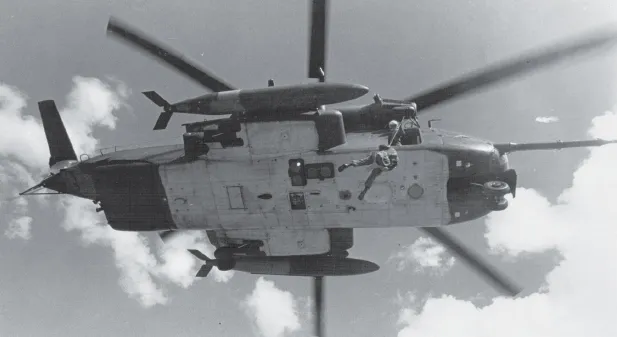
The Sikorsky HH-53C helicopter was the workhorse of rescue operations in South east Asia. During such a mission the aircraft’s flight engineer would have to lean out the door of the aircraft to guide the hoist line and for est penetrator, a device for lowering pararescuemen and retrieving survivors. During these moments the flight engineer would be in constant contact with the pilot, giving positioning updates.—National Archives
By rank, McGrath is a sergeant, an enlisted airman. In the hierarchy of the military, he’s a commoner, someone who had walked off the street into a recruiter’s office. At the other end of that hierarchy are the officers. They’re college graduates from the respective academies or ROTC programs. And in the Air Force, the elite of this elite are the fighter pilots. These are the men entrusted with multimillion-dollar aircraft, rocketing at twice the speed of sound, dogfighting the enemy and executing maneuvers so physically awesome that they require specialized G-suits.
Yet, McGrath is no ordinary sergeant. He is a member of a select, highly-trained fraternity that could turn military protocol on its head. On the rare occasion when he and his colleagues might cross paths with their aviator brethren, they’d rarely have to pay for a drink. And while salutes and “sirs” are respected, it isn’t unusual for some pilot to do a favor for this class of enlistees of common rank but uncommon training and duty. McGrath is part of a human safety net in Southeast Asia. He is a pararescueman, a weaponized guardian angel whose job it is to leap into peril and bring some unfortunate brother in arms back to safety.
Somewhere in McGrath’s mind this June morning he knows his tour is coming to an end. The previous month, he had passed-by his first date to rotate home after a year of combat duty—DEROS, Date Eligible for Return from Overseas in the parlance of the military. He chose to extend his stay for one very good reason. Unlike some of his colleagues, McGrath hadn’t left a wife or sweetheart at home in the States. She had come to Southeast Asia too, and he wasn’t leaving without her.
The six-foot tall, brown-haired Maryland resident had graduated high school in 1966. “So I went to college. In those days everyone was going to college,” McGrath explains, alluding to the draft deferment men would receive if they were working toward a degree. “I was taking classes, but I was also working and eventually lost my deferment.”
Then on December, 1, 1969, the Selective Service System implemented a lottery for the first time since 1942. The United States was in the midst of the Vietnam Conflict. For a decade, rebels backed by communist North Vietnam had been trying to topple the government of South Vietnam. President Richard Nixon and his military advisors believed a surge of American troops would be necessary before the South’s military could stand on its own and enforce a forthcoming treaty with the North.
Nixon’s plan actually was to reduce U.S. presence in the area, handing all the fighting over to the South Vietnamese. However, 1968 had been the peak of U.S. involvement in Southeast Asia with more than 500 thousand troops in the region. In order to gradually step down the American presence and also rotate troops home when their tours were up, Nixon needed more manpower.
Hence, Selective Service developed the lottery as an attempt at a fair way to augment the draft. The lottery featured 366 blue capsules, each with a birth date inside. The televised drawing involved randomly pulling the capsules from a bin to determine the order in which men would be conscripted into the military. The first capsule drawn was September 14. The ninety-sixth capsule was December 16, Chuck McGrath’s birthday. With those odds, the twenty-year-old figured he would rather enlist than be told where to go. “I didn’t mind going,” McGrath says of serving in the wartime military, “but I wanted to have some kind of control over what I was doing. I didn’t want to be just a number. I wanted something technical, something I could use when I got out.”
Chuck’s assessment of his draft odds proved correct. In 1970 alone, Se lective Service reached all the way to number 195 on the lottery. The following year, Selective Service modified the lottery slightly after some noted a seemingly not-random correlation between late birthdays—say those in December—and being drawn early in the draft. The assertion was that the capsules were put into the bin in order, January first, December last, and hadn’t been mixed well enough.
While that may have helped explain how Chuck ended up with a low number and his buddy at the time ended up in the 360s, it didn’t change the fact that at some point, likely early in the forthcoming year, he would be drafted. Chuck made the decision that many potential draftees did. He chose to enlist, and he already had some thoughts about the different branches of the military given that both his father and step-father had served in the Navy.
“And so I pretty much knew I didn’t want the Navy,” he deadpans. Growing up, Chuck moved around, as military families do, and in addition to spending his high school years in Maryland, he also lived in Hawaii and California. “And so from six or seven years old, I was always in the water,” he says, “whether in a pool or the ocean. I was a water rat.”
During high school he would visit his aunt and uncle on the Delaware coast. Enthralled with idea of being a lifeguard, he took lifesaving classes and spent the summer before his senior year of high school and the next two summers as an ocean-beach lifeguard at the shore in Delaware. In between college semesters he would lifeguard at the beach. In the winter he worked at other jobs and eventually worked at a pharmacy and swimming pools in Columbia, Maryland. One of the regular pharmacy customers, a man named Jim Davis, ran a timber operation and must have thought that the large-framed McGrath had what it took to join his small crew.
In 1969, he signed on with Davis, who would serve as a bit of a father figure for McGrath. In the fall of ‘69, he was again taking college courses but continued to work cutting timber on days when he had no classes. That was his routine up until December 1, when a random draw of a blue capsule set in motion the events that led him to this June morning in 1972.
Seeking to join the burgeoning world of computers, he sought out an Air Force recruiter. “At that point when you entered the Air Force you had four fields you could select for: electrical, mechanical, administrative and general. And under general was where the data processing came in,” he says. And so that became his goal when he completed basic training and reported to Lackland Air Force Base in San Antonio, Texas. However, when they displayed the list of available positions, none in data processing were open to the new enlistee.
There he was on base, wondering if he might be relegated to serving out his enlistment in some terribly boring way when in walked—actually he more limped than walked—a staff sergeant.
“Here comes this big guy, and he had jump wings, flight wings, a whole mess of ribbons, walking with a cane,” explains Chuck. “His face is kind of lopsided, and he says ‘I want to talk to you about pararescue.’”
Staff Sergeant Tommy Miles proceeded to give an overview of being a pararescueman, a PJ!1 as he called it, and he was there recruiting for the next class. About nine months earlier Miles had been the sole survivor of a harrowing rescue attempt gone wrong. While as a member of the 38th ARRS, Miles was on board an HH-43 helicopter that had been assigned to check for crew trapped inside a B-52 that had skid off the runway at U-Tapao air base in Thailand. The bomber was fully loaded with ordnance as it burned from the minor crash. As the helicopter circled lower, Miles saw a bright flash. His next memory was twenty-two weeks later, waking up in an Air Force hospital.2
In addition to sustaining serious burns, Miles broke virtually every bone in his body and had a crushed skull that had to be repaired with a titanium plate. As McGrath came to understand the story, Miles apparently died and was resuscitated three times in the immediate aftermath of the crash, his fellow pararescuemen at his side the entire way, ushering him from death’s door.
If this tougher-than-death recruiter wasn’t enough to entice interest in pararescue, he also offered another attraction: Any man interested in hearing about PJs could sign up and get an opportunity to watch a movie about the pararescue service. For McGrath, who moments earlier saw looming boredom on the horizon, both pararescue and the opportunity to be distracted from barracks life had unavoidable appeal.
As Chuck went to the sign-up sheet for the movie, Miles stopped him, “Are you a good swimmer?”
“I’ve been a lifeguard for four years.” McGrath answered.
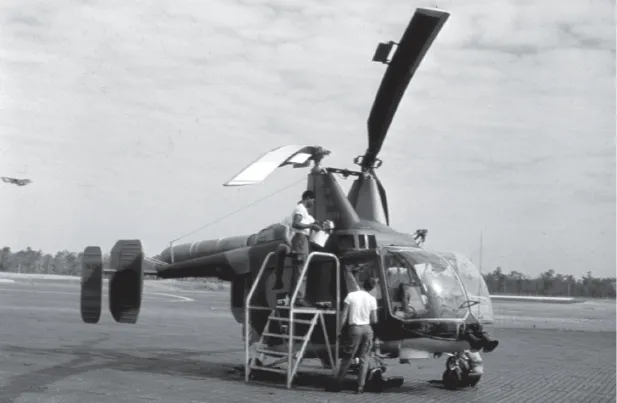
The HH-43 “Pedro” was a predecessor to the HH-53 for rescue operations in Southeast Asia. Compared to the larger HH-53, it lacked speed, range and load-carrying capability. It was an HH-43 very much like this one that PJ Tom Miles had flown in on July 19, 1969, when he and the crew of Pedro 70 were blown out of the sky from the exploding ordnance of a crashed B-52. Staff Sergeant Miles, the lone survivor, like other PJs, went recruiting for the pararescue service while recovering from his injuries. In the spring of 1970, a fresh enlistee named Chuck McGrath, after hearing Miles’s pitch for pararescue at basic training, decided to enter the rigorous qualification and training that many refer to as “Superman School.”—R. Hutchinson
“I didn’t ask you that,” shot back Miles. “I asked you if you were a good swimmer.”
“Yes sir,” said McGrath.
“Don’t sir me,” responded Miles. “I’m a sergeant.”
McGrath realized the mistake as the words left his mouth. He was just finishing basic training where everyone was “sir” to the new enlistees. Thus began Chuck’s baptism to the world of pararescue. The movie consisted of showing the day-to-day tasks of PJs, going down helicopter hoist lines, parachuting into water, and other high-adventure but high-risk duties. Miles also discouraged any interest from married men as PJs had a high rate of divorce.
At the end, he told the group of about sixty or so that if they had lost interest, they could leave. About half the room stood up and walked out. McGrath was fascinated, however, and Miles continued with a second movie.
“They were talking about jumping into water, climbing, parachuting, just all sorts of neat stuff,” Chuck recalls about this introduction to parares-cue. “These were just all things that sounded as though they would interest me.”
The next step for McGrath and the others was to sign up for a physical training (PT) test. The test required running a mile and doing a specified number of pushups, sit-ups and other exercises within set time limits. At each step, PJ hopefuls would drop out or not make the cut. Then came the swim test at a pool on the base of the nearby Brooks Air Force Base. The test was to swim one mile in under an hour, an easy task for a water rat like McGrath.
As Chuck and the other recruits were in the water, Miles, whose legs were held together with pins, seemingly had had enough of watching and not doing. He threw down his cane, dove into water with full jungle fatigues. The veteran PJ came up from the water and snarled at the pararescue hopefuls. This was a long way from lifeguarding.
Miles wasn’t just recruiting. He was working his body back into shape. While he did go back on active duty, he never did serve in combat again. But, he made an impression on McGrath, who was quickly proving he had the basic physical tools for the program. Next, Chuck had to be cleared for airborne assignments with a flight physical.
Between his birth date being pulled on December 1 and when he reported for basic training the following March, Chuck took advantage of what was left of his freedom from military structure and discipline. “I par-tied a bit,” he says. Also, while cutting timber, his upper body had bulked up from carrying logs and heavy chain saws. McGrath had reported to basic training weighing 212 lbs. In just the week since, which included his PT test, he had dropped down to 204. But for the flight test, McGrath, whom the Air Force measured as 5-foot, 11-and-3/4-inches tall, he had to be 194 lbs to meet the height-to-weight ratio. At six feet, 205 lbs would have been the mark Chuck had to hit.
As much as the inflexible rules reminded him what he didn’t like about the military, the sergeant in charge of the flight test had worked with a number of PJs and must have seen McGrath was right for the specialized service; he gave McGrath seven days to drop the 10 lbs. to qualify. McGrath made the weight in three.
With all the testing complete, of the sixty-or-so men that had packed into the room for Staff Sergeant Miles’s initial presentation, Chuck was the last man standing, the only man of the original group to receive orders to report to the pararescue training program.
The history of pararescue traces back to World War II. In August 1943, a C-46 transport went down near the China-Burma border with twenty-one people aboard, including a young, relatively unknown, war correspondent named Eric Severeid. Long before the age of high-altitude reconnaissance, never mind any kind of satellite-assisted surveillance or navigation, the only way to get the men out was to parachute in, aide the injured, and then somehow guide the entire party to a more accessible location.
A lieutenant colonel and two medical corpsmen volunteered for the job. Over the course of a month, while caring for the injured, they led the entire group toward safety. Severeid, who went on to become one of the early and great broadcast journalists in America, later wrote of his rescuers, “Gallant is a precious word; they deserve it.”
The American military didn’t need such praise or publicity to recognize the evolving nature of war, particularly where the battlefield was shifting toward the skies. There was a need for an elite type of rescuer, a soldier-doctor-superhero that could go anywhere to save the injured. Before the end of World War II, the military began practicing early pararescue operations. But the future of this fledgling function was unclear.
At some point during his initial recruitment, McGrath noticed Miles wearing a maroon beret. He perhaps didn’t even think twice about the distinctive headgear, which also featured a silver badge, a “flash” in the vernacular of the military. Little did he know at the time that it was that beret and flash he would be working toward over the next sixteen months.
The beret was a symbol of military elite. During World War II, British paratroopers wore a red beret, and in a display of Allied respect, they gave a version to their comrades in the U.S. Army’s 509th Parachute Infantry Regiment. Thus berets were introduced to American military dress, for the most part being reserved for elite units. To this day, U.S. airborne units wear a red beret as a nod to the origins of the tradition. As an airborne unit, the PJs were given their own red berets. However, in 1966 then Air Force Chief of Staff General John McConnell authorized a maroon-colored beret for the pararescuemen, the word-of-mouth reasoning being that maroon symbolized the blood sacrificed by this special brand of rescuer.
The complement to the beret was the flash. Engraved on it was a winged guardian angel embracing a globe. Inscribed beneath in capital letters was a simple, direct message: THAT OTHERS MAY LIVE.
The words form the conclusion of the Pararescue Creed, authored by the first commander of what was then called the Air Rescue Service (ARS), Richard T. Kight. In 1946, Lieutenant Colonel Kight was handed command of the of infant ARS. His orders were simple: build up the ARS or shut it down. He became an avid supporter of air rescue operations, lobbying for more resources while also formalizing the pararescue training. His indelible mark on the program was the creed:
It is my duty as a Pararescueman to save life and to aid the inju...
Table of contents
- Cover Page
- Title Page
- Copyright Page
- Contents
- Foreword
- Introduction
- Chapter 1: The Long Ride In
- Chapter 2: The Mission
- Chapter 3: Making the Best of a Tough Situation
- Chapter 4: The Good Mission
- Chapter 5: A Bad Day for F-4s
- Chapter 6: Four Is on Fire!
- Chapter 7: Taking Fire
- Chapter 8: So That Others May Live
- Chapter 9: All the Way Home
- Epilogue
- Acknowledgments
- Glossary
Trusted by 375,005 students
Access to over 1.5 million titles for a fair monthly price.
Study more efficiently using our study tools.
Frequently asked questions
Yes, you can cancel anytime from the Subscription tab in your account settings on the Perlego website. Your subscription will stay active until the end of your current billing period. Learn how to cancel your subscription
No, books cannot be downloaded as external files, such as PDFs, for use outside of Perlego. However, you can download books within the Perlego app for offline reading on mobile or tablet. Learn how to download books offline
Perlego offers two plans: Essential and Complete
- Essential is ideal for learners and professionals who enjoy exploring a wide range of subjects. Access the Essential Library with 800,000+ trusted titles and best-sellers across business, personal growth, and the humanities. Includes unlimited reading time and Standard Read Aloud voice.
- Complete: Perfect for advanced learners and researchers needing full, unrestricted access. Unlock 1.5M+ books across hundreds of subjects, including academic and specialized titles. The Complete Plan also includes advanced features like Premium Read Aloud and Research Assistant.
We are an online textbook subscription service, where you can get access to an entire online library for less than the price of a single book per month. With over 1.5 million books across 990+ topics, we’ve got you covered! Learn about our mission
Look out for the read-aloud symbol on your next book to see if you can listen to it. The read-aloud tool reads text aloud for you, highlighting the text as it is being read. You can pause it, speed it up and slow it down. Learn more about Read Aloud
Yes! You can use the Perlego app on both iOS and Android devices to read anytime, anywhere — even offline. Perfect for commutes or when you’re on the go.
Please note we cannot support devices running on iOS 13 and Android 7 or earlier. Learn more about using the app
Please note we cannot support devices running on iOS 13 and Android 7 or earlier. Learn more about using the app
Yes, you can access Taking Fire by Kevin O'Rourke,Joe Peters in PDF and/or ePUB format, as well as other popular books in Historia & Historia militar y marítima. We have over 1.5 million books available in our catalogue for you to explore.