The author of
Into the Dark Water "balances scholarly research with accessible storytelling" to tell the heroic WWII account of Torpedo Boat Squadron 3 (
Midwest Book Review).
During the opening days of World War II in the Pacific, a small group of American sailors in the Philippines were propelled into the forefront of the fighting against the navy and air power of Imperial Japan. They were manned with six small, wooden PT-boats and led by a courageous, larger-than-life character in Lt. John D. Bulkeley.
As America's defense of the Philippines crumbled under the weight of a massive Japanese assault, the courageous activities of Bulkeley's Torpedo Boat Squadron 3 made headlines across the United States—often as the only good news coming from the bleak Pacific front. The unit achieved everlasting fame by evacuating Gen. Douglas MacArthur from the front. Then, the squadron continued to fight on until all six of its torpedo boats were lost under fire. The fate of the doomed American defenders was sealed when the Japanese won the battle for the islands in the spring of 1942.
The exploits of the unit were immortalized in the blockbuster 1945 movie
They Were Expendable, starring John Wayne and Robert Montgomery, but since then, the saga of Bulkeley and his men has slipped into history.
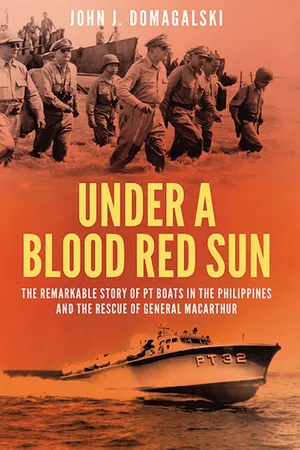
Under a Blood Red Sun revives the story of the Philippine PT-boats through the intertwined accounts of Bulkeley and his subordinate officers and men. It is a story of the courage and sacrifice of men thousands of miles from their homeland, representing American gallantry and fighting prowess, giving the Japanese a taste of what was to come their way.
eBook - ePub
Under a Blood Red Sun
The Remarkable Story of PT Boats in the Philippines and the Rescue of General MacArthur
- 304 pages
- English
- ePUB (mobile friendly)
- Available on iOS & Android
eBook - ePub
Under a Blood Red Sun
The Remarkable Story of PT Boats in the Philippines and the Rescue of General MacArthur
About this book
Information
PART I
VOYAGE TO THE ORIENT
CHAPTER 1
Daylight was on the horizon when three tugboats gathered around Guadalupe as she slowly entered the Brooklyn Navy Yard. The New York City skyline loomed in the distance across the East River. The new Navy tanker had been in service for less than two months and had spent the last six weeks transporting oil from Texas to New Jersey.1 Workers quickly began to tie down mooring cables after the tugs gently nudged her into a berth along sprawling Pier G.
The expansion of the Navy was making the Brooklyn base a busy place. Five large warships and two small coast guard vessels had been launched in the last five years alone. With war already under way in Europe and tensions mounting in the Pacific, the orders for new ships kept coming. The massive 45,000-ton battleships Iowa and Missouri were in the early stages of construction just across the yard.2
Morning light marked the start of August 16, 1941. The day promised to be full of activity for Guadalupe. Lieutenant John Bulkeley and his fellow officers of a new PT boat squadron boarded the ship just after 6:00 am.3 Bulkeley’s stocky and muscular body stood 5 feet 8 inches tall. He had thinning black hair and penetrating eyes infused with shades of blue and gray.
The ship would serve as Bulkeley’s home for the next six weeks. She was the means of transporting his squadron halfway around the world. Bulkeley, his boats, men, and associated supplies were about to undertake a long voyage to the Philippines.
Activity on the tanker began in earnest when yard workers came aboard to make her ready for the special cargo. The work began when the tug Penobscot brought an ammunition barge along the starboard side. A crane then began transferring over the ordnance almost immediately.
A 350-ton Hammerhead crane towered over Guadalupe from Pier G. It was an iconic image known throughout the yard as a symbol of power and might. The crane sprang into action just after the noon hour, hoisting the first PT boat onto the tanker’s deck. The work continued throughout the day, with tugs twice shifting the position of the tanker to better align with the crane. All six of the PTs were aboard by 8:30 pm.
Yard workers returned the next morning to secure the PTs to the tanker’s deck. Three boats were positioned on each side of the ship. All of the boats were on the well deck, an area in the middle of the ship that was positioned slightly lower than the deck forward and aft. The workers began to install machine guns on each boat. A total of 656,400 rounds of ammunition—mostly 50-caliber bullets—were now safely aboard.4 A variety of spare parts rounded out the PT supplies.
Tuesday, August 19 was Bulkeley’s 30th birthday. It was also the day for Guadalupe to depart the Brooklyn Navy Yard. The yard workers left the ship for good late in the night after completing nearly three days of hard labor. The tanker and her cargo were now ready to set sail.
The silence of the dark morning hours was broken when the ship tested her siren and whistle at 2:00 am. She was under way 15 minutes later. Commander Harry B. Thurber conned the vessel down the East River and past the southern tip of Manhattan. The Statue of Liberty faintly appeared off the starboard side as she continued to follow the Hudson River towards the open ocean. Speed increased to 16 knots as the tanker paralleled the eastern seaboard by following a southerly heading for a full day of sailing. The setting sun found Guadalupe in international waters about 145 miles southeast of Virginia Beach, Virginia.
John Duncan Bulkeley was born on August 19, 1911 in New York City to Elizabeth and Fredrick Bulkeley.5 His father’s side of the family had a long history with the United States Navy going all the way back to the Revolutionary War, when a distant relative served under John Paul Jones aboard the famous warship Bonhomme Richard. Fredrick also served a stint in the Navy, contracting a tropical disease while on a port call in Panama. He later married a hospital nurse, settled in New York City, and became a successful businessman.
The younger Bulkeley grew up with a great fascination with the sea. He decided at an early age that he wanted to attend the United States Naval Academy in Annapolis, Maryland. The elder Bulkeley, sensing his son’s nautical interest, signed him up to become a seaman aboard the S.S. Baracoa of the Colombian Steamship Line. The younger Bulkeley spent three consecutive summers, starting at the age of 12, learning about seamanship from an international crew as the ship plied the waters of the Caribbean. He was paid 30 dollars a month for his work. Bulkeley later recalled it to be a “fantastic amount for doing what I dearly loved.”6
Bulkeley was unable to gain the required congressional appointment to the Naval Academy from his home state after graduating from high school in Hackettstown, New Jersey in 1928. He scored high enough on the entrance exam to be considered as an alternate, available to enter the school only if one of the chosen candidates withdrew. Luck, however, did not work in his favor and no spots from New Jersey opened up.
The young man was undaunted. He decided to travel to Washington, D.C. to personally lobby members of congress who might still have appointments available. Bulkeley made little progress until he walked into the office of Representative Morgan G. Sanders of Texas. All of Sanders’ candidates for both the navy and army school had failed the entrance exams.
The congressman became intrigued when Bulkeley mentioned his father owned land in Sanders’ district. Impressed by his determination and initiative, Sanders offered Bulkeley his choice of an appointment to either the Naval Academy or the Army equivalent at West Point.7 Bulkeley chose the Navy, passed the entrance exam a second time, and entered the school the following summer.
Like all first-year students at the Naval Academy, Bulkeley was forced to suffer cruel hazing at the hands of upper classmen. The acts, including physical beatings, were designed to weed out those unable to endure the physical and psychological rigors of military life. Bulkeley survived the hazing, but it left him with bad feelings about the academy that lingered throughout the remainder of his long naval career.8
Bulkeley graduated in the lower half of the class of 1933. President Roosevelt attended the commencement and personally handed him a diploma. The country, however, was in the mist of the Great Depression and the hard times also extended to the Navy. Budget constraints led to extreme measures. Only the top half of the graduating class became commissioned naval officers.
In the unusual position of having graduated from the Naval Academy, but not formally entering the service, Bulkeley searched for something to do with his life. He was accepted as a flying cadet by Army Air Corps and reported to San Antonio, Texas in the fall of 1933 to begin pilot training. He knew aviation was the future, and thought it would be a good opportunity to get into the fast-growing field. Bulkeley, however, was not destined to become a pilot. Crashing at least one plane, he did not make it through the training. Bulkeley was luckily able to cheat death, walking away from the aborted flight training with no serious injuries.
A breakthrough with the Navy came the following year when Roosevelt recalled the recent graduates to active duty. Bulkeley was formally commissioned an ensign, the lowest-ranking naval officer, on June 19, 1934.9 His first assignment was to serve aboard Indianapolis. Bulkeley served as a junior officer after reporting aboard the heavy cruiser at Cape Cod, Massachusetts. He became a qualified turret officer for the warship’s 8-inch main battery guns before rotating among the various functional departments.
The new officer’s first great naval adventure occurred while Indianapolis was visiting Norfolk, Virginia. It began innocently enough with a few days of leave. Bulkeley boarded a coastal steamer bound for Washington. While aboard the small vessel he noticed several Japanese men, one of whom was identified as the Japanese Ambassador to the United States. He thought the men were acting suspiciously and wondered why diplomats would be near the bastion of American naval power on the Atlantic.
Bulkeley decided—on his own accord—to delve into the world of espionage and intelligence. He used the cover of darkness to swipe the ambassador’s briefcase and then immediately plunged overboard. Keeping the case above water, he swam to shore and hitchhiked to Washington. A couple of days later he presented the unopened briefcase to a startled individual who answered the door at the Office of Naval Intelligence.
Bulkeley was sent to see the captain shortly after returning aboard Indianapolis. The commanding officer did not want to know any details of his exploits, but simply directed him to resolve his affairs aboard the cruiser immediately and report to the transport Chaumont. The ship was moored nearby and promptly sailed for Shanghai, China two days later.
Making the long voyage across the Pacific gave Bulkeley time to put the Japanese ambassador’s briefcase caper behind him and focus on the next stage of his naval career. He was assigned to the old gunboat Sacramento in December 1936, soon after arriving in China. Entering service before the start of World War I, the vessel began her China duty in April 1932.10 Her mission, in conjunction with a small group of other warships in the area, was to protect American interests in the region. A variety of duties awaited Bulkeley aboard Sacramento. The junior officer stood watches and spent time in engineering and gunnery.
China was soon a nation ravaged by war with Japan. A biographer later wrote that Bulkeley, already suspicious of the Japanese, quickly developed a deep hatred for them after hearing and seeing the many cruelties—rape, murder, torture of various kinds, and even public beheadings—being inflicted on the Chinese people. His extreme dislike flourished after Japanese planes sank the American gunboat Panay, allegedly by accident, on the Yangtze River near Nanking in late 1937. Bulkeley became convinced the United States and Japan would someday be at war.
The officer sought revenge in various ways for the Panay incident. He failed to sound the alarm as required by duty when Chinese torpedo boats sped past Sacramento. The small craft later torpedoed a Japanese warship. He again tried his hand at espionage work, dressing as a civilian to take pictures of military forces with a hidden camera. The ploy unraveled when he was taken into custody after refusing to bow to a Japanese sentry. Bulkeley was released after reluctantly writing the phrase 100 times, “I must bow before sentries who represent the Imperial Majesty the Emperor of Japan.”11
A chance meeting in the coastal city of Swatow during the fall of 1937 again changed Bulkeley’s life. He was among a small group of American officers invited to attend a farewell party aboard H.M.S. Diana. The British warship was preparing to depart for a long voyage to England. She had been operating near Sacramento in the area about 180 miles northeast of Hong Kong. Bulkeley was waiting to climb aboard the vessel when a group of British civilians arrived. One particular young lady caught his eye. It was Hilda Alice Wood.
Known to her family and friends as Alice, she held a degree from Hong Kong University and lived with her parents in the Swatow area. Her father worked for Lloyds of London as a harbor pilot. “On our first meeting, I saw a rather boyish looking young man with a zest for life and terrific drive, with the navy blue and gold running through his veins,” she later recalled.12
The two began dating and romance soon flourished. The couple was married in a simple civil ceremony by a U.S. judge in Shanghai on November 10, 1938. Circumstances did not allow for a more formal event.13 The newlyweds took a launch back to Sacramento and dined aboard ship with other officers. The couple spent then their wedding night apart, as John was required to stand watch aboard ship. He took his bride to a nearby abandoned house along with some marines for protection. She slept alone on a cot with her husband’s pistol nearby and guards patrolling outside. She was now a navy wife.
The decrepit Sacramento received orders in December 1938 to return to the United States for some badly-needed overhaul work. She first moved from China to the Philippines. The gunboat left the Philippines on January 12, 1939 bound for New York, via the Mediterranean. The five-month journey spanned nearly 18,000 miles and featured many ports of call, including Singapore, Bombay, Egypt, Naples, and Gibraltar.14
Alice Bulkeley was not yet formally an American citizen even though she was married to an American naval officer. Immigration rules forced her to stay behind in China until her husband arrived in the United States and sent for her. The couple then set up home in Long Island City, New York.
Promoted to a lieutenant (junior grade) while in China, Bulkeley was aware that his naval career was moving at a slow pace as he waited for his next assignment. However, new orders came in January 1940 with a directive to report to one of the Navy’s largest vessels, the aircraft carrier Saratoga. Bulkeley traveled across the full width of the country to board his new ship in Long Beach, California. Life aboard the big ship was far different than on the small Sacramento. He was assigned to be a second division officer, a position of great responsibility aboard such a large vessel. The assignment allowed him to stand deck watches and to observe flight operations.
Seeing the planes take off and land rekindled Bulkeley’s interest in becoming a pilot. Captain Albert Reed, Saratoga’s spit and polish commanding officer, took a special interest in the aggressive junior officer. An accomplished aviator himself, Reed soon recommended Bulkeley for naval flight school. Bulkeley was quickly accepted. He set out for Pensacola, Florida in early...
Table of contents
- Front Cover
- Half-Title Page
- Title Page
- Copyright Page
- Contents
- Map List
- Prologue: War Comes to the Philippines
- PART I: VOYAGE TO THE ORIENT
- PART II: THRUST INTO THE FIRE
- PART III: EVACUATION
- PART IV: SCATTERED
- Epilogue
- Appendix 1: MacArthur’s Evacuation Mission
- Appendix 2: Motor Torpedo Boats Squadron Three Final Disposition of Boats
- Notes
- Bibliography
- Plates Section
Trusted by 375,005 students
Access to over 1.5 million titles for a fair monthly price.
Study more efficiently using our study tools.
Frequently asked questions
Yes, you can cancel anytime from the Subscription tab in your account settings on the Perlego website. Your subscription will stay active until the end of your current billing period. Learn how to cancel your subscription
No, books cannot be downloaded as external files, such as PDFs, for use outside of Perlego. However, you can download books within the Perlego app for offline reading on mobile or tablet. Learn how to download books offline
Perlego offers two plans: Essential and Complete
- Essential is ideal for learners and professionals who enjoy exploring a wide range of subjects. Access the Essential Library with 800,000+ trusted titles and best-sellers across business, personal growth, and the humanities. Includes unlimited reading time and Standard Read Aloud voice.
- Complete: Perfect for advanced learners and researchers needing full, unrestricted access. Unlock 1.5M+ books across hundreds of subjects, including academic and specialized titles. The Complete Plan also includes advanced features like Premium Read Aloud and Research Assistant.
We are an online textbook subscription service, where you can get access to an entire online library for less than the price of a single book per month. With over 1.5 million books across 990+ topics, we’ve got you covered! Learn about our mission
Look out for the read-aloud symbol on your next book to see if you can listen to it. The read-aloud tool reads text aloud for you, highlighting the text as it is being read. You can pause it, speed it up and slow it down. Learn more about Read Aloud
Yes! You can use the Perlego app on both iOS and Android devices to read anytime, anywhere — even offline. Perfect for commutes or when you’re on the go.
Please note we cannot support devices running on iOS 13 and Android 7 or earlier. Learn more about using the app
Please note we cannot support devices running on iOS 13 and Android 7 or earlier. Learn more about using the app
Yes, you can access Under a Blood Red Sun by John J. Domagalski in PDF and/or ePUB format, as well as other popular books in History & Military & Maritime History. We have over 1.5 million books available in our catalogue for you to explore.