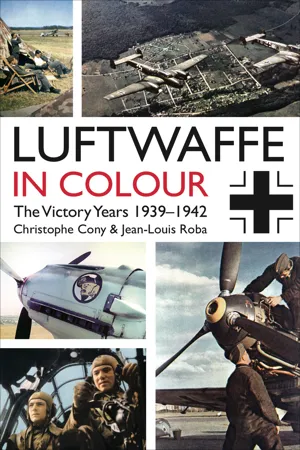
A photo-packed look at the men and machines of one of history's legendary air forces.
This remarkable work explores the Luftwaffe as it truly existed day-to-day, underneath the propaganda of their own regime and the stories of their enemies. In Hitler's Germany, color photography was primarily co-opted for state purposes, such as the military publication
Signal or the Luftwaffe's own magazine,
Der Adler. But a number of men had cameras of their own, and in this painstakingly acquired collection, we can witness true life on Germany's airfields during the period of the Luftwaffe's ascendancy.
Not only do we see famous planes such as the Me-109, Ju-87, and He-111, but the wide variety of more obscure types with which the Germans began the war. The array of Arados, Dorniers, Heinkels—not to mention elegant four-engine Condors—that were initially employed in the war are here in plain sight and full color, providing not only an insight into WWII history but a model maker's dream.
Just as fascinating are the shots of the airmen themselves, along with their ground crews—full of confidence and cheer as they bested every other air force in Europe during these years, with the single exception of the RAF's Fighter Command in late summer 1940. But that was no big stumbling block to the Luftwaffe, which had bigger fish to fry in Russia and North Africa the following year.
"Both volumes [
The Victory Years and
From Glory to Defeat] are a fantastic addition to your aviation library. The reproduction quality is superb." —
War History Online
- 160 pages
- English
- ePUB (mobile friendly)
- Available on iOS & Android
eBook - ePub
Luftwaffe in Colour: The Victory Years 1939–1942
About this book
Information
Part I
The Pre-War Period

Gliding was a well-established national sport in Germany by the time the Nazi Party took power in 1933. Taking advantage of this enthusiasm for flight, the Third Reich did all it could to interest its young men in aviation by organizing huge glider competitions. This photo shows the famous Wasserkuppe peak in the Rhön mountains, which since 1920 had been the site of an annual gliding competition. This photograph of the 1939 competition which took place between July 23rd and August 6th is from Signal magazine. Various single-seater performance gliders can be seen including D-4-866, D-2-385, D-9,575, D7, 2193, D-12-454, D-7-331 and D-13-429 as well as the Akaflieg München Mü 13D. (Signal)

FVA-13 “Olympia Jolle” D-12-411 at the Rhön Glider Competition in 1939. This glider was developed by Flugwissenchaftliche Vereiningung Aachen (Flight Research Association Aachen) for the 1940 Olympic Games in Finland, which for the first time would have included a gliding event, but the design was passed over by the Olympic Commission in favour of the DFS “Olympia Meise”. (Signal)

Assembling a Göppingen Gö 3 “Minimoa”. The cockpit is encased in moulded Plexiglas, a new innovation at the time. (Signal)

Seen here gliding silently above the Rhön mountains, Gö 3 Minimoa D-10-921 was used in 1939 by the NSFK-Gr. 10 in Dortmund. (Signal)

A DFS 108-68 “Weihe” just launched from the Wasserkuppe, displaying the markings of the NSFK-Gr. 14. The NSFK (Nationalsozialistisches Fliegerkorps) was an organization formed by the Nazi Party in October 1937 which brought together all civil aviation activities in Germany. This new paramilitary training organisation was much more politicized than its predecessor, the DLV (Deutscher Luftsportverband), created in March 1933. (Signal)

Martin Schempp and Wolf Hirth under the wing of the 100th Minimoa built in their Göppingen workshop on June 30th, 1939. This model is the Gö 3 D-14-295, a glider from NSFK-Gr. 14 which operated in southern Bavaria. Note the metal airbrake installed behind the wing shaft.

From January 1939, “D” (for Deutschland) was replaced by “WL” (for Wehrmacht Luftwaffe) on civil machines used in military aviation, such as this glider – Grunau “Baby” IIb – from the Münster Luftgaukommando, registration WL-VI-105.

A symbol of the rebirth of German aviation, the three-engined Junkers 52 was built before the war in many civil and military variants. This Ju 52/3m (W.Nr. 5797) was registered D-ATYZ in August 1937 to Lufthansa; it was named Hans Hackmack in honour of the chief pilot of the company, who was killed on February 26th, 1928 while testing the prototype of the single-engine Messerschmitt M20 transporter.

The Nazis put on huge displays of powered flight to attract the population to aviation. This two-seater Klemm L25e Vii R (W.Nr.836) D-EGUX of the NSFK participated in one such demonstration, the Tour of Germany (Deutschlandflug), in 1938, bearing the race number Z5b.

Also participating in Deutschlandflug 1938, this Ju W 34 hi, registration D-OMDO, is surrounded by many curious spectators who have come to see it take off from a small field in Marburg, a little over 70km north of Frankfurt.

The first production version of the famous “Stuka” dive bomber Ju 87 A-1 was still limited by its Junkers Jumo 210 Da engine, which only produced 680 hp. It could only carry a 250 kg bomb, or a 500 kg bomb if the pilot flew alone (without the rear gunner/observer).

Amongst the new generation of modern machines developed by German engineers was this magnificent Bf 108 B-1 D-IOIO, built by Willy Messerschmitt, photographed above the Alps in about 1936. It was the direct precursor to the famous Bf 109, of which more were built than any other fighter aircra...
Table of contents
- Front Cover
- Half-Title Page
- Title Page
- Copyright Page
- CONTENTS
- INTRODUCTION
- PART I The Pre-War Period
- PART II From Poland to Sitzkrieg
- PART III Blitzkrieg in the West
- PART IV The Battle of Britain and the Blitz
- PART V Marita and Merkur: Blitz in the Balkans
- PART VI Operation Barbarossa
- PART VII African Adventure and the Mediterranean Front
- PART VIII In the West
- PART IX The Second Line: Schools, Factories and Training
Trusted by 375,005 students
Access to over 1.5 million titles for a fair monthly price.
Study more efficiently using our study tools.
Frequently asked questions
Yes, you can cancel anytime from the Subscription tab in your account settings on the Perlego website. Your subscription will stay active until the end of your current billing period. Learn how to cancel your subscription
No, books cannot be downloaded as external files, such as PDFs, for use outside of Perlego. However, you can download books within the Perlego app for offline reading on mobile or tablet. Learn how to download books offline
Perlego offers two plans: Essential and Complete
- Essential is ideal for learners and professionals who enjoy exploring a wide range of subjects. Access the Essential Library with 800,000+ trusted titles and best-sellers across business, personal growth, and the humanities. Includes unlimited reading time and Standard Read Aloud voice.
- Complete: Perfect for advanced learners and researchers needing full, unrestricted access. Unlock 1.5M+ books across hundreds of subjects, including academic and specialized titles. The Complete Plan also includes advanced features like Premium Read Aloud and Research Assistant.
We are an online textbook subscription service, where you can get access to an entire online library for less than the price of a single book per month. With over 1.5 million books across 990+ topics, we’ve got you covered! Learn about our mission
Look out for the read-aloud symbol on your next book to see if you can listen to it. The read-aloud tool reads text aloud for you, highlighting the text as it is being read. You can pause it, speed it up and slow it down. Learn more about Read Aloud
Yes! You can use the Perlego app on both iOS and Android devices to read anytime, anywhere — even offline. Perfect for commutes or when you’re on the go.
Please note we cannot support devices running on iOS 13 and Android 7 or earlier. Learn more about using the app
Please note we cannot support devices running on iOS 13 and Android 7 or earlier. Learn more about using the app
Yes, you can access Luftwaffe in Colour: The Victory Years 1939–1942 by Christophe Cony,Jean-Louis Roba in PDF and/or ePUB format, as well as other popular books in History & German History. We have over 1.5 million books available in our catalogue for you to explore.