The story of Gen. George S. Patton's magnificent Third Army as it advanced across Nazi-occupied Europe and into Hitler's redoubt. Includes photos.
As America's own answer to the Blitzkrieg, Third Army's actions from the Normandy coast across France and Germany to Austria gave a new dimension to the term "fluid warfare." They only needed one general order—to seek out the enemy, trap, and destroy them. This they did, relentlessly overcoming every obstacle thrown in their way.
Third Army's story is one of teamwork, of armor, infantry, and aircraft working together with a perfection that amazed even the Germans, who'd always considered themselves the masters of the mobile offensive. Though Third Army is often remembered for its tank spearheads, like the 4th Armored Division, these pages also give credit to the brave infantry divisions which butted their heads against fortresses such as Metz with ultimate success. It is also the story of a triumph of administration as thousands of trucks carried forward the vital supplies to keep the army on the move and fighting.
When a German counteroffensive nearly burst through the US lines in the Ardennes, it was Patton's Third Army that turned on its heel and immediately drove in the "Bulge," ending Hitler's last great hope for success in the west. Afterward nothing could stop it as it crossed the Rhine and overran the Reich. Much of Third Army's greatness, driving force, and will to win, was owed to one man—Gen. George Smith Patton Jr.—and a significant part of this book is devoted to him alone.
In these pages, a renowned military historian gives a vivid impression in words and pictures of what it was like to live and fight with Patton's men. Full of eyewitness accounts, photographs, and maps, it relates the full story of how America's most dynamic fighting formation led the Allied effort against the Nazis' seemingly invincible European empire.
- 224 pages
- English
- ePUB (mobile friendly)
- Available on iOS & Android
eBook - ePub
Patton's Third Army at War
About this book
Information
1 | THE YANKS ARE COMING |
Goodbye America
In company with thousands of other doughboys, WACs and nurses, the GIs of Third Army had first to make the dangerous, uncomfortable crossing of the Atlantic Ocean. Many traveled on the Queen Mary (SS490 as she was known in wartime) or on her sister ship the Queen Elizabeth. The impressions gained at the beginning of these voyages were indelibly stamped on the minds of all those who experienced them. The lights, the bustle, the magnificent panorama of New York City, as the harbor boat swung down the East River, around the Battery and up the Hudson. The band playing on the pier as troops transferred to their ocean going home, the Red Cross “Doughnut” girls handing out mugs of steaming coffee, and finally the long climb, with full equipment, up the steep gangplank. Here is how such an embarkation was described by one GI:
“Now, visualize the long queue of khaki-clad men which is filing slowly across the narrow gangway into the maw of the waiting monster. This is not a mere figure of speech, for the Queen Mary and the Queen Elizabeth and other great liners used for troop carrying are known affectionately in the navies of both America and Britain as the ‘monsters’ …
“At the dark entrance stands a white-helmeted MP. ‘Keep goin’, soldier,’ he will say, and those three words will ring in your ears like the refrain of a litany throughout the trip, varied on occasion by the sharp command, ‘Put out that cigarette!’ In your hand is a blue card and, once inside, you will find yourself in a long alleyway with a staircase at the far end. It smells hot and stuffy, but you bump your way down it until you reach the stairway and then climb up or down. Here and there you will catch a glimpse of a steward in a white coat or a British seaman in dark blue trousers and a polo-necked pullover. They are members of a crew of 800 Britishers in whose hands you will be until the ship is safely in the Clyde. At last you reach your standee bed. One of eighteen, it is situated in an oblong box, in peacetime a stateroom on D deck which held at most four. Next to it is a bathroom with more cots in it. You won’t trouble much about baths during the voyage. Presently a loud impersonal voice coming from the public address systems tells you the evening meal is beginning and you shuffle off to the main dining room with its decorations of polished wood and steel where once first-class passengers ate. Thence, after eating you will, if you are wise, find out the whereabouts of the PX canteen, note the hours of opening and realize that if you want Coca-Cola, that is where you go for it … “
The Queen Mary and Queen Elizabeth both made the voyage unescorted, ploughing effortlessly through the waves at an average speed of 28.5 knots—faster than many escorts could manage. They were loaded to the gunwales on every crossing. Experience had shown that hammocks were unsuitable for land-lubbers, so “standee” bunks were installed, anything up to eight tiers high! They could be folded flat when not in use and were put up practically everywhere, so that nearly 8,000 could sleep at a time. However, even this was not enough, and a two-shift system had to be instituted, two men being allocated to every bunk. In this way up to 15,000 troops were carried on each voyage, roughly the equivalent of an entire infantry division.
Two of the major headaches while on board were feeding and safety. Imagine, for example, cooking three tons of sausages at a time! Safety was, of course, paramount, boat and raft drill being practiced daily and everyone was made to carry a lifebelt at all times. Anyone seen without one immediately had to surrender their shoes. These were impounded on the spot by the military police and returned only when the culprit presented himself with his lifebelt at the shoe store. “The finest incident I saw on any of my trips,” reported one distinguished official who crossed the Atlantic many times during the war, “was the sight of an American admiral stopped by a GI sentry and ordered to remove his shoes because he had no lifebelt. I can see the great man now, padding obediently away in his socks over the wet decks and returning meekly with the belt.”
I have included in this section photographs which show GIs embarking for the European Theatre of Operations (ETO), but I cannot swear that they actually feature members of Third Army. However, they are typical of the thousands and thousands who made the crossing. Typical also is this account of the journey sent to me by Frank J. Paskvan of Lorain, OH, who served with the engineers in Third Army:
“After receiving my basic training I was transferred to the 995th Engineer Treadway Bridge Company. I had no previous training in building a bridge but was told my training would be finished when we were shipped overseas. My outfit left Camp Barkley, TX in January 1944 and moved to Camp Kilmer, NJ, an embarkation center for the ETO. Receiving more shots and a little training in gas warfare, all of us were given a night off to visit New York City. I went with a buddy of mine, who called his wife and told her that he would soon be leaving for overseas duty. I didn’t call my wife, but his wife called her and told her what was happening. The next day we were paraded and told to get rid of all civilian clothing and material not issued by the United States Army and to place it on a pile in one of the empty barrack rooms. When my turn came to pass through the barrack room the pile was almost up to the ceiling: we never did find out what happened to all those extra towels, soap, socks, shorts etc. When we had ridded ourselves of all this fine material, they said the reason was that we were only allowed so many pounds to a man on the ship. Another thing they told us was that when we boarded the ship there would be two men to each stateroom and that we had to stay in the staterooms until orders were given for us to be allowed to move about.
“On January 28, 1944, we embarked for England on a ship called the Andes. As we boarded through an opening in the side of the ship, a band played the ‘Star-Spangled Banner’ and all of us slowly went up the gangplank and inside the ship. Down, down, down we went, until I thought we would come out at the bottom. By this time my pack was so heavy that I’d lost all interest and only wanted to sleep in my stateroom. Someone asked the captain when we would be allowed to go to our staterooms. He said, ‘Staterooms? This is your stateroom,’ and he left in a hurry! To make something out of nothing, one of the sailors gave us some hammocks and I hung one up, almost fell out a couple of times, but found out if I held my breath I didn’t fall out and was soon asleep. Morning was breaking when I noticed the lamp above me swaying slowly. I told my buddy that the ship was moving. He looked at me then at the lamp and said, ‘Naw, no way is this ship moving.’ I told him to listen and you could hear the motors of the ship. When he heard them he immediately got seasick, so did several others. It took us ten days to cross the Atlantic and my buddy was sick for the whole ten days. I thought he was going to die. We all managed to survive, however, and landed in Liverpool, England, boarded a bus and the driver scared hell out of me by driving on the wrong side of the street. Anyhow he got us to our destination, the railway station, and we were soon on our way to Southern England, to a small town called Ross-on-Wye where we were billeted in Nissen huts and given a bucket of coal!”

On the gangplank. Well-laden GIs move on board to begin their journey to the European Theater of Operations.
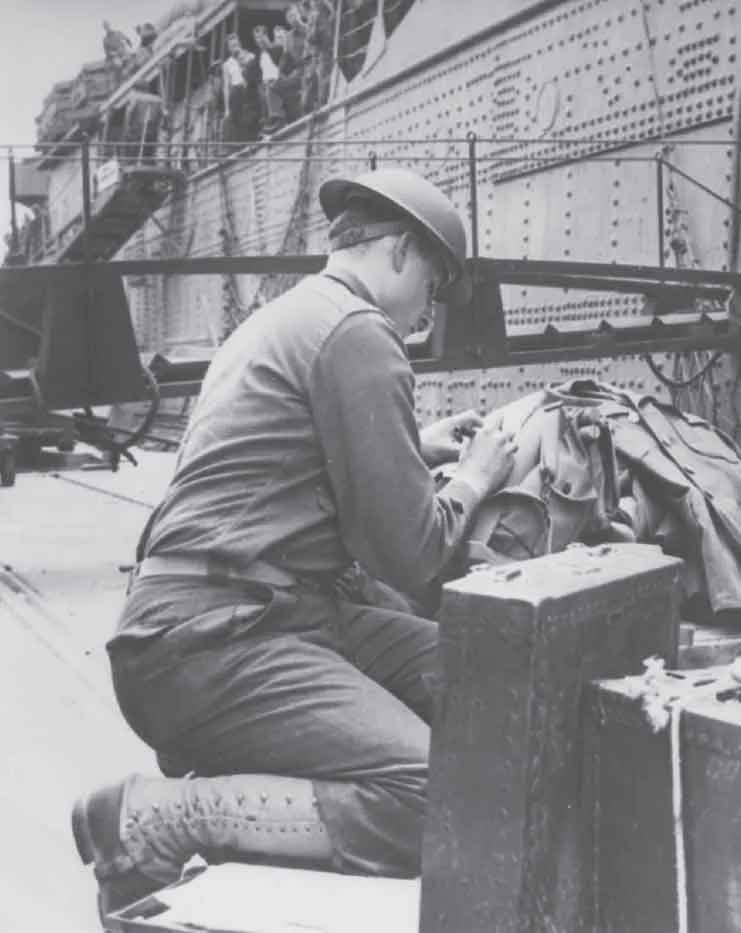
A last letter home. Soon this soldier’s family will be receiving mail with foreign postmarks.
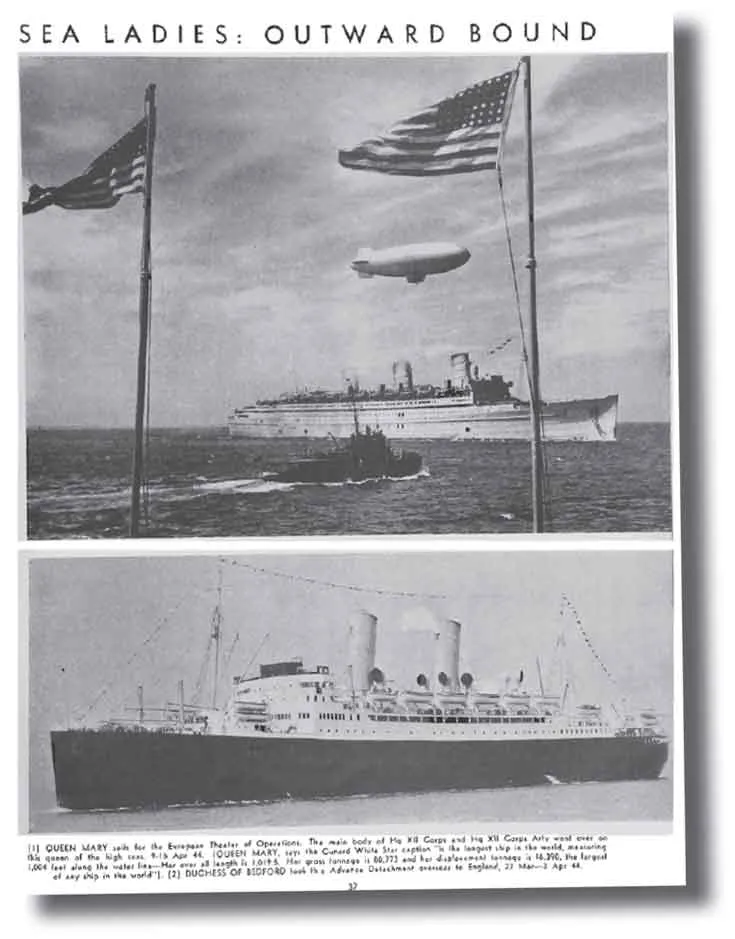
RMS Queen Mary (or SS490 as she was known in wartime) leaving America complete with overwatching blimp. The main body of HQ XII Corps and HQ Corps Arty traveled to the UK aboard the Queen, April 9–16, 1944. The advanced detachment went on the Duchess of Bedford, Mar...
Table of contents
- Cover
- Title Page
- Copyright
- Dedication
- Contents
- Abbreviations
- Timeline
- Foreword
- Introduction
- Chapter 1: The Yanks Are Coming
- Chapter 2: Breakout!
- Chapter 3: Patton
- Chapter 4: Georgie’s Boys
- Chapter 5: The Gallop Across France
- Chapter 6: Mud and Blood in the Saar
- Chapter 7: Continental Living
- Chapter 8: The Battle of the Bulge
- Chapter 9: Across the Rhine
- Chapter 10: The Last Roundup
- Chapter 11: Death and Legacy
- Bibliography
- Credits
Trusted by 375,005 students
Access to over 1.5 million titles for a fair monthly price.
Study more efficiently using our study tools.
Frequently asked questions
Yes, you can cancel anytime from the Subscription tab in your account settings on the Perlego website. Your subscription will stay active until the end of your current billing period. Learn how to cancel your subscription
No, books cannot be downloaded as external files, such as PDFs, for use outside of Perlego. However, you can download books within the Perlego app for offline reading on mobile or tablet. Learn how to download books offline
Perlego offers two plans: Essential and Complete
- Essential is ideal for learners and professionals who enjoy exploring a wide range of subjects. Access the Essential Library with 800,000+ trusted titles and best-sellers across business, personal growth, and the humanities. Includes unlimited reading time and Standard Read Aloud voice.
- Complete: Perfect for advanced learners and researchers needing full, unrestricted access. Unlock 1.5M+ books across hundreds of subjects, including academic and specialized titles. The Complete Plan also includes advanced features like Premium Read Aloud and Research Assistant.
We are an online textbook subscription service, where you can get access to an entire online library for less than the price of a single book per month. With over 1.5 million books across 990+ topics, we’ve got you covered! Learn about our mission
Look out for the read-aloud symbol on your next book to see if you can listen to it. The read-aloud tool reads text aloud for you, highlighting the text as it is being read. You can pause it, speed it up and slow it down. Learn more about Read Aloud
Yes! You can use the Perlego app on both iOS and Android devices to read anytime, anywhere — even offline. Perfect for commutes or when you’re on the go.
Please note we cannot support devices running on iOS 13 and Android 7 or earlier. Learn more about using the app
Please note we cannot support devices running on iOS 13 and Android 7 or earlier. Learn more about using the app
Yes, you can access Patton's Third Army at War by George Forty in PDF and/or ePUB format, as well as other popular books in History & Military Biographies. We have over 1.5 million books available in our catalogue for you to explore.