This definitive account of the final war between the US government and Florida's Seminole tribe "brings to life a conflict that is largely ignored" (
San Francisco Book Review).
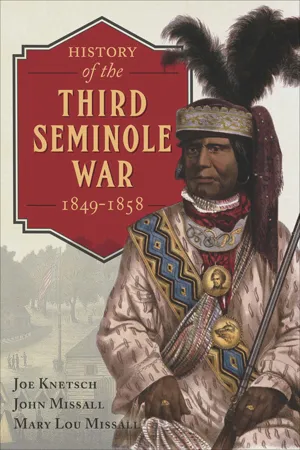
Spanning a period of over forty years (1817–1858), the three Seminole Wars were America's longest, costliest, and deadliest Indian wars, surpassing the more famous ones fought in the West. After an uneasy peace following the conclusion of the second Seminole War in 1842, a series of hostile events, followed by a string of murders in 1849 and 1850, made confrontation inevitable. The war was also known as the "Billy Bowlegs War" because Billy Bowlegs, Holata Micco, was the central Seminole leader in this the last Indian war to be fought east of the Mississippi River. Pushed by increasing encroachment into their territory, he led a raid near Fort Myers. A series of violent skirmishes ensued. The vastness of the Floridian wilderness and the difficulties of the terrain and climate caused problems for the army, but they had learned lessons from the second war, and, amongst other new tactics, employed greater use of boats, eventually securing victory by cutting off food supplies.
History of the Third Seminole War is a detailed narrative of the war and its causes, containing numerous firsthand accounts from participants in the conflict, derived from virtually all the available primary sources, collected over many years. "Any reader interested in learning more about Indian wars, Army history, or Florida history will profit from reading this book," as well as Civil War enthusiasts, since many of the officers earned their stripes in the earlier conflict (
The Journal of America's Military Past).
- 288 pages
- English
- ePUB (mobile friendly)
- Available on iOS & Android
eBook - ePub
History of the Third Seminole War, 1849–1858
About this book
Information
CHAPTER ONE
Florida Has Been Deeply Injured
Was the Second Seminole War (1835–1842) really over? People throughout the nation, and especially in Florida, had a right to be skeptical. For almost seven years, the Seminole Indians had fought against the government’s effort to remove them from their Florida homeland and send them to new homes west of the Mississippi River. It had been an embarrassing war for the government, costly in terms of dollars spent and lives lost, and in the end there were still hundreds of Seminole living in Florida.
It was not the first time America had waged war upon the Seminole people. In late 1817 tensions along the border between Georgia and what was then Spanish Florida exploded into open conflict. General Andrew Jackson was sent into Florida with a force of more than 4,000 men including allied Lower Creek Indian warriors to destroy the Seminole and capture any runaway slaves living in the area. By May 1818 Jackson had pushed the Indians deep into the peninsula, destroying major settlements and taking much of their livestock. After devastating the Seminole, Jackson turned his attention to the Spanish capital at Pensacola, and contrary to orders, captured the city after a short siege. Having accomplished his mission, Jackson returned to his home in Tennessee, leaving it to Secretary of State John Quincy Adams to clean up the diplomatic mess. To the Spanish it had become obvious they could no longer hold on to the colony, and in 1819 the Adams-Onis Treaty was signed, ceding Florida to the United States. When the land changed hands in 1821, Andrew Jackson was appointed Military Governor.1
The Seminole, who had for the most part been left alone by the Spanish authorities, now had to deal with the Americans. The Natives occupied some of the best land in the peninsula and owned huge herds of valuable cattle. In addition, the Indians also held a large number of their own slaves and usually welcomed runaways. Disputes over land, livestock, and slaves were inevitable. In the Treaty of Moultrie Creek, signed in 1823, the Indians were granted a 4-million-acre reservation in central Florida, but the land was unproductive, and they found it difficult to survive.2
In 1830, at the urging of President Andrew Jackson, Congress passed the Indian Removal Act, which called for the relocation of all Native Americans who lived east of the Mississippi to a new Indian Territory in what is now Oklahoma. In 1832 the Treaty of Payne’s Landing was signed by a small number of Seminole leaders but was not presented to the Tribal Council for debate or ratification. In it the tribe supposedly relinquished all claim to land in Florida in exchange for new land in the West. The majority of the Seminole, including the Tribal Council, called the treaty fraudulent and refused to prepare for emigration. The government insisted they had no choice. Leave voluntarily, the Indians were told, or the army will force you out.3
Open warfare began in December 1835 with the annihilation of a detachment of 108 men under Maj. Francis Langhorne Dade at a point midway between Fort Brooke (Tampa) and Fort King (Ocala). For the United States Army, one defeat followed another. On New Year’s Eve the Seminole repulsed 750 men at the Withlacoochee River, and by the end of January virtually the entire sugar industry (Florida’s biggest business) had been destroyed. In early March a force of 1,000 men was held under siege for over a week before being rescued, and several weeks later an army of about 5,000 men failed to kill or capture any significant number of Seminole before the season for active campaigning ended in May. The Seminole, who refused to fight in the orderly, Napoleonic tactics the army was trained in, seemed to be winning the war.4
As it would be for the next five years, the war was put on hold for the summer. Daily rains made the roads impassible and flooded much of the land. Hordes of disease-bearing insects attacked the troops in their barracks, causing far more fatalities than Seminole bullets ever would. Posts in the interior, considered unhealthy, were abandoned. Troops were sent north to allow them to recover or to deal with other problems facing the nation. By the time autumn arrived, both sides were ready to resume the conflict.
In November 1836 Florida Governor Richard Keith Call led about 2,100 men into the Seminole strongholds near the Withlacoochee River. After a sharp battle at the Wahoo Swamp, most of the Seminole made their escape. President Jackson then placed Maj. Gen. Thomas Jesup in charge of the war. Jesup understood that the only way to end the war was to wear the Seminole down. Fighting a prolonged war of attrition was new for the United States and would require an unprecedented effort on the part of the military. Half of the regular army was brought to Florida, and thousands of State Militia and Volunteer units were raised and sent to the war zone. Even the navy and marines were involved. Forts were built within a day’s march of each other, and patrols were sent out to constantly harass the Indians. Millions of dollars worth of supplies and weaponry were transported by wagon trains or ships. It took over a year, but by January 1838 Jesup had captured or killed hundreds of belligerents and forced many to surrender. Most of the remnant Seminole fled to the inhospitable Everglades, where they hoped the army couldn’t follow them.5
Feeling he had accomplished all that could be expected, Jesup asked the administration to declare the war over. He knew that chasing and rounding up the remaining Seminole hiding in the Florida wilderness would be an impossible task, and that the Seminole’s guerilla tactics rendered nearly every homestead and road in Florida vulnerable. Officials in Washington wouldn’t hear of it and told Jesup the war would not end until every last Indian was removed from Florida. Jesup was relieved by Brig. Gen. Zachary Taylor, who fortified the settled areas, but did little to capture the Seminole. In 1839 Maj. Gen. Alexander Macomb, the highest ranking officer in the army, was sent down to negotiate a peace with the Indians. It was the only time in American history that a Native nation had forced the government to sue for peace. Unfortunately, the agreement fell apart after a brutal attack on a trading post near the Caloosahatchee River.6
For the next three years, the government continued its war of attrition against the Seminole, who responded with guerilla tactics the army found difficult to counter. For the army, operating in Florida had proven a logistical nightmare, a place where adequate supplies and efficient transportation were difficult to come by. While military patrols scoured the Everglades, Seminole war parties raided throughout the peninsula. No one, Indian or white, could feel safe. Hundreds of soldiers fell victim to disease, while homesteaders and travelers perished in Indian raids. At the same time, Seminole families were killed or captured, forced from their homes, or saw their crops destroyed. After six years of warfare, people were dying and suffering on both sides, yet there seemed no end in sight to the fighting.
So who were these seemingly invincible people who were able to hold off the might of the American nation for so long? Of all the tribes in the southeastern United States, the Seminole had been the smallest and least cohesive. Their population before the war had numbered only about 5,000 individuals, with perhaps 1,500 capable of being called “warriors.” The term “Seminole” was not one they had chosen for themselves but had been applied by others, the term generally implying “separatist” or “runaway” from the Creek Confederacy.7
For the most part they weren’t even aboriginal to Florida. There had been several hundred thousand Indians in Florida when the Spaniards arrived in 1513, but within two hundred years the Natives had been virtually wiped out by disease, warfare, and enslavement. Some moved north into the English colonies and were living among the closely related Creek tribes, while others fled Spanish-held territory and moved into the more remote areas of Florida. In the early 1700s Creek Indians from what is now Alabama and Georgia began to move into the sparsely inhabited peninsula. Some came to hunt game, others because they were displaced by white encroachment, and others were leaving behind political or personal disputes within their own tribes. They came from different places at different times, settled in different areas, and spoke different dialects. They were called Alachua, Mikasuki, Apalachee, Tallahassee, Uchee, and other tribal names. Some of them mixed with remnants of the Natives who were already in Florida. In the end “Seminole” came to mean any Indian living in Florida.8
Theirs was an ancient and sophisticated culture that few whites of the time really understood. The fact that separate groups had migrated from widely spaced places meant that different languages were spoken. Even today, Florida’s Seminole speak two distinct tongues. It was, however, a common culture. In Creek/Seminole society, the primary social units were the clans. Seminole clans are matrilineal, unlike the common practice in European society where people tend to take their father’s surname and trace their lineage through the paternal line. Throughout a person’s life he or she would identify with his mother’s clan, even married men, who would traditionally move in with the wife’s clan. If a marriage dissolved, the husband would return to his own clan, but children and common property stayed with the wife.9 For the Seminole, “family” meant anyone of the same clan, no matter how many generations removed or how distant their residence. It still does.10
While a Seminole’s personal life was rooted in his or her clan, social life was centered on the town. A Seminole town was much more than a geographic entity, and a significant portion of the population might live some distance away from the town center in remote villages or camps, often populated by members of the same clan. The town was the ceremonial and political center of the Seminole’s world, the place where they would gather in times of celebration or danger.11
Ceremonies, rituals, and religious beliefs have always played an important part in the lives of the Seminole. Their most significant ritual was the annual Green Corn Dance. The term “dance” can be a bit misleading. Although tribal members spent a lot of time chanting and moving in rhythmic patterns around the central fire, it was much more than simple recreation. The dances had meaning, conveying tribal history, philosophy, and mores. Dancing helped bring continuity to the Indians’ lives, allowing them to come closer to the world in which they lived and the lives of their ancestors.12 Above all else, the Green Corn Dance was a time of spiritual purification and cleansing. By the end of the four-day ceremony the community was spiritually renewed and prepared to face the challenges of the coming year. The Green Corn Dance is still the most important event of the Seminole year.13
The Seminole were never friendly toward their northern neighbors. Many had come to Florida because of differences within the Creek tribes they had left or because of encroachment by colonists in Georgia. An animosity remained, and during the American Revolution, when Florida remained an English colony, they occasionally fought against the rebels in Georgia. During the War of 1812, some of them again sided with the British, which only served to make them more of an enemy in the eyes of the Americans.14
The Seminole were not alone in their hatred of the white Americans. Many Upper Creek Indians from what is now eastern Alabama, inspired by Tecumseh and his message of Indian solidarity and resistance to white expansion, formed the Red Stick faction, which sought more independent power from the Creek National Council. Opposed to them were many Lower Creeks from western Georgia and southern Alabama, who were more accepting of white culture. In 1813 war broke out between the two groups, and the United States soon became involved. The following spring General Andrew Jackson led a large army of volunteers from Tennessee and Kentucky and defeated the Red Sticks at the Battle of Horseshoe Bend. Hundreds of refugee Red Sticks fled to the safety of Spanish Florida and took up residence alongside the Seminole.15
There was yet another group of people living among the Florida Indians who had an even greater reason to fear white Americans. As long as Florida was in the possession of Spain, it was seen as a safe haven for runaway slaves from Georgia and the Carolinas. The Seminole welcomed these people, who possessed skills in farming, understood white culture, and could serve as interpreters. Some leading Seminole families also purchased slaves. The surplus crops produced by these people brought wealth to their owners, and the slaves were rewarded with a life that was less like slavery and more like share-cropping. Generally treated with respect by the Indians, the Black Seminole did everything in their power to remain free and were always a point of contention between the Indians and whites.16
Yet as diverse and at times antagonistic as these various groups could be, they were united in the defense of their homeland when faced with forced removal. Although their numbers were small, they enjoyed some major advantages over their white adversaries. At the beginning of the Second Seminole War, the army knew very little of the interior of Florida; few whites had ever been there. The Seminole, on the other hand, knew every lake, stream, swamp, wooded hammock, and hiding place in the peninsula. They knew where to find food, while the military was forced to import vast amounts of supplies from hundreds of miles away. Soldiers, who lived in crowded forts, were more prone to disease than the Seminole, who lived in small groups and were acclimatized to the sub-tropical conditions. The army, schooled in European-style combat, found it difficult to adjust to the tactics of guerilla warfare. The Indians, raised in a warrior culture, proved themselves to be excellent tacticians, executing deadly ambushes, selecting superior defensive positions, and choosing to fight when the advantage was with them. The Seminole’s tenacity and fighting prowess became legendary, almost mythic.
The Second Seminole War appeared as if it could go on forever, but as the war progressed, the army’s skill and efficiency...
Table of contents
- Cover
- Title
- Copyright
- Contents
- Preface
- 1 Florida Has Been Deeply Injured
- 2 By This Shot Capt. Payne and Dempsey Whidden Were Killed
- 3 We Must Take Time Enough to Avert War
- 4 It is the Intention of the Government to Remove the Indians
- 5 Our Citizens Are Now Compelled to Abandon Their Homes
- 6 The Bullets Whistled Over and Around Me Like Hail
- 7 The Evils of a Savage Warfare
- 8 This is a Mere Show of Doing Something
- 9 The Indians Cannot Hold Out Much Longer
- 10 Everything Was Destroyed That Could Be
- Appendix: U.S. Military Killed in Action (Regulars and Volunteers) Third Seminole War
- Picture Credits
- Abbreviations
- Bibliography
- Endnotes
Trusted by 375,005 students
Access to over 1.5 million titles for a fair monthly price.
Study more efficiently using our study tools.
Frequently asked questions
Yes, you can cancel anytime from the Subscription tab in your account settings on the Perlego website. Your subscription will stay active until the end of your current billing period. Learn how to cancel your subscription
No, books cannot be downloaded as external files, such as PDFs, for use outside of Perlego. However, you can download books within the Perlego app for offline reading on mobile or tablet. Learn how to download books offline
Perlego offers two plans: Essential and Complete
- Essential is ideal for learners and professionals who enjoy exploring a wide range of subjects. Access the Essential Library with 800,000+ trusted titles and best-sellers across business, personal growth, and the humanities. Includes unlimited reading time and Standard Read Aloud voice.
- Complete: Perfect for advanced learners and researchers needing full, unrestricted access. Unlock 1.5M+ books across hundreds of subjects, including academic and specialized titles. The Complete Plan also includes advanced features like Premium Read Aloud and Research Assistant.
We are an online textbook subscription service, where you can get access to an entire online library for less than the price of a single book per month. With over 1.5 million books across 990+ topics, we’ve got you covered! Learn about our mission
Look out for the read-aloud symbol on your next book to see if you can listen to it. The read-aloud tool reads text aloud for you, highlighting the text as it is being read. You can pause it, speed it up and slow it down. Learn more about Read Aloud
Yes! You can use the Perlego app on both iOS and Android devices to read anytime, anywhere — even offline. Perfect for commutes or when you’re on the go.
Please note we cannot support devices running on iOS 13 and Android 7 or earlier. Learn more about using the app
Please note we cannot support devices running on iOS 13 and Android 7 or earlier. Learn more about using the app
Yes, you can access History of the Third Seminole War, 1849–1858 by Joe Knetsch,John Missall,Mary Lou Missall in PDF and/or ePUB format, as well as other popular books in History & Military & Maritime History. We have over 1.5 million books available in our catalogue for you to explore.