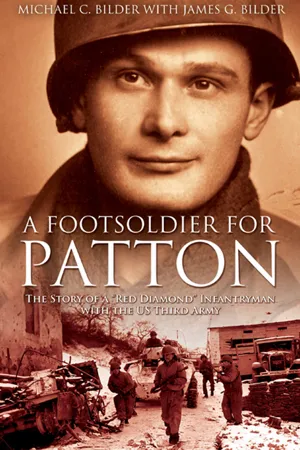
This candid memoir of a GI serving under Gen. Patton offers a rare glimpse into the realities of life and combat in Europe during WWII.
Though Gen. Patton's army is famous for dashing armored attacks, some of the most intensive fighting of World War II was done by Patton's infantry—the foot sloggers who were deployed to reduce enemy strong points. This candid account of the US infantry in the European theater takes the reader from the beaches of Normandy to the conquest of Germany—all through the eyes of an infantryman who had the unique perspective of speaking the enemy's language.
A fluent German speaker, Michael Bilder was called upon for interrogations and other special duties. As a combat lifeguard, he also played a key role in successive river crossings. Here, Bilder relates his experiences of infantry life, from German snipers to intoxicated Frenchwomen, to the often morbid humor of combat. He also describes the Battle of Metz in all its horror, as well as the 5th Infantry's drive into the Bulge, where they faced their first winter battle against enemy veterans of Russia.
eBook - ePub
A Foot Soldier for Patton
The Story of a "Red Diamond" Infantryman with the US Third Army
- 304 pages
- English
- ePUB (mobile friendly)
- Available on iOS & Android
eBook - ePub
A Foot Soldier for Patton
The Story of a "Red Diamond" Infantryman with the US Third Army
About this book
Information
1
PEACETIME INDUCTION
Just a One-Year Hitch for Preparedness
“I’m nobody! Who are you?
Are you—nobody—Too?”
—Emily Dickinson, “I’m Nobody! Who Are You?”
I didn’t know it at the time, but September 16, 1940 was a date that would have a pivotal impact on my life. On that day, Franklin Roosevelt signed the Selective Service Act into law. It was the start of the first peacetime draft in American history.
Induction in the United States had previously taken place only as a necessity of war. It first occurred in 1863 at the midpoint of the Civil War, and again in 1917 after the United States entered World War I. Selective Service was thus synonymous with war to most Americans, and it created a considerable amount of apprehension.
Circumstances in 1940 caused a strange, almost schizophrenic, split in our thinking. Much of the globe was embroiled in another world war. Most Americans on the other hand were isolationists at heart and wanted no part in it. Any American who had graduated from grade school was familiar with George Washington’s “Farewell Address,” in which he warned his countrymen against entangling foreign alliances. Washington’s advice seemed horrifically justified after the United States entered World War I and won what appeared to be a meaningless victory in a never-ending line of European struggles and conquests.
As in 1917, interventionists in 1940 wanted “to send every aid short of war” to assist the Allied nations in their struggle. This included the United States President, Franklin Delano Roosevelt, who insisted that the Allies were “fighting our fight,” implying that if American aid failed to win the war for the Allies, then America herself should enter the conflict. We wondered, were the interventionists right this time?
This split thinking also spilled into America’s foreign policy. Neutrality laws that had on the books as since the mid-1930s were amended so that policies such as “Cash and Carry” and “Lend-Lease” enabled the States to extend armaments to nations that were friendly to democratic values. America could remain officially neutral while still taking sides. The result of war-related manufacturing made America the world’s “arsenal of democracy” and produced yet another strange split in our values and thoughts as the very war most Americans wanted to avoid was producing jobs and a potential end to the terrible depression of the 1930s.
Even the presidential election campaign that year split America over an issue that it had never before experienced. An American President was running for a third term of office. The entire campaign centered on foreign policy. Who, Roosevelt the incumbent president, or Wilkie the business and administrative whiz-kid, could best get the country prepared for war without getting us into the fray? This was the two-sided coin of our circumstances in the early war years.
We all saw the ominous events occurring throughout the world in 1940. By September, the war had been underway for a year and the Nazis and Soviets had already overrun most of Europe, while the Japanese did much the same in Asia. This was disconcerting, but it occurred across the oceans, on continents far from our own. The attack on Pearl Harbor was more than fifteen months away. Meanwhile, we enjoyed America’s neutrality.
My generation was young and largely oblivious to many of the details related to all these happenings. We were busy getting on with our lives. Things were far from perfect, but I had good things to enjoy in the big city of Chicago where I lived. On a hot summer’s night we went to plush movie houses like the Avalon Theater to sit in the comfort of “air conditioning” and watch Hollywood’s best on a huge silver screen. We went horseback riding in Washington Park, rented rowboats in Jackson Park, and went to see the Cubs play at Wrigley Field or watched the White Sox at Comiskey Park. The most popular activity of all was dancing. “It don’t mean a thing if it ain’t got that swing,” went the song. Everybody danced. We all loved it and it was a great way for guys and gals to mix. Chicago was a hub for great music and big bands and we saw and heard them all: Glenn Miller, Tommy Dorsey, Benny Goodman, Les Brown and his Band of Renown, and countless others.
A peacetime draft for America was a historic first, but hardly the type of thing to lead to serious protests. There was a real debate as to whether the country should get involved in the war, but there was never any question as to whether we should be able to defend it. Under the new conscription law, the government required all males between the ages of 21 and 35, residents and aliens alike, to register for the draft. This process allowed 900,000 “selectees” to be inducted into the army to serve a twelve-month hitch. We knew that this would help make the country better prepared militarily and more likely to deter any attack from a foreign dictator.
The draft certainly seemed reasonable under the circumstances. Nazi Germany and Soviet Russia were still allies in 1940. Hitler also had alliances with Italy and Japan and the only belligerents of any significance were the British and Chinese. It only made sense that American military might be strong enough to give aggressors reason to think before attacking us.
I met the legal criteria for draft eligibility so I walked the two blocks over to Hendricks Public (Grammar) School at the corner of 43rd and Princeton and registered on October 16, 1940. I had attended Hendricks for kindergarten and first grade, but completed the rest of my grammar school education at St. George Catholic grade school. The registrar’s report listed me as 6 feet 1 inch, 195 pounds, with brown hair and eyes and a “ruddy complexion.” I was order number 765 and my registration serial number was 2,639. I was now a number among the 16,000,000 men who registered for the draft.
I had been employed for two years as a shipping clerk at the Sears and Roebuck warehouse at 1400 W. 35th Street in Chicago. My main qualification for the job had been my Catholic faith. In the days when people and companies were free to practice discrimination of all types, we were asked to list our religion on our employment applications. A clerk at Sears explained to me later that they liked to hire Catholics because, in their words, they felt that Catholics were less likely to steal.
A few years earlier, before the draft and even before the war itself, some of the guys in the neighborhood were farsighted enough to see another world war as inevitable and joined the National Guard with the hope of having some rank and a good assignment by the time war came. They tried to talk me into doing the same, promising me I’d get a good deal, but I wanted no part of it. I was happy to enjoy civilian life and its creature comforts and it literally took an act of congress to get me to give them up.
Despite my love of the creature comforts, I had gone to the Canadians in 1939 to inquire about enlisting in the RAF. I had loved flight ever since I first read about the brave knights of the air who did battle amongst the clouds in World War I. I saw movies like Hell’s Angels, Dawn Patrol and The Eagle and the Hawk over and over again, and dreamed of one day flying in combat.
I had two problems. First, I had no college, and fighter pilots were expected to have at least two years of undergraduate work upon induction. Second, and more importantly, I had problems with depth perception. These became obvious when I took private flying lessons at Lewis College near Joliet. Whenever I lined up my approach to land, I always angled my plane with the wing on my right dipping down. It seemed level to me, but the instructor always had to take the controls. Needless to say, the Canadians rejected me.
I felt no real apprehension or resentment at being drafted into the army. After all, the war was in Europe and the Pacific, and the United States wasn’t involved. Roosevelt won his third term as president in large part by pledging at the Boston Gardens a few days before the election, “I have said this before, but I shall say it again and again. Your boys are not going to be sent into any foreign wars.” My family and I accepted that presidential campaign promise at face value. The feeling amongst most Americans, as many as 80 percent according to the polls of the day, was that while America should be prepared and the defeat of the Axis Powers was important, foreign wars didn’t really concern us and we should make every effort to stay out of them. We had oceans to separate and protect us from aggressors.
We regarded ourselves as wiser in 1940 than we had been in 1917. America would not be “tricked” into war again: we would “walk softly and carry a big stick,” making every attempt to stay out of conflict. Still, there was a nagging suspicion, even a fear, that things were getting out of hand overseas. We all knew that something would have to be done, but hoped that England and China would be the ones to do it. Even in 1940 and 1941, however, it was obvious that they were hanging on by their fingernails.
Maybe if we could show foreign dictators that we were no one to tread on, that would be enough. At least that was what many of us hoped. Like almost every other young man of the time, I didn’t mind going into the army for a year. It was only the fighting that concerned me.
My selective service records show that on March 13, 1941, the government mailed me an eight-page questionnaire, which I completed and returned within six days. I soon received the famous (I would prefer “infamous”) greetings letter from Uncle Sam telling me to report to my local draft board. I would need to answer some questions from the men who would ultimately pass judgment on my availability for national service.
At the time, I was living with my widowed grandmother. I briefly flirted with the idea of seeking a deferment based on the claim that I was her sole means of support, but I knew this was bogus and even if the government bought it, I wouldn’t have been able to live with it. Besides, the order to report to the draft board created in me a certain feeling of importance and opened the door to adventure. There was real trouble in the world and the nation needed men capable of putting America’s best defensive foot forward. This wasn’t a job for just anybody. America needed the best! You have to be 21 to think that way. You aren’t experienced enough yet to know any better or wise enough to know that you’re not immortal. Every nation of every era has always known that war is for the young.
Local Selective Service Board 101 was located at 5437 South Halsted Street in Chicago, about a mile and a half from where I lived. When the big day came, I hopped the streetcar filled with a sense of adventure. The army “offices” were nothing but a vacant storefront furnished with card tables and folding chairs.
I seated at a table across from three old men, who looked quite ancient to me as a 21-year-old. They proceeded to ask me questions, verifying what was already on my forms. They checked my name, date of birth, and home address, along with a few things regarding my family and health. After about 10 minutes, they concluded the interview and told me to return to my normal routine. I could expect to hear from them in a few weeks.
The draft board wasted no time: I received an order on April 2 to report for a physical exam two days later. Passing the exam was the final step for induction. The army was initially very picky about the mental, moral, family, and physical status of their potential recruits, but their lofty standards dropped dramatically as the war progressed and the need for manpower grew more and more intense. I knew I was in great shape and could count on passing the physical.
As I said, none of this really bothered me all that much. My life at the time was far from perfect. I lived in a cold-water flat on Chicago’s south side at 4315 S. Wells with my grandmother in a poor working class neighborhood known as “Canaryville.” It was very near the Chicago Stock Yards and local legend holds that the neighborhood got its name because many households put canaries out on their front porches so their singing would drown out the screams of the animals being slaughtered. We did not actually hear the animals dying, but when the wind was right (or wrong) we sure could smell them.
My father, who died before my birth, was an ethnic German who immigrated to the United States when he was 21 years old, just before the outbreak of World War I. He left his home and family in the Austrian-Hungarian Empire to avoid the draft and set out to find a better life in America. A skilled tradesman, he settled in the German community on Chicago’s south side and went to work as a cooper (barrel maker), at a local brewery. My uncle became acquainted with him through social events at Saint George Parish and brought him home to meet his mother, my grandmother, who took an instant liking to him. She saw him as a hard-working man with a skilled trade, good looks, German blood, and the Catholic faith. This was everything a woman in this neighborhood could hope for in a man, and so my grandmother decided that her sixteen-year-old daughter would marry him.
My folks were married in July of 1917 and moved into a flat in my grandparents’ building. My mother always told me that my father loved life, had a great sense of humor, and treated her very well. She also told me that she quickly grew to love him.
Their circumstances, however, very hard. My mother’s dad died just a few weeks after her marriage, and then in June 1918, she gave birth to a stillborn son during her sixth month of pregnancy. I was conceived some three or four months later, but my father died in December 1918 of the flu pandemic, at the youthful age of 26. He and my mother had been married for only 18 months, and now she was a widow and four months pregnant with me. My mother and grandmother reasoned that life was hard and that responsible adults accepted its circumstances. They instilled this same belief in me. They were repulsed by those few who suggested that an abortion was the answer. I was born the following May.
My mother needed a husband to support her and her infant son, which played no small role in her decision to marry my stepfather in January 1920. My stepfather had been a loose acquaintance of my father’s and had even been a member of my parents’ wedding party. Despite this, he and I never saw eye to eye on anything. My stepfather had us in a typical city bungalow at 4403 S. Princeton. He always took in boarders to help make ends meet, so I slept in the family room on a day bed that was too short for me. Our differences continued to mount over the years, and at 19 I moved in with my grandmother on the next block.
In my grandmother’s eyes I could do no wrong and my stepfather could do little right. He was tight with a buck and did little more than tolerate me, and my grandmother paid the dollar-a-month tuition for me to attend St. George’s Catholic grade school. My grandmother was old country, typical of her time and background, and believed it was best for people to marry within their own ethnic group and religion. If forced to choose between the two, then choose religion, but in her mind it was best not to have to choose at all.
It was rather understandable that my stepfather resented his mother-in-law. When I was only six years old, my grandmother told me about my biological father’s death, instilling in me a feeling of loss. The sense of deprivation I felt over the loss of my natural father’s love and affection resonated ever more strongly with me as I grew up. It was obvious to me that my stepfather was in many ways my (and my late father’s) complete opposite.
My stepfather considered me and my friends to be nothing more than a bunch of ne’er-do-wells. My friends always thought him bizarre with his rude mannerisms and frequent cursing, and avoided him whenever possible. With his dour attitude, he was always quick to assure me of two dreadful fates that were certain to befall me. First, that I was destined to grow up to be a bum. In this I can say thankfully that he was very wrong. Second, that I would one day “eat wild pears.” Here, he was more correct than he ever could have imagined.
The only thing that was really right in my life at the time was Mary. We had met on a blind date in July 1940. She was intelligent and gorgeous both, and she knew it. Far from lacking in self-confidence, she was even a little on the stuck-up side, but she had a good heart and was really a kind person. Mary was about 5 feet 8 inches tall and had brown hair worn in a pageboy, with beautifully matching brown eyes. Her legs were long and slender and her figure was near perfect. She dressed well, but her true sexiness was contained in a cool air of self-confidence and sophistication that made her a real lady.
I was no slouch myself in those days. I was tall with a very full head of brown hair, clear brown eyes, nicely chiseled facial features, and a solid athletic build. My grandmother refused to charge me rent, so I blew most of my money on good clothes. The guys I hung around with respectfully referred to me as the “Esquire Kid.” The fact that I frequently dated a number of pretty girls earned me the nickname “lover boy Bilder” among the local ladies.
Mary and I were well suited to each other, and although we didn’t have an engagement ring or a wedding date, I proposed to her and she accepted. What possible difference could a year in the army make?
By the end of March 1941, the draft had succeeded in putting some 306,000 American men in uniform, about a third of its stated goal. I knew that within days I would increase that number by one. I reported, as per my orders, on April 4 to the Armory on Madison Avenue in Chicago. My letter stated that I was to keep my draft notice with me at all times dur...
Table of contents
- CONTENTS
- FOREWORD
- INTRODUCTION
- 1
- 2
- 3
- 4
- 5
- 6
- “LAFAYETTE, WE ARE HERE,” AGAIN!
- 7
- PATTON AND THE DASH ACROSS FRANCE
- 8
- METZ THE MEAT GRINDER
- 9
- 10
- THE PUSH INTO GERMANY
- 11
- EPILOGUE
- ACKNOWLEDGMENTS
- THE 2ND INFANTRY ROLL OF HONOR
Trusted by 375,005 students
Access to over 1.5 million titles for a fair monthly price.
Study more efficiently using our study tools.
Frequently asked questions
Yes, you can cancel anytime from the Subscription tab in your account settings on the Perlego website. Your subscription will stay active until the end of your current billing period. Learn how to cancel your subscription
No, books cannot be downloaded as external files, such as PDFs, for use outside of Perlego. However, you can download books within the Perlego app for offline reading on mobile or tablet. Learn how to download books offline
Perlego offers two plans: Essential and Complete
- Essential is ideal for learners and professionals who enjoy exploring a wide range of subjects. Access the Essential Library with 800,000+ trusted titles and best-sellers across business, personal growth, and the humanities. Includes unlimited reading time and Standard Read Aloud voice.
- Complete: Perfect for advanced learners and researchers needing full, unrestricted access. Unlock 1.5M+ books across hundreds of subjects, including academic and specialized titles. The Complete Plan also includes advanced features like Premium Read Aloud and Research Assistant.
We are an online textbook subscription service, where you can get access to an entire online library for less than the price of a single book per month. With over 1.5 million books across 990+ topics, we’ve got you covered! Learn about our mission
Look out for the read-aloud symbol on your next book to see if you can listen to it. The read-aloud tool reads text aloud for you, highlighting the text as it is being read. You can pause it, speed it up and slow it down. Learn more about Read Aloud
Yes! You can use the Perlego app on both iOS and Android devices to read anytime, anywhere — even offline. Perfect for commutes or when you’re on the go.
Please note we cannot support devices running on iOS 13 and Android 7 or earlier. Learn more about using the app
Please note we cannot support devices running on iOS 13 and Android 7 or earlier. Learn more about using the app
Yes, you can access A Foot Soldier for Patton by Michael C. Bilder,James G. Bilder in PDF and/or ePUB format, as well as other popular books in History & Military Biographies. We have over 1.5 million books available in our catalogue for you to explore.