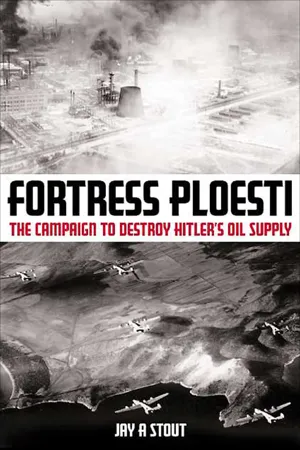
A comprehensive account of the World War II Allied bombing campaign to destroy pivotal Romanian oil refineries—by the retired Marine Corps fighter pilot.
Unlike previous books on Ploesti, Jay Stout goes well beyond the famous big and bloody raid of August 1943 and depicts the entire 1944 strategic campaign of twenty-plus missions that all but knocked Ploesti out of the war and denied the German war machine the fuel and lubricants it so desperately needed. Stout's account is also a launching point for the author's inquiries into many aspects of the American strategic bombing effort in World War II. It delivers across the board.
Stout, who served as a Marine F/A-18 pilot in the First Gulf War, asks questions about aviation combat history and technique that any modern combat pilot would be dying to ask. He carries the ball far beyond the goal post set by all other Ploesti historians. He has gone out of his way to describe the defenses throughout the campaign, and he brings in the voices of Ploesti's defenders to complement the tales of Allied airmen who brought Ploesti to ruin. He describes the role of the bombers, as well as that of the fighters, the antiaircraft defenses, even the technique of obscuring the Ploesti complex with smoke.
Stout's lucid presentation of complex issues at the tactical and strategic levels makes his narrative "a must for those with a special interest in the attacks on Ploesti" (
World War II History Magazine).
- 320 pages
- English
- ePUB (mobile friendly)
- Available on iOS & Android
eBook - ePub
About this book
Information
Topic
StoriaSubtopic
Storia militare e marittimaChapter 1
OIL
SS-OBERSTURMBANNFÜHRER Joachim Peiper was damned if he did, and damned if he didn’t. It was December 20, 1944, and the highly decorated veteran of some of Nazi Germany’s greatest battles was at the cusp of the Ardennes Offensive, more popularly known as the Battle of the Bulge.
The handpicked officer’s own Kampfgruppe Peiper was stalled near the tiny Belgian town of Stoumont. After leading his panzers on a four-day assault that had sent American soldiers reeling in disarray, he had pulled up short of his immediate objective—desperately low on fuel. Without it, his King Tiger and Panther tanks, arguably the best armored vehicles in the world, were immobile. If he advanced and engaged the disorganized Americans, his tanks might stall—a death sentence for armor. On the other hand, if he stopped his attack to prepare a defense, the new stocks of fuel he so desperately needed might never arrive, and the advantages he had gained over several days of bloody combat would be thrown away. Peiper’s decision was made more difficult with the certain knowledge that the Americans would soon regroup and return to face him in force.
With his armored units starved for fuel, Peiper decided to err on the side of caution. He stopped. Ultimately, the massive German offensive was beaten back. Unable to adequately fuel its war machine for much of the war, Nazi Germany, too, was finally defeated only a few months later.

Even before Adolf Hitler began gobbling up territory and nations in pieces and wholesale—beginning in 1936 with the reoccupation of the demilitarized zone of the Rhineland, followed by Austria and the Sudeten areas in 1938—he knew he could not hope to wage his war without a ready and reliable source of crude oil. Fielding the modern, mechanized forces that he was developing would require petroleum resources beyond those available in Germany. During 1939, the Nazi nation accounted for only two-tenths of one percent of the world’s total production of crude oil.1
Conversely, Germany’s future enemies had ample stocks. The Soviet Union, an exporter of oil to Germany until the Nazi invasion of June 1941, had more reserves than it could exploit. The United States, too, was blessed with enormous oil fields and a petroleum industry and infrastructure second to none. Indeed, on the eve of World War II, the United States was responsible for the production of 60 percent of the global output.2 Even tiny Britain had petroleum assets in the Middle East and Far East that dwarfed Germany’s supplies.
Hitler, then, would have to exercise the ingenuity of the German people, and his own greed, to get the oil he needed. To this end existing fields in Germany and Austria were exploited to the fullest. More important, Germany set about developing the largest synthetic fuel industry in the world.
German industrial giant IG Farben had for some time possessed patents on a process for developing high-quality gasoline from low-grade lignite coal—a grade of coal available to Germany. The process, while not as cheap as refining crude oil, was economically viable. Further, the industrial expertise within the country was sufficient to develop it.
Wasting no time, Hitler gave support to the German firm as early as 1933, the year he achieved power. By 1936 the development of a full-blown synthetic fuel industry was well underway. When Germany invaded Poland on September 1, 1939, there were no fewer than thirteen synthetic fuel plants in operation, and more were under construction. A year later, these plants were producing 72,000 tons of fuel per day, or nearly half of Hitler’s requirements.3
But the synthetic fuel plants could not meet all of Germany’s needs. Not soon enough, anyway. To make up the shortfall, Hitler was forced to look beyond Germany’s borders to Hungary and Romania.
Both nations had significant oil fields and refineries, but Romania’s were by far the most extensive and best developed. Located thirty-five miles north of the capital city of Bucharest, the city of Ploesti was the center of Romania’s petroleum industry. Sitting at the foot of the Sub Carpathian Mountains—also known as the Transylvanian Alps—the site was first settled in the 1500s as a military encampment. Unknown to those first inhabitants, the thick, soft, sandstone formations, or flysch, that made up the local geology were heavy with crude oil. This came into play in 1856 when Ploesti became the site of one of the world’s first oil refineries.
Development came quickly. Foreign interests, aware of the enormous profit potential promised by the huge oil fields, invested heavily. This foreign investment was possible largely because Romania possessed neither the financial nor technical means to exploit the resource. The region grew in such importance that it was already of strategic consequence by World War I. It was taken by the Germans during 1916, and subsequently returned—albeit wrecked—to Romania at the cessation of hostilities. By the time post-war reconstruction of the infrastructure was complete, foreign firms controlled the majority of petroleum production and processing in Romania. A quick review of the major operations illustrates this point: The Astra Romana company was a joint English and Dutch concern; as was the Unirea operation; the Steaua Romana refinery was jointly held by the English, the French, and the Romanians; the Sirius Concordia refinery was operated by joint French, Belgian, and Romanian concerns; and Standard Oil of New Jersey owned the huge Romano Americana complex. Only the Credit Minier operation was wholly Romanian.
This heavy foreign participation in the construction and operation of the Ploesti petroleum infrastructure would pay untold dividends during the future war in a way that was unanticipated. Information provided by engineers and workers who had worked in Romania would prove to be invaluable in making targeting decisions for the great air raids of 1943 and 1944.
By the late 1930s Ploesti was surrounded by thirteen major refineries, many smaller complexes, and the infrastructure to support all of them. Nearly all of it was still owned and operated by the largest oil companies in the world.
Ploesti’s position as the largest petroleum complex on the continent was unchallenged. For that reason, Romania and the plum that was Ploesti were too much for Hitler to resist.
Romania’s history, like the histories of many of the nations of central Europe, is a tangle of back-and-forth settlement and conquest dating from prehistory. The Romans displaced the Dacians around 100 A.D. and in turn were pushed out by various warrior tribes from the east. Goths, Huns, and Tatars, among others, left their imprint on the plains and forests and mountains that eventually became Romania.
Precisely because it was so often invaded, the modern concept of the nation of Romania was a long time coming. In fact, it wasn’t until 1861, near the end of a long and brutal Ottoman rule, that the principalities of Walachia and Moldavia joined to form the nation of Romania. After complete independence was gained from the Ottoman Empire in 1879, the nation was governed by a succession of wealthy rulers, mostly on the backs of rural peasants, into the next century.
The start of World War I found Romania looking on in angst but uncommitted to either side. Uncertain which way the tide would turn, and capable of fielding only a second-rate army, it wasn’t until the Allies promised to reward Romania with territory from the Austro-Hungarian Empire that the nation’s rulers entered the war against Germany and the Central Powers on August 29, 1916.
It was a disaster. Unable to match the experience and fire power of Austrian and German forces, the Romanians fell into retreat within weeks, and by December 6 had lost their capital, Bucharest, to the Germans. Romanian wheat and oil would service the Central Powers until the end of the war. Worse, the Central Powers dismembered and divided chunks of the country amongst themselves.
Happily for Romania, though, the Allies won the war—and kept their promises. Not only did the hapless nation regain all its lost territory, it was additionally rewarded with sections of Hungary, including Transylvania, Bukovina, and Banat. After the last treaties were signed Romania was one-third larger than it had been at the start of hostilities.
After bumping along through the 1920s, Romania’s poor peasants were hit hard by the worldwide depression of the 1930s. A fascist counter-government movement, the Iron Guard, rose to prominence and played to popular sentiment by blaming the country’s woes on Jews and Communists, among others. The Iron Guard grew in popularity until 1938, when King Carol II, fearful of the movement’s very real threat to his parliamentary-style government, crushed it and established himself as dictator.
By this time Nazi Germany had begun to destabilize Europe. For its part Romania, significantly increased in size since its participation in World War I, wanted no part of any change in the status quo. It looked to powerful France—a sponsor of the treaty by which Romania had gained so much of its territory—as a guarantor of that status quo. Still, Germany was a rich and powerful nation, and Romania sought to improve its own condition by entering into economic agreements with the Nazis during 1939. Through these agreements, Germany was able to exert a considerable influence on the Romanian economy.
The fall of France in 1940 marked a turning point for Romania. Not militarily strong, and allied with no one worthwhile, the country was beset by demands for territory. The Soviet Union demanded Bessarabia and Bucovina, Hungary wanted parts of Transylvania returned, and Bulgaria demanded Dobruja in the south. These demands, especially those of the Soviet Union, put not only Romania but also Hitler in a very difficult fix. Hitler wanted nothing to do with ceding chunks of Romania to Stalin, but he had a war to tend to in the West and could ill afford to upset the Soviet leader at that moment. The demands by Hungary and Bulgaria further complicated the mess. The Nazi leader took the easy way out. At Hitler’s insistence, King Carol II acquiesced to these demands and the lands were ceded, in return for which Hitler guaranteed the sovereignty of the remainder of Romania. German troops and aircraft began arriving in July.
The Romanian populace was outraged. Carol appointed General Ion Antonescu as prime minister then abdicated to his son Michael on September 6, 1940. Antonescu was a fascist who had been a major participant in the seamier side of Romanian politics for several years. The new King Michael, only nineteen years old, was little more than a figurehead for Antonescu’s dirty political machinations. For the next four years, aside from a quickly quashed re-emergence of the Iron Guard, there was no serious resistance to the growing German economic and military presence in Romania. In fact, under Antonescu’s leadership, Romania grew to become one of Germany’s staunchest allies.
Hitler had gained Ploesti without firing a shot.
Chapter 2
BEGINNINGS
HITLER WAS not alone in recognizing the importance of Ploesti to Germany’s ability to conduct his war. With its huge reserves and tremendous refining capacity, the significance of the region was obvious to all. British war planners earmarked the complex as one that demanded attention early on. Prime Minister Winston Churchill himself aptly labeled Ploesti as the “taproot of German might.”
In fact, the British defensive actions in Greece and on the island of Crete were undertaken in part with an eye toward preserving them as bases from which to launch bomber offenses against Ploesti. Hitler, just as determined to prevent this, prevailed in both campaigns, and any immediate British plans for an aerial assault against the Romanian oil fields were stymied.
The Soviets recognized Ploesti’s importance as well. Notwithstanding the huge American strikes later in the war, the Red Air Force was the first to bomb the refineries. Within a month of being betrayed and invaded by the Nazis, the Soviet Union sent aircraft against Ploesti—on July 13, 1941. The hope was that the Luftwaffe would be forced to shift fighter units from the front to Romania to defend the oil fields. As it turned out, considering its size, the small force of six bombers sent against the Astra Romana, Orion, and Unirea refineries on the southern outskirts of the city, caused significant damage. More than 9,000 tons of oil were set ablaze and a number of storage tanks and railway tanker cars were also destroyed. Nevertheless, the Red flyers paid a high price for their success; four of the six bombers fell to German fighters. Further, the strike caused no displacement of German fighter units from the front.1
The Soviets continued to attack oil targets within Romania. Constanta, the Black Sea coastal port, refined, stored, and shipped petroleum products and was served by a network of pipelines. Largely for this reason the city was hit by more than fifty Soviet air raids. These raids continued until late 1941 when the German capture of Soviet air bases in the Crimea put a virtual stop to them.
The Soviet attacks were undertaken with no strategic objective and were small and scattered in nature. They proved little more than nuisance raids. More than two years would pass before anyone devised a strategic campaign with the ultimate goal of destroying the refineries at Ploesti.
The United States was on the defensive early in 1942. In the Pacific, stunned American forces were retreating from the all-consuming Japanese hydra. At the same time American forces in Europe were still virtually nonexistent. On the home front American citizens had only just started to divert their energy from panic to productivity. It was a dark time; morale was poor.
It was during this period—March 1942—that Col. Harry A. Halverson was called to Washington to be given command of the B-24-equipped 98th Heavy Bombardment Group, then located at Barksdale Field in Shreveport, Louisiana. Halverson was an opinionated but highly professional officer with a distinguished record and ties to some of the most influential officers in the Army Air Forces. He had helped to crew the Question Mark, a Fokker C-2 that set an airborne endurance record of more than six days, from January 1 to January 7, 1929. The crew had been led by Maj. Carl A. “Tooey” S...
Table of contents
- Front Cover
- Other Books by Jay A. Stout
- Title Page
- Copyright Page
- My Mother
- Contents
- Foreword and Acknowledgments
- Chapter 1. Oil
- Chapter 2. Beginnings
- Chapter 3. Liberator
- Chapter 4. Preparations
- Chapter 5. En Route
- Chapter 6. Chaos
- Chapter 7. Egress
- Chapter 8. Assessments
- Chapter 9. Strategy
- Chapter 10. Buildup
- Chapter 11. Loophole
- Chapter 12. Downed
- Chapter 13. Defenses
- Chapter 14. Mountaineers
- Chapter 15. Bombardiers
- Chapter 16. Teamwork
- Chapter 17. Romanian
- Chapter 18. Lightnings
- Chapter 19. Germans
- Chapter 20. Selflessness
- Chapter 21. Bulgarians
- Chapter 22. Svengali
- Chapter 23. Honor
- Chapter 24. Nightmare
- Chapter 25. Ingenuity
- Chapter 26. Night
- Chapter 27. Terror
- Chapter 28. Straps
- Chapter 29. Tally
- Epilogue
- Appendix One: Fifteenth Air Force Organizational Chart
- Appendix Two: Statistics—1944 Ploesti Campaign
- Chapter Notes
- Bibliography
Trusted by 375,005 students
Access to over 1.5 million titles for a fair monthly price.
Study more efficiently using our study tools.
Frequently asked questions
Yes, you can cancel anytime from the Subscription tab in your account settings on the Perlego website. Your subscription will stay active until the end of your current billing period. Learn how to cancel your subscription
No, books cannot be downloaded as external files, such as PDFs, for use outside of Perlego. However, you can download books within the Perlego app for offline reading on mobile or tablet. Learn how to download books offline
Perlego offers two plans: Essential and Complete
- Essential is ideal for learners and professionals who enjoy exploring a wide range of subjects. Access the Essential Library with 800,000+ trusted titles and best-sellers across business, personal growth, and the humanities. Includes unlimited reading time and Standard Read Aloud voice.
- Complete: Perfect for advanced learners and researchers needing full, unrestricted access. Unlock 1.5M+ books across hundreds of subjects, including academic and specialized titles. The Complete Plan also includes advanced features like Premium Read Aloud and Research Assistant.
We are an online textbook subscription service, where you can get access to an entire online library for less than the price of a single book per month. With over 1.5 million books across 990+ topics, we’ve got you covered! Learn about our mission
Look out for the read-aloud symbol on your next book to see if you can listen to it. The read-aloud tool reads text aloud for you, highlighting the text as it is being read. You can pause it, speed it up and slow it down. Learn more about Read Aloud
Yes! You can use the Perlego app on both iOS and Android devices to read anytime, anywhere — even offline. Perfect for commutes or when you’re on the go.
Please note we cannot support devices running on iOS 13 and Android 7 or earlier. Learn more about using the app
Please note we cannot support devices running on iOS 13 and Android 7 or earlier. Learn more about using the app
Yes, you can access Fortress Ploesti by Jay A. Stout in PDF and/or ePUB format, as well as other popular books in Storia & Storia militare e marittima. We have over 1.5 million books available in our catalogue for you to explore.