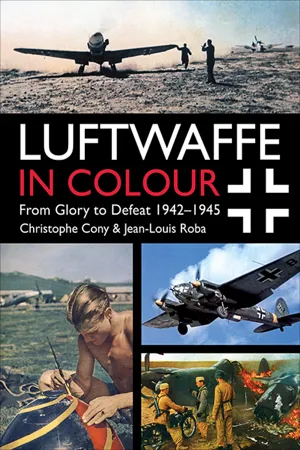
Nearly four hundred photos documenting the last years of the Luftwaffe: "If you're interested in unit history then this book is a must have" (
Britmodeller.com).
A companion to the first volume of
Luftwaffe in Colour, which covered the victory years from 1939 to Spring 1942, this book contains even more fascinating material on the machines of the Luftwaffe and the men who flew them as their fate took an increasingly grim path.
Initially, the Luftwaffe ruled the skies, but eventually, they fought an increasingly futile war of attrition that, when combined with vital strategic mistakes in aircraft production, was its death knell. Despite this, the Luftwaffe produced the most successful air aces of all time. Among many remarkable images, we see one of the last Junkers 87 B-2 operational on the Eastern Front during the winter of 1942-1943; the huge BV 222 V-5 of Lufttransportstaffel in the port of Heraklion in late 1942; pilots in Tunisia in 1943; the aces Hans Philipp, Wolfgang Späte, and Heinz Schnaufer; and a vivid demonstration of the reversal in fortunes in 1944 as Allied bombers destroy 106 sites, engulfing them in fire at Schwäbisch Hall on German soil.
In this painstakingly curated collection, the full detail behind the propaganda is once more revealed in rare color photographs.
- 160 pages
- English
- ePUB (mobile friendly)
- Available on iOS & Android
eBook - ePub
Luftwaffe in Colour: From Glory to Defeat 1942–1945
About this book
Information
Part X
Face-to-Face with the Soviet Steamroller
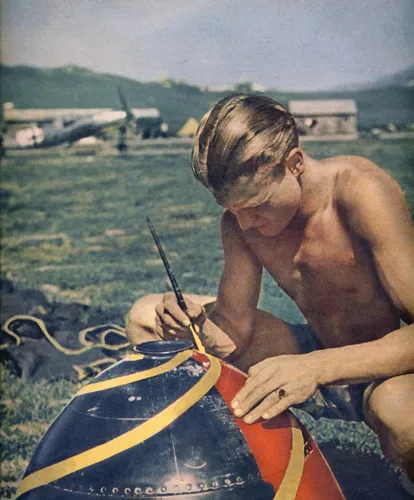
A mechanic paints a spiral onto the nose cone of a “Friedrich” in early spring 1942. The plane visible in the background – possibly from 2./JG 3 – has been given a yellow engine cowling.
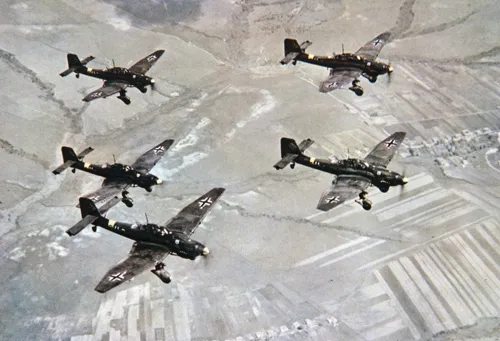
1942 saw the introduction of the first line of an improved version of the Stuka, the Ju 87 D “Dora”, equipped with a more powerful and higher-spec Jumo 211 J engine (1,400hp). These Ju 87 D-1s of 7./St.G 1 are flying over the Dnieper region in the summer of 1942, led by J9+AR that has the back of its wheel fairings painted yellow. (Jacques Moulin collection)
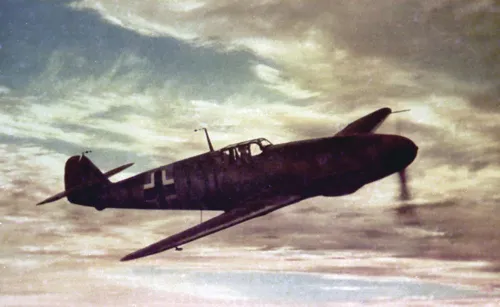
A Jagdgeschwader 54 Friedrich in flight at sunset.
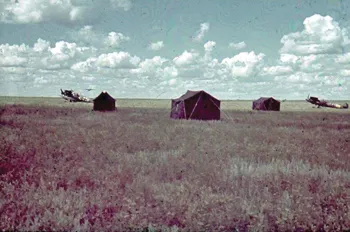
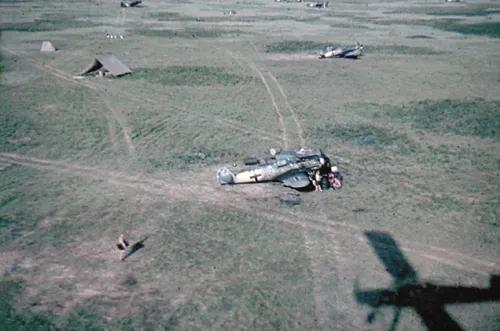
Two views of Bf 109 F-4s of I./JG 3 being overflown by a Fieseler Storch at Rogan, near Kharkov, around June 1942. The terrain is indicative of the vastness of the Ukrainian steppe.
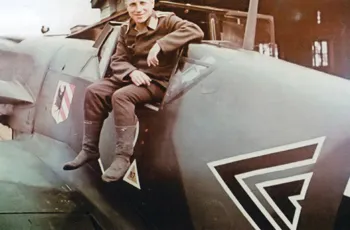
Krasnogwardeisk, June 1942: this I./JG 54 mechanic proudly poses in Bf 109 F-4 <<, which belongs to his commander, Hptm Hans Philipp.
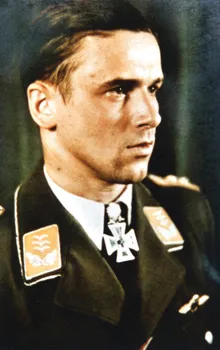
“Fips” Philipp claimed his 100th confirmed kill on June 6th, 1942.
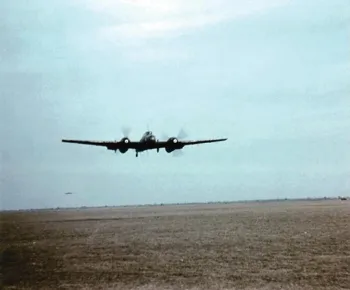
Two Messerschmitt Bf 100s of 7.(H)/LG 2 operating in support of the 6. Armee fly over the countryside near Stalino (Donetsk) in spring 1942.
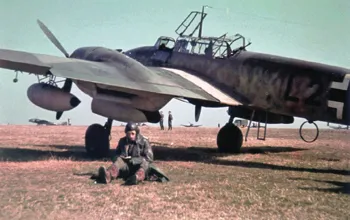
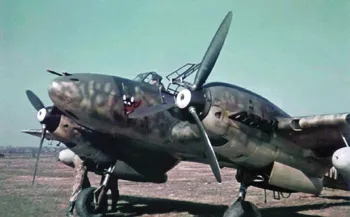
A 7.(H)/LG pilot 2 consults his logbook while mechanics put the finishing touches to his Bf 110 C-5 L2+MR, which is already equipped with 300-litre drop tanks. The squadron’s motif, a magnificent laughing devil, is clearly visible on the nose of the aircraft.
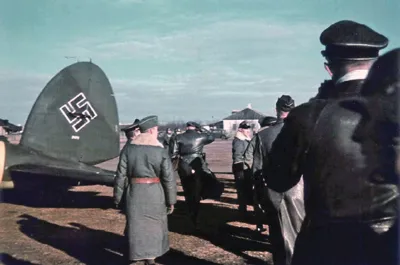
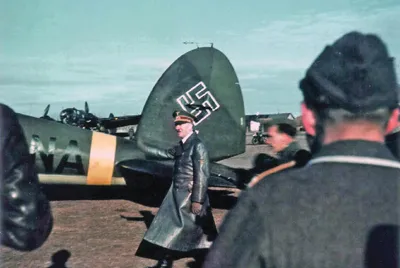
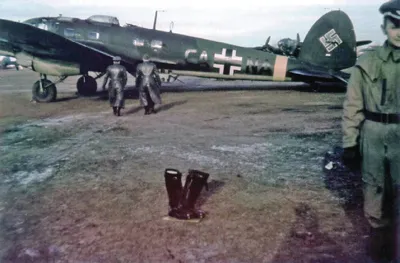
Adolf Hitler visits a muddy airfield, perhaps at Stalino, in the southern sector of the Eastern Front in the spring of 1942. The Führer is seen here next to Heinkel 111 P-2 CA+N (W.Nr. 2741) of his personal squadron, the Fliegerstaffel des Führers. After entering service in October 1938 as D-ADNH, this plane received the stammkennzeichen CA+NA in February 1941. It served in the F.d.F. until at least August 1944. The boots in the foreground of the bottom photo are those of an officer who offered them to the Führer so that the latter would not get his own dirty. Hitler politely declined the offer on his arrival, but used them on the return flight, the cabin of a Heinkel He 111 being completely open to the elements.
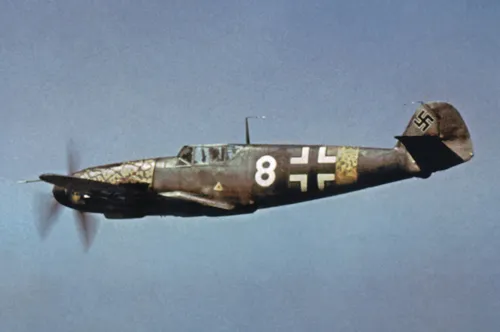
Bf 109 F-4 “White 8” of I./JG 52 in the Kharkov sector, June 1942. The yellow markings of the Eastern Front have been overlaid with green on the engine cowling and fuselage band.
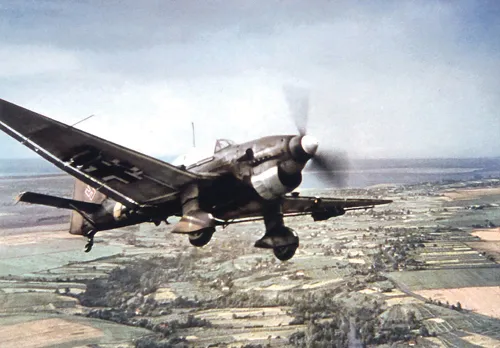
A Ju 87 B-2 gaining altitude above the Soviet plains in spring 1942. (Jacques Moulin collection)
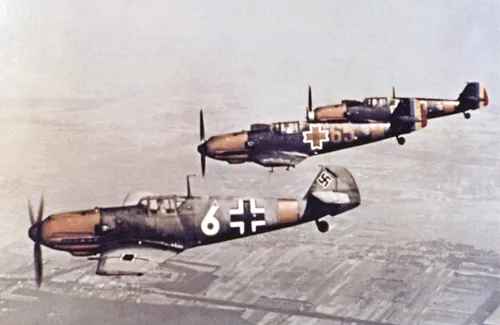
Much farther to the south-west, it was also necessary to maintain an aerial presence, as demonstrated by these three “Emils” in flight near Mizil in late spring 1942. In the foreground E-4 or E-7 “White 6” of the Ölschutzstaffel Ploesti, a Luftwaffe squadron dedicated to the defence of the Romanian oil refineries, is followed by two Bf 109 E-7s of the Romanian Grupul 7 – W.Nr. 1363 “Yellow 65” and W.Nr. 1482 “Yellow 63”. It is notable that the Germans and the Romanians used the same bright orange paint for their codes and markings – a far cry from the standard Luftwaffe RLM 04 yellow.
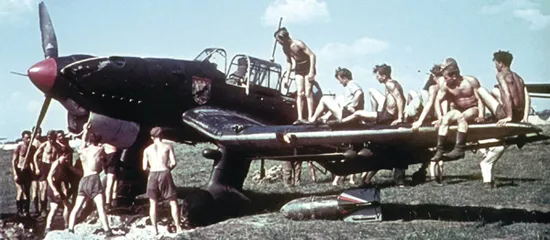
Mechanics struggle to unload this Ju 87 B-1 of 5./St.G 77 based in Ukraine, June–July 1942. The 250kg bomb this plane normally carries has been removed, but it still has four 50kg projectiles attached under its wings.
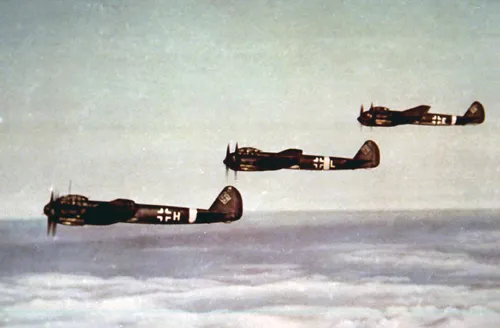
Three Ju 88 A-4s in formation in the southern sector of the Eastern Front. These bombers come from the 3rd squadron of an unidentified group; unfortunately, most of the markings on these planes have been censored.
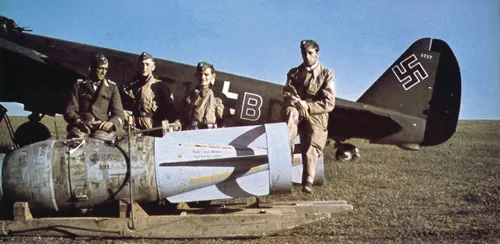
A Ju 88 A-4 of Stab III./KG 76 photographed in mid-1942 on the Crimean steppes. The crew of W.Nr. 5757 F1+BD pose here with a one-ton SC 1,000 bomb. The brand-new plane (delivered in April–May 1942) became F1+BR in 7./KG 76. It was 40% damaged when its engine failed on July 2nd outside Kitay, near Sarabouz. Repaired, it was then transferred to 8./KG 1 where it was involved in a minor accident whilst taxiing at Dno on April 17th, 1943. This plane ended its career as a “flying bomb” in 1945 (see story in the final chapter). (Private collection)
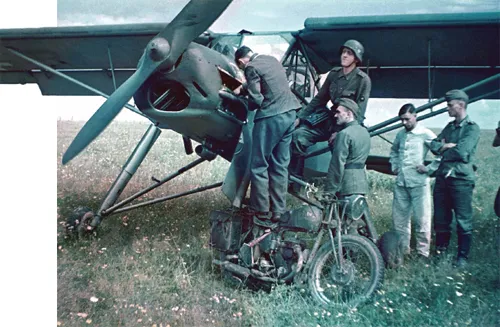
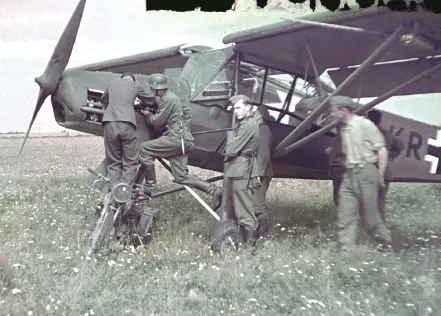
Two shots of Fi 156 C-3 KR+QZ (W.Nr. 5505), which had to land in a field on the Eastern Front in spring 1942 due to engine problems. A passing motorcyclist (riding a captured British BSA M20) stopped to give the mechanic a hand. This Storch appears to have belonged to a medical evacuation unit (Sanitäts-Flugbereitschaft), though the insignia that can just be made out on the cowling is very similar to that of I./JG 54.
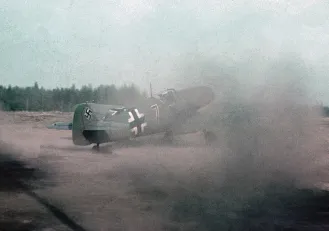
At the end of spring 1942, a small German naval force was deployed to Lake La...
Table of contents
- Cover
- Title
- Copyright
- CONTENTS
- INTRODUCTION
- PART X Face-to-Face with the Soviet Steamroller
- PART XI The Mediterranean Front
- PART XII The West: From One Landing to the Next
- PART XIII Second Line and Training Units
- PART XIV The Eagle Falls
Trusted by 375,005 students
Access to over 1.5 million titles for a fair monthly price.
Study more efficiently using our study tools.
Frequently asked questions
Yes, you can cancel anytime from the Subscription tab in your account settings on the Perlego website. Your subscription will stay active until the end of your current billing period. Learn how to cancel your subscription
No, books cannot be downloaded as external files, such as PDFs, for use outside of Perlego. However, you can download books within the Perlego app for offline reading on mobile or tablet. Learn how to download books offline
Perlego offers two plans: Essential and Complete
- Essential is ideal for learners and professionals who enjoy exploring a wide range of subjects. Access the Essential Library with 800,000+ trusted titles and best-sellers across business, personal growth, and the humanities. Includes unlimited reading time and Standard Read Aloud voice.
- Complete: Perfect for advanced learners and researchers needing full, unrestricted access. Unlock 1.5M+ books across hundreds of subjects, including academic and specialized titles. The Complete Plan also includes advanced features like Premium Read Aloud and Research Assistant.
We are an online textbook subscription service, where you can get access to an entire online library for less than the price of a single book per month. With over 1.5 million books across 990+ topics, we’ve got you covered! Learn about our mission
Look out for the read-aloud symbol on your next book to see if you can listen to it. The read-aloud tool reads text aloud for you, highlighting the text as it is being read. You can pause it, speed it up and slow it down. Learn more about Read Aloud
Yes! You can use the Perlego app on both iOS and Android devices to read anytime, anywhere — even offline. Perfect for commutes or when you’re on the go.
Please note we cannot support devices running on iOS 13 and Android 7 or earlier. Learn more about using the app
Please note we cannot support devices running on iOS 13 and Android 7 or earlier. Learn more about using the app
Yes, you can access Luftwaffe in Colour: From Glory to Defeat 1942–1945 by Christophe Cony,Jean-Louis Roba in PDF and/or ePUB format, as well as other popular books in History & German History. We have over 1.5 million books available in our catalogue for you to explore.