The untold story of US Special Forces in Laos, one of the longest secret wars of the Cold War—by a military historian and Special Forces veteran.
The Secret War in Laos was one of the first "long wars" fought by US Special Forces, spanning a period of about thirteen years. It was one of the largest CIA-paramilitary operations of the time, kept out of the view of the American public until now.
Between 1959 and 1974, Green Berets were covertly deployed to Laos during the Laotian Civil War to prevent the Communist Pathet Lao from taking over the country. Operators disguised as civilians and answering only to "Mister," were delivered to the country by Air America, where they reported to the US Ambassador. With limited resources, they faced a country in chaos. Maps had large blank areas. and essential supplies often didn't arrive at all. In challenging tropical conditions, they trained and undertook combat advisory duties with the Royal Lao Government.
Shrouded in secrecy until the 1990s, this was one of the first major applications of special warfare doctrine. Now, the story is comprehensively told for the first time using official archival documents and interviews with veterans.
eBook - ePub
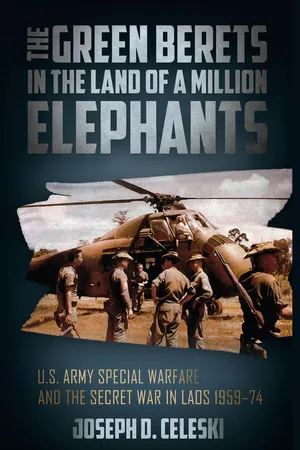
The Green Berets in the Land of a Million Elephants
U.S. Army Special Warfare and the Secret War in Laos 1959–74
- 400 pages
- English
- ePUB (mobile friendly)
- Available on iOS & Android
eBook - ePub
The Green Berets in the Land of a Million Elephants
U.S. Army Special Warfare and the Secret War in Laos 1959–74
About this book
Information
PART I
BACKGROUND
CHAPTER ONE
Fighting in the Land of a Million Elephants
“The Vietnamese plant rice, the Cambodians watch it grow, and the Lao listen to it grow.”COLONIAL FRENCH SAYING ON THE CULTURE OF THE LAO PEOPLE
The strategic success or failure of the use of force is dictated by many variables. A military strategy aligned with achieving policy objectives is highly important. Applying force in the correct way, and choosing the forces with the most utility, follows. However, there are other variables to take into consideration to ensure the maximum performance of military force. At the tactical level, this review is accomplished through a commander’s estimate of the situation. At the operational and strategic level, the review is known as the conduct of a strategic appreciation.
In limited war, such as insurgency and counterinsurgency (COIN), the variables change. Key terrain may not be the holding of a major river crossing, but rather a village astride a mountain pass. Insurgencies and the conduct of COIN often take place in rugged, inaccessible terrain, precisely used to negate the strengths of the government forces. Depending on where the conflict might occur, a commander must take into account the effects of weather and seasonal patterns which can dictate the tempo and style of fighting in a larger way.
Human variables which dictate the style of fighting come to the forefront. Insurgency and COIN are fought on human terrain and in the minds and psyche of the populace. Legitimacy of the government in the eyes of the populace may be more strategically important than holding terrain. An understanding of culture, religion, and belief systems becomes just as important as knowing the enemy order of battle, and are often factors affecting the morale of friendly forces and the populace.
The geography of a country and its infrastructure, or lack thereof, must be studied with an eye to seeking advantage as to the tempo and place combat is offered. Men must train to operate in rugged terrain and military equipment may need retooling to operate in such environments.
All countries excel or suffer as a result of their geographical position on the map and from the historical events which impact their national existence. At the top of this pyramid is the relative nature of a country’s economy, accessibility, national resources and the geostrategic pressures from its neighbors. Some adjacent countries, for instance, offer sanctuary to guerrillas.
Laos had all of these variables, much to the detriment of the ability to fight an effective war. An astute commander of either side would play to these strengths and weaknesses to jockey for advantage. The tangible and intangible variables dictated the art and style of fighting in this Southeast Asian country and how the militaries of the countries involved were utilized.
In ancient times the region of Laos was known as the Kingdom of Lang Xang (Land of a Million Elephants and the White Parasol). The kingdom was served ably by a succession of kings until around the mid-16th century when political power struggles and regional wars resulted in the division of Laos into three governing areas—effectually turning Laos into a backwater. In the latter half of the 1800s, the French, seeking colonial expansion and economic opportunities, arrived in the region and ultimately conquered Laos. The country was subsequently used as a buffer zone between British interests in Thailand and Burma against French holdings in Indochina. Through gunboat diplomacy, the French were able to reunify the three separated areas of Laos in the early 1900s.1
During World War II, the Japanese successfully conquered Laos and evicted the French. After the Japanese surrender in 1945, the Japanese assisted separatist movements to officially declare Laotian independence from France. To support this effort, Prince Phetsarath of the royal family formed an opposition movement to the reimposition of French control. Prince Phetsarath was helped by his two brothers: Prince Souvanna Phouma and Prince Souphanouvong.
However, the Western powers abetted France reclaiming Laos. This resulted in increased political opposition to the move and the resultant rise and formation of a resistance movement, the Lao Issara (Free Laos), the same movement supported by the OSS to resist the Japanese.
By September of 1946, the French once again controlled and dominated the country, forcing the three brothers into exile, taking with them their political philosophies to replace the French:
• Phetsarath dictated a military clash with the French
• Souvanna Phouma wanted to retake Laos with a legitimate political process
• Souphanouvong aligned with the communist Viet Minh
Souvanna Phouma eventually won over the debate and, through the political process, became the prime minister.
The Lead-up to War
There were three main causes for the secret war in Laos: (1) the disagreement of the three brothers on which style of government best suited the country, (2) communist expansion, and (3) superpower manipulation of the differing factions, to include sponsorship of proxy war inside the country.
In 1950, the French established Vietnam, Laos, and Cambodia as “associated” states within a French Union. As the communist threat grew within the French Union, the United States began military aid to the French to help stop its spread. The United States and France signed the Pentalateral Mutual Defense Assistance Act and by 1952 the United States was paying for one-third of the French war costs.
Frustrated at the continuing presence of the French in Laos, Souphanouvong convened a revolutionary congress on the Plaine des Jarres and formed a resistance government. The new congress formed for war and established their political arm, the Lao Patriotic Front, and an action arm, later to be named the Pathet Lao.
The Pathet Lao Communist Resistance Front (action arm) formed with the assistance of the Viet Minh to defeat the French and Royal Laotian Government’s (RLG) allies. It was headed by The Resistance Committee of Eastern Laos with Prince Soupannavong accepted as its nominal leader. The first twenty-five-man guerrilla force was formed in January of 1949—recruits were from the hill tribes, including the Tai and Hmong.
In 1950, over 150 members of the movement met with Ho Chi Minh and the organization renamed themselves the Neo Lao Issara (Free Lao Front) with its armed wing incorporating the Pathet Lao. They adopted a Maoist people’s revolutionary war strategy and began the first phase of the strategy, guerrilla warfare. The Viet Minh, as well as China and Russia, supplied and supported the Pathet Lao.2
In response, the French deployed one colonial battalion per province. With French training to raise a Lao military force, the first two 600-man battalions of the Royal Laotian Government—formed by the Mission Militaire Française (MMF)—were raised and employed as bataillons d’infanterie laotienne (BILs, the 1st and 2nd). In 1951, with the addition of two infantry battalions and one parachute battalion, the Laotian government’s total military manpower was about five thousand. Owing to U.S. military aid, the number of battalions increased and were provided with American arms and equipment; moreover, additional counterinsurgency units were formed to expand the capabilities and number of government security forces. For example, the paramilitary forces known as Garde Nationale, consisting of 170-man companies of peasant militias, were formed. COIN light infantry battalions were also formed along with units known as Mixed Airborne Commando Groups (GCMAs).3
In 1953 four infantry divisions of the Viet Minh, along with the Pathet Lao led by Prince Souphanouvong, tried to capture Luang Prabang—a regional, historic governmental center and the home for the king—and were successful in seizing the PDJ from the French/Laotian military forces. They were also successful in capturing the province of Sam Neua where they immediately established a rebel government. To assist in the fight to recapture this vital area, the CIA’s Civil Air Transport (CAT) subsidiary asset assisted the French from May to June 1953 with C-119 paradrops. CAT was later to become “Air America.”
In 1954 the Viet Minh defeated French forces at the battle of Dien Bien Phu, changing the security dynamic in the region. The Geneva conference of May 1954 split Vietnam into North and South, while Laos was declared independent and neutral. A ceasefire was implemented in Laos in August of 1954 to remove foreign troops and to demobilize and integrate Pathet Lao forces into the government’s military forces.
The Geneva Conference and Agreement of 1954 spelled out the new security arrangement for the country of Laos. Two of the key provisions were:
• Prohibiting introduction into Laos of foreign or regular troops, or irregular troops, foreign paramilitaries, or foreign military personnel
• Prohibiting introduction into Laos of armaments, munitions, and war material, except for conventional items necessary for the Royal Government of Laos to defend itself
In response, U.S. policy objectives, which began during the Eisenhower administration, were to maintain a pro-United States country, secure freedom from communism, disrupt the flow of communist supplies, and adhere to the spirit of the Geneva accords. The U.S. strategy consisted of a political warfare covert operation (POLWAR), using clandestine interagency assets and unconventional warfare (UW) with special operations forces as needed, combined with the conduct of foreign internal defense (FID) and security assistance (SA) programs. President Eisenhower also acted to counteract subversive communist activities still ongoing throughout the region by increasing aid to Thailand and South Vietnam. The diplomatic response to the growing communist threat created a new security organization, the Southeast Asia Treaty Organization (SEATO).
With the many restrictions of the Geneva protocols to the Agreement, the priority of effort was focused on Thailand as the bulwark against aggression, starting with foreign aid programs, and then with military aid programs to follow. The U.S. military established a Military Advisory Assistance Group (MAAG Thailand).
Even with reduced foreign military assistance, the Royal Laotian Army—the Armée Nationale Laotienne (ANL) until 1959—was able to continue building in strength with up to 25,000 troops. Laotians, now weakened by the Geneva restrictions, sought a compromise to reduce the threat and worked out agreements with the Pathet Lao to form a coalition government. The Pathet Lao were also affected by the Geneva restrictions and could not win without North Vietnamese support. As a result, in September of 1954 a leftist government was formed with hopes of attracting the Pathet Lao to lay down their arms and participate in the political process.
There was still a small loophole for the U.S. to operate, however; the provision of military aid could continue due to the allowance in the Geneva agreements, “except for conventional items necessary for the Royal Government of Laos to defend itself.” Consequently, U.S. Ambassador Charles W. Yost, arrived in Laos to establish the U.S. Operations Mission (USOM) and started the process to provide “conventional” aid and military funding, along with continued French military support.
With the Geneva restrictions preventing additional foreign military forces operating in Laos, a program evaluations office (PEO) was established within the USAID section of the embassy instead of a MAAG-type organization, to work around the restrictions. Most of the PEO staff were retired military personnel who began to work through and with the French Military Mission (FMM). John Prados described the PEO:
One special feature of the United States’ operating mission in Laos was that military representation was not restricted to the attaché. There was a military advisory group in all but name, headed by a United States general officer. In deference to the Geneva Agreement, the advisory group was called a Programs Evaluation Office (PEO) and had the ostensible task of monitoring the effects of American Programs in the country. The PEO had its beginnings in December 1955, with the installation of a six-man staff at Vientiane. By early 1956, PEO was dispatching small teams of advisors to RLAF units, usually with Thai interpreters who translated English to Lao.4
After the national elections in 1958, the Pathet Lao gained enough political power to be included into the coalition government, alarming the United States, which subsequently halted U.S. economic aid to the new government as a sign of its displeasure. (This practice, known as coercive diplomacy, is a tool commonly used in political warfare.) A mini-coup by the Laotian Congress and other influential leaders ousted Prime Minister Souvanna and the Pathet Lao representatives, resulting in the formation of a new government which was anti-communist and pro-West. The Pathet Lao were enraged, and resumed their attacks on the government. Souphanouvong and the ringleaders of the revolt were jailed but later escaped to conduct a civil war and resume armed action.
In 1958 Brigadier General John A. Heintges provided the U.S. government a study and assessment on the security situation in Laos. His dire report resulted in an increased role for the PEO to add more military trainers and advisors to assist the Laotian government security forces. To circumvent the restrictions of the Geneva Agreement the Eastern Construction Company in Laos (ECCOIL) was formed as a front company to increase combat advisors. It was manned by ex-Filipino military personnel trained in COIN by the United States, as a result of Ed Lansdale’s brilliant work to assist the Philippine government to contain the Hukbalahap insurgency. There were also uniformed officers of the U.S. Army, majors and lieutenant colonels, who served in each military region as advisors from the PEO.
The Geopolitical Situation
The geopolitical situation in Laos was framed by three regional competing interests, the first being the American position to prevent the spread of communism in Southeast Asia. The second major geopolitical interest was China’s position to prevent foreign military forces and bases from being introduced into Laos. Although the Chinese never overtly intervened in Laotian affairs to any great extent, the threat of action by China dictated to some extent the level of American effort to assist Laos. What would be the trigger point to encourage a Chinese intervention?
The third competing interest was North Vietnamese attempts to conduct a war to reunify the two Vietnams, split as a result of the Geneva agreements. This required securing their flank in Laos and establishing a logistical route to support communist forces in South Vietnam—the Ho Chi Minh Trail. No country wants an enemy at their border. It was inevitable t...
Table of contents
- Cover
- Title
- Copyright
- Dedication
- Contents
- Foreword
- Acknowledgements
- Introduction: Army Special Warfare and the War in Laos
- Part I: Background
- Part II: American Military Assistance
- Part III: Operation White Star: Green Berets At War
- Part IV: U.S. Army Special Forces in Laos 1966–1974
- Epilogue: Legacy and Lessons Learned
- Endnotes
- Glossary
- Selected Bibliography
- Plate section
Trusted by 375,005 students
Access to over 1.5 million titles for a fair monthly price.
Study more efficiently using our study tools.
Frequently asked questions
Yes, you can cancel anytime from the Subscription tab in your account settings on the Perlego website. Your subscription will stay active until the end of your current billing period. Learn how to cancel your subscription
No, books cannot be downloaded as external files, such as PDFs, for use outside of Perlego. However, you can download books within the Perlego app for offline reading on mobile or tablet. Learn how to download books offline
Perlego offers two plans: Essential and Complete
- Essential is ideal for learners and professionals who enjoy exploring a wide range of subjects. Access the Essential Library with 800,000+ trusted titles and best-sellers across business, personal growth, and the humanities. Includes unlimited reading time and Standard Read Aloud voice.
- Complete: Perfect for advanced learners and researchers needing full, unrestricted access. Unlock 1.5M+ books across hundreds of subjects, including academic and specialized titles. The Complete Plan also includes advanced features like Premium Read Aloud and Research Assistant.
We are an online textbook subscription service, where you can get access to an entire online library for less than the price of a single book per month. With over 1.5 million books across 990+ topics, we’ve got you covered! Learn about our mission
Look out for the read-aloud symbol on your next book to see if you can listen to it. The read-aloud tool reads text aloud for you, highlighting the text as it is being read. You can pause it, speed it up and slow it down. Learn more about Read Aloud
Yes! You can use the Perlego app on both iOS and Android devices to read anytime, anywhere — even offline. Perfect for commutes or when you’re on the go.
Please note we cannot support devices running on iOS 13 and Android 7 or earlier. Learn more about using the app
Please note we cannot support devices running on iOS 13 and Android 7 or earlier. Learn more about using the app
Yes, you can access The Green Berets in the Land of a Million Elephants by Joseph D. Celeski in PDF and/or ePUB format, as well as other popular books in History & Asian History. We have over 1.5 million books available in our catalogue for you to explore.