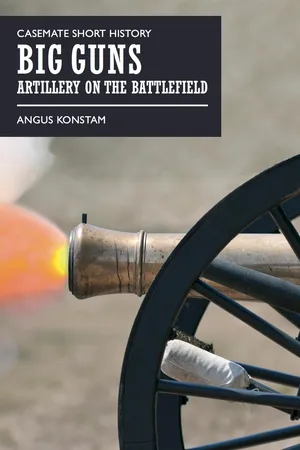
A concise, illustrated introduction to artillery from medieval times to the modern era.
Over seven centuries, the artillery piece has evolved from a status symbol to one of the most deadly weapons wielded by man. Using gunpowder weapons was initially something of a black art, but over time, gunnery became a science, a dependable method of breaching fortifications or overcoming an enemy on the battlefield.
By the nineteenth century, most European armies had artillery units manned with trained gunners; Napoleon, originally an artillery officer, then took the use of artillery to a new level. Over the following decades, rapid advances in gun technology paved the way for the devastatingly powerful heavy artillery that literally transformed the landscape during World War I. The use of rolling and box barrages shaped how armies fought on the front lines, and powerful naval guns dictated the outcome of battles at sea.
By World War II, the range of artillery had expanded to include self-propelled guns and powerful antitank and antiaircraft guns. In this informative introduction, historian Angus Konstam concisely explains how the development and evolving deployment of artillery led to big guns becoming the key to victory in two world wars and a potent force on the modern battlefield.
- 160 pages
- English
- ePUB (mobile friendly)
- Available on iOS & Android
eBook - ePub
About this book
Information
CHAPTER 1

MEDIEVAL ORIGINS
14th–15th centuries
WE ALL KNOW THAT ARTILLERY CAME to be a battle-winning weapon – ‘the queen of the battlefield’ or ‘the god of war’. This though is a modern idea, born a century ago amid the blood and carnage of World War I, when hundreds of guns pulverised enemy trench lines before the infantry went ‘over the top’. Even then it was a notion more than 600 years in the making. When artillery first made its appearance it was seen as little more than a novelty – a toy for princes to play with. Back then, those who created and fired these strange new weapons were seen as practitioners of a ‘black art’, not unlike alchemy, medicine, and witchcraft. Everything though, has to start somewhere, and artillery quickly emerged from its misty origins to become first a reliable military weapon, and then a crucial part of any self-respecting army. This journey was a tricky one, with more than a few wrong turnings along the way. Even today historians disagree where the road actually began. What follows is the most commonly agreed version of the way artillery was first invented, and how it developed.
The first guns
In September 1325, at Altopascio in Tuscany, the Florentine army was soundly defeated on the battlefield. The Florentines dug deep into their coffers to raise and equip another force to defend the city, and the ledgers listing this great outlay still survive. Hidden in one dated 1326 is an entry that shows that medieval Florence was at the cutting edge of military technology. It records the appointment of gunfounders, hired to produce bronze guns for the Florentine arsenal, together with the iron balls and arrows for them to fire. This is the earliest written evidence for the use of artillery in Europe.
This confusing reference to arrows is easily explained thanks to a pair of English illuminated manuscripts. They were produced in 1327 by Walter de Milemete, the chaplain to King Edward III. Both of their illustrations show small bulbous guns shaped like a vase, sitting on a trestle table. In the manuscripts they were described as a pot de fer (iron pot). In each picture, a mail-clad gunner is shown firing the weapon by applying a piece of burning rope or even a red-hot poker to a small touchhole. From the mouths of these guns a large harpoon-like arrow can be seen. Halfway down its shaft a ball of rope or cloth was wrapped round it, to hold the arrow firmly in the pot, and to seal the mouth of the gun. Clearly this was the projectile, waiting to be fired by the gun at the enemy. These medieval illustrations show some of the world’s first ever pieces of artillery. Crude though they were, these guns, and those that followed them, would transform the face of warfare.
They were fired using gunpowder. This is a combination of three ingredients – saltpetre (or potassium nitrate), charcoal, and sulphur. While the recipe changed with the telling, the ratio used to make modern ‘black powder’ for fireworks or the firing of replica weapons is roughly seven parts of saltpetre to one part of the others (7-1-1). The saltpetre acts as an oxidising agent, while the other two are forms of fuel. The combination is a volatile explosive mixture, which burns extremely quickly when set alight. As it does so it generates a large amount of heat, light, and gas. Someone then had the idea of compressing this gunpowder into a small open-ended metal chamber, then setting it alight. They discovered the explosive blast was directed out of the open end of the chamber. By plugging the open end with a projectile, they found this was blasted out with shocking force. This metal chamber therefore became the first gun.

A pot de fer (early artillery piece), an illustration from the illuminated manuscript by Walter de Milmete entitled De nobilitatibus sapientii et prudentiis regum, c.1326. (Stratford Archive)
Oriental origins
Quite where guns and gunpowder were invented remains a mystery. In the 19th century some historians claimed that gunpowder weapons were first invented in antiquity, citing a passage written by the Roman historian Livy that mentioned a machine invented by Archimedes which ‘with a terrible noise did shoot forth great bullets of stone’. Similarly, a much earlier Sanskrit code of laws suggested that the Indians of pre-history used gunpowder weapons. Both of these, and other similar claims have long since been discredited. They referred to mechanical weapons, not firearms, and a combination of poor translation work by antiquarians and a lack of understanding about old projectile weapons led to the confusion.
Much more credence can be given to the claim that the Chinese were the inventors of gunpowder weapons. As early as AD 940, Chinese chronicles describe the use of ‘fire lances’ in battle. Most historians now believe these were probably a form of flamethrower, fixed to the end of a bamboo pole – one that used gunpowder to work. Effectively, these fire lances were the forerunners of the modern firearm. In 1044 an even clearer description of them is found in a manuscript which speaks about explosive fire lances. Soon imperial workshops were created, solely to produce gunpowder weapons for the state, while the production of gunpowder was also a state-run industry. Clearly the Chinese were leading the world when it came to firearms.
Chinese used larger gunpowder weapons too. In the 11th century, Chinese weapons described as large ‘eruptors’ were used to launch projectiles at the enemy, ‘capable of killing a man or horse’, and could even ‘transfix several persons at once’. While there is no clear reference to guns or gunpowder here, it was obvious this was what they meant. By that time the Chinese were mining potassium nitrate in near-industrial quantities from the caves in the Laojun Shan Mountains, in Sichuan province. Eleven gun foundries in Liao Dynasty China were kept busy creating weapons that would transform the Imperial Chinese army, while in 1067 – the year after the battle of Hastings – the Liao Emperor Daozong prohibited the export of saltpetre and sulphur. The Liao Dynasty wanted to keep this new technology out of the hands of both rebels and the barbarians beyond the Great Wall.
Relief carvings in Sichuan dating from the mid-11th century show the use of both fire lances and rocket-launched arrows. By the 12th century larger gunpowder weapons were being used by the Jin Dynasty against Chinese rebels, while in 1232 the armies of the Emperor Aizong used artillery to recapture cities during their doomed counter-offensive against the Mongols. Following the overthrow of the last Jin emperor and the seizure of the Imperial throne by Ogedai Khan (son of Genghis Khan), the Mongols gained access to this new technology, and the weapons that came with it. The Mongols probably used gunpowder weapons during their later campaigns in Europe. While these may have been limited to flaming arrows and naphtha bombs, some claim that it was the Mongols who first introduced gunpowder to Europe.
Of course, flamethrowers and naphtha weren’t new to the west. The Byzantine navy had used the flamethrower known as Greek fire in the 7th century AD, while in the mid-14th century, at the time of the Mongol invasions, Muslim troops were using naphtha weapons against the Crusaders. These were fire weapons though, rather than explosive ones. If the Mongols had indeed used gunpowder weapons against the Hungarians at the battle of Mohi (1241), then this could have been the first use of this Chinese technology in Europe. Certainly, despite the attempts of the Mongol emperors to limit the spread of gunpowder the Koreans were using it by the start of the 14th century, while in the same century gunpowder weapons were being produced in the Arabian peninsula. This diffusion of technology is reasonably evident from the historical record. What remains unclear though, is how and when the use of gunpowder first developed in Europe.
Introduction into Europe
Certainly the English Franciscan monk Roger Bacon (c. 1219–92) knew about gunpowder in 1267, as he described it in his Opus Majus (Greater Work), which he presented to Pope Clement IV. It has been suggested that the Oxford-based academic encountered it from another Franciscan, who brought a sample back from his travels in the Mongol Empire. Others suggest Bacon created the mixture of saltpetre, charcoal and sulphur himself, and tested it with explosive effect. Claims that Bacon produced a gunpowder recipe have proved misleading, as the proportions he recorded in cypher would have been virtually non-combustible. Still, it was clear he knew of gunpowder’s dramatic properties. Wherever its origins, it was clear that gunpowder – if not gunpowder weapons – had reached Europe by the time Bacon wrote his book.
Claims that artillery was used by King Henry III of England during his campaign to restore royal authority in the 1260s are misleading, as the term encompassed siege engines, which fired solid spherical projectiles, or even incendiary ones. Even this use of incendiaries is unlikely. The Church disliked the idea of Christians waging war against each other when there were hordes of Muslims and Mongols to fight. So, to limit the scale of warfare it banned the use of such weapons within Europe. This might have temporarily curtailed experimentation with gunpowder, but it certainly didn’t stop it. Liber Ignium (Book of Fires), a collation of recipes for incendiary mixtures written around 1300 included notes on the gathering of saltpetre, and recipes to make gunpowder. The genie was out of the bottle.
The existence of the late 14th-century German monk Berthold Schwarz is doubtful, as no record of him exists. It is just as likely he was invented by later scholars to provide a Germanic origin for the development of gunpowder. By the time he was supposedly carrying out his alchemic experiments, guns and gunpowder had been in military use for almost half a century. That account of guns being used in Florence in 1325 was merely the first of a growing number of instances where gunpowder weapons appear in the historic record. It was claimed that guns were used by Germans at the siege of Metz (1324), and by the Moors at the siege of Baza near Grenada the following year, but no contemporary records survive. Jean Froissart’s Chronicles, written in the later 15th century, mention both ‘bombards’ and ‘cannon’ being used by the French at the siege of Le Quesnoi (1340), but in the contemporary French accounts these terms aren’t found – only the much more dramatic name tiaiux de tonnaire (tubes of thunder).
Then, in the accounts of the Flemish city of Bruges for 1339, there is a mention of a ribaudequin, which from Froissart we learn meant a light gun, three or four of which could be mounted together on a small cart, called a char de guerre (war cart). Then, at the battle of Crécy (1346), Edward III reputedly used a handful of pots de fer to help him win his battle against the French. They would have been of little tactical use, but he probably deployed them for their psychological impact rather than their potency. Next, in 1353, in the stores records of the Tower of London, is a mention of just such a group of royal guns. In Latin, the record states that four copper guns, 16 pounds of gunpowder and one copper mortar and iron pestle were stored there. In this period, ‘copper’ really means bronze. A further note claims that the guns were made by William of Aldgate, and cost 13 shillings and 4 pence apiece. Could these have been the very guns used by the king at Crécy?
These four guns were still there when the next inventory was made seven years later. However, by 1365 there were 11 bronze guns in the store, two of which were described as ‘large’. Clearly then, not all guns were the same. Despite the term pot de fer, only the projectile was iron – the pot itself appears to have been bronze. Both its shape and the need to contain the blast necessitated the use of this stronger metal. These small ribaudequins (ribaudekins) and pots de fer were only the start. Even larger bronze guns now made an appearance. How then, did these differ from the two French guns made by Ramundus Arquiero of Toulouse in the mid-14th century, described as ‘iron cannon’, and supplied with lead shot and leather-covered wedges? Guns were now appearing in a variety of sizes, and made from both bronze and iron. What did they look like?
The pot de fer was simply a vase-shaped container made from bronze, with a touchhole at the end. The mouth of the vase was around 2–3 inches (50–75 mm) in diameter, into which was placed the projectile – usually an iron arrow, bound with leather so it sat securely in the mouth – or muzzle. From a surviving example excavated at Losholt in Sweden we know that the base was thicker than the rest of the pot, to help absorb the blast. The whole thing was laid horizontally to fire, strapped to a table or trestle. Experiments have shown that the arrow could be fired with reasonable accuracy for a few hundred yards. However, the bang caused by the combustion of the gunpowder was impressively loud. This supports the notion that the pot’s main use was to strike fear into the enemy.
Ribaudequins were probably little bigger than later medieval handguns, but appear to have been made from iron. However, there is little hard evidence to base this on, apart from a surviving example from Perigord in southern France, which probably dates from the 15th century. It had a dozen barrels, which could be fired off in groups of three. Unlike the iron pot though, when mounted on wheeled carts these small gun batteries were fully mobile, which made them useful on the battlefield. Finally there were the larger guns – the cannons and bombards mentioned by Froissart, of the kind reportedly built by the contemporary gunfounder Arquiero of Toulouse. These though, were probably made using wrought iron. Bronze gunfounding technology was in its infancy in the 14th century, and was carried out by founders used to casting church bells rather than weapons of war. They had no knowledge of the power of gunpowder, unless they learned from trial and error, and survived the process.
Building large bronze guns was therefore problematic, unless they were little more than large versions of the pot de fer, like the two stored in the Tower of London in 1365. For big guns, iron was the material of choice. The way this was done was to build a barrel using wrought-iron bars with angled edges, like the staves of a barrel. These were grouped around a wooden core, until they formed the shape of a tube. White-hot wrought-iron hoops which were marginally wider than the tube were then hammered over the staves, until the tube was completely covered by them. As the metal cooled they would form an even tighter fit around the staves. So, when the wooden core was removed, what you were left with was a heavily reinforced iron tube, open at both ends. This became the barrel of the gun. This method was known as ‘hoop and stave’ construction.
There were two ways to turn this barrel into a weapon. One would make it a muzzle-loaded gun, the other a breech-loaded one. In the former, a thick cast-iron disc was inserted over one end of the tube, usually by plugging the end hole. This though, was a weak point in the design – if the gunpowder blast was too large, the end piece could be blown from the gun. This was a risk the builders were willing to take, as ballistic power imposed a constraint on the size of a breech-loading gun. A breech chamber sat at the end of the gun, and was held in place using wooden blocks and wedges, or by having its own slot in a wooden gun carriage. It contained the powder and shot, and when the charge was ignited the projectile would be blasted through the barrel towards the target.
The weak point of this design was the seal between the powder chamber and the barrel. If it wasn’t tight enough gas would leak out when the gun was fired, lessening the explosive power of the weapon. It was also dangerous if a gunner was caught unawares. The breech (or powder) chamber varied in size depending on the size of the gun. Small ones would be little bigger than a beer mug, forged from wrought iron. Larger ones needed four men to lift it into place. The larger the gun then the greater the likelihood of gas escaping through the breech. Larger still and the chamber would be too heavy to move. So, for the largest bombards, muzzle loading was the preferred option.
The great bombards
In 1375, Jehan le Mercier was ordered to build ‘a grand cannon of iron’ in Caen for the French crown. He hired three master smiths, who set about forging over a ton of wrought iron. The long staves were fused together by heating and hammering them, and then the heated rings were hammered in place. Rope was used to wrap the iron barrel, and then a skin of leather hide was stitched over the top, to make the whole thing weatherproof. As no mention is made of either an endpiece or a powder chamber, it is unclear whether this was a muzzle-loading or a breech-loading weapon, although its evident size suggests the former.

A late medieval ...
Table of contents
- Cover
- Title
- Copyright
- CONTENTS
- Introduction
- Timeline
- Chapter 1: Medieval Origins (14th–15th centuries)
- Chapter 2: The Renaissance (16th–17th centuries)
- Chapter 3: The Age of Reason (18th century)
- Chapter 4: The Wars of Napoleon (1792–1815)
- Chapter 5: The Industrial Age (1815–1914)
- Chapter 6: World War I (1914–1918)
- Chapter 7: World War II and After (1919–present)
Trusted by 375,005 students
Access to over 1.5 million titles for a fair monthly price.
Study more efficiently using our study tools.
Frequently asked questions
Yes, you can cancel anytime from the Subscription tab in your account settings on the Perlego website. Your subscription will stay active until the end of your current billing period. Learn how to cancel your subscription
No, books cannot be downloaded as external files, such as PDFs, for use outside of Perlego. However, you can download books within the Perlego app for offline reading on mobile or tablet. Learn how to download books offline
Perlego offers two plans: Essential and Complete
- Essential is ideal for learners and professionals who enjoy exploring a wide range of subjects. Access the Essential Library with 800,000+ trusted titles and best-sellers across business, personal growth, and the humanities. Includes unlimited reading time and Standard Read Aloud voice.
- Complete: Perfect for advanced learners and researchers needing full, unrestricted access. Unlock 1.5M+ books across hundreds of subjects, including academic and specialized titles. The Complete Plan also includes advanced features like Premium Read Aloud and Research Assistant.
We are an online textbook subscription service, where you can get access to an entire online library for less than the price of a single book per month. With over 1.5 million books across 990+ topics, we’ve got you covered! Learn about our mission
Look out for the read-aloud symbol on your next book to see if you can listen to it. The read-aloud tool reads text aloud for you, highlighting the text as it is being read. You can pause it, speed it up and slow it down. Learn more about Read Aloud
Yes! You can use the Perlego app on both iOS and Android devices to read anytime, anywhere — even offline. Perfect for commutes or when you’re on the go.
Please note we cannot support devices running on iOS 13 and Android 7 or earlier. Learn more about using the app
Please note we cannot support devices running on iOS 13 and Android 7 or earlier. Learn more about using the app
Yes, you can access Big Guns by Angus Konstam in PDF and/or ePUB format, as well as other popular books in History & Military & Maritime History. We have over 1.5 million books available in our catalogue for you to explore.