The account of these elite paratroopers' encounter with the Germans is "a story of raw courage in the face of seemingly impossible odds . . . a great read" (
World War II).
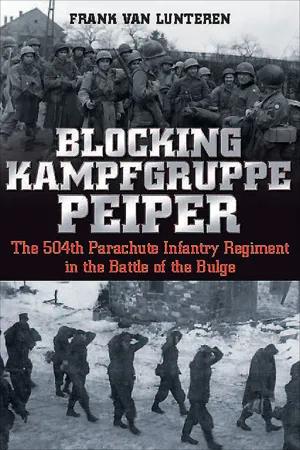
In December 1944, an enormous German army group crashed through the thin American line in the Ardennes forest. Caught by surprise, the Allies were initially only able to throw two divisions of paratroopers to buttress the collapse—the 82nd Airborne, which was rushed to the area of St. Vith, and the 101st, which was trucked to Bastogne.
After their successful campaign in Holland, Col. Reuben Tucker's elite 504th Parachute Infantry Regiment was resting and refitting in France when news came of the German breakthrough. Most dangerous to the Allies was the German spearhead of the 1st SS Panzer Division led by Jochen Peiper, which aimed to sever the Allied front. The 504th was committed to block the SS advance, and within forty-eight hours of their arrival, Col. Tucker's paratroopers were attacking the SS-Panzergrenadiers of Peiper's battlegroup, eventually forcing them to withdraw.
More ferocious fighting ensued as follow-up German units forced a US retreat from St. Vith. In adverse weather conditions against the German 9th SS Panzer and 3rd Fallschirmjäger Divisions, the 504th lived up to its regimental motto: Strike and Hold. Although some rifle companies were whittled down to less than fifty paratroopers, the Americans doggedly fought on until victory was achieved.
This work provides a fascinating, up-close view of the 504th PIR during the Battle of the Bulge, as well as its gallant sacrifice. Using never-before-published diaries, letters, battle reports, and interviews with over a hundred veterans, a comprehensive account is painted of a triumphant US regiment in one of the fiercest-fought campaigns in the history of the US Army.
eBook - ePub
Blocking Kampfgruppe Peiper
The 504th Parachute Infantry Regiment in the Battle of the Bulge
- 368 pages
- English
- ePUB (mobile friendly)
- Available on iOS & Android
eBook - ePub
Blocking Kampfgruppe Peiper
The 504th Parachute Infantry Regiment in the Battle of the Bulge
About this book
Information
CHAPTER 1
CAMP SISSONNE
SISSONNE, FRANCE, NOVEMBER 15–DECEMBER 15, 1944
SISSONNE, FRANCE, NOVEMBER 15–DECEMBER 15, 1944
While the 504th Regimental Combat Team [RCT] and the remainder of the 82nd Airborne Division [ABD] were still fighting in Holland and Germany, preparations had been made by Maj. Gen. Matthew B. Ridgway’s XVIII Airborne Corps Headquarters to install new base camps in the French towns of Sissonne and Soissons, some thirteen miles east of the city of Laon and twenty-six miles north of Reims. A number of recent jump school graduates of the Parachute School at Ashwell, along with some veteran paratroopers—both officers and enlisted men—of the 82nd Airborne Division who had not participated in Operation Market Garden were sent to France to prepare the camps.
Private First Class Hugh D. Wallis of H Company, who had recuperated from wounds received during the Waal Crossing, eagerly waited at Camp Sissonne for the remainder of the regiment to arrive from Holland, wondering who would return alive and well and who would not. Waiting with him were S/Sgt. Leroy M. Richmond, Pfc. Charles L. Zlamal, and his best friend, Pfc. Cletus J. Shelton, of H Company: “We had all come out of hospitals. We were waiting for our battalion to return from Holland.”3 Among the other returning veterans were S/Sgt. Ernest W. Parks of D Company and Sgt. Charles L. Peers of C Company, who had both missed the Holland Campaign due to wounds received on the Anzio Beachhead.
One of the recent jump graduates sent to Sissonne was 23-year-old Pfc. Edwin R. Bayley, born on November 25, 1921, in the small town of Canton, Maine: “My father was the principal of the small high school. I was raised in the town of Whitman, Massachusetts, about 20 miles southeast of Boston. It was from that town that I entered the army.”4 Bayley was inducted at Fort Devens, Massachusetts, and further trained at a chemical warfare training camp in Gadsen, Alabama. Here he was placed with a couple of other northerners in a company that was made up almost entirely of southerners, including the officers and cadre. Although it took a while to prevent a small-scale recurrence of the Civil War, the rifle range competition with .30 Springfield rifles helped establish both an esprit de corps and unit cohesion. Having played trumpet as a civilian, Private Bayley became one of the battalion buglers, spending each tour of guard duty in a guard house, leaving it only to blow the requisite calls several times a day.
After several weeks of infantry and specialized chemical training, including the use of smoke generators and handling hazardous chemicals, Bayley and some of his comrades were assigned to the Army Specialized Training Program [ASTP] and returned to college life. He opted to study Mechanical Engineering at the University of Florida, but his studies were interrupted when the government broke up the ASTP program in early 1944. The need for replacements for the European Theater of Operations exceeded the number of men in the infantry pool. Assigned to the 347th Infantry Regiment of the 87th Infantry Division in South Carolina, Bayley was one of thousands of young ASTP students assigned to an active outfit due to the shortage in manpower.
“It was a tremendous and abrupt change from a sheltered academic life in nice, warm, comfortable college dorms in a nice, comfortable climate,” Bayley recalled. “The reality of military life had returned. The time at Fort Jackson was spent in intensive infantry training. A great amount of firing-range time was spent on qualifying and familiarization with the M1 rifle, the .45 automatic and the carbine. I also qualified for the Browning Automatic Rifle [BAR]. We were trained in the use of bayonets, hand grenades, rifles and incendiary bombs, hand-to-hand combat, the laying of several types of mines and of barbed wire, and learned how to crawl for several hundred feet below barbed wire entanglements while under continuous machine-gun fire directed just over the top of the wire. If anyone stood up, he would have been cut to pieces by the bullets.
“In August, when the company returned from several days of field manoeuvres, we found that our company had grown to nearly double its normal size. We thought that we were being reinforced prior to going overseas as a unit for combat. We were shocked to learn that the new personnel had completed a very short training schedule and in reality were practically raw recruits. Then we found out what was happening. Congress had promised the mothers of the boys in the States that their 18-year-old sons would not be shipped overseas to combat, unless they were a member of a combat division or regiment, so they moved all these young kids in, the 18-year-olds, and at the same time they moved us old guys to a general replacement depot at Fort Meade, near Washington D.C. The big day finally came when names were called out for shipping rosters to Camp Kilmer, New Jersey, the port of embarkation. At that point we knew we were probably headed for Europe.”5
After being shipped across the Atlantic Ocean as a general replacement, Private First Class Bayley ended up in a replacement depot outside of Liverpool, England: “One day a parachute colonel came by and addressed our large group. The airborne troops had suffered great losses and quickly needed replacements. If we volunteered, were accepted after a physical and completed an intensified physical- and jump-training program, we could become full-fledged paratroopers and double our base pay.
“A few of us close friends thought about this, and concluded that we had no real choice as to when our time would be up. So why not join the troopers, get twice as much money, and have twice as good a time while we were alive? About this time I was given another tempting choice. The camp bugle calls were being played on a record player and amplifier. I was given the chance to become the official bugler, have a jeep to drive, etc. In my abysmal ignorance of what combat would be like, I said that I had come to fight and not be a replacement depot bugler.
“A few days later a bunch of busses with the smallest seats I have ever seen came to the camp and took the soon-to-be paratroopers off to the nearest rail station. After about a two-hour ride on the London, Midland, and Scottish Railroad, we were dumped off at a small town station outside the city of Leicester. We were met by several non-coms [non-commissioned officers] with red, white and blue shoulder patches with the letters ‘AA’ on them. Immediately we all said we didn’t come to be in the antiaircraft artillery. We were going to be paratroopers. We were informed that we were now at Camp Ashwell Jump School of the 82nd Airborne Division—the ‘All American’ Division—the reason for the ‘AA’. We were assigned sleeping quarters, some in steel huts and most in tents. I got the steel hut, which was most welcome when the wind and the rains came.
“Training started early the next day with long stretches of double-time running, push-ups and other strenuous physical training, rope climbing and tests for mental alertness. In the afternoons we were given instruction and practice on handling parachutes, using harnesses suspended from the training building roof. We were awed by the ability of the trainers to do several hundred push-ups on one hand. They also made rope climbing with one hand look easy as well. We found that many of them were said to have been circus personnel in civilian life. We heard all sorts of war stories and trooper adventures.
“We practiced exiting planes through use of a mock door. After a week of this we were taken to a nearby airport for our first jump. We had no 250-foot jump towers like they had in the States. Our first jump was to be the real thing. We were issued main and reserve parachutes, instructed on how to put them on, and told to count for three seconds after leaving the plane. If the main chute didn’t open then, we were to pull the reserve and hope for the best.
“Eighteen of us were put into the plane along with a jumpmaster and instructor. For most of us this was the first time we had been in a plane. We took off and after gaining about 1000 feet altitude headed for the drop field. We were given the command ‘Stand up and hook up.’ This we did and then we inspected the chute and hook-up of the man in front of us. A jump trainer inspected the last man in the string.
“Next came the command, ‘Stand in the door.’ This was the big moment. What was going to happen? Would anyone refuse to jump? If we did, would there be a second chance? We remembered we had been told not to look down but to look up at the distant horizon as we positioned ourselves in the door.
“Everybody in the string left the plane in seconds. The opening shock was just as violent as predicted. I found myself drifting down and feeling great that I had actually jumped. Then came the ground shock, equal to jumping off the back of a truck going about 15 miles per hour. We walked back to our nearby camp and went to our tents and huts. We found that one person had apparently been killed in practice that afternoon, and another had clean, complete breaks of both legs just above the ankle.
“The next day there was another jump—this one was a little easier for me. There were some refusals. The penalty for returning with the plane was the removal of your shoes and having to walk back barefoot several miles to the camp. The final punishment was assignment to the 325th Glider Infantry Regiment [GIR] as an infantryman. No one wanted to be in the gliders since they were thought to be very life-hazardous during crash landings.
“Our first jump was from a plane at 1000 feet. Each day we dropped about 100 feet lower, and on the fifth day we came down to 500 feet and jumped. Our final jumps had to be taken under less than ideal conditions because our training camp time was running out. The wind speed was much higher than would usually be considered safe. My final jump landed me in the middle of a turnip patch where the tops of the turnips were about one to two inches above the ground level. I wasn’t able to collapse the chute right away, so was dragged a hundred feet or so. It was like being dragged over a cobblestone road.
“The training was hard and rough, but we were all the better for it as later events proved. At the beginning I weighed about 186 pounds and had a 36-inch waist. At the end of the two weeks I weighed about 205 pounds and the same clothes fit perfectly. The successful trainees got their jump boots and were awarded the coveted winged parachute, identifying us as qualified jumpers.
“A few days later we boarded trucks and went to the former Leicester City golf course to the 504th Parachute Infantry Regiment tent city. We were assigned tents, shown the mess hall, the recreation room, and the Red Cross doughnut line. Every evening a Red Cross girl served us doughnuts and coffee. The camp sanitary facilities were very primitive, an outdoor latrine with a canvas wall and big buckets below wooden seats for toilets. The camp prisoners had the detail of cleaning and emptying these every morning. In the middle of a small field in the camp was a small, closed structure about three feet high and maybe six by ten feet wide. This was said to be solitary confinement for incorrigible prisoners. I believe it had at least one tenant.
“The regiment was over in Holland near Nijmegen, having jumped into a very successful phase of the ill-fated Market Garden operation in which the British parachute brigades were decimated. We went through minor training exercises, including night marches and night compass drills. There were other minor training exercises during the day, but generally the camp was a relaxing type of life without much to do. Passes were issued for evenings and Saturdays and Sundays in town, where we could go to the movies, to pubs for a beer, and out with the girls.
“After a few weeks, we were told to get our gear ready for transfer. We went to an airport, boarded C-47 transports and found ourselves on the way to north central France. We landed at a small, isolated airfield. After a long wait, trucks picked us up and took us several miles to a nearby empty French army barracks just outside of the town of Sissonne. The barracks consisted of many large, concrete-constructed, two- and three-story buildings, several large, one-story mess halls, and a lot of small, one-story warehouses, garages, and other such buildings.
“Our mission was to prepare the barracks and related buildings for the arrival of the 504th, 505th and 508th PIRs and the 325th Glider Infantry Regiment [GIR] returning from Holland. The camp had been recently cleaned of mines after the Germans left. Many of the dangerous antipersonnel mines were still piled around the place, but they supposedly had been defused.
“It was now late October and very cold at night, but we did have stoves, for which we had to go to the woods and cut fuel. The green wood did not always burn very well and troopers would help it with a little gasoline now and then. Some of the stove pipes were hooked up to chimneys and some to the building ventilating system. It was a wonder we didn’t kill ourselves with carbon monoxide. One day, in our barracks section, one of the troopers threw on a little more than the usual amount of gasoline while trying to light the fire. Ignition was delayed, and finally, when it did occur, the evaporating gasoline fumes had spread into the ventilation ductwork. There was a loud explosion followed by falling ceilings. Fortunately, nobody got hurt.
“One day a bunch of us were selected to ride trucks to a large city about two or three hours’ drive from our Sissonne campsite to get a lot of wood-constructed double-decker beds so that the returning troops would have a place to sleep. We had very large, long tractor trailer units. During the way to the city we stopped near an apple orchard. Foolishly, I ate one or two apples, never realizing that the Germans might have poisoned them. I paid dearly. The next day I was taken to see a camp doctor and found myself in an ambulance on the way to a general hospital in Reims. After about a week I recovered. In an ordinary ward for a few days awaiting discharge, I began to get an idea of what might occur in the future. The ward was full of soldiers who had been in a very serious battle near Metz. Many had trench foot and some had serious battle-inflicted wounds.
“On the day of discharge I was sent outdoors to an ambulance waiting to transport me and others back to Sissonne. During the several-hour wait some of the ambulance crew filled time by drinking champagne, of which there appeared to be a non-ending supply.
“Back at Sissonne I now had a problem. The regiment had returned to camp while I was in the hospital. I had no idea where I belonged or where my stuff was. I went to the barracks from which I had gone to the hospital and found exactly where I had been assigned and where to find my clothes and equipment. I was assigned to A Company, 1st Platoon. I was the only one from my jump class that I know of who was assigned to the 1st Platoon. I went to the orderly room and was surprised to find that my arrival was no big deal. They said to go find an empty bunk in the platoon squad room and settle in. That’s all there was to it—immediate acceptance by the more experienced troopers without question of where I came from. Later I realized that replacements and new arrivals were non-events because they were always occurring. Sometimes during combat a replacement would appear and be gone without ever getting to know anyone or be known other than a temporary name on a roster.”6
Bayley became close friends with Pfc. Harold (“Harry”) Freeman of Willimantic, Connecticut, one of the veterans in the 1st Platoon: “Freeman was one of the guys that had been around for a long time. The first day I joined the platoon in November, I didn’t know anybody. We went to the Red Cross place, the coffee and the donut line, and he made me welcome to the platoon and we became real close friends. He was a good guy. Harry was one of the old guys because he had one of the desert uniforms, the light-colored uniforms.
“Within a company or platoon the only people you might know well were the few in your squad, and maybe not all of them. One usually had a few close friends that stuck together and went to town, USO shows, etc. You might know by sight that a fellow soldier belonged to the company or platoon, but never really know that person. The squad operated as sort of a family group, all for one and one for all.”7
On November 16, a long file of British trucks arrived in the old French army cantonment at Sissonne, about twenty-five miles northwest of Reims, France. A cold drizzle fell while the trucks stopped near the three-story barracks. Aboard a number of trucks were the tired paratroopers of Col. Reuben H. Tucker’s 504th Regimental Combat Team. The 504th would be stationed in Sissonne, while the 505th PIR, 325th GIR and the division artillery units would camp at Suippes, east of Reims. Thus the 376th Parachute Field Artillery Battalion [PFAB] was separa...
Table of contents
- Cover
- Title Page
- Copyright
- Contents
- Maps
- Dedication
- Foreword
- Introduction
- Acknowledgments
- Chapter 1: Camp Sissonne: Sissonne, France, November 15–December 15, 1944
- Chapter 2: A Serious Breakthrough: Werbomont and Rahier, Belgium, December 16–19, 1944
- Chapter 3: The Road to Cheneux: Cheneux, Belgium, December 20, 1944
- Chapter 4: The Battle of Cheneux: Cheneux, Belgium, December 20, 1944
- Chapter 5: The Capture of Cheneux: Cheneux and Monceau, Belgium, December 20–21, 1944
- Chapter 6: The End of Kampfgruppe Peiper: Cheneux and Trois Ponts, Belgium, December 22–24, 1944
- Chapter 7: Entrapment and Endurance: Bra-sur-Lienne, En Floret, Belgium, December 25–26, 1944
- Chapter 8: Breaking Up the German Assault: Bra-sur-Lienne, Bergifaz, Belgium, December 26–31, 1944
- Chapter 9: Striking Back: Belgium, January 1–6, 1945
- Chapter 10: Victory at a High Price: Farnières, Mont and Rochelinval, January 7, 1945
- Chapter 11: Twin Towns: Petit Halleux and Grand Halleux, Belgium, January 8–11, 1945
- Chapter 12: Recuperation: Remouchamps, Belgium, January 12–24, 1945
- Chapter 13: Advance by Attrition: Hunnange and Herresbach, Belgium, January 25–29, 1945
- Chapter 14: Decimation at Manderfeld: Holzheim, Eimerscheid and Manderfeld, Belgium, January 30–31, 1945
- Chapter 15: The Battle for the Mertesrott Heights: Mertesrott Heights, Germany, February 2, 1945
- Chapter 16: Breaching the Siegfried Line: Mertesrott Heights, Germany, February 2, 1945
- Chapter 17: From One Forest to Another: Huertgen Forest, Germany, February 3–21, 1945
- Postscript: United States, January 1946–January 2015
- Appendix A: Distinguished Service Cross Recipients
- Appendix B: Prisoners of War Captured in the Battle of the Bulge
- Appendix C: B Company Replacements at Cheneux, December 22, 1944
- Appendix D: C Company Replacements at Cheneux, December 22, 1944
- Appendix E: Order of Battle for the Battle of the Bulge, December 18, 1944
- Appendix F: Order of Battle for the Battle of the Bulge, January 5, 1945
- Appendix G: Order of Battle for the Battle of the Bulge, January 26, 1945
- Appendix H: Order of Battle for the 551st Parachute Battalion, January 7, 1945
- Appendix I: The Prisoner of War Experience of 2nd Lieutenant Harry Rollins
- Notes
- Contributing Veterans
- Selected Bibliography
Trusted by 375,005 students
Access to over 1.5 million titles for a fair monthly price.
Study more efficiently using our study tools.
Frequently asked questions
Yes, you can cancel anytime from the Subscription tab in your account settings on the Perlego website. Your subscription will stay active until the end of your current billing period. Learn how to cancel your subscription
No, books cannot be downloaded as external files, such as PDFs, for use outside of Perlego. However, you can download books within the Perlego app for offline reading on mobile or tablet. Learn how to download books offline
Perlego offers two plans: Essential and Complete
- Essential is ideal for learners and professionals who enjoy exploring a wide range of subjects. Access the Essential Library with 800,000+ trusted titles and best-sellers across business, personal growth, and the humanities. Includes unlimited reading time and Standard Read Aloud voice.
- Complete: Perfect for advanced learners and researchers needing full, unrestricted access. Unlock 1.5M+ books across hundreds of subjects, including academic and specialized titles. The Complete Plan also includes advanced features like Premium Read Aloud and Research Assistant.
We are an online textbook subscription service, where you can get access to an entire online library for less than the price of a single book per month. With over 1.5 million books across 990+ topics, we’ve got you covered! Learn about our mission
Look out for the read-aloud symbol on your next book to see if you can listen to it. The read-aloud tool reads text aloud for you, highlighting the text as it is being read. You can pause it, speed it up and slow it down. Learn more about Read Aloud
Yes! You can use the Perlego app on both iOS and Android devices to read anytime, anywhere — even offline. Perfect for commutes or when you’re on the go.
Please note we cannot support devices running on iOS 13 and Android 7 or earlier. Learn more about using the app
Please note we cannot support devices running on iOS 13 and Android 7 or earlier. Learn more about using the app
Yes, you can access Blocking Kampfgruppe Peiper by Frank van Lunteren in PDF and/or ePUB format, as well as other popular books in History & European History. We have over 1.5 million books available in our catalogue for you to explore.