"Intense . . . anyone familiar with the Band of Brothers story will want to read this book" (
Military Review).
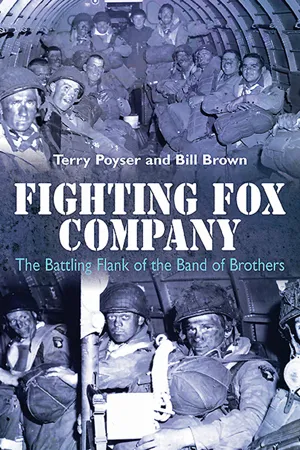
Easy Company of the 506th Parachute Infantry Regiment of the 101st Airborne Division has become one of the most famous small units in US history. But fewer people are aware of Fox Company of that same regiment—the men who fought alongside Easy Company through every step of the war in Europe, and who had their own stories to tell.
WWII vet Bill Brown decided to research the fate of a childhood friend who had served in Fox Company. Along the way, he met Terry Poyser, who was on a similar mission to research the combat death of a Fox Company man from his hometown. Together, the two authors proceeded to locate and interview every surviving Fox Company vet they could find. The ultimate result was this book, a decade in the making, offering a wealth of fascinating firsthand accounts of WWII combat as well as new perspectives on Dick Winters and others of the "Band."
Told primarily through the words of participants,
Fighting Fox Company takes us through some of the most horrific close-in fighting of the war, beginning with the chaotic nocturnal paratrooper drop on D-Day. After fighting through Normandy, the drop into Holland saw prolonged, ferocious combat and even more casualties; and then during the Battle of the Bulge, Fox Company took its place in line at Bastogne during one of the most heroic against-all-odds stands in US history.
As always in combat, each man's experience is different, and the nature of the German enemy is seen here in its equally various aspects. From ruthless SS fighters to meek Volkssturm to simply expert modern fighters, the Screaming Eagles encountered the full gamut of the Wehrmacht. The work is also accompanied by rare photos and useful appendices, including rosters and lists of casualties, to give the full look at Fox Company that has long been overdue.
- 344 pages
- English
- ePUB (mobile friendly)
- Available on iOS & Android
eBook - ePub
About this book
Information
CHAPTER 1
TOCCOA
Drab Army trucks sat silent near the railroad tracks as a train pulled into the station in the small town of Toccoa, Georgia, in the summer of 1942. Volunteers for the newly formed 101st Airborne Division, dirty and tired from their travel, exited their train cars. As the trucks coughed to life, they loaded up for the short ride to their new home, Camp Toombs. Leonard Hicks, seeing a sign for the Toccoa Coffin Factory at the train station, and the name Camp Toombs on arrival to his new home, could not help but be more alert, and concerned. Fortunately for Hicks and the other worried men, the name of the camp was changed to Toccoa a short time later.
The men were taken to an area on the post with approximately a hundred tents, with eight assigned to each tent. This group was referred to as W Company. Each tent had cots for the men and a single lightbulb suspended from its canvas ceiling. The ground was muddy from a recent rain. As Roy Zerbe recalled, “It was the muddiest, dirtiest place I ever saw. We had wooden planks to walk on to try to stay out of the mud.”
Wooden blocks had to be put under the cots as well, to keep them from sinking into the red mud. The camp was bustling with activity, and building was taking place almost every day for both new housing and training facilities. Eventually the men moved from their muddy tents to hastily built barracks, and sixteen to twenty men were assigned from the tent city to one of the new buildings. A mess hall situated at the end of the street could house an entire company of 130-plus men, with benches aligned to feed ten men at each table.
A group of men were soon assigned to F, or Fox, Company of the Second Battalion of the 506th Parachute Infantry Regiment. Once they were assembled, they were welcomed by their regimental commander, Col. Robert Sink. Sink told them that they would be the first parachute troops to be trained outside of Fort Benning, Georgia. They were told the training would not be easy, would be the toughest in the US Army, and would occur day and night. Sink told them they would be second to none, and the men soon learned to believe him.
Haircuts were soon given to the men of Fox. Men from all over the country, from all walks of life, soon looked the same, with shaved heads and uniforms without ranks or unit insignia. Physical examinations soon followed. Many were frightened they would not meet Colonel Sink’s tough standards. One man from Fox was forced to pack his bags when he was found to be color-blind, but another snuck through with the same problem. Bill Tucker remembered their exam was not over until they had gone unclothed in front of Colonel Sink, who looked them over like a horse merchant.
The men ranged drastically in height and weight, with the average trooper being five feet, seven inches tall and weighing 155 pounds. Although the regulation cutoff was six feet, one Fox lieutenant was over that. Some men were as short as five feet, four inches.
Physical training (PT) began immediately on the men’s arrival to the camp, and they never walked anywhere. “Double time,” Army jargon for jogging, was soon their only method of movement, and they quickly became accustomed to briskly moving to every assignment. With the crack of dawn and the bugling of “Reveille” each morning came formation, “police” (cleanup) call, and then calisthenics. Clad in blue swim trunks, GI shoes, and sometimes without t-shirts, the men were run through their exercises by the well-conditioned Lt. Andrew Tuck. Bill True remembered the morning PT as vigorous to the point of exhaustion.
David “Bud” Edwards wrote home on September 8 about his initial experience at Toccoa:
We started our thirteen weeks of training yesterday and we really started out with a bang. We drilled all afternoon in the rain, and it really rained. We were soaked to the bone when we came in. This morning we had about a half hour of exercise and we had close order drill. After all this we are given lectures and other demonstrations. In the afternoon they taught us how to pitch tents.
After morning PT would be breakfast, and the company barracks would be readied for inspection. Then the company would fall in for either a run or the obstacle course. The most notable feature of Camp Toccoa’s landscape was nearby Currahee Mountain. Currahee was an Indian word for “Stands Alone” and became the motto of the 506th.
According to Vince Occhipinti, each Monday, Wednesday, and Friday the men of Fox Company ran up and down Currahee Mountain, initially taking just over an hour to complete the course. Eventually the run was made in fifty minutes. Mario “Gus” Patruno remembered that after he got into peak physical condition, the mountain run “was a breeze for me. We would run three abreast up, and some guys could even run it backwards.” Tom Alley recalled, “We would run the mountain after dinner as not only a challenge to ourselves, but to assure our place in the unit.”
The company commander, Lt. Thomas Mulvey, warned his men that the run up the mountain would “separate the men from the boys,” and he would wait at the top of the mountain to encourage his men on. “Boys” who fell out during the run or any other physical training were sent packing, while the “men” continued with their grueling schedule.
On each Tuesday, Thursday, and Saturday, the Fox Company physical training consisted of an obstacle course. It was run in groups of four or five that started at the top of a small hill. After a steep seventy-five-yard run down the hill, the participants would cross a fifty-foot ditch of water by swinging hand over hand on monkey bars. Rope-swinging over ditches and crawling through wooden tunnels followed over the next fifty yards. An eight-foot sloped log ladder was climbed up over a creek and then participants jumped from the ladder over the creek bed into a pit of shredded bark. There was an inclined pipe ladder to cross and wooden logs spanned a creek, with three or four logs for men to cross at a time. Finally, there was a sloped fifteen-foot log wall to clamber over. Some remember using ropes to assist in pulling themselves up and over, others only brute force.
After completing the course the men would run back to the top of the hill to where they’d started and wait, exhausted, for their next turn. “I liked running the obstacle course and was rather good at it,” said Roy Zerbe. “I was one of the fastest in the company. Merlin Shennum was really good at it as well—seemed to always be having a good time while running it.”
The PT staff at Toccoa was very creative, and other physical fitness tests awaited the troops beyond their mountain run and obstacle course. Fifty-yard duckwalks, hundred-yard sprints, standing broad jumps, pull-ups, and a knotted rope climb of twenty-five feet without the use of one’s legs were practiced as well. Men were constantly made to do twenty-five to fifty push-ups for the slightest mistakes, infractions, and sometimes for no reason at all.
Log training was added to the physical curriculum as well. Men in groups of six or eight would pair off. They would pick up ten- to twelve-foot-long logs, similar to a telephone pole, then together would toss it in the air, catch it, lower it to the ground, and then start over. Vince Occhipinti remembered an added strain to the log exercises. Six men would get on the ground, and six others would lay a log across their chests. Then the six men on the ground would, in unison, lift the log straight up in the air above them with their arms extended. It took complete teamwork to accomplish without injury.
Outside of PT was the basic Army training, which usually happened before their ninety-minute lunch and later in the afternoons, right after mail call. Close order drill, such as being taught to stand at attention, at ease, and at parade rest, and marching with and without rifles were taught. No actual rifles were yet available, so the men trained with broom handles.
Barracks were regularly inspected, with the men tightening their bunk blankets so tight that quarters could be bounced off of them during the inspections. If one man in a barrack made a mistake during the inspection, the entire barrack’s occupants were punished. The men quickly learned to help each other out to assure they all passed with perfection.
Lt. Carl MacDowell, the company’s executive officer (second in command) taught the men general orders for guard duty and the regulations of military courtesy. Lt. Freeling Colt taught infantry tactics, and Lieutenant Tuck taught map reading, compass use, orienteering, and land navigation. Other classes included articles of war, military sanitation, first aid, sex hygiene, protection of military information, and organization of the Army. The classes were given both indoors and outside the barracks in a newly built amphitheater, and were often a relief from the long hours of difficult physical training.
One thing that came with the intense training and conditioning was superior physical fitness, and with that came an intense camaraderie and confidence. Len Hicks described it as an attitude that “nothing can stop us, to never give up and that you can do better than anyone.” It was an attitude and bond that made the 506th one of the finest fighting regiments in the US Army in WWII. The bonds made and spirit gained lasted a lifetime.
In addition to the military instruction, inspection, drill, and physical training, was parachute training. A mock C-47 transport aircraft’s fuselage was built, and the men formed into groups of sixteen—a full planeload, or “stick”—for practice exiting the aircraft. Sitting on buckets inside the pseudo plane, the men were given their jump instructions while wearing their parachute harness equipment. The first orders were “Stand up!” and “Hook up!” The static line attached to their parachutes was hooked to an overhead cable that ran the length of the plane.
Next came equipment check. The jumpers looked over their gear to make sure everything was fastened correctly and secure. They then looked over the men in front and back of them, thus ensuring a complete safety inspection. “Sound off for equipment check!” followed, and the troopers counted off down from sixteen. “Sixteen OK!,” “Fifteen OK!,” and so on was shouted down the line. “Stand in the door!” came next, with the lead jumper placing his left foot in the lone door of the mock aircraft. “Go!” followed, and the men exited quickly by swinging their right legs out the door and turning left, with their backs to the left wing and to the nonexistent prop blast coming from it.
A stick could exit a plane in practice, and later during actual jumps, in seconds. As each man exited the mock plane, he shouted, “One one thousand! Two one thousand! Three one thousand!” to mark the time it took for him to fall away from the plane and have his parachute deploy.
After the mock plane exits, the men would move to nearby platforms, where they practiced jumping to the ground and tumbling forward or backward, to simulate their rough parachute landings. Also included in the training was a platform that had parachute harnesses hanging from overhead supports. The men buckled themselves into the harnesses and suspended themselves off the platform. This was also known as suspended agony due to the pain that was caused by their dead weight on their lower extremities while in the harness.
During this training the men were taught how to steer their parachutes by pulling on one or more of the four riser straps that went from the parachute harness to the suspension lines above. The steering allowed the men to turn their parachutes into the wind, stop oscillations, and assist in their landings. It seemed to be a simple exercise but later saved several of the men’s lives during their first combat jump.
The next lesson in parachuting was jumping from thirty-five foot towers. This proved to be both a physical and mental challenge—at thirty-five feet their depth perception was severely impaired, and the height seemed greater than it actually was. The trainees would put on a parachute harness that had its overhead risers attached to a pulley on a cable that ran outside the tower and gradually ran down to the ground below. The jumper would stand in the tower, also made up like a mock aircraft, and jump out as was done from the previous grounded mock plane. He would then count to “three one thousand,” be jolted in his harness as the risers became taut with the pulley and cable, and then ride the pulley down the cable to the ground and practice a parachute landing.
The parachute training was practiced daily in Toccoa. When the men eventually arrived at jump school at Fort Benning, the process of exiting, steering, and landing was second nature to them.
As explained by Bud Edwards in a letter home on September 21, the men were motivated by an exhibition put on by the camp staff:
After lunch we fell out in coveralls and went up the mountain to a different spot than we usually go and were given a demonstration on how to jump out of an airplane. A plane came over about four times and each time they dropped out a colored chute with some kind of equipment. The plane then came over twice and dropped out seven men each time it came over. They dropped from about a thousand feet. It looked fun!
Each Friday night the men went on night maneuvers or on marches, and either could last four to seven hours. The marches would cover from ten to twenty miles along all the dirt trails and back roads that twisted through the mountains. The maneuvers would test their compass skills.
VINCE OCCHIPINTI • They took us in trucks in units of about squad size about ten miles from camp. This was all mountainous country, and pretty soon you weren’t sure where camp was. Now, you could walk back on the road you came in on. But this was a winding, mountainous road, and the distance was more like twenty miles back to camp along that route. Or you could cut cross-country by the compass route, which would be a lot quicker if you managed an accurate compass reading.
The best thing about the Friday night activity was the return to camp, because the kitchen would be open. Fresh, warm sugar doughnuts and hot coffee awaited the troops as they filtered in from the maneuvers or marches. Those who got lost often did not return until daylight, and some would even have to be later located by searchers sent out in the morning to track the disoriente...
Table of contents
- Cover Page
- Title Page
- Copyright
- CONTENTS
- PREFACE & ACKNOWLEDGMENTS
- 1 Toccoa
- 2 Parachute School
- 3 Furloughs, Camp Mackall, and the Tennessee Maneuvers
- 4 Fort Bragg, Camp Shanks, and the HMS Samaria
- 5 England
- 6 D-Day Flight
- 7 D-Day Night Jump
- 8 Chaos, Confusion, and First Blood
- 9 First Day in Normandy
- 10 Normandy
- 11 Carentan
- 12 Winding Down
- 13 Back in Aldbourne
- 14 Holland
- 15 On the Move and Black Friday
- 16 Gus and Pop
- 17 The Island
- 18 Patrols
- 19 Quail Hunting
- 20 Bastogne
- 21 Foy
- 22 On the River
- 23 Tent City
- 24 The Rhine
- 25 The Alps
- 26 Moving Back
- AFTERWORD Two Men Who Fought
- APPENDIX A Company Rosters
- APPENDIX B D-Day Sticks
- APPENDIX C Orel Lev’s Distinguished Service Cross Citation
- APPENDIX D Manning Haney’s Distinguished Service Cross Citation
- SELECTED BIBLIOGRAPHY
- INDEX
- Colour Plates
Trusted by 375,005 students
Access to over 1.5 million titles for a fair monthly price.
Study more efficiently using our study tools.
Frequently asked questions
Yes, you can cancel anytime from the Subscription tab in your account settings on the Perlego website. Your subscription will stay active until the end of your current billing period. Learn how to cancel your subscription
No, books cannot be downloaded as external files, such as PDFs, for use outside of Perlego. However, you can download books within the Perlego app for offline reading on mobile or tablet. Learn how to download books offline
Perlego offers two plans: Essential and Complete
- Essential is ideal for learners and professionals who enjoy exploring a wide range of subjects. Access the Essential Library with 800,000+ trusted titles and best-sellers across business, personal growth, and the humanities. Includes unlimited reading time and Standard Read Aloud voice.
- Complete: Perfect for advanced learners and researchers needing full, unrestricted access. Unlock 1.5M+ books across hundreds of subjects, including academic and specialized titles. The Complete Plan also includes advanced features like Premium Read Aloud and Research Assistant.
We are an online textbook subscription service, where you can get access to an entire online library for less than the price of a single book per month. With over 1.5 million books across 990+ topics, we’ve got you covered! Learn about our mission
Look out for the read-aloud symbol on your next book to see if you can listen to it. The read-aloud tool reads text aloud for you, highlighting the text as it is being read. You can pause it, speed it up and slow it down. Learn more about Read Aloud
Yes! You can use the Perlego app on both iOS and Android devices to read anytime, anywhere — even offline. Perfect for commutes or when you’re on the go.
Please note we cannot support devices running on iOS 13 and Android 7 or earlier. Learn more about using the app
Please note we cannot support devices running on iOS 13 and Android 7 or earlier. Learn more about using the app
Yes, you can access Fighting Fox Company by Terry Poyser,Bill Brown in PDF and/or ePUB format, as well as other popular books in History & Military Biographies. We have over 1.5 million books available in our catalogue for you to explore.