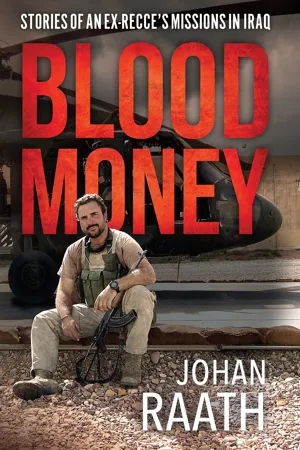
A former Special Forces soldier—and presidential bodyguard—shares heart-stopping stories of his time as a private military contractor in Iraq.
"I remember the cracking sound of the AK-47 bullets as they tore through our windscreen . . . A piece of bullet struck my bulletproof vest in the chest area and another piece broke off and lodged in my left forearm."
Johan Raath and a security team were ambushed in May 2004 while on a mission to reconnoiter a power plant south of Baghdad for an American firm. He had been in the country for only two weeks. This was a taste of what was to come over the next few years as he worked as a private military contractor (PMC) in Iraq.
His mission? Not to wage war, but to protect lives. Raath and his team provided security for engineers working on reconstruction projects in Iraq. Whether in the notorious Triangle of Death, in the deadly area around Ramadi, or in the faction-ridden Basra, Raath had numerous hair-raising experiences.
Key to his survival was his training as a Special Forces operator, or Recce.
This riveting account offers a rare glimpse into the world of private military contractors and the realities of everyday life in one of the world's most violent conflict zones.
- 344 pages
- English
- ePUB (mobile friendly)
- Available on iOS & Android
eBook - ePub
About this book
Information
1
Good morning, Baghdad!
The smell of Baghdad was the first thing that hit me. Because of the bombings, the city’s sewerage system had disintegrated, leaving the city smelling like one massive turd. It was not uncommon to see open sewage seeping out of damaged pipes and floating into the Tigris and Euphrates – along with the bodies that could be occasionally spotted in the rivers.
It was April 2004, just over a year after America had invaded Iraq to topple the regime of Saddam Hussein. In those days, no commercial airlines flew into Baghdad – all flights were chartered or people flew there in private planes. I arrived at Baghdad International Airport in an old private chartered jet. As we approached the airport, the pilots put the plane into a downward spiralling dive, much to the horror of the passengers, who thought we were going down.
During the flight, I had found out that the pilots were South African, so I understood immediately that the alarming approach trajectory was nothing more than a safety manoeuvre. South African Air Force pilots adopted the same procedure in the 1980s when they flew personnel into the operational area for deployments during the Border War in Namibia and Angola. The idea was to avoid approaching the runway in a straight line for too long, as this would allow attackers to take aim more accurately with surface-to-air missiles, rocket launchers and small-arms fire. Instead, they would take the plane down in a corkscrew motion, then level out shortly before touching down. It was a very scary manoeuvre when you experienced it for the first time, although I understood the value of it. Still, I was surprised that a non-military aircraft, a Boeing 727, was performing this hair-raising descent tactic.
At the airport I was met by the team from the Steele Foundation, the American private military security company I worked for at the time, who had just won a contract in Iraq. I had been deployed by the Steele Foundation to Iraq as a team leader and personal protection officer, a bodyguard basically, for American engineers working on expanding and upgrading the Musayyib Power Plant, a key but ageing electrical power station southwest of Baghdad. My other duties included securing the site with static guards and providing armed-escort transport from Baghdad to the site and back for clients and our own team members.
The team from the Steele Foundation escorted us to the parking area, where they handed us flak jackets (bullet-resistant vests) and informed us about the notoriously dangerous stretch of road between the airport and the city, called Route Irish, for some reason (roads were given code names by the CF). This was one of the main roads into Baghdad used by foreigners and security forces, and the insurgents knew this. The road also had several US military and Iraqi checkpoints. It was a magnet for the terrorists. I was therefore taken through the emergency drills should we get hit.1 These were pretty standard in our line of work.
Between the end of 2003 and well into 2005, Route Irish was considered one of the most dangerous stretches of road in the world. Many soldiers, PMCs and citizens were attacked on this 12-kilometre strip of perilous highway, and a number paid the ultimate price. Drive-by shootings, roadside ambushes and suicide bombers targeting the checkpoints were commonplace. In one incident, video footage showed how insurgents killed three PMCs in April 2005 in cold blood following an ambush.2
In the later years of the conflict, private military security companies charged upwards of what may seem like an exorbitant $3 000 to ferry people from the airport to Baghdad. But the costs were justifed: armoured sport utility vehicles (SUVs) with armed PMC escorts do not come cheaply, especially as the client expects these escorts to protect his or her life with theirs.
Once on the road, the drivers hit the throttle and went hell for leather. This, it turned out, was to try to outrun possible improvised explosive device (IED) blasts and sniper fire. They drove at an average of 120 km/h. Despite the speeding – or perhaps because of it – I made it safely to the hotel.
My first accommodation, and temporary operations base for a couple of weeks, was the Babylon Hotel in the Red Zone on the west bank of the Tigris. The Red Zone is the term used to refer to parts of the city immediately outside the perimeter of the safe area, known as the Green Zone. This was the 10-km2 high-security international enclave established in central Baghdad following the Allied invasion. The Green Zone was on the other side of the river from our hotel. This was the governmental centre of the US Coalition Provisional Authority, the transitional government that ruled the country between April 2003 and June 2004. To this day, the Green Zone is still the hub of the international presence in the capital.3

Map 2
Once I got to my room, I unpacked my gear and started putting together one of the most essential items when working in a war zone – my escape and evasion, or E & E, bag. This is a backpack that contains all your essential survival gear in case you have to leave an operational area in a hurry. Americans call it a go bag or a grab bag; others refer to it simply as a runaway bag.
I had somehow managed to get all my security equipment – known in contractor circles as one’s ‘contraband’ – into Iraq. As well as my E & E bag, this kit included a GPS device, knives, a tactical vest, first-aid kit, heavy-duty clothing, boots, a multi-tool knife, parachute cord, compass, signals mirror, strobe light, torches and other tactical gadgetry.
After I had sorted my E & E bag out, my next job was to clean and conduct a functionality test on the AK-47 issued to me.4 I was satisfied that the AK-47 would more than likely fire. Although it is advisable to get to a shooting range as soon as possible with a new weapon to test-fire it and zero the sights, in the military contracting world such a luxury is not always possible. But I reckoned I was good to go.
A few days after my arrival at the Babylon Hotel, we were having breakfast in the restaurant area when we heard a loud bang and, a split second later, the large glass windows shook violently. The shockwaves, it turned out, were from a car comb that had gone off a few hundred metres from the hotel in the vicinity of the checkpoint that led over the Tigris to the Green Zone.
A couple of seconds after the blast, some joker in the restaurant shouted out, ‘Good morning, Baghdad!’ We all laughed at the comic reference to the Robin Williams movie Good Morning, Vietnam. I had just witnessed what the situation was like in Baghdad, and if I hadn’t known it before, I realised then that my time in Iraq promised to be an interesting adventure.
The Triangle of Death
Two weeks after I arrived in Iraq, I was due to lead a team on a reconnaissance mission to the Musayyib Power Plant. Our mission was to set up a base to receive and secure the first engineers and other workers from Southeast Texas Industries Inc., the engineering firm building the plant on a contract from the Iraqi Ministry of Electricity. We were a six-man configuration – three local nationals and three expatriate security contractors.
The facility was about 120 kilometres southwest of Baghdad. The route there and the area that we were to reconnoitre were in the so-called Triangle of Death (not to be confused with the Sunni Death Triangle, which is northwest of the city). The Triangle of Death got its name from the heavy combat activity and sectarian violence in the area between 2003 and 2007.

Map 3
Our team members were all armed with assault rifles – we had five AK-47s and one M4 between us. We all also carried 9 mm pistols. When we set off that day, we initially weren’t wearing our body armour, as the idea was to blend in, low-profile, with the locals. But, after a while, I got a bad feeling about the area and asked the team to put on their vests. (Later, wearing body armour would become standard operating procedure and it was mandatory for all team members to wear body armour vests with ballistic plates in the front and back carrier pouches.5)
We were travelling in two unarmoured (known as soft-skin) vehicles. Two of the Iraqis were in the front in a Pajero SUV and the rest of us followed in a BMW 740. The customary procedure was that the local guys would drive in front, so they could speak in Arabic to the Iraqi security forces, who manned most of the checkpoints. At many of the major checkpoints, the US forces had a greater presence, in which case the vehicle with the expat contractors would approach the checkpoint first to liaise in English and to present our US Department of Defense cards (commonly called DoD cards), or Common Access Cards. The DoD or CaC card proved that you were security-vetted and cleared to work on US government contracts. As a private military contractor, you couldn’t move anywhere in Iraq without one.
We headed south on National Route 6 (known in CF jargon as ‘Route Bismarck’). At around 10:30, shortly after we had turned onto a secondary road, we approached a checkpoint where the men in our lead vehicle showed their paperwork to the security forces and we followed with our DoD cards.
Not long afterwards, I spotted an old black Opel that was occupied by a group of young men. The strange thing was that they were trying to overtake us on the right – Iraqis drive on the right-hand side of the road. They then pulled off the shoulder of the tarmac road and onto the dirt.
I thought it odd but just wrote it off to bad driving, which I’d heard was typical of young Iraqi men. By then we were driving at about 140 km/h, a standard practice for private security teams in those days – the idea being to drive faster than the normal traffic to prevent too many vehicles from passing your convoy and to thwart rolling ambushes from the rear. But despite our speed, the Opel eventually managed to pass us on the outside, kicking up a massive ball of dust in the desert. Seconds later, the vehicle started swerving left aggressively and was back onto the asphalt road, pushing in front of us. They were clearly trying to split up our convoy.
As they overtook, the Opel driver glanced at me fleetingly and I can still vividly recall the look in his eyes. He was just a few metres away when they passed us. His pupils were dilated and he had an intense look of hatred and anger in his eyes. For a moment, I thought he might be under the influence of narcotics, but later I realised I was staring into the eyes of a mujahideen fighter who was drunk not on any substances, just emotions of hate welling up from his religious and sociopolitical convictions.
The next moment, I saw two men lean out of the front right and rear left windows armed with AK-47s. They opened fire on our lead vehicle. Bullets smashed the rear windscreen of the Pajero.
‘Contact front!’ I yelled immediately.
One of our team members in the back of the BMW, Ali Tehrani, wasted no time. Positioning himself at the back window, he opened fire on the Opel with his M4. The attacking vehicle was in the line of his two o’clock. The attackers immediately turned their attention to us and fired back at our vehicle before they slowed down and veered off the road.
I remember the cracking sound of the AK-47 bullets as they tore through our windscreen. A friend’s Garmin GPS and my digital camera were on the dashboard – the bullets pierced both. A piece of a bullet struck my bulletproof vest in the chest area, and another piece broke off and lodged in my left forearm (and is still there to this day). That’s how close it was.
In the midst of all this, our Kurdish driver drew his pistol and started firing back at the attackers through the windscreen, now destroyed by bullets, while at the same time trying to control the speeding vehicle with his left hand. We were doing 160 km/h, taking incoming fire and some of us were trying to return fire – it felt like I was in a Hollywood action movie, but one with a potentially lethal real-life outcome.
Our driver got so carried away with firing his pistol that at one point I had to block his right arm when he pushed the gun in front of my face in an attempt to fire at the attackers sideways. I leaned over and grabbed the steering wheel of the BMW, which had swerved dangerously across the road and in the process I dislocated my left shoulder. At the time the adrenaline numbed the pain. (I had to get reconstructive surgery for this a couple of years later.)
I remember very clearly seeing how the attacker shooting at us from the rear window slung his AK-47 over his shoulder, pulled a pistol from his belt and started spraying lead our way again. In hindsight, this showed a level of training and proficiency, because it is a tactical drill to sling your assault rifle when you are out of ammunition or have a jam, and to continue shooting with your handgun.
By this time the Opel had disappeared from sight – presumably Ali’s return fire had hit their vehicle – but then we heard shots being fired from our rear as another car with shooters pulled in behind. Our rear window shattered. Brian Smith, one of the expat team members and our project medic, was bleeding from his forehead but, thankfully, he was not seriously injured. He and Ali even managed to fire a couple of rounds at the second vehicle.
By now, our speeding convoy was fast approaching another checkpoint and the attackers disappeared into the desert on secondary roads. When we arrived at the checkpoint, we reported the ambush and realised that the driver of the front vehicle had been shot through both arms, close to the elbows. Brian stopped the bleeding...
Table of contents
- Cover
- Title
- Copyright
- Dedication
- Contents
- Preface
- Historical background to the war in Iraq
- Acronyms and abbreviations
- List of maps
- 1. Good morning, Baghdad!
- 2. From Special Forces operator to private military contractor
- 3. A taste of everyday life in Iraq
- 4. Badlands: Northwestern Iraq
- 5. A Black Hawk encounter
- 6. Tremulous times
- 7. A country drenched in blood
- 8. The road to hell
- 9. Camp Tiger
- 10. Feeling the heat
- 11. A break from the Sandbox
- 12. The ‘new’ Iraq
- 13. Building villages from scratch
- 14. Caught up in tribalism
- 15. Reinvigorated evil
- 16. New horizons
- 17. A history written in blood
- Epilogue
- Addendum A
- Addendum B
- Notes
- Roll of Honour
- About the author
Trusted by 375,005 students
Access to over 1.5 million titles for a fair monthly price.
Study more efficiently using our study tools.
Frequently asked questions
Yes, you can cancel anytime from the Subscription tab in your account settings on the Perlego website. Your subscription will stay active until the end of your current billing period. Learn how to cancel your subscription
No, books cannot be downloaded as external files, such as PDFs, for use outside of Perlego. However, you can download books within the Perlego app for offline reading on mobile or tablet. Learn how to download books offline
Perlego offers two plans: Essential and Complete
- Essential is ideal for learners and professionals who enjoy exploring a wide range of subjects. Access the Essential Library with 800,000+ trusted titles and best-sellers across business, personal growth, and the humanities. Includes unlimited reading time and Standard Read Aloud voice.
- Complete: Perfect for advanced learners and researchers needing full, unrestricted access. Unlock 1.5M+ books across hundreds of subjects, including academic and specialized titles. The Complete Plan also includes advanced features like Premium Read Aloud and Research Assistant.
We are an online textbook subscription service, where you can get access to an entire online library for less than the price of a single book per month. With over 1.5 million books across 990+ topics, we’ve got you covered! Learn about our mission
Look out for the read-aloud symbol on your next book to see if you can listen to it. The read-aloud tool reads text aloud for you, highlighting the text as it is being read. You can pause it, speed it up and slow it down. Learn more about Read Aloud
Yes! You can use the Perlego app on both iOS and Android devices to read anytime, anywhere — even offline. Perfect for commutes or when you’re on the go.
Please note we cannot support devices running on iOS 13 and Android 7 or earlier. Learn more about using the app
Please note we cannot support devices running on iOS 13 and Android 7 or earlier. Learn more about using the app
Yes, you can access Blood Money by Johan Raath in PDF and/or ePUB format, as well as other popular books in History & Social Science Biographies. We have over 1.5 million books available in our catalogue for you to explore.