eBook - ePub
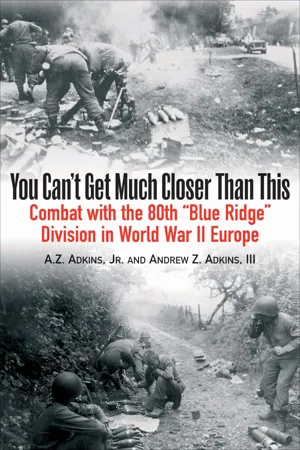
You Can't Get Much Closer Than This
Combat With the 80th "Blue Ridge" Division in World War II Europe
- 288 pages
- English
- ePUB (mobile friendly)
- Available on iOS & Android
eBook - ePub
You Can't Get Much Closer Than This
Combat With the 80th "Blue Ridge" Division in World War II Europe
About this book
A young soldier's memoirs of fighting in WWII: "Fascinating . . . A personal record like this is a valuable resource to anyone interested in the period"( Military Model Scene).
After the Citadel and Officer Candidate School, Andrew Z. Adkins Jr., was sent to the 80th Infantry Division, then training in the California-Arizona desert. There, he was assigned as an 81mm mortar section leader in Company H, 2nd Battalion, 317th Infantry Regiment.
When the division completed training in December 1943, it was shipped in stages to the United Kingdom and then Normandy, where it landed on August 3, 1944. Lieutenant Adkins and his fellow soldiers took part in light hedgerow fighting that served to shake the division down and familiarize the troops and their officers with combat. The first real test came within weeks, when the 2nd Battalion, 317th Infantry, attacked high ground near Argentan during the drive to seal German forces in the Falaise Pocket. While scouting for mortar positions in the woods, Adkins met a group of Germans and shot one of them dead with his carbine. This baptism in blood settled the question faced by every novice combatant: He was cool under fire, capable of killing when facing the enemy. He later wrote, "It was a sickening sight, but having been caught up in the heat of battle, I didn't have a reaction other than feeling I had saved my own life."
Thereafter, the 2nd Battalion, 317th Infantry, took part in bloody battles across France, sometimes coping with inept leadership and grievous losses, even as it took hills and towns away from the Germans. In the fighting graphically portrayed here, Adkins acted with skill and courage, placing himself at the forefront of the action whenever he could. His extremely aggressive delivery of critical supplies to a cut-off unit in an embattled French town earned him a Bronze Star, the first in his battalion.
This is a story of a young soldier at war, a junior officer's coming of age amid pulse-pounding combat. Before his death, Andy Adkins was able to face his memory of war as bravely as he faced war itself. He put it on paper, honest and unflinching. In 1944-45, he did his duty to his men and country—and here, he serves new generations of military and civilian readers.
Information
Chapter 1
THE MAKING OF A SOLDIER
December 7, 1941–August 5, 1944
December 7, 1941, began just like any other Sunday at The Citadel in Charleston, South Carolina. There was early morning reveille, followed by physical training and a good breakfast. Sunday service followed in the Summerall Chapel. Little did we know this would be the “day that shall live in infamy.”
As part of our education in world politics, we were required to stay informed of current events around the world. But, like most other 20-year-olds in a military college, my main focus was on education and an eventual commission, not world politics. I was still eighteen months away from graduation.
We knew Europe was again engulfed in war with Hitler’s blitzkrieg into Poland in 1939. In the early morning darkness of May 10, 1940, the Germans attacked Holland and Belgium. French and British troops rushed to the rescue but were caught in the retreat of refugees and slowly pushed back. The troops fought valiantly, but in vain; the German war machine continued to advance unperturbed. In England, Hitler’s invasion forced the resignation of Prime Minister Neville Chamberlain; Winston Churchill took his place. The Germans skirted the French Maginot Line and slashed into France through Luxembourg and the Ardennes Forest. Hitler’s tanks rushed straight to the sea, reached the English Channel on May 21, and cut off the Allied armies in the north. The Germans turned once again, fought their way into the heart of France, and entered Paris on June 14, 1940.
On the other side of the world, the Japanese military was engaged in the seemingly endless war it had started against China in 1931 and was in desperate need of oil and other raw materials. Commercial access was gradually curtailed as the Japanese conquests continued. Eighteen months earlier, President Franklin D. Roosevelt had transferred the U.S. Pacific Fleet to Pearl Harbor as a presumed deterrent to Japanese aggression. In July 1941, the Western powers effectively halted trade with Japan. Desperate, the Japanese schemed to seize the oil and mineral-rich Netherlands East Indies and Southeast Asia; a Pacific war was now virtually inevitable. By late November 1941, with peace negotiations clearly approaching an end, American officials expected a Japanese attack into the Indies, Malaya, and probably the Philippines. No one expected an attack on Hawaii.
I think I first learned of the attack on Pearl Harbor late in the afternoon. Most cadets were sleeping or listening to the music on the radio when the reports started coming in. “Pearl Harbor bombed” and “Japanese attack the Philippines.” Word traveled fast through The Citadel. At first we thought the stories were rumors or somebody’s idea of a joke. Soon, our worst fears proved to be true: Japan had attacked Pearl Harbor. The first of two waves of attacks hit its target beginning at 7:53 a.m. Hawaii time; 366 Japanese fighters and bombers struck the airfields and battleships. The second wave of 168 planes attacked other ships and shipyard facilities at 8:55 a.m. It was all over by 9:55. By 1:00 p.m., the carriers that had launched the planes from 274 miles off the coast of Oahu were heading back to Japan.
The Citadel cadets received the news with surprising calmness, almost as if it had been expected. Later, we learned that 2,403 men had died in the unprovoked attack, and another 1,178 had been wounded. The strike destroyed 188 planes and crippled a Pacific Fleet that now included eight damaged or destroyed battleships. Nearly half of the dead were aboard the USS Arizona. Innocent men and women lost their lives protecting our country. That night we marched to supper chanting “Beat Japan” to the rhythm of the old Bulldog cadence.
On Monday, December 8, 1941, President Roosevelt signed the declaration of war granted by Congress. In the most historic speech of modern times, he stated the goal of the country would be the “absolute abolishment” of Japan, no matter what the cost. “The rising sun has risen; and it must now set never to rise again” was the opinion of one congressional observer. The next day, Germany and Italy, as partners of Japan in the Tripartite Pact, declared war on the United States. The shock of these declarations of war changed the entire future for most of us. It was then that we knew, deep down inside, that we were destined to be The Citadel’s second war class.
My first instinct, like that of most cadets at The Citadel, was to drop out of college, join the Army, and fight those cowardly bastards who had murdered innocent Americans. In fact, some of my Citadel buddies did just that. In a letter dated December 9, 1941, I wrote my dad: “All of the cadets, just like everybody else, are gravely concerned with matters. None of us want to sit still, but we all realize that is the only thing to do. So we will just continue our regular schedule.” My father’s advice was solid: “Finish school, son. This will be a long war and you’ll have your chance to serve your country and fight.” He was right, as usual.
The Citadel, like many other American institutions, began planning for possible repercussions by unknown enemies. General Charles Pelot Summerall, president of The Citadel, issued General Order No. 14 on December 12, 1941, giving precise instructions to cadets, faculty, and administration in case The Citadel was attacked:
1. At the sounding of the City Siren for the air raid alarm, all members of the faculty and their families will remain in their houses until the alarm ceases.2. The Commandant of Cadets will issue orders to carry out the instructions of the President as to the formation and security of the Corps of Cadets.3. The employees in the mess and the laundry will remain indoors.4. The Commandant of Cadets will appoint a fire marshal and will organize the companies into fire fighting units with assignments to all buildings on the campus. Requisitions will be submitted for all equipment needed.5. The Commandant of Cadets will cooperate with the aircraft warning service in operating a warning station. He will secure the necessary equipment and have the Officer-in-Charge turn off the current at the master switch when the blackout is ordered.6. All persons will turn out all lights immediately when the air raid alarm sounds at night.7. The Commandant of Cadets will order practice alarms and practice the Corps of Cadets in the alert, the blackout and in fighting fire.By Command of General Summerall
I continued my studies in political science, but with a renewed sense of strength, courage, and focus. When I first entered The Citadel in September 1939, I was eighteen years old, full of exuberance and young foolishness. My father was a lawyer and I was a spoiled brat, or so my two older sisters told me. My father insisted I attend The Citadel and become a man. After the bombing at Pearl Harbor, it meant more to me than ever to be an American, a feeling that would surface again and again in my years in the U.S. Army and continue throughout the rest of my life.
February 16, 1942, was another important day in the life of a cadet at The Citadel. Several hundred cadets who had turned twenty on or before December 31, 1942, and who were not in the Reserve Officers Training Corps or the Naval Reserve, registered for the draft. They were now eligible for service in the armed forces of the United States. Although they didn’t expect to be called into service before the end of the present college term, they were subject to immediate call if they were needed.
“There were Citadel men at Pearl Harbor when the enemy struck so violently and unsuspectingly,” exclaimed The Sphinx, the 1943 Citadel yearbook. It continued:
There were sons of The Citadel on Bataan and Corregidor. They fought and some of them died though the task was hopeless, and only then did the survivors submit in body as prisoners of war. They are now present in Africa, India, China, Australia, Persia, and Iceland; in short, wherever the American flag is flying as a symbol of freedom and liberty, there are Citadel men there to guard it. In all parts of the world, in every climate, they have fought as they were taught, that right is might and that a free people with the love of God and mankind firmly embedded in their hearts could never be crushed or moved from the pedestal on which they stand as living symbols of truth and freedom.
Those words echoed in my mind and heart every day. I graduated from The Citadel on Saturday, May 29, 1943. Four years earlier we had started out with 501 entering cadets and had been whittled down to 218. Chief Justice George W. Maxey, of the Supreme Court of Pennsylvania, told the survivors of the 1943 graduating class, “You young men are now going forth to fight for civilization against barbarism. Whenever the armies of Germany and Japan have exercised their furious and brutal power they have trodden under every decency of life and established new landmarks of infamy. . . . America accepts the challenge and answers ‘present’ when the roll is called of nations which love liberty and the right enough to fight for them.”
My class would be the last graduating class for the duration of the war. Underclassmen, as well as graduating seniors, had also received orders to report for active duty. Besides a diploma, it was also customary for graduating seniors to receive graduation rings. Realizing that there would be no senior class the following year, the Class of 1943 voted that the Class of 1944 also be given rings as departing juniors, bearing the numerals “44.”
It was an exciting time for me. I’ll admit, I was a little nervous because I didn’t know where I might end up fighting what was now known as World War II. I reported to Fort Benning, Georgia—Officer Candidate School—on July 25, 1943.
Fort Benning
Fort Benning, Georgia, was an astonishing military facility. Much larger than The Citadel, it housed tens of thousands of men and women. It was the training ground for the Army’s officers. In a letter to my mother and father dated July 28, 1943, I wrote, “We have about 200 men in our company—63 from The Citadel, 124 from Texas A&M, and a few regular Army men. If things go O.K. I’ll be here until the latter part of November.”
Fort Benning was no picnic. The routine was dawn-to-dusk studies and physical work, followed by more studying and never enough sleep. Not everyone made it. “The school board met last week and kicked out 40 men in my company of 200, so you can see this place isn’t easy,” I wrote home that September. “Bob Roper left because his eyes were weak. He was sent to a finance school. My old roommate, Fred Fuller, was kicked out by the board—he has a growth on his lungs and is just waiting around for orders. He thinks he’ll get a medical discharge from the Army.”
The problem at Fort Benning was there were too many officer candidates. The “school board” was composed of high ranking and company officers who met periodically to interview men who had fallen behind. Fort Benning was hard on a man, and the fact that the Army had too many second lieutenants made matters worse, because they could run you into the ground and weed out those who couldn’t make it.
“We went on our bivouac a week ago last Thursday and stayed until the following Monday. We slept on the ground in little tents like the one dad gave me when I was a little boy,” I wrote my parents. “We were studying problems of scouting and patrolling and technique of rifle fire. It was hot in the daytime and cold at night. It’s a hard life, but I [am] learning a lot.”
After four months of grueling officer training I finally graduated November 23, 1943. I was now a fully commissioned second lieutenant in the United States Army. I have to admit, there were times when I didn’t think I’d make it, whether it was the physical training or the continuous studying and testing. But I was determined to enter this war as an officer in the U.S. Army.
I was finally able to proudly wear my new officer’s uniform, tailor-made, with my single gold bar. Several weeks prior to graduation we had a uniform display and I selected several officer uniforms. With all those who were dropping out (the school board continued to drop officer candidates because there were still too many), I wasn’t sure if I’d ever be able to wear my new uniforms.
I was proud of myself. I had gone from an 18-year-old high school graduate of Bradford County High School in Starke, Florida, to a graduate of The Citadel in Charleston, South Carolina, and now a graduate and commissioned officer of Fort Benning, Georgia. My orders now read, “Report to the 80th Infantry Division, California–Arizona Maneuver Area, Camp Laguna.” Now just where in the hell is Yuma, Arizona?
California–Arizona Maneuver Area: Camp Laguna
In the early days of World War II, it became apparent the United States would need to meet the challenges of engaging the enemy in the deserts of North Africa. On March 1, 1942, Major General George S. Patton, Jr., commanding general of the I Armored Corps, himself a native of southern California, opened the Desert Training Center (DTC) in the Mojave Desert. Patton chose the town of Desert Center, population 19, as his headquarters. On October 20, the DTC was expanded to include maneuver areas and became the California–Arizona Maneuver Area (CAMA).
From 1942 to 1944, the facility served as the largest military training facility and a place to toughen the infantry for the rigors of combat in the forthcoming invasion of North Africa. In addition, it was a fertile testing ground to develop suitable equipment for harsh desert conditions. General Patton commanded the facility in its early years, followed by General Walton Walker.
The DTC/CAMA encompassed about 18,000 square miles (more than 12 million acres) in California, Arizona, and Nevada, stretching from Indio, California, eastward to Prescott, Arizona, and from Yuma, Arizona, northward to Searchlight, Nevada—roughly 350 miles wide and 250 miles deep. Patton and his team of advisors designated various locations within the area where temporary tent camps would be built to house individual units. The camps were situated so each unit could train individually without interfering with others. As each individual unit reached the end of its training period, it would join one or more units to train in corps operations.
Due to its hasty construction, expected short duration, and the U.S. Army’s desire to train men in sparse conditions, the DTC/CAMA contained few permanent structures and was quite basic compared to other military bases. The Laguna Maneuver Area, one of eleven divisional camps in the CAMA, consisted of large valleys tucked between a series of mountain ranges.
I traveled by train to Yuma, Arizona, stopping in New Orleans to pick up the majority of my buddies from Fort Benning, Georgia. We got into Yuma on a Sunday afternoon, December 5, 1943. After several days on the train, I was hungry for some good chow. A few of us decided to go into town for some supper. I’d never been to Arizona before, so I didn’t really know what to expect. I loved fried seafood though, so I ordered a big platter of fried oysters. Imagine my surprise when they came and I found out the restaurant didn’t have any catsup. Here I was a fresh lieutenant, straight from officer training, lean and mean to the bone, facing a plate of big juicy fried oysters without any catsup! I just about gagged myself to death trying to choke down those awful slimy things and still keep a straight face in front of my buddies.
I was assigned to Company H, the heavy weapons company in the 2d Battalion, 317th Infantry Regiment, 80th Infantry Division. Eventually, I would be assigned as a mortar section leader. I would soon learn everything there was to know about the 81mm medium mortar, including range firing and tactics. I soon wished I’d paid more attention in my math classes at The Citadel, because firing the mortar involved a lot of angles, calculations, and math.
The heavy weapons company was one of four companies in a battalion. My company’s mission was to provide support to the three rifle companies (Companies E, F, and G) in the 2d Battalion. The heavy weapons company was equipped with 81mm mortars and water-cooled .30-caliber medium machine guns. The mortar platoon was composed of three mortar sections with two squads each, which gave the company a total of six mortars. Each mortar squad consisted of six men: a squad leader (usually a staff sergeant), the #1 gunner (usually a corporal), the assistant gunner, and three ammunition bearers. At least, that’s how it was described in the U.S. Army Table of Organization and Equipment (TO&E).
The 81mm (3.2 inches) mortar consisted of a 49.5-inch-long smooth-bore tube with a fixed firing pin at the bottom. The tube fit into a base plate that rested on the ground; the plate also helped to dissipate the recoil shock. A bipod, which was used to adjust for elevation, also supported the front end of the tube. The mortar was carried in three sections: the tube, the base-plate, and the bipod. The total weight of the 81mm mortar was about 135 pounds, and it was usually carried by two men.
The 81mm mortar had a range of 100 to 3,290 yards (almost two miles) and could be fired at a rate of 30 to 35 rounds per minute, with a normal rate of fire of 18 rounds per minute. There were two types of rounds used in the ...
Table of contents
- Cover
- Title Page
- Copyright
- PREFACE AND ACKNOWLEDGEMENTS
- CONTENTS
- CHAPTER 1: THE MAKING OF A SOLDIER
- CHAPTER 2: FIRST TASTE OF BATTLE
- CHAPTER 3: CROSSING THE MOSELLE
- CHAPTER 4: HILL 382 (ST. GENEVIEVE)
- CHAPTER 5: VILLERS-LES-MOIVRON
- CHAPTER 6: SIVRY, FRANCE
- CHAPTER 7: MEDICAL EVACUATION AND RECOVERY
- CHAPTER 8: BACK TO THE FRONT
- CHAPTER 9: THE BATTLE OF THE BULGE
- CHAPTER 10: THE RELENTLESS, BITTER COLD WINTER
- CHAPTER 11: THE SIEGFRIED LINE
- CHAPTER 12: R&R IN PARIS
- CHAPTER 13: MARCHING ONWARD
- CHAPTER 14: CROSSING THE RHINE
- CHAPTER 15: MOVING FAST
- CHAPTER 16: BUCHENWALD
- CHAPTER 17: NUREMBERG
- CHAPTER 18: THE END OF THE WAR
- APPENDIX 1: THE 80TH INFANTRY DIVISION
- APPENDIX 2: INFANTRY ORGANIZATIONS
- GLOSSARY
- NOTES
- BIBLIOGRAPHY
Trusted by 375,005 students
Access to over 1.5 million titles for a fair monthly price.
Study more efficiently using our study tools.
Frequently asked questions
Yes, you can cancel anytime from the Subscription tab in your account settings on the Perlego website. Your subscription will stay active until the end of your current billing period. Learn how to cancel your subscription
No, books cannot be downloaded as external files, such as PDFs, for use outside of Perlego. However, you can download books within the Perlego app for offline reading on mobile or tablet. Learn how to download books offline
Perlego offers two plans: Essential and Complete
- Essential is ideal for learners and professionals who enjoy exploring a wide range of subjects. Access the Essential Library with 800,000+ trusted titles and best-sellers across business, personal growth, and the humanities. Includes unlimited reading time and Standard Read Aloud voice.
- Complete: Perfect for advanced learners and researchers needing full, unrestricted access. Unlock 1.5M+ books across hundreds of subjects, including academic and specialized titles. The Complete Plan also includes advanced features like Premium Read Aloud and Research Assistant.
We are an online textbook subscription service, where you can get access to an entire online library for less than the price of a single book per month. With over 1.5 million books across 990+ topics, we’ve got you covered! Learn about our mission
Look out for the read-aloud symbol on your next book to see if you can listen to it. The read-aloud tool reads text aloud for you, highlighting the text as it is being read. You can pause it, speed it up and slow it down. Learn more about Read Aloud
Yes! You can use the Perlego app on both iOS and Android devices to read anytime, anywhere — even offline. Perfect for commutes or when you’re on the go.
Please note we cannot support devices running on iOS 13 and Android 7 or earlier. Learn more about using the app
Please note we cannot support devices running on iOS 13 and Android 7 or earlier. Learn more about using the app
Yes, you can access You Can't Get Much Closer Than This by A.Z. Adkins,Andrew Z. Adkins in PDF and/or ePUB format, as well as other popular books in History & Military Biographies. We have over 1.5 million books available in our catalogue for you to explore.