This thrilling account of WWII espionage by the former French secret service chief chronicles an Allied spy's actions in the German Cipher Office.
A spy for the French Secret Service during World War II, Hans-Thilo Schmidt was embedded in the nerve center of the Third Reich. From deep within Hitler's most sensitive operations, Schmidt created an intelligence network between France, Poland, and England. In
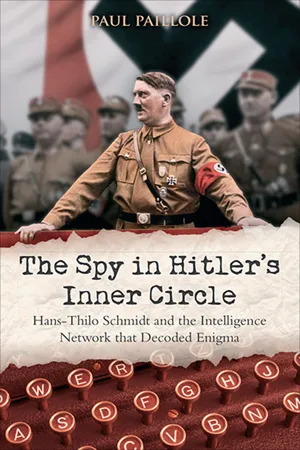
The Spy in Hitler's Inner Circle, France's former secret service chief, Paul Paillole, offers a revealing chronicle of how Schmidt helped the Allies infiltrate German agencies and crack their encryption system, the Enigma machine.
Paillole details how Schmidt delivered intelligence to France right from the source of the German Cipher Office. Revealed here are the most secret aspects of the so-called war of numbers that led to Alan Turing's historic codebreaking achievement at Bletchley Park. From information about Germany's rearmament and the reoccupation of the Rhineland to fundamental technical intelligence about the Enigma machine, Schmidt's contributions were key to the Allied victory in the intelligence war.
eBook - ePub
The Spy in Hitler's Inner Circle
Hans-Thilo Schmidt and the Allied Intelligence Network that Decoded Germany's Enigma
- 304 pages
- English
- ePUB (mobile friendly)
- Available on iOS & Android
eBook - ePub
The Spy in Hitler's Inner Circle
Hans-Thilo Schmidt and the Allied Intelligence Network that Decoded Germany's Enigma
About this book
Information
CHAPTER I
Enigma’s Secrets Revealed
The Verviers rendezvous • Rex, the S.R.’s jack-of-all-trades • The unveiling of the Enigma • H.E.’s work begins to take shape • Rex in Berlin • Breaching the Enigma • H.E. at the heart of the Nazi intelligence services • The strange discretion of the Poles and the infancy of the computer
The Verviers rendezvous
Verviers, Sunday November 1, 1931—All Saints Day—10.30 a.m. An anxious traveler descended from a train that had arrived from Berlin two hours late.
Of average build, wrapped in a dark, unassuming overcoat, and with a black hat drawn down over his eyes, the man left the station, stopping briefly to ask for directions to the Grand Hotel.
Minutes later, the hotel concierge gave him the key to a room that had been reserved by phone, along with a letter delivered the previous evening, labeled: “Deliver to Hans-Thilo Schmidt upon his arrival.”
Schmidt rushed into the elevator. A man in his sixties40 was sitting on the couch in the lobby, observing him closely from behind a newspaper. Schmidt dropped his heavy black leather bag and frantically tore open the envelope. His face, puffy from lack of sleep, began to turn red as he read the brief message hand-written in German: “You are expected in suite 31, first floor, at 12 noon.”
That left an hour to clean up, take a short rest, go through some papers, and reread a few notes he had pulled from an inner pocket of his bag.
At noon, Schmidt knocked on the door of suite 31. To his surprise, a distinguished woman with white hair opened the door and invited him to sit in an armchair before disappearing into an adjoining room. In the background music softly plays on a radio. The living room was cozy; the atmosphere warm. On the small bar stood a few bottles of aperitifs and elegant crystal glasses next to several cigar boxes.
“Guten Morgen, Herr Schmidt! Hatten sie eine gute Reise?”
The sexagenarian entering the room was immense. His strange light blue eyes, framed by large glasses, were staring at Schmidt, who immediately jumped to his feet, looking intimidated.
“Sit down, please. How are Madame Schmidt and your two children?”
The question was kindly asked, in a very pure German without any regional accent. Caught off guard by the question, Schmidt replied that, for the moment and due to the economy, he was living alone in a furnished room in Berlin on 17 Lorenzstrasse. His family were living with his in-laws in Bavaria.
“I know,” his host interrupted. “You will want to bring your family back together soon and resume a pleasant life. That, of course, depends on you. We will assist you if your cooperation proves fruitful to us. Whiskey? Port, sherry? Would you like a cigar?”
Schmidt, confused, sank further into his chair, a big glass in his hands.
“Your resourcefulness last June in Berlin was quite exceptional and effective, Mr. Schmidt. Quite fortunately you happened upon an official of the French Embassy who had been previously notified about you and was inconspicuous… What would you have done if he had thought you were an agent provocateur and had called the police?”
The question was blunt and brutal. Schmidt suddenly became conscious of the strangeness of his situation. His future could well depend on his response. All of a sudden he became a different man, confident, defiant, ready to challenge his interrogator:
“I thought you would understand. If you feel this way, my only option is to withdraw. Others will know how to interpret my motivations and the rationale of my propositions.”
“Easy now, Mr. Schmidt. It is not common for an official of your standing, who holds such an important position in a secret organization, to provide such services to a foreign power. We appreciate your initiative and the benefit we can gain from it. However, it is still necessary to maintain a level of trust between us and that our reports be free of suspicion.
“Let me be frank. My name is Lemoine, and I represent the French Intelligence Bureau. Here is your letter dated July 1, 1931 from Prague to the War Ministry, Deuxième Bureau, 75, rue de l’Université in Paris. As I promised in my response, I will reimburse you for your travel and hotel expenses. You shall even receive a substantial bonus if, at the end of our interview, we are all satisfied.
“You must have undoubtedly understood that we would have already performed a background check on you. Tell me in detail who you are, what you do and why you are turning to us. I will listen… but first, would you like another glass of whiskey? We can have lunch together a little later.”
Lemoine said all of this without raising his voice, though with a firm and reassuring authority.
Schmidt sat with a freshly topped-up glass and lit his cigar as if he were a connoisseur. In silence he pulled his identity card out of his wallet and a German Ausweis card crossed through in red. Lemoine, a.k.a. Rex, was able to read on the first document: Schmidt, Hans-Thilo, born May 13, 1888 in Berlin, residing in Berlin Lorenzstrasse 17—Occupation: civil service employ. The second document was a permanent pass issued by the War Ministry41 in the name of Reserve Lieutenant Schmidt, Hans-Thilo, Beamter im höheren Dienst at the Chiffrierstelle (civil servant posted within the intelligence office).
“How on earth were you able to gain access to such a secure position?”
More relaxed after his whiskey, the German said: “I have an older brother, a lieutenant colonel, currently head of the transmissions bureau for the Reichswehrministerium. From 1925 to 1928 he was the chief of the Chiffrierstelle. As for me, after working in a soap factory, I was unemployed along with more than 6,000,000 of my compatriots. This has been the case for the past two years. It has been impossible for me to find any work despite my high school studies, despite my certification as a chemical technician, despite my soldier status, and even despite my family situation and my two children. I’ve been desperate.”
Schmidt’s demeanor became more impassioned. He stared straight into Lemoine’s eyes: “How can one live on 75 marks42 unemployment allowance per month? You have to admit it’s rather degrading. Rudolf, my brother, realized that I could not go on like that any more. Miraculously, his successor to the Chiffrierstelle, Major Oschmann,43 was looking for a trusted colleague. He recommended me.”
Lemoine listened, his face revealing no emotion. Unperturbed, Schmidt continued: “Oh, it’s far from being an ideal situation! With what they give me I still won’t be able to repay my debts… The work, however, is interesting. We must provide the Reichswehr with the means and methods to produce secret and impenetrable ciphers.”
Schmidt hesitated. Rex moved closer to him, inquiring, pressing him to continue. Schmidt resumed his story, resolute and full of information: “The technicians responsible for identifying the material to be adopted for the army began with a commercial machine intended to encrypt and decipher codes called Enigma. The modifications they’ve made to it allow for an infinite number of possible encryption combinations.”
“As for the Chiffrierstelle, it establishes the rubrics for operating the machine. They vary the rubrics each day depending on the ciphers we secretly broadcast every month. Furthermore, each message has a specific key.
“When the message is encrypted, it is assigned to a transmission unit who sends it by radio to the recipient. The receiver possesses a machine set with the same rubrics as the one that produced the code, which he then uses to decrypt the code.”
Schmidt paused again. He observed Rex, whose face reflected an air of puzzlement, and smiled, pleased at the effect his revelations had had on the Frenchman: “Believe me, Mr. Lemoine, the reliability of our Enigma is total, absolute. Your cryptologists will never manage to decrypt its messages unless they have help.”
“Is this what you are proposing?”
“Of course. That’s what I tried to explain to the foolish official at your embassy.”
“Not so foolish, as I am here! How is your relationship with your brother?”
“Excellent. I repeat: it was he who pulled me out of the rut I was in. As a signals and encryption specialist, he ended the war as a captain in the General Staff of 4th Army and was awarded the Iron Cross First and Second Class. He is very interested in armored warfare, and says that it’s the future. He took his General Staff training from 1928 to 1930. I believe he is destined for the highest ranks of the military.”
At that very moment, the blue eyes of the German toughened: “See how fate is unjust and how ungrateful my country is. I too was in the war, second lieutenant, then lieutenant. I also won the Iron Cross. I had the misfortune of being gassed and disabled several years after the armistice. While my brother pursued a successful career, I was struggling to make ends meet. I am appalled when I think about the past, about my origins—my father a history professor with a doctorate in philology; my mother, whose family is of Prussian nobility; about my privileged childhood. I’ve had enough of my miserable life! This has to change!”
With an expert eye Lemoine flipped through and inspected the pages of the booklet stamped GEHEIM (“SECRET”). Its authenticity and timeliness were obvious. His conviction was set. The case was huge. Urgent. This must be achieved without further delay.
“Return here next Sunday with as much intelligence you’re able to provide about this. I’ll tell you exactly what we will pay. How much do you earn now?
“Five hundred Reichsmarks a month,44 sometimes working night and day.”
“Here is triple that amount to compensate you for this first assignment, and to assist you with getting back here on Sunday. But beware! You are taking an enormous risk crossing the border with secret documents. How did you manage it?”
“That is my problem, my dear sir; could I trouble you for another whiskey?”
*
Waxing eloquently, Lemoine recounted to me his first interview with Hans-Thilo Schmidt, the number one agent of our Intelligence Service. It was Saturday, January 17, 1936, around 8.00 p.m. I had gone to his home, rue de Lisbonne, at the request of Commander Perruche, head of the research section. A letter posted in Berlin on January 15, 1936 had arrived at one of the mailboxes in Paris specifically dedicated to this agent’s correspondence, listed in our special file under the code “H.E.”45 Orders stated that such correspondence was always to be handled with urgency and priority.
Lemoine carefully opened the envelope and pulled out the letter. The contents revealed nothing more than some small talk about the severe cold that paralyzed the capital of the Reich and the health of a cousin. Lemoine carefully moistened the paper with a cotton cloth soaked in a solution of silver nitrate before ironing it with a hot iron.
“It is simple and relatively reliable,” he said. “H.E. did this intentionally. He has a good background as chemist. He writes to us between the lines with a simple solution of sodium chloride (salt), holding the letter over steam for about 30 seconds and then covering the contents with a starch solution.”
Together we read the message that appeared, written in German: “Rendezvous on January 24, 1936 at 9 p.m. at the agreed location stop—Attendance of Alison and Rex essential.” Alison was the alias of Perruche, and Rex that of Lemoine.
What a unique character that Rex was! Of German origin, he became a naturalized French citizen in 1900 and served, without making a big deal of it, our country for over twenty years. His loyalty was demonstrated on many occasions and his effectiveness proven by his masterful ability to resolve the most varied and ambiguous problems in a thorough and trustworthy manner. Thus initial contacts with those who were viewed as being potentially useful to our Intelligence Bureau were generally delegated to him. He performed wonders through his key role as recruiter of agents, his interpersonal skills and psychology, his knowledge of other countries, especially Germany, his language skills and understanding of dialects. His height and his piercing and domineering stare added to the prestige conferred upon him by the label Deuxième Bureau and by his financial security, the origin of which never appeared entirely clear to me. The variety and lavishness of his personal activities, often on the very limit of what was considered acceptable, provided him effective cover and resources, the ostentation of which demonstrated his importance.
In around mid-August 1931, Captain Lacape brought to him on behalf of the chief of our Military Secret Service the famous letter of July 1, 1931 by Hans-Thilo Schmidt, addressed to 75 rue de l’Université.46 What did he think of it?
“Believe me, sir, everyone sensed that a provocation was imminent. Of course, Germany in 1931 was in complete disarray, but still the nerve of this man was unbelievable. Listen and I will translate for you the gist of what he wrote:
I confirm what I said to your representative from Pariser Platz47 on June 8, 1931 who gave me your address. I am able to transmit documents that are of the highest importance. To convince you of the seriousness of my offer, below I am offering you some references. Your specialists will know what they are worth. Please answer me by October 1, 1931 at the following address: Hans-Thilo Schmidt, 2 Kaufhausgasse—Basel—Switzerland. If this goes unanswered and the date passes, I will take my intelligence elsewhere. If you are able to provide me with an appointment, make sure that it is on a Sunday and preferably in Belgium or Holland, near the German border.
Salutations.”
As a postscript, Schmidt indicated that he was in a position to deliver two documents: the instructions for both the use and the encryption process for the machine that had been in service since June 1, 1930.
Lemoine then shared with me the response to this letter: “I went to see Commander Perruche, chief of the Intelligence Bureau (S.R.) and Captain Bertrand, head of Section D responsible for encryption research.”
Both men were aware of this unique offer, and though immensely interested by it, they w...
Table of contents
- Cover
- Title Page
- Copyright
- Contents
- Glossary
- Preface
- Foreword
- Introduction
- Chapter I: Enigma’s Secret Revealed
- Chapter II: Inside the Reich
- Chapter III: France Defeated, England Saved
- Chapter IV: The Pursuit
- Appendices
- Notes
Trusted by 375,005 students
Access to over 1.5 million titles for a fair monthly price.
Study more efficiently using our study tools.
Frequently asked questions
Yes, you can cancel anytime from the Subscription tab in your account settings on the Perlego website. Your subscription will stay active until the end of your current billing period. Learn how to cancel your subscription
No, books cannot be downloaded as external files, such as PDFs, for use outside of Perlego. However, you can download books within the Perlego app for offline reading on mobile or tablet. Learn how to download books offline
Perlego offers two plans: Essential and Complete
- Essential is ideal for learners and professionals who enjoy exploring a wide range of subjects. Access the Essential Library with 800,000+ trusted titles and best-sellers across business, personal growth, and the humanities. Includes unlimited reading time and Standard Read Aloud voice.
- Complete: Perfect for advanced learners and researchers needing full, unrestricted access. Unlock 1.5M+ books across hundreds of subjects, including academic and specialized titles. The Complete Plan also includes advanced features like Premium Read Aloud and Research Assistant.
We are an online textbook subscription service, where you can get access to an entire online library for less than the price of a single book per month. With over 1.5 million books across 990+ topics, we’ve got you covered! Learn about our mission
Look out for the read-aloud symbol on your next book to see if you can listen to it. The read-aloud tool reads text aloud for you, highlighting the text as it is being read. You can pause it, speed it up and slow it down. Learn more about Read Aloud
Yes! You can use the Perlego app on both iOS and Android devices to read anytime, anywhere — even offline. Perfect for commutes or when you’re on the go.
Please note we cannot support devices running on iOS 13 and Android 7 or earlier. Learn more about using the app
Please note we cannot support devices running on iOS 13 and Android 7 or earlier. Learn more about using the app
Yes, you can access The Spy in Hitler's Inner Circle by Paul Paillole in PDF and/or ePUB format, as well as other popular books in History & Military Biographies. We have over 1.5 million books available in our catalogue for you to explore.